A 2026 Molecular Psychiatry study found that oral FP802 disrupted the NMDAR/TRPM4 death complex and preserved memory-task performance in 5xFAD Alzheimer’s mice treated for 3 months.1 The finding is mechanistically sharper than a generic anti-amyloid claim: FP802 targeted a glutamate-toxicity complex downstream of amyloid stress.
Research Highlights
- Complex formation was blocked: 5xFAD mice had increased NMDAR/TRPM4 coupling, and FP802 at 10 or 40 mg/kg/day reduced key complex interactions.1
- Memory tasks improved vs. vehicle: FP802-treated 5xFAD mice outperformed vehicle-treated 5xFAD mice in the Morris water maze, contextual fear conditioning, and novel object/location recognition tasks after 3 months of treatment.1
- Synapses and dendrites were protected: FP802 preserved dendritic complexity, synapse structure, mitochondrial morphology, and amyloid-β plaque measures in the mouse model.1
- The mechanism differs from memantine: TwinF interface inhibitors aim to uncouple toxic extrasynaptic NMDAR signaling while preserving normal synaptic NMDAR function.2
- Translation remains preclinical: 5xFAD mice are useful but aggressive amyloid-model animals; the next step is human target-engagement evidence.3
NMDARs are N-methyl-D-aspartate receptors, glutamate receptors that help neurons communicate and adapt. The same receptor family can support learning when signaling is synaptic and can contribute to toxicity when excessive or extrasynaptic signaling pushes neurons toward injury.
TRPM4 is a transient receptor potential channel. The death-complex idea is that extrasynaptic NMDARs become more harmful when coupled to TRPM4. FP802 is a TwinF interface inhibitor, a small molecule designed to disrupt that NMDAR/TRPM4 interaction rather than blocking all NMDAR activity.
FP802 Reduced NMDAR/TRPM4 Coupling at 10 and 40 mg/kg/day
Yan et al. used the 5xFAD mouse model, an aggressive amyloid-model strain that develops Alzheimer’s-like amyloid pathology and memory impairment.3 FP802 was given orally in drinking water at 10 mg/kg/day or 40 mg/kg/day, beginning in 3-month-old 5xFAD mice and continuing for 3 months.1
Co-immunoprecipitation experiments found that 5xFAD mice had more interaction between TRPM4 and the NMDAR subunits GluN2A and GluN2B than wild-type controls. FP802 reduced GluN2B/TRPM4 complex formation at both doses; high-dose FP802 also reduced GluN2A/TRPM4 complex formation. Total GluN2A, GluN2B, and TRPM4 levels did not explain the effect.1
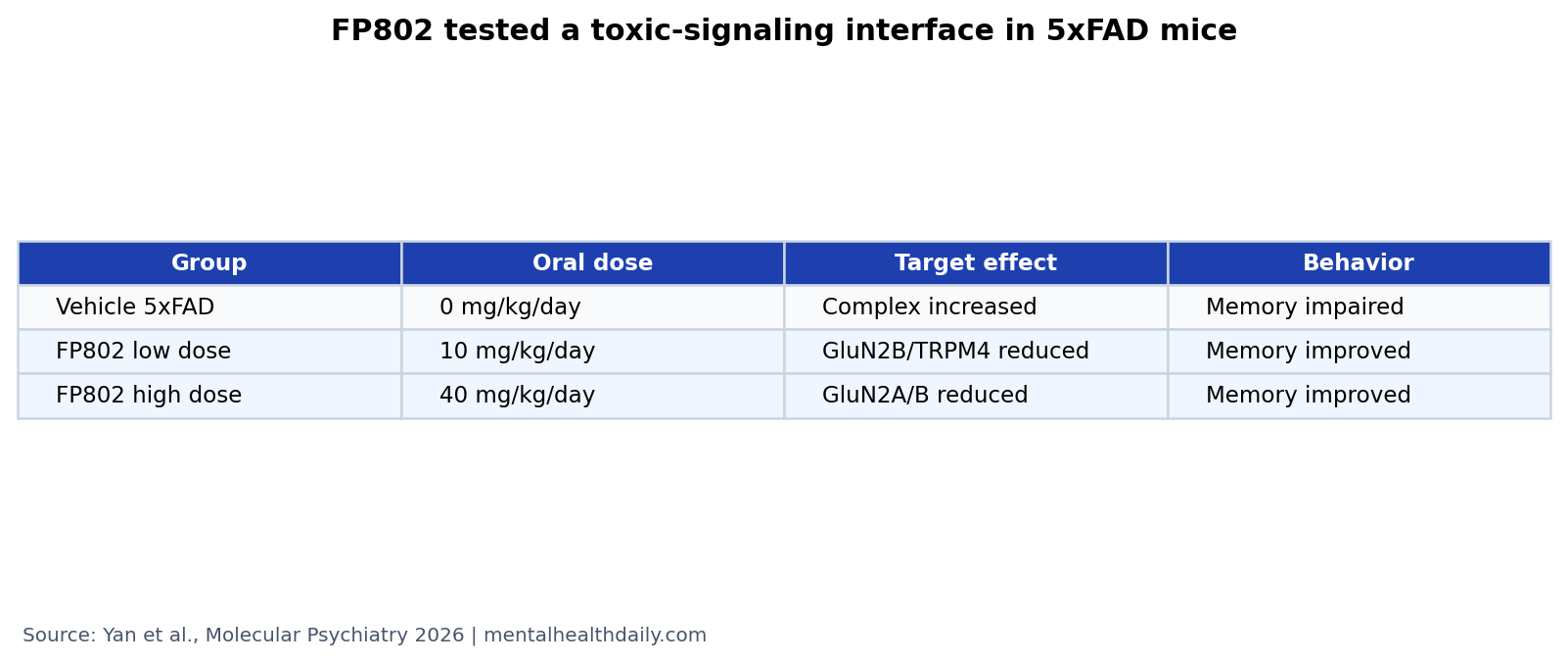
Plain-English interpretation: the drug disrupted a physical toxic-signaling interaction that was more common in the Alzheimer’s mouse model.
Memory Preservation Was Seen Across Several Behavioral Tasks
FP802-treated 5xFAD mice improved across a battery of memory-related tasks. In the Morris water maze, high-dose FP802-treated mice spent more time in the target quadrant on the day 6 probe test than vehicle-treated 5xFAD mice. In contextual fear conditioning, FP802 increased freezing time, a memory-linked response to the training context. Novel object and novel location recognition also improved.1
The task battery sampled several memory demands rather than leaning on one behavioral readout. The Morris water maze tested spatial learning across 5 training days plus a day 6 probe without the hidden platform.
Novel object recognition tested whether mice preferred a new object after a 1-hour delay, while novel location recognition tested whether mice noticed that a familiar object had moved after 24 hours. Contextual fear conditioning tested memory for an aversive training context 24 hours later. Those tasks are not interchangeable, so the cross-task signal is more useful than a single positive maze result.
Motor confounding check: open-field testing did not show a genotype or treatment effect on free movement, which makes a simple mobility explanation less likely. That check matters because a memory task can look better or worse if an animal moves differently.
That control also makes the recognition and freezing results easier to read as memory-linked behavior rather than sedation, hyperactivity, or gross motor impairment.
Wild-type mice given FP802 did not show obvious behavioral enhancement compared with vehicle-treated wild-type mice. That pattern supports the idea that FP802 corrected disease-model toxicity rather than acting as a general cognitive stimulant.
Dendrites, Synapses, Mitochondria, and Amyloid Moved Together
The study linked behavioral preservation to multiple tissue-level readouts. FP802 preserved dendritic structural complexity, protected synapses, reduced abnormal mitochondrial morphology, and reduced amyloid-β plaque formation in 5xFAD mice.1
Dendrites are branching neuronal structures that receive input. Synapses are the contact points where neurons communicate. Mitochondria are energy-producing organelles, and their swelling or structural breakdown is a common injury signal in neurodegeneration models.
The multi-readout pattern strengthens the paper. A single maze result could be fragile. A behavioral rescue aligned with synapse, dendrite, mitochondrial, and plaque readouts is still preclinical, but it is harder to dismiss as one noisy behavioral endpoint.
Why This Is Different From Ordinary NMDAR Blockade
Memantine is an NMDAR antagonist used for symptomatic treatment in Alzheimer’s disease, with modest clinical benefit in moderate-to-severe disease.4 Its limitation is conceptual as well as clinical: blocking NMDAR channels too broadly risks interfering with normal synaptic signaling that neurons need.
TwinF interface inhibition is a more selective idea. It tries to uncouple toxic NMDAR/TRPM4 signaling while leaving normal NMDAR-dependent synaptic function intact.2 Yan et al. apply that idea to an Alzheimer’s model and show that the complex itself increased in 5xFAD brains.
Clinical implication: if this target ever translates, it would probably sit beside amyloid-lowering strategies. The paper frames the death complex as an amplifier of pathology initiated by amyloid-β.
Mouse-Model Strength Is Also the Main Limitation
5xFAD mice overexpress mutant human amyloid precursor protein and presenilin-1, producing rapid amyloid pathology. That speed makes the model useful for testing mechanisms, while also making it different from a slow, sporadic, mixed-pathology human Alzheimer’s brain.
Supported: NMDAR/TRPM4 complex formation increased in 5xFAD mice; FP802 disrupted that complex; treated mice showed preserved memory-task performance and better tissue-level readouts.
Not supported: FP802 being safe or effective in people, the death complex explaining all Alzheimer’s neurodegeneration, or mouse plaque reduction guaranteeing clinical benefit. Human pharmacokinetics, target engagement, tolerability, dose selection, and cognitive endpoints remain open.
Where the Target Fits in Alzheimer’s Treatment Logic
Alzheimer’s disease has many interacting pathways. Amyloid-β aggregation, tau pathology, synapse loss, neuroinflammation, vascular injury, mitochondrial dysfunction, sleep disruption, and aging-related resilience all shape clinical decline. A therapy that targets one mechanism may still be useful if it interrupts an important injury loop.
The NMDAR/TRPM4 death-complex model places FP802 in that downstream-injury category. Amyloid may help initiate or amplify stress, but the proposed actionable step is toxic extrasynaptic glutamate signaling coupled to TRPM4. That makes the treatment idea different from plaque clearance, tau immunotherapy, or broad anti-inflammatory suppression.
Combination logic: a future human program would probably test whether death-complex inhibition adds benefit to background amyloid-directed care, symptomatic drugs, or risk-factor management. The mouse paper gives a mechanistic reason to ask that clinical sequencing question.
Human Development Would Need Target-Engagement Biomarkers
A human FP802 trial would need more than a memory score. The most useful early trial would show that the drug reaches the central nervous system, disrupts NMDAR/TRPM4 coupling or a downstream marker of that coupling, and does so without impairing normal synaptic signaling.
Target engagement means evidence that a drug hits the biological target it is supposed to hit in living participants. For this pathway, that could involve cerebrospinal-fluid biomarkers, imaging readouts, electrophysiology, or a peripheral assay if one can be validated against brain effects.
Safety would be central because glutamate signaling is load-bearing for cognition. A selective interface inhibitor is attractive precisely because broad NMDAR blockade has limits, but human studies would still need to demonstrate selectivity directly.
The Mouse Evidence Is Stronger When Read as Mechanism, Not Cure
The study is most persuasive as a disease-mechanism experiment. It shows that a toxic-signaling complex increased in an Alzheimer’s model and that disrupting the complex improved several readouts. It is less persuasive if read as a near-term cure headline, because aggressive amyloid mice regularly overpredict human efficacy.
Useful standard: treat FP802 as a candidate tool for testing whether death-complex signaling is clinically relevant. If later studies show target engagement, tolerability, and cognitive signal in humans, the mechanism graduates. Until then, the main advance is knowing where to look.
The value of the paper is therefore directional and mechanistic: it makes a specific toxic complex measurable, druggable, and behaviorally relevant in a defined Alzheimer’s mouse model.
That standard also gives future negative studies a clear target. If later models show FP802 reaches brain tissue but fails to disrupt the complex or preserve synapses, the pathway weakens. If target engagement occurs with behavioral benefit across models, the human case becomes stronger.
Questions About FP802 and Alzheimer’s Mechanisms
Is FP802 an Alzheimer’s treatment now?
No. This is a mouse-model study. It identifies a plausible therapeutic target and a candidate mechanism, but human trials would be needed before clinical use.
Why target the interface rather than block NMDARs broadly?
NMDARs also support normal synaptic function. The FP802 strategy is to disrupt the toxic NMDAR/TRPM4 interface rather than shut down NMDAR signaling broadly.
Does this compete with amyloid antibodies?
Not directly. Amyloid antibodies target amyloid clearance. FP802 targets a downstream toxic-signaling pathway that may be amplified by amyloid pathology.
What would make the evidence stronger?
Replication in other Alzheimer’s models, target-engagement biomarkers, toxicology, and eventually human trials that test cognition, safety, and disease-stage specificity.
References
- Yan J, Huang C, Liu S, et al. The NMDAR/TRPM4 death complex is a major promoter of disease progression in the 5xFAD mouse model of Alzheimer’s. Molecular Psychiatry. 2026. doi:10.1038/s41380-025-03143-5
- Yan J, Bengtson CP, Buchthal B, et al. Coupling of NMDA receptors and TRPM4 guides discovery of unconventional neuroprotectants. Science. 2020. doi:10.1126/science.aay3302
- Oakley H, Cole SL, Logan S, et al. Intraneuronal beta-amyloid aggregates, neurodegeneration, and neuron loss in transgenic mice with five familial Alzheimer’s disease mutations. Journal of Neuroscience. 2006. doi:10.1523/jneurosci.1202-06.2006
- Tariot PN, Farlow MR, Grossberg GT, et al. Memantine treatment in patients with moderate to severe Alzheimer disease already receiving donepezil. JAMA. 2004. doi:10.1001/jama.291.3.317