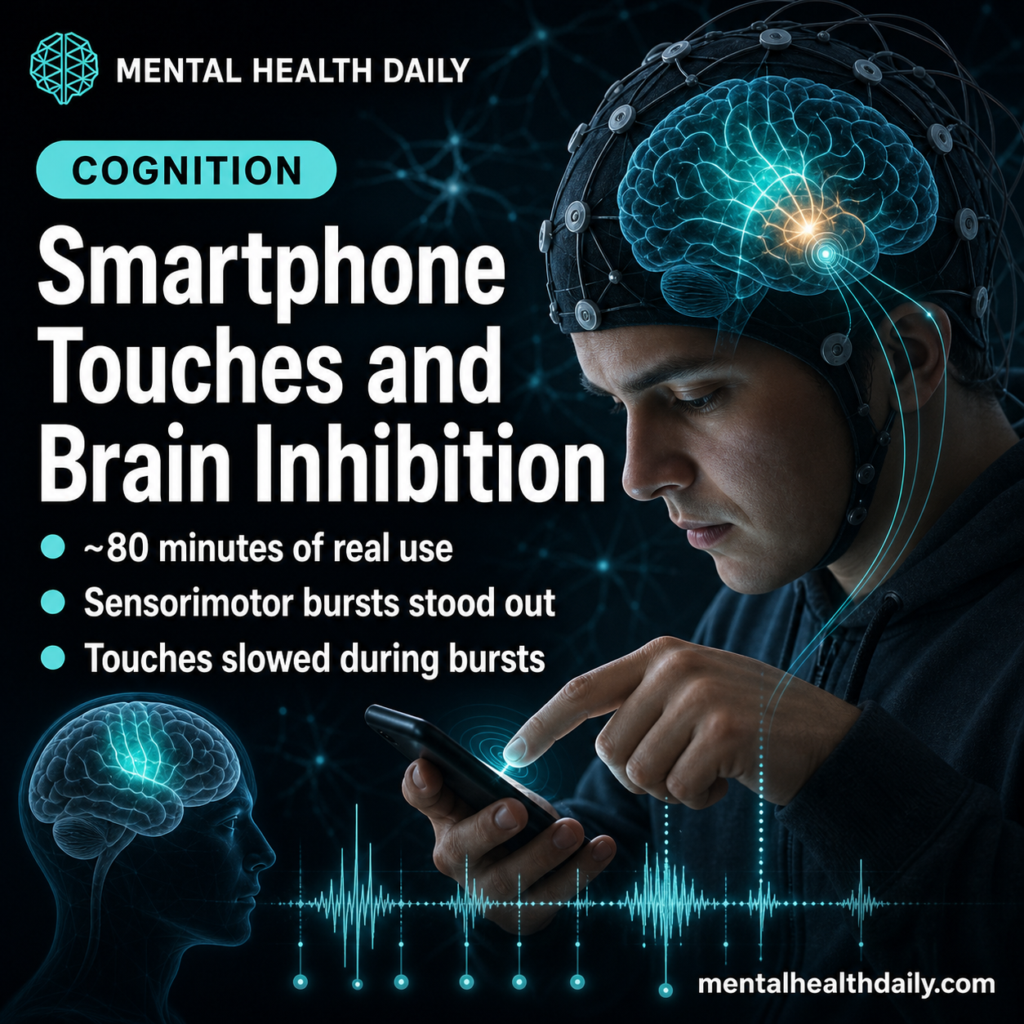
An iScience EEG study found that approximately 80 minutes of natural smartphone use was interleaved with transient beta bursts, especially over bilateral sensorimotor cortex, and touchscreen intervals became longer when sensorimotor bursts were present.1
Research Highlights
- Natural smartphone behavior carried beta bursts: participants used smartphones with the right thumb for approximately 80 minutes while EEG recorded transient beta activity.1
- Sensorimotor cortex stood out: bilateral sensorimotor electrodes showed higher burst occupancy than other scalp regions, with population burst occupancy around 0.10 to 0.15.1
- Bursts were brief: population-level burst durations ranged from 151 to 181 ms across the scalp, consistent with transient events rather than sustained beta activity.1
- Touch timing changed around bursts: burst probability decreased before touchscreen touches and increased afterward, with the strongest modulation over left sensorimotor cortex.1
- This is not a smartphone-harm study: the result describes motor inhibition during naturalistic behavior, not 1:1 evidence for anxiety, addiction, or attention decline.1
Beta bursts are brief events in the beta frequency band, roughly 13 to 30 Hz, rather than a continuous brain rhythm. In motor systems, beta activity is often interpreted as a temporary stabilizing or inhibitory signal: it can help hold the current motor state, and movement often follows beta suppression.
Sensorimotor cortex is the cortical system that links body sensation with movement planning and execution. A smartphone touchscreen task is useful for studying this system because thumb movements are frequent, precisely timestamped, and embedded in natural behavior rather than a stripped-down laboratory button press.
Beta Bursts Were Common During ~80 Minutes of Smartphone Use
Wan and Ghosh recorded electroencephalography while participants interacted with their own smartphones using the right thumb for approximately 80 minutes.1 EEG is a scalp-recorded measure of electrical activity that has high timing precision, making it useful for millisecond-scale movement dynamics.
The researchers detected beta bursts across the scalp. Population-level burst durations ranged from 151 to 181 ms, and burst occupancy ranged from 0.10 to 0.15. Burst occupancy means the proportion of recording time spent inside detected bursts.
The topography was not random. Bilateral sensorimotor electrodes showed higher burst occupancy, longer individual burst durations, and more burst events than the overall mean. That pattern fits a motor-control interpretation rather than a generic arousal claim.
Touchscreen Events Happened Around Inhibition, Not Outside It
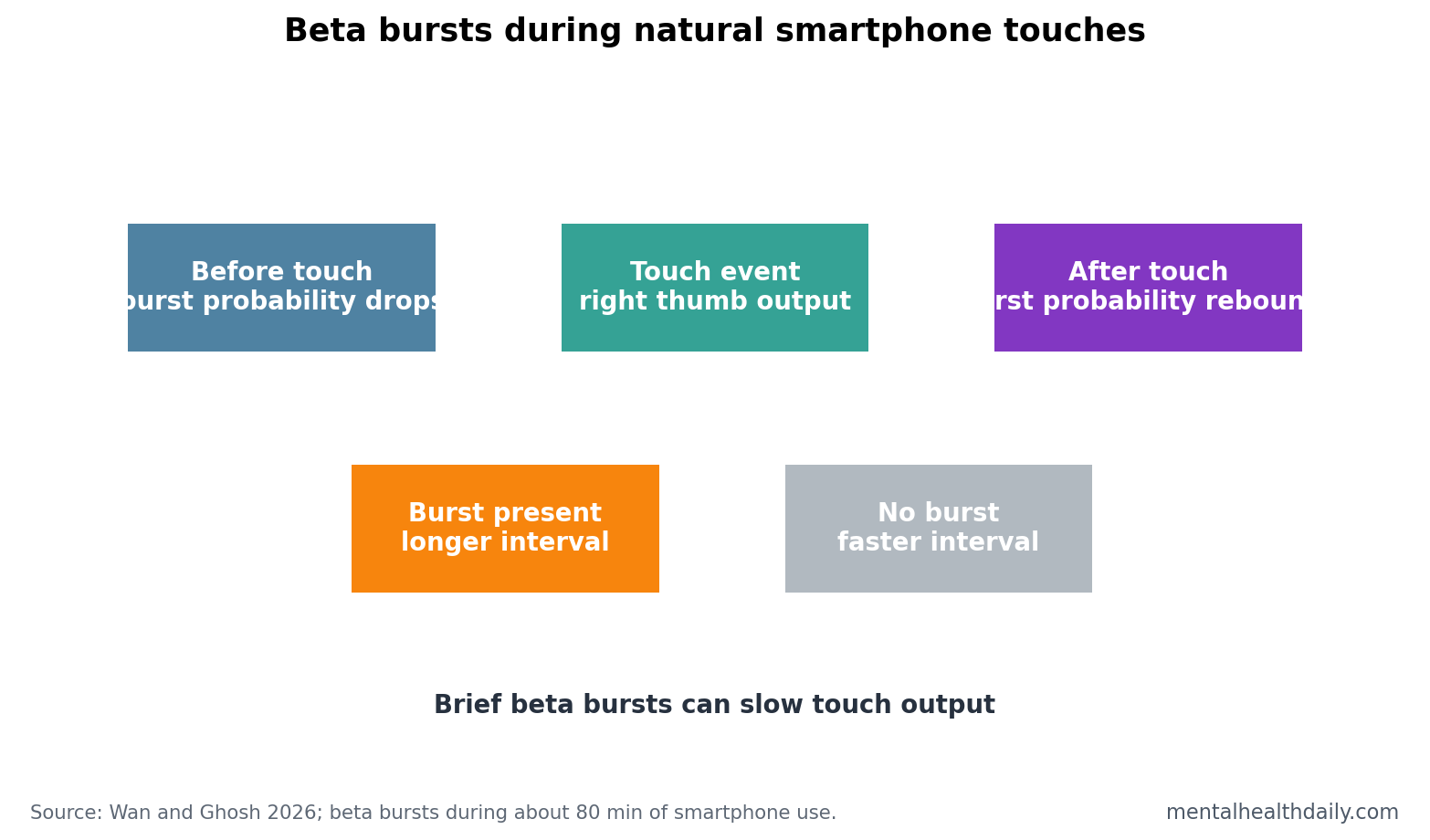
Smartphone interaction was not a simple sequence of movement commands. Burst probability decreased before touchscreen touches and increased afterward, with strongest modulation over left sensorimotor cortex. Since the task used right-thumb movement, left sensorimotor involvement is anatomically coherent.
The key behavioral detail was escape from inhibition. Touches could still happen during bursts, but they occurred at lower rates over left sensorimotor regions than elsewhere. When intervals contained bursts, the intervals were longer, especially in sensorimotor cortex.
Plain-English interpretation: the motor system did not wait for a perfectly inhibition-free brain state. It could still produce touches during beta bursts, but outputs were slower when those inhibitory transients were present.
Naturalistic Neuroscience Is the Main Contribution
Prior beta-burst studies showed that motor beta activity often occurs in brief events and can relate to movement timing.2,3 Laboratory tasks can isolate mechanisms, but they usually reduce behavior to simplified actions.
Smartphone use gives the opposite tradeoff: behavior is messier, but it is real. People make rapid touch sequences, pauses, corrections, and app-specific actions without following an artificial button-press rhythm. That makes the study useful for asking whether known motor-control dynamics survive in everyday digital behavior.
The answer appears to be yes. Beta bursts during smartphone use were spatially concentrated, time-locked around touches, and associated with slower output intervals.
Why beta matters: beta activity has repeatedly been linked to motor state and movement timing, with broader cognitive interpretations depending on the task. Litvak et al. measured movement-related synchronization changes in Parkinson’s disease, while Feingold et al. and Shin et al. showed that transient beta events can track behavior across movement tasks and species.2,3,4
Wan and Ghosh moved that timing question into a messier but more ordinary setting: the right thumb moving through a phone interface. The beta bursts were not disease markers in this sample. They were brief motor-control events that made the next touch slower when they appeared in sensorimotor regions.
The Result Should Not Be Repackaged as Phone Panic
Evidence-strength note: this study did not test smartphone addiction, anxiety, depression, attention problems, or cognitive decline. It tested transient cortical inhibition during touchscreen behavior.
That boundary is important because smartphone-neuroscience headlines drift easily into vague “phones change the brain” language. Every behavior changes brain activity while it is happening. The useful claim here is narrower: real-world thumb interactions are shaped by brief sensorimotor beta bursts that appear to gate motor timing.
Clinical or psychiatric relevance would require different data: symptom measures, longitudinal exposure, individual differences, task context, app type, and functional impairment. This paper supplies a physiological measurement tool and a motor-control finding, not a diagnosis or warning label.
Why the Finding Still Belongs in Cognitive Neuroscience
The study is narrow, but it is not trivial. Many cognitive-neuroscience experiments use simplified tasks because clean timing is easier to analyze. Smartphone use offers clean timing inside messy behavior: every touch has a timestamp, but the action sequence is self-directed and embedded in ordinary digital activity.
Measurement advantage: touchscreen logs give researchers many natural movement events without asking participants to repeat an artificial laboratory motion hundreds of times. That makes it easier to ask whether motor-control signals generalize outside the lab.
Interpretive limit: smartphone touches are not a complete model of cognition. Reading, scrolling, typing, searching, messaging, and app switching involve different perceptual and motivational demands. The beta-burst result is strongest for motor timing, not for the meaning of the content on screen.
Future work could combine beta-burst timing with task labels, error rates, typing speed, fatigue, and attention lapses. That would begin to connect motor inhibition with cognitive state. The current paper stops earlier: it shows that brief inhibitory transients are visible during real phone behavior and relate to when the next touch happens.
For mental-health interpretation, the most responsible bridge is measurement. Digital behavior is often discussed through screen time totals, but total minutes are crude. A neural-timing approach could eventually ask whether fatigue, medication, Parkinsonian slowing, stimulant exposure, anxiety, or compulsive checking changes the relationship between beta bursts and touch output.
That bridge would still require symptom data. Without anxiety ratings, attention measures, sleep data, and impairment outcomes, beta bursts remain a motor physiology signal. The value of the 2026 study is that it makes a sharper future question possible: which clinical states change real-world motor timing, and are beta bursts part of that change?
The same boundary protects readers from overclaiming. Smartphone use is not a single exposure. Reading a message, typing a response, checking a map, and scrolling a feed have different cognitive and emotional loads. The EEG result describes the thumb-action layer underneath those behaviors.
A stronger follow-up would annotate the behavioral stream. Researchers could separate typing, scrolling, tapping icons, deleting errors, pausing before a reply, and rapid switching between apps. Each action may have a different relationship with beta bursts because the motor demand and decision demand are not the same.
Clinical groups would add another layer. Parkinson’s disease, ADHD, depression, sedating medications, stimulants, and sleep loss could each change movement timing for different reasons. A smartphone-touch paradigm might eventually become a low-friction way to measure those timing signatures, but only after validation against clinical outcomes.
For now, the safest conclusion is mechanistic: beta bursts are not confined to artificial lab tasks. They appear during ordinary phone interaction, concentrate over sensorimotor regions, and mark moments when the next touch is slower.
That modest conclusion is still useful because it turns ordinary touchscreen behavior into a measurable motor-control window. The next step is not a broader phone-harm headline; it is careful mapping of which behavioral states change burst timing, touch timing, or both.
For a field overloaded with screen-time totals, that is a sharper and more testable measurement target for future clinical research programs.
Digital phenotyping implication: future phone-based mental-health research should separate behavior layers before making clinical claims. Total screen time, app category, typing rhythm, touch timing, and neural timing are different measures. Mixing them into one exposure variable would hide the motor-control signal this study isolated.
A useful follow-up would pair touch timing with validated symptom and medication data. That would let researchers test whether the same beta-burst pattern changes with sleep loss, stimulant exposure, Parkinsonian slowing, or anxiety without pretending that the 2026 experiment already answered those clinical questions.
Questions About Beta Bursts During Smartphone Use
Does this prove smartphones damage attention?
No. The study measured EEG beta bursts during touch behavior. It did not measure attention disorder, anxiety, addiction, or long-term cognition.
Why study smartphones instead of a lab button press?
Smartphone touches are frequent, precisely timed, and naturalistic. They let researchers test whether motor-control signals seen in laboratory tasks also appear during everyday behavior.
What does a longer interval during beta bursts mean?
It suggests that transient beta activity may briefly inhibit or stabilize motor output. Touches can still occur, but the behavioral output slows when bursts are present.
References
- Wan W, Ghosh A. Bursts of regional cortical inhibition during smartphone use. iScience. 2026. https://doi.org/10.1016/j.isci.2026.115375
- Litvak V, Jha A, Eusebio A, et al. Movement-related changes in local and long-range synchronization in Parkinson’s disease revealed by simultaneous magnetoencephalography and intracranial recordings. Journal of Neuroscience. 2012;32(31):10541-10553. PubMed PMID: 22855804
- Feingold J, Gibson DJ, DePasquale B, Graybiel AM. Bursts of beta oscillation differentiate postperformance activity in the striatum and motor cortex of monkeys performing movement tasks. eLife. 2015. doi:10.7554/elife.07860
- Shin H, Law R, Tsutsui S, Moore CI, Jones SR. The rate of transient beta frequency events predicts behavior across tasks and species. eLife. 2017. doi:10.7554/elife.29086