
Low-burden digital phenotyping is appealing because college students already leave daily traces in phones, messages, sleep logs, and voice samples. In Henry et al.’s 120-student study, positive emoji use was the clearest signal compared with GPS and complex voice biomarkers: higher positive emoji use tracked lower depression and anxiety, while speech rate and sleep added smaller selective signals.1
Research Highlights
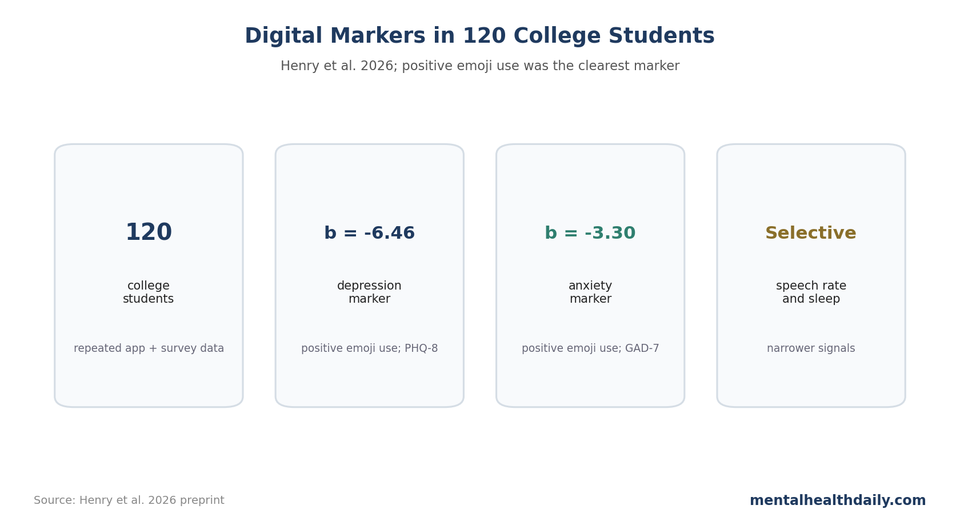
- Positive emoji use carried the clearest signal: students with a higher average proportion of positive emojis had lower Patient Health Questionnaire-8 (PHQ-8) depression scores, with b = −6.46 after false-discovery correction.1
- Day-to-day anxiety also moved with emoji use: on days when students used more positive emojis than usual, Generalized Anxiety Disorder-7 (GAD-7) scores were lower, with b = −3.30 and corrected p = 0.042.1
- Speech rate was narrower: higher average words per minute predicted lower anxiety, but most other voice features did not survive correction.1
- Sleep was not a universal symptom marker: longer average sleep related more clearly to flourishing and weakly to anxiety than to depression in this sample.1
- The practical use is screening, not diagnosis: these 120-student correlational signals may help flag risk patterns, but they cannot replace consent-based clinical assessment or a support pathway.
This study fits a larger digital-mental-health problem. Smartphones collect huge amounts of behavioral data, but most passive markers are noisy: phones are not always carried, voice samples depend on compliance, and mobility features can be uninformative on a campus where many people move through the same small set of places.
The stronger contribution here is the separation between simple affective expression and higher-tech sensing. Positive emojis are not a psychiatric test, but they gave a cleaner read than many heavier data streams.
120 College Students Provided Repeated Mental-Health and Digital-Marker Data
Henry et al. analyzed 120 college students with repeated mental-health surveys and low-burden digital features. Depression was measured with the Patient Health Questionnaire-8 (PHQ-8), anxiety with the Generalized Anxiety Disorder-7 (GAD-7), and well-being with a flourishing scale.1
- Baseline symptom load: 22.7% had clinically significant PHQ-8 depression scores, and 24.4% had clinically significant GAD-7 anxiety scores.
- Repeated observations: models used hundreds of PHQ/GAD observations and a larger flourishing set, with predictors separated into within-person and between-person effects.
- Data channels: the analysis compared self-reported emoji/emotion measures, voice-derived features, and GPS or behavior-derived measures such as meals, steps, places, and sleep.
The within-person vs. between-person split is crucial. A within-person effect asks whether a student is different on days when their own behavior changes. A between-person effect asks whether students who usually behave a certain way differ from other students.
Positive Emoji Proportion Outperformed Most Passive Markers
For depression, the strongest result was between-person. Students with a greater average proportion of positive emoji use had lower overall PHQ-8 scores: b = −6.46, unadjusted p < 0.001, corrected p < 0.001.1
The day-to-day depression result pointed the same way but was weaker. Higher-than-usual positive emoji use predicted lower PHQ-8 scores before correction, but the corrected p-value was 0.086, so it should be treated as suggestive rather than settled.
For anxiety, the within-person result was stronger. When students used a higher-than-usual positive emoji proportion, GAD-7 scores were lower: b = −3.30, corrected p = 0.042. Between-person positive emoji use also pointed toward lower anxiety but landed marginal after correction.
Speech Rate and Sleep Added Smaller, More Selective Signals
Voice features did not behave like a broad mental-health detector. Higher average words per minute predicted lower GAD-7 anxiety scores, with b = −0.06 and corrected p = 0.033.1
For depression, higher utterance count and higher words per minute were only marginal. Other voice features were mostly non-significant after correction.
Sleep was similarly selective. Higher average sleep was linked to lower anxiety before correction and to higher flourishing more clearly, but it did not function as a universal depression marker in the reported models.
The scanner-friendly interpretation: emoji use looked like the most consistent affect marker, speech rate looked anxiety-relevant, and sleep looked more connected to well-being than to every symptom domain.
Consent and External Validation Come Before Campus Deployment
Digital phenotyping studies can overpromise because the measurement sounds objective. A phone-derived variable is not automatically more clinically meaningful than a survey item; it can be noisier, more biased, and easier to misread.
- Correlation is not mechanism. This design cannot show whether positive emoji use reduces symptoms, whether lower symptoms make positive expression easier, or whether both reflect a third process.
- Campus homogeneity weakens GPS markers. If most students live, study, and socialize in the same small geography, location signals can flatten.
- Voice sampling is selective. Students willing to provide voice data may differ from students who avoid it.
- Screening needs a support pathway. A flag without voluntary outreach, privacy rules, and real help is a surveillance tool, not a mental-health intervention.
How to Use Emoji Signals Without Campus Surveillance
The most defensible use of a marker like positive emoji proportion is not silent monitoring. It is a voluntary, consent-based supplement to ordinary check-ins, especially when students are already using a mental-health app or research platform that explains exactly what is being collected.
A student-facing system should expose the logic plainly:
- Prompt, not diagnosis: less positive expression, faster social withdrawal, reduced sleep, or slower speech may justify asking how someone is doing, not labeling the student as depressed, unsafe, or noncompliant.
- Consent before inference: students should know exactly which signals are collected, how long they are stored, and who can see them.
- Help pathway: any alert needs a voluntary outreach option, not an administrative penalty or disciplinary flag.
False positives are also unavoidable. A student may stop using emojis because their friend group changes platforms, because they write more formally, because they are busy, or because they are communicating with family instead of peers. A good support system treats the signal as a reason to offer help, not as a reason to assign a label.
The results also suggest a design hierarchy. Start with measures that are easy to explain and easy for students to audit. Positive emoji proportion is crude, but understandable. Black-box combinations of GPS, voice, and phone behavior may look sophisticated while being harder to contest.
Replication should also test whether emoji signals hold across messaging platforms, friend groups, cultures, and academic calendars. Exam weeks, summer breaks, and private family communication can change emoji meaning without changing clinical state.
The practical standard should be opt-in, transparent, and low-stakes. Digital phenotyping becomes more humane when it helps a person notice patterns in themselves rather than letting an institution quietly profile them.
The safest use is personal feedback inside a voluntary tool: the student sees the pattern first, controls sharing, and chooses whether to seek support.
Adjacent Digital-Mental-Health Research Supports a Narrow Read
Earlier digital-phenotyping work has shown that phones can capture mood-relevant behavior, but replication is uneven. GPS mobility, screen use, typing behavior, speech acoustics, sleep timing, and social communication each carry different noise sources.
The Henry result is strongest when it is treated as an affect-expression finding, not a general phone-sensing breakthrough. Positive emoji proportion is closer to a daily-life emotional behavior than to a hidden biomarker.
That makes it easier to interpret alongside positive-affect research. Positive emotion can broaden attention, support social connection, and help people recover from stress. A student who expresses more positive affect in everyday communication may also be embedded in better social regulation loops.
Still, the causal arrow remains open. Low depression may permit more positive expression. Supportive relationships may drive both positive emoji use and lower symptoms. A student may also use emojis performatively while feeling worse privately.
What Better Replication Would Measure
A stronger replication would sample a larger, more diverse student group across campuses, include weekends and exam periods, and pre-register a small set of markers instead of testing many features at once. It should also separate private messaging, public posting, and app-specific communication, because emoji meaning changes by platform and audience.
Clinical outcomes should include symptom scales, functional impairment, help-seeking, and stressful events. That would clarify whether positive emoji use is a mood marker, a social-support marker, a coping marker, or simply a communication-style marker.
Questions About Emoji Use and Student Mental Health
Could a school use emoji data to identify depressed students?
Not responsibly from this study alone. Any use of private communication markers would need explicit consent, privacy protections, independent validation, and a clear support pathway that does not punish students for being flagged.
Is positive emoji use just another mood questionnaire?
It is different, but not magic. It is a behavioral expression of positive affect in communication, and it may capture something a person does naturally rather than what they report on a form.
Does this mean negative emojis predict worse mental health?
Not necessarily. The reported signal centered on the proportion of positive emojis. Negative affect markers, loneliness, avoidance, and other self-reported states had their own patterns, but the positive-emoji marker was the easiest result to carry forward.
References
- Low-Burden Digital Phenotyping of Affective Risk: Positive Emoji Usage, Speech Rate, and Sleep Relate to College Student Mental Health. Henry et al. doi:10.21203/rs.3.rs-9226835/v1
- Digital phenotyping and college mental health studies. PubMed search. PubMed search
- Vocal biomarkers for depression and anxiety. PubMed search. PubMed search
- Positive Emotions Trigger Upward Spirals Toward Emotional Well-Being. Fredrickson and Joiner. doi:10.1111/1467-9280.00238