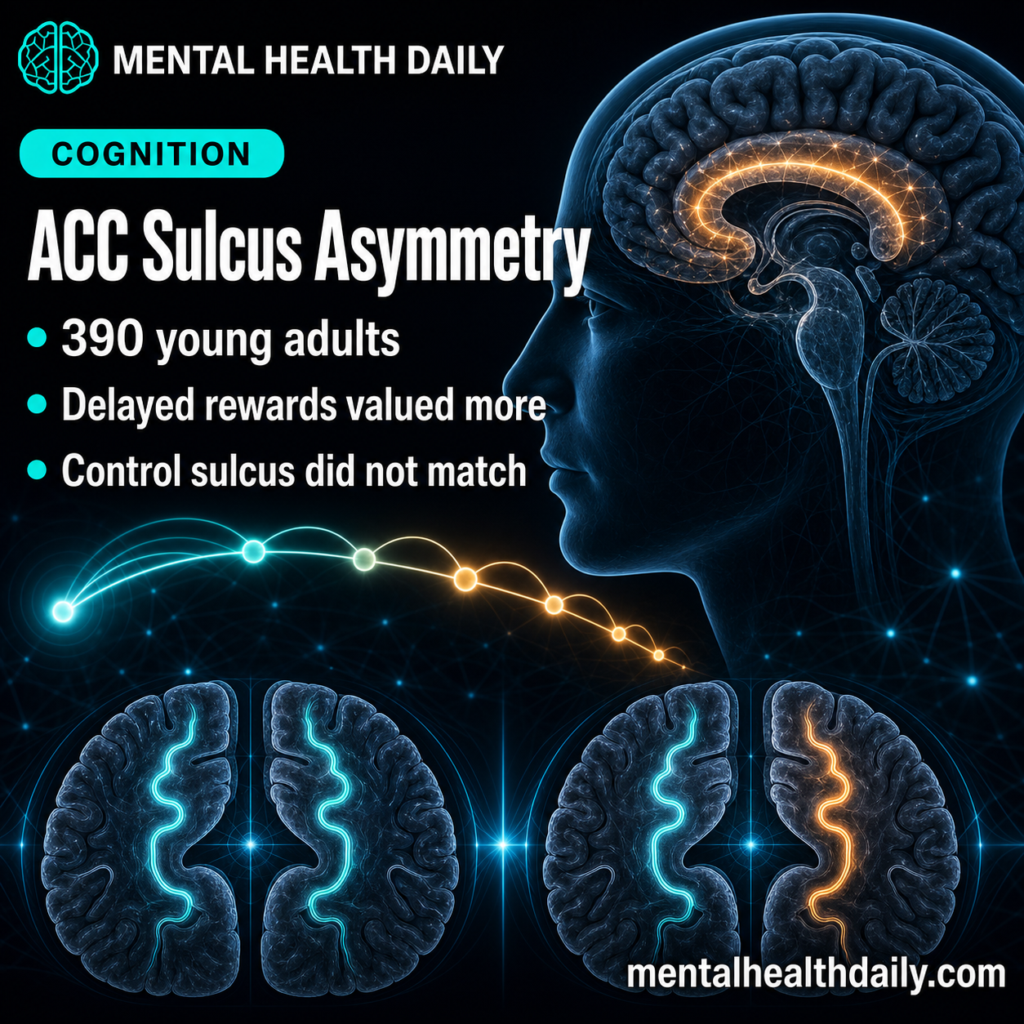
A 2026 Human Connectome Project MRI study linked asymmetric anterior cingulate cortex sulcal pattern to lower delay discounting in 390 healthy young adults: asymmetric ACC morphology predicted a higher delay-discounting area under the curve, meaning delayed rewards lost less value.1 The finding is not a diagnostic scan for impulsivity, but it puts an early-formed cortical-folding marker next to a behavior that cuts across addiction, gambling, obesity, and other impulse-control problems.
Research Highlights
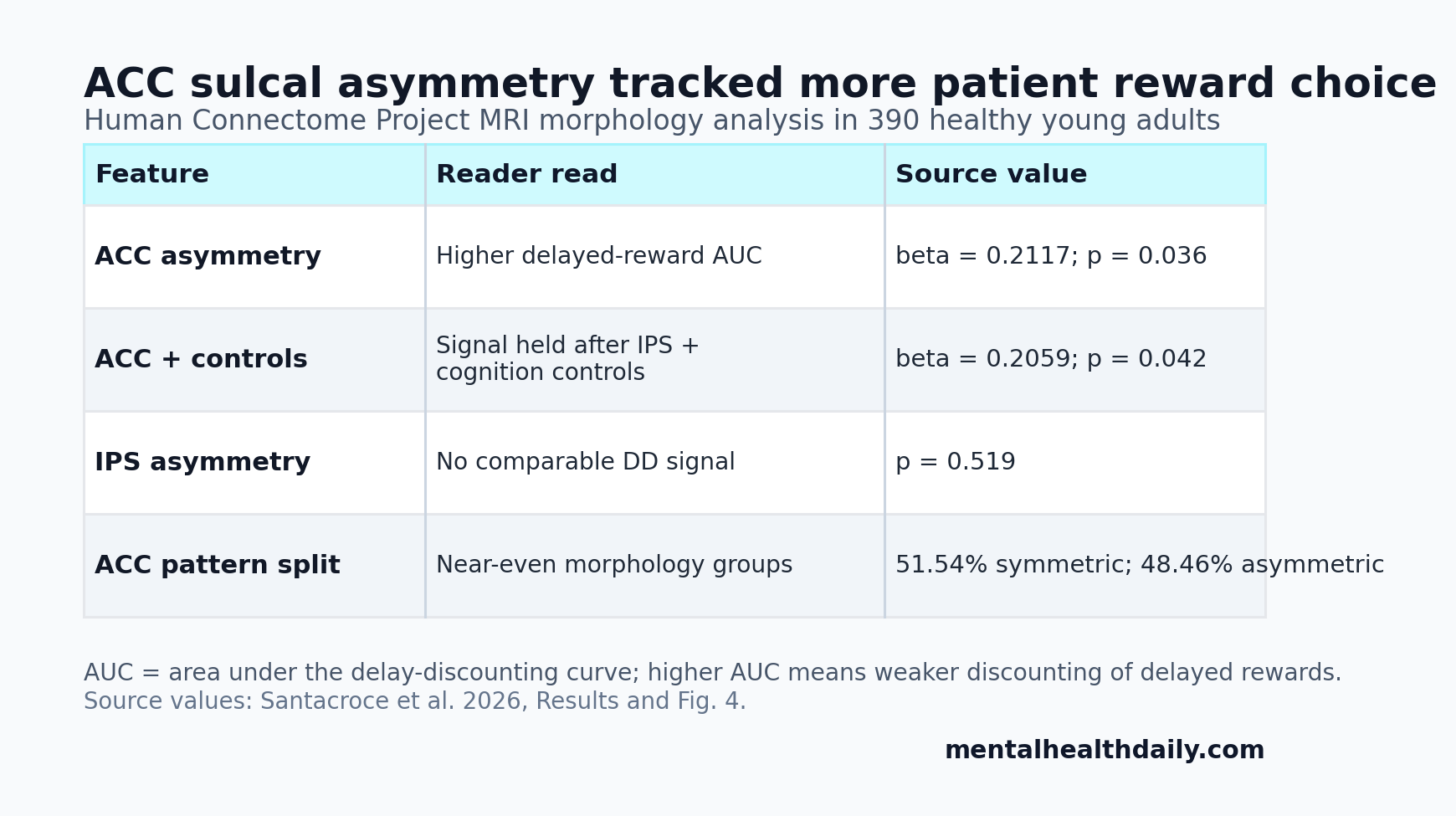
- ACC asymmetry tracked patience: Santacroce et al. analyzed 390 Human Connectome Project adults and found that asymmetric anterior cingulate cortex sulcal pattern predicted higher delayed-reward AUC, with beta = 0.2117, p = 0.036.1
- The signal survived specificity checks: after controlling for intraparietal sulcus morphology plus memory-language and executive-function PCA factors, the ACC association remained significant, beta = 0.2059, p = 0.042.1
- A control sulcus did not copy the pattern: intraparietal sulcus symmetry/asymmetry was not associated with delay discounting, p = 0.519, supporting an ACC-specific morphology signal rather than a generic folding-asymmetry effect.1
- The groups were almost evenly split: the sample was 51.54% symmetric and 48.46% asymmetric for ACC sulcal pattern, reducing the risk that the result was driven by a tiny morphology subgroup.1
- Clinical meaning stays calibrated: delay discounting is elevated across psychiatric conditions in meta-analysis, but this MRI study tested healthy young adults and does not prove treatment response or individual diagnosis.2
Delay discounting is the tendency to devalue a reward because it arrives later. A person who strongly prefers $200 now over a much larger future reward shows steeper discounting; a person who can wait keeps more of the delayed reward’s subjective value.
The anterior cingulate cortex (ACC) is a medial frontal brain region involved in conflict monitoring, effort allocation, and cognitive control. In intertemporal choice, that control system helps the brain resist an immediately available option when a delayed option is worth more.
ACC Sulcal Pattern Was Classified Before Behavior Was Modeled
Santacroce et al. used structural MRI scans from the Human Connectome Project S1200 release, limiting the analysis to 390 adults aged 26-30 years without major neurological, psychiatric, or medical disorders.1 The study team classified each participant’s ACC folding pattern in both hemispheres, blind to age, contralateral hemisphere label, and other morphology labels.
Sulcal pattern means the visible folding layout of the cortex. For the ACC, the relevant distinction was whether a hemisphere had a single cingulate sulcus or a double-parallel pattern that included the paracingulate sulcus, a parallel groove above the cingulate sulcus.
Raters agreed on single vs. double-parallel ACC pattern in 92.82% of hemisphere ratings. The 28 discrepant or doubtful cases were reviewed by a third expert, leaving no participant excluded because of unresolved morphology.
- Right ACC: 81.28% of hemispheres had the single pattern, p < 0.001, 95% CI 77.4%-85.1%.
- Left ACC: 53.85% had the single pattern, p = 0.14, 95% CI 49.0%-58.7%.
- Whole-brain ACC pattern: 51.54% of participants were symmetric across hemispheres and 48.46% were asymmetric, p = 0.57, 95% CI 46.7%-56.4%.
That near-even symmetric/asymmetric split matters because the delay-discounting test was not comparing a common pattern with a rare anatomical oddity. It compared 2 large morphology groups inside the same healthy-adult cohort.
Asymmetric ACC Folding Predicted Weaker Discounting of Delayed Rewards
The behavioral measure came from Human Connectome Project delay-discounting tasks. Participants chose between smaller immediate rewards and larger delayed rewards across 6 delays, from 1 month to 10 years, and 2 reward amounts, $200 and $40,000.1
Area under the curve (AUC) summarizes how quickly delayed rewards lose subjective value. Lower AUC means steeper discounting and more preference for the immediate option. Higher AUC means weaker discounting and more willingness to wait.
The main generalized linear model found an ACC symmetry/asymmetry effect on the delay-discounting factor: beta = 0.2117, df = 1, p = 0.036. Asymmetric ACC pattern was associated with higher AUC, so delayed rewards retained more value.
Sex did not explain the result in that model, beta = −0.01510, df = 1, p = 0.137. A second model kept the ACC signal after adding intraparietal sulcus symmetry/asymmetry and the first 2 PCA factors, memory-language and executive functions: beta = 0.2059, df = 1, p = 0.042.
- Main read: asymmetric ACC folding pointed toward weaker discounting of future rewards.
- Control read: the result persisted after the analysis added IPS morphology and broader cognitive factors.
- Calibration: the association was statistically significant but modest, so it should guide replication rather than individual prediction.
The p-values sit close to the conventional 0.05 threshold, so the result should be read as a modest structural association, not a large deterministic effect. The stronger point is anatomical specificity: ACC asymmetry tracked delay discounting, while the control sulcus did not.
The IPS Control Sulcus Helped Rule Out Generic Brain Asymmetry
The researchers also examined the intraparietal sulcus (IPS), a parietal fold involved in spatial and numerical processing but not a core delay-discounting control node. IPS symmetry/asymmetry was included to test whether any left-right folding difference would predict the behavior.
It did not. IPS morphology showed no significant effect on delay discounting, p = 0.519. IPS symmetry/asymmetry also failed to predict the memory-language factor, beta = −0.0254, p = 0.809, or the executive-function factor, beta = −0.1301, p = 0.209.1
Specificity read: the study does not say asymmetric brains are generally more patient. It says asymmetry in a control-relevant ACC fold, not asymmetry in a comparison parietal fold, tracked a delay-discounting factor.
That distinction is the article’s usable calibration. A stable anatomical marker can be interesting without becoming a personality label, a diagnostic sign, or a universal “better brain” pattern.
Why Early Cortical Folding Is Different From Brain Volume
Most structural MRI work on impulsivity and discounting focuses on cortical thickness, gray-matter volume, white-matter integrity, or task-linked fMRI activation. Those measures can change with age, learning, disease, or treatment, which makes timing difficult: did the structure shape behavior, or did behavior and experience reshape the structure?
Sulcal pattern is different. Major cortical folds form during fetal development and remain broadly stable across life. In the ACC, the relevant pattern is established during early gestation and is already visible at birth.7
That does not prove causality. A cross-sectional MRI study cannot show that fetal folding caused adult delay discounting. It does, however, make reverse causation less plausible than it would be for a plastic measure such as cortical thickness.
Adjacent structural evidence points in the same direction but with different methods. McIntyre-Wood et al. examined sulcal morphology and fractal dimensionality in delayed reward discounting, while Tissier et al. linked ACC and inferior frontal sulcal polymorphisms to inhibitory-control variability.5,6 Santacroce et al. add a larger healthy-adult sample and a control-sulcus test.
Delay Discounting Is Transdiagnostic, But This Was Not a Clinical Test
Amlung et al. meta-analyzed delay discounting across psychiatric disorders and reported that steeper discounting cuts across multiple diagnostic categories.2 Lempert et al. framed delay discounting as a Research Domain Criteria-style process, partly because it maps onto valuation, future-thinking, and prefrontal-cingulate control networks.3
Koban et al. later developed an fMRI-based brain marker of individual differences in delay discounting, reinforcing the idea that intertemporal choice has measurable neural signatures rather than being only a questionnaire trait.4
Evidence-strength note: the 2026 ACC morphology study sits upstream of clinical application. It supports a developmental structural correlate of delayed-reward valuation in healthy adults. It does not show that ACC sulcal pattern predicts addiction onset, gambling severity, obesity treatment response, ADHD medication response, or neuromodulation outcome.
The most defensible clinical implication is hypothesis generation. If future studies replicate the association in clinical groups, ACC sulcal pattern could become one piece of stratification evidence for impulsivity-linked phenotypes. It would still need prospective prediction, test-retest reliability, and treatment-response validation before becoming useful in care.
Replication target: the next useful test is whether the same morphology signal appears in people with clinically elevated discounting.
Questions About ACC Asymmetry and Delay Discounting
Does asymmetric ACC folding mean someone is less impulsive?
Not by itself. In this study, asymmetric ACC sulcal pattern was associated with weaker delay discounting on behavioral tasks, but the result was group-level and modest. It is not an individual impulsivity diagnosis.
Why is higher AUC interpreted as better delayed-reward valuation?
AUC preserves the value of delayed rewards across longer waits. Higher AUC means the delayed option loses less subjective value, so the person is less pulled toward the immediate smaller reward.
Was the finding specific to the anterior cingulate cortex?
The specificity evidence was reasonably strong for this design. ACC symmetry/asymmetry predicted delay discounting, while IPS symmetry/asymmetry did not, and ACC morphology did not show the same relationship with unrelated memory-language measures.
Can ACC sulcal pattern be changed?
Probably not in the way a training program changes behavior. Sulcal pattern is an early-formed cortical-folding feature. The useful question is whether it helps explain vulnerability, resilience, or treatment heterogeneity, not whether it can be modified directly.
References
- Santacroce F, Procida F, Baldassarre A, Cachia A, Sestieri C, Committeri G. Asymmetry of the sulcal pattern of the anterior cingulate cortex modulates delay discounting. Brain Structure and Function. 2026;231:55. doi:10.1007/s00429-026-03114-8
- Amlung M, Marsden E, Holshausen K, Morris V, Patel H, Vedelago L, Naish KR, Reed DD, McCabe RE. Delay discounting as a transdiagnostic process in psychiatric disorders: a meta-analysis. JAMA Psychiatry. 2019;76:1176-1186. doi:10.1001/jamapsychiatry.2019.2102
- Lempert KM, Steinglass JE, Pinto A, Kable JW, Simpson HB. Can delay discounting deliver on the promise of RDoC? Psychological Medicine. 2019;49:190-199. doi:10.1017/s0033291718001770
- Koban L, Gianaros PJ, Kober H, Wager TD. An fMRI-based brain marker of individual differences in delay discounting. Journal of Neuroscience. 2023;43:1600-1613. PubMed
- McIntyre-Wood C, et al. Neuroanatomical foundations of delayed reward discounting decision making part II: evaluation of sulcal morphology and fractal dimensionality. NeuroImage. 2022;257:119309. doi:10.1016/j.neuroimage.2022.119309
- Tissier C, Linzarini A, Allaire-Duquette G, Mevel K, Poirel N, Dollfus S, Etard O, Peyrin C, Raznahan A, Dehaene-Lambertz G, Cachia A, Borst G. Sulcal polymorphisms of the IFC and ACC contribute to inhibitory control variability in children and adults. eNeuro. 2018;5:ENEURO.0197-17.2018. doi:10.1523/eneuro.0197-17.2018
- Cachia A, Amiez C, Brunet M, et al. Towards deciphering the fetal foundation of normal cognition and cognitive symptoms from sulcation of the cortex. Frontiers in Neuroanatomy. 2021;15:712862. doi:10.3389/fnana.2021.712862