A 2026 mechanistic study involving 28 healthy adults found that a single 25 mg psilocybin session changed acute brain entropy, psychological insight, well-being, cognitive flexibility, and some MRI-derived white-matter signals for up to 1 month.
Research Highlights
- Acute brain entropy rose clearly: 25 mg psilocybin increased Lempel-Ziv complexity (LZc; a measure of signal irregularity) at 1 and 2 hours after dosing, both p < 0.001, while the 1 mg low-dose session produced no comparable electroencephalography (EEG) change.1
- One-month MRI changes were selective: diffusion tensor imaging (DTI; MRI that tracks water movement in tissue) showed lower axial diffusivity in prefrontal-striatal and prefrontal-thalamic tracts after 25 mg, with p = 0.006 and p = 0.005 against the 1 mg comparison.
- Psychological changes were measurable: insight rose at 1 day, 2 weeks, and 1 month after 25 mg psilocybin, and well-being improved at 2 weeks (d = 0.8) and 1 month (d = 0.6).
- Entropy predicted later well-being: acute LZc predicted 1-month well-being improvement (r = 0.66, p = 0.006), and next-day insight helped explain that pathway.
- Evidence strength is limited: this was a 28-person, single-blind, fixed-order study in healthy psychedelic-naive adults, so expectancy, order effects, and healthy-sample generalizability remain serious caveats.
First-time high-dose psilocybin produced a coherent set of brain and psychology signals, but the clinical meaning is indirect. The study helps explain why psilocybin-assisted therapy has attracted psychiatric interest; it cannot show that casual first use is therapeutic.
25 mg Psilocybin Raised EEG Entropy Within 1 to 2 Hours
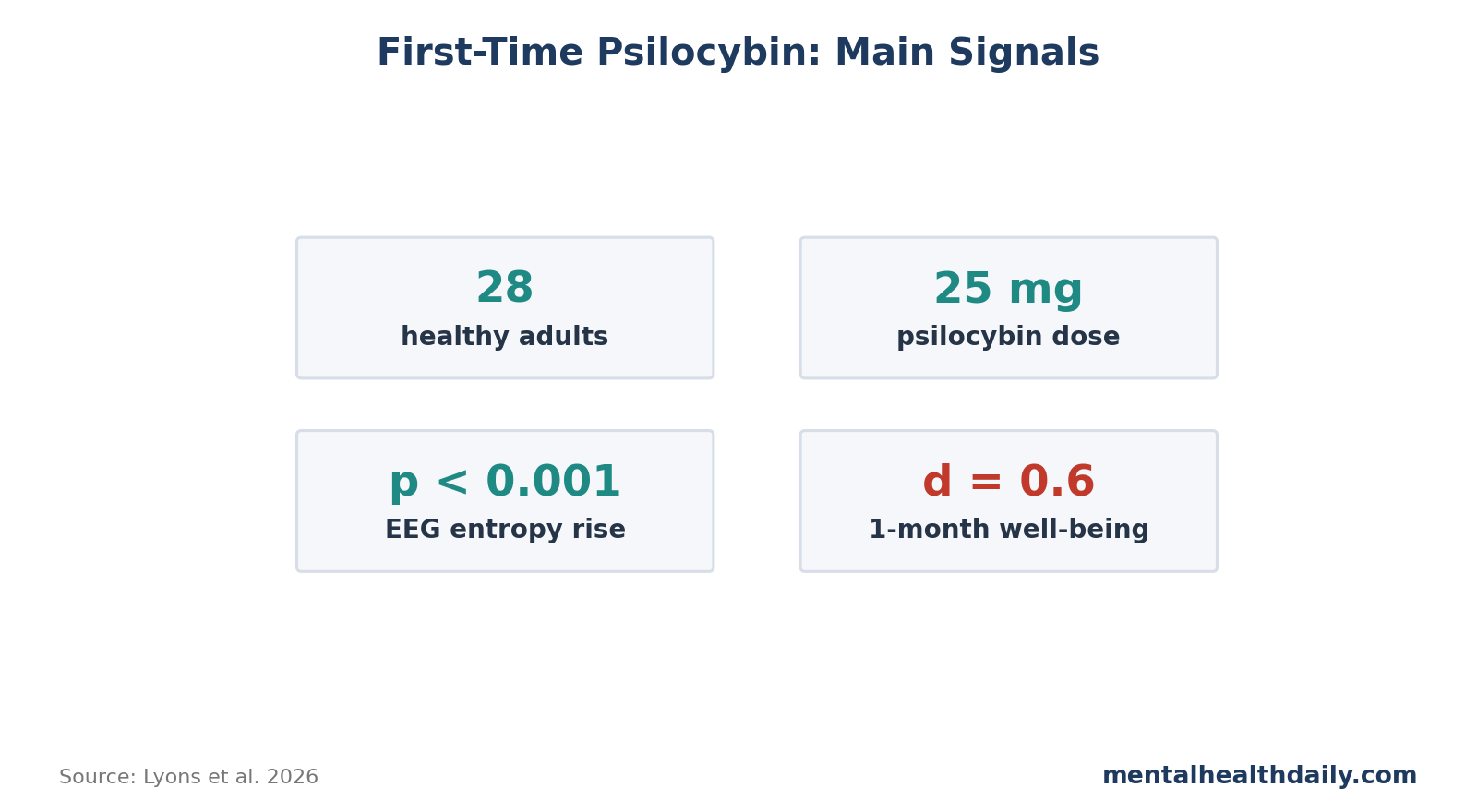
Study design: Lyons et al. studied 28 healthy volunteers with no prior psychedelic use, mean age 41 years, 43% female and 57% male.1 Each participant received 1 mg psilocybin first and 25 mg psilocybin 1 month later. That fixed order is important: the low dose functioned as a weak control, but it was not a fully randomized dose sequence.
EEG result: the strongest acute signal came from EEG. The researchers measured spontaneous brain activity before dosing and at 1, 2, and 4.5 hours after dosing. After 25 mg, LZc increased significantly at 1 and 2 hours, both p < 0.001. Alpha power decreased, gamma power increased at 2 hours, and theta power decreased at 1 and 2 hours.
LZc is a signal-complexity metric. In plain terms, a more irregular EEG signal is harder to compress mathematically. Psychedelic researchers often call this “brain entropy,” but the phrase should not be inflated into a claim that the brain became healthier. It means the acute neural signal became less stereotyped during the drug state.
Subjective intensity: the subjective ratings lined up with the EEG. Dose by time interaction for drug intensity was large, F(8,197) = 57.73, p < 0.0001. All but 1 participant, or 94%, rated the 25 mg session as the single most unusual state of consciousness in their life. Most participants rated 1 mg as no more unusual than ordinary consciousness.
One-Month White-Matter Signals Were More Specific Than Global fMRI Change
The MRI results were narrower than popular coverage may imply. DTI found significant changes in axial diffusivity (AD; water diffusion along the main direction of a white-matter tract) in 2 overlapping prefrontal-subcortical pathways:
- Prefrontal-striatal tract: F(2,48) = 10.30, p = 0.005; post-hoc 25 mg vs. 1 mg comparison t(24) = −3.72, p = 0.006.
- Prefrontal-thalamic tract: F(2,48) = 9.51, p = 0.008; post-hoc 25 mg vs. 1 mg comparison t(24) = −3.85, p = 0.005.
- Overlap matters: the 2 tracts spatially overlapped, so they should not be counted as 2 independent anatomical discoveries.
The researchers also tested functional magnetic resonance imaging (fMRI; MRI that tracks blood-oxygen changes as an indirect marker of neural activity). Here the findings were weaker. Brain network modularity did not significantly decrease in the main 25 mg vs. 1 mg comparison, p = 0.209, d = 0.3. Modularity did decrease when the 1-month post-25 mg scan was compared with baseline, t(24) = −2.95, p = 0.007, d = 0.6.
Modularity describes how strongly brain networks divide into separate communities. Lower modularity suggests more global integration, a pattern also reported in depression trials of psilocybin therapy.2 In this healthy-volunteer study, lower modularity correlated with better well-being change after controlling for pre-25 mg well-being, r = −0.40, p = 0.04. That is suggestive, not decisive.
Insight and Well-Being Improved After 25 mg, Not After 1 mg
Insight change: psychological insight rose after the high-dose session at every measured follow-up: 1 day, 2 weeks, and 1 month. The 1-day difference was large, Mdiff = 50.90, 95% CI [39.50, 62.29], d = 1.9. At 2 weeks the difference remained large, d = 1.3, and at 1 month it remained large, d = 1.2.
Well-being change: well-being also improved after 25 mg psilocybin. On the Warwick-Edinburgh Mental Well-Being Scale (WEMWBS; a self-report well-being scale), the 25 mg session outperformed the 1 mg session at 2 weeks, Mdiff = 5.83, p < 0.01, d = 0.8, and at 1 month, Mdiff = 4.70, p < 0.05, d = 0.6.
Cognitive flexibility changed more modestly. The task tested extradimensional shifting, meaning the ability to detect that the rule for sorting information has changed. Participants made fewer extradimensional-shift errors 1 month after 25 mg than 1 month after 1 mg, Mdiff = 0.06, p = 0.016, d = 0.5.
Mechanism link: the mediation analysis tied the psychology back to EEG. Acute brain entropy at 2 hours predicted next-day insight, normalized β = 0.55, p = 0.008. Both LZc and insight predicted 1-month well-being. The model fit better when insight was included, consistent with a pathway in which the acute altered state feeds next-day psychological meaning, which then tracks later well-being.
Depression Trials Make the Brain Signal More Clinically Relevant
Clinical-adjacent evidence: the healthy-volunteer imaging result belongs in psychiatric discussion because adjacent clinical trials have tested whether psilocybin can change depressive or anxiety symptoms. Davis et al. randomized 24 adults with major depressive disorder to immediate vs. delayed psilocybin-assisted therapy and found rapid, large depression reductions through 1 month.3
Griffiths et al. studied 51 patients with life-threatening cancer and depression or anxiety symptoms. High-dose psilocybin produced sustained symptom reductions, with about 80% continuing to show clinically significant decreases at 6 months.4
Shared imaging direction: Daws et al. analyzed fMRI from 2 depression trials and reported that antidepressant response to psilocybin correlated with decreased network modularity, suggesting increased global integration.2 That makes the Lyons et al. modularity result interesting because it points in the same direction, even though the healthy-volunteer main contrast was weaker.
The field also has real methodological arguments. Olson criticized overinterpretation of the 2022 modularity evidence, raising concerns about statistical choices, regression to the mean, and the ambiguity of resting-state fMRI.5 That criticism is useful here: a correlation between modularity and well-being is not a biomarker until it predicts outcomes across larger, blinded, clinically diverse samples.
Limitations of This First-Use Psilocybin Study
The sample was small and healthy. A 28-person volunteer study can find mechanistic signals, but it cannot estimate treatment effect, rare harms, or real-world risk in people with bipolar disorder, psychosis vulnerability, severe anxiety, or substance-use risk.
The dose order was fixed. Participants received 1 mg before 25 mg. The researchers used this design for practical and scientific reasons, but a fixed sequence leaves order and expectancy effects partly unresolved.
The 1 mg session was not an active psychedelic control. The study itself showed that most participants experienced 1 mg as ordinary consciousness. Blinding is therefore weaker than the word placebo-controlled may suggest.
Brain imaging does not equal clinical benefit. DTI and fMRI signals may help explain mechanisms, but they do not tell an individual reader whether psilocybin is safe, appropriate, or useful.
Screening, preparation, supervised dosing, and integration are part of the clinical package. The study measured brain-behavior biology after dosing, not outcomes from informal use without medical or psychological support.
Practical boundary: a mechanistic first-use study can justify better therapeutic trials, but it cannot estimate adverse-event rates in people with psychiatric vulnerability or polysubstance exposure.
Questions About Psilocybin Brain Changes
Did psilocybin change the brain permanently?
The study showed changes up to 1 month after 25 mg psilocybin. It did not test whether those changes persisted for 6 months, reversed, or predicted later mental-health outcomes.
Does higher brain entropy mean better mental health?
No. Higher entropy in this study was an acute drug-state signal. It predicted later insight and well-being in this small sample, but entropy by itself is not a mental-health score.
Does this support psilocybin for depression?
Indirectly. The paper strengthens a mechanistic link that also appears in depression trials, especially around network integration and psychological insight. It was not a depression treatment trial.
How should readers interpret first-time psilocybin findings?
High-dose psilocybin can produce measurable acute and 1-month brain-behavior changes after first use. The responsible clinical question is how those changes behave under screened, supported, controlled treatment conditions, not whether unsupervised first use is a shortcut to better mental health.
References
- Human Brain Changes After First Psilocybin Use. Lyons T et al. Nature Communications. 2026;17:3977. doi:10.1038/s41467-026-71962-3
- Increased Global Integration in the Brain After Psilocybin Therapy for Depression. Daws RE et al. Nature Medicine. 2022;28:844-851. doi:10.1038/s41591-022-01744-z
- Effects of Psilocybin-Assisted Therapy on Major Depressive Disorder: A Randomized Clinical Trial. Davis AK et al. JAMA Psychiatry. 2021;78(5):481-489. doi:10.1001/jamapsychiatry.2020.3285
- Psilocybin Produces Substantial and Sustained Decreases in Depression and Anxiety in Patients With Life-Threatening Cancer: A Randomized Double-Blind Trial. Griffiths RR et al. Journal of Psychopharmacology. 2016;30(12):1181-1197. doi:10.1177/0269881116675513
- Skepticism About Recent Evidence That Psilocybin “Liberates” Depressed Minds. Olson DE. ACS Chemical Neuroscience. 2022;13(17):2540-2543. doi:10.1021/acschemneuro.2c00461