In a 2026 interview study, people of color living with both PTSD and a substance use disorder described racism and sexism as part of how both conditions began.1
Women and men told different stories, though: for women, the path ran through sexual violence and fear of being blamed; for men, through street and family violence and fear of arrest.
Research Highlights
- Small, in-depth study: researchers interviewed 23 adults of color (16 women, 7 men) from community mental health clinics in Michigan, Georgia, New Mexico, and California.1
- Most saw a link: 21 of the 23 connected their race and gender to how their PTSD and substance use disorder developed.1
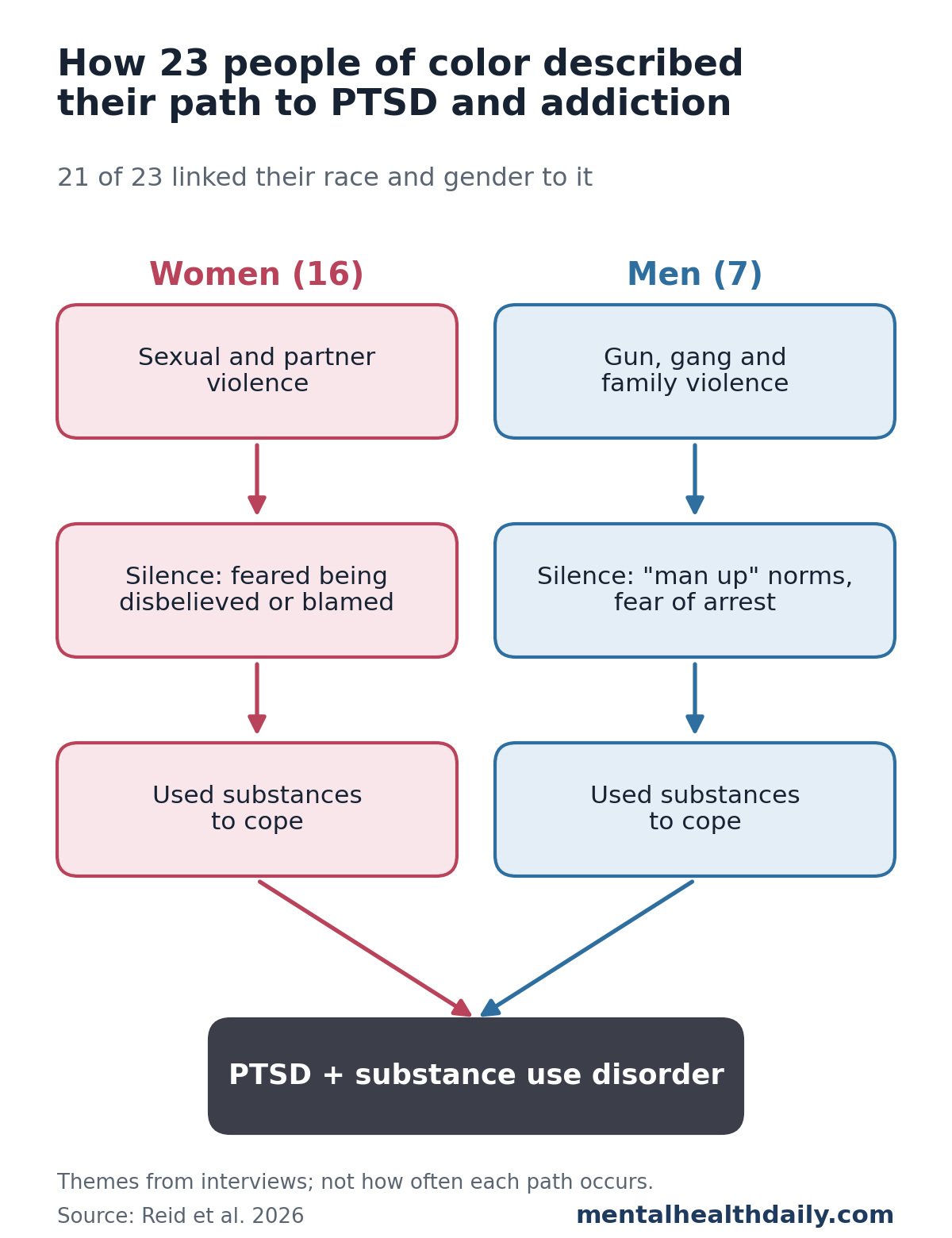
- Women’s path: sexual or partner violence, then silence out of fear they would be disbelieved or blamed, then alcohol or drugs to cope.1
- Men’s path: gun, gang, or family violence, then silence shaped by “man up” expectations and fear of police, then alcohol or drugs to cope.1
- What it can show: how people describe their own experience. It cannot say how common these paths are or prove that racism and sexism caused either condition.
Who Took Part in the PTSD and Substance Use Interviews
Posttraumatic stress disorder (PTSD) is a condition that can follow a frightening or violent event, bringing intrusive memories, nightmares, constant alertness, and avoidance of reminders. A substance use disorder (SUD) is a pattern of alcohol or drug use that keeps causing harm and becomes hard to control.
The 2 conditions often show up together, and each can make the other harder to treat. Many people with PTSD use alcohol or drugs to quiet symptoms, which can turn into addiction over time.
A team led by Mallet Reid at Michigan State University wanted to know how people of color with both conditions understood their start.1 They posted flyers at partner clinics from November 2023 to March 2024.
- Who: 23 adults with a clinician’s diagnosis of both PTSD and SUD, all of whom had received treatment for one or both.
- Background: 10 Latine, 8 Black, 4 multiracial, and 1 Asian participant; 16 women, including 2 transgender women, and 7 men.
- Education: 12 had a high school education, 8 a college degree, and 3 a master’s degree.
- Interviews: 23 first interviews of about an hour each, plus 5 follow-up interviews with randomly chosen participants, for 28 in total.
This was a qualitative study: instead of counting symptoms or running statistics, researchers listened to open-ended accounts and sorted what people said into recurring themes. Two coders worked through the transcripts and agreed about 83% of the time, and participants checked their own transcripts for accuracy.1
Violence, Silence, and Coping Took Different Forms for Women and Men
Across both groups, the same 3 steps kept appearing: violence, then silence about it, then using substances to cope. The researchers explained the gender split with multiple jeopardy, an idea from Black feminist scholarship that racism and sexism combine to create distinct kinds of harm depending on a person’s mix of identities.1
Women Described Sexual Violence, Then Fear of Being Disbelieved
Most women had lived through gender-based violence, including sexual assault, abuse by a partner, or stalking. They named that violence as the start of their PTSD.1
What came next was silence. Women said they did not tell others, especially health professionals, because they expected to be doubted or blamed, and several said being a woman of color made that more likely.
- Maritza said she could not stop thinking about being raped but felt she could not tell anyone, because “people never believe the girl.” Pain pills she took for a soccer injury made her feel the trauma “didn’t matter anymore.”
- Bell, abused by a former partner, said she would have been blamed for staying with him “so it was just a whole lot easier to hit the bottle.”
- Alicia, assaulted at a party, said she did not want to tell “cops, therapists, or anyone” because she felt they would blame her.
Researchers describe this fear with 2 terms. Testimonial injustice means a person’s account is given less credit because of who they are, and victim blaming means holding a person responsible for harm done to them.1 All participant names are pseudonyms.
Men Described Street and Family Violence, Then Fear of Arrest
Most men described interpersonal trauma: watching friends get shot, gang violence, child abuse, or seeing a parent beaten at home. Martin linked the setting itself to race, describing a neighborhood with no police or playgrounds where young men either got caught up in violence or stayed inside.1
Their silence had 2 sources. One was masculinity norms that discourage men from talking about feelings or seeking therapy; the other was fear that admitting trauma or drug use could bring in police.
- Malcom, who grew up with abuse at home, said Black men “don’t talk about their mental health,” and called that “culture of silence” the reason he became addicted.
- Martin, who watched friends get shot, said he could not tell a therapist or school counselor because he worried they would call the police. “I drank a lot,” he said.
- Oscar, whose father abused the family, said he felt he had failed as the protector his culture expected him to be, and feared telling anyone could get his mother or himself in trouble.
Even after their substance use became addiction, many men stayed away from therapy. They described a double bind: getting help meant risking both their sense of masculinity and possible arrest.
Fear of Blame or Arrest Led Both Groups to Avoid Treatment
Women expected to be discounted or blamed for their trauma. Men worried that disclosing trauma or drug use could lead to police involvement.1
All 23 participants did eventually get treatment for PTSD, SUD, or both, which is how they were recruited. Their accounts describe the silence before that point.
The researchers argue that clinicians need to understand these fears to reach people of color with PTSD and SUD. They also note that research on the 2 conditions together has paid very little attention to race or racism, and that gender-specific treatment mostly targets sexual violence, missing the issues men described.1
Larger Studies Link Discrimination to PTSD and Substance Use
Quantitative research, which measures patterns across many people, points in a similar direction for each condition on its own:
- Substance use: a 2025 meta-analysis pooled 130 studies and found racial discrimination was linked to 16 of 17 alcohol and drug outcomes in racial and ethnic minority groups. For substance use disorder, the correlation was r = 0.25, a small-to-moderate link.2
- PTSD course: a 5-year study of 152 African American and 139 Latinx adults with anxiety disorders found that more frequent reported discrimination predicted having PTSD, but not other anxiety or mood disorders.3
- Brain response: in 55 trauma-exposed Black women, more experiences of racial discrimination were linked to stronger brain responses to threat cues, even after accounting for trauma and PTSD symptoms.4
Those studies are mostly observational, so they show links rather than cause. The interview study adds something they cannot: how people themselves describe the steps from violence to silence to substance use.
What Interviews With 23 People Can and Cannot Show
Evidence strength: qualitative interviews are good at revealing how people make sense of their experiences and at generating ideas for larger studies. They cannot estimate how often a pathway occurs or test whether racism and sexism caused PTSD or addiction.
- Small, specific sample: 23 people, only 7 of them men, recruited through clinics with an existing tie to the lead researcher. Just over half (12) had a high school education.
- Looking back: participants described past events in hindsight, through the lens of memory and recovery. The researchers note their understanding may have changed over time.
- Broad grouping: combining Black, Latine, Asian, and multiracial participants under “people of color” may hide real differences between communities.
- No comparison group: the study did not interview White participants or people without both conditions, so it cannot say which experiences are specific to people of color.
- Stated framework: the analysis was openly guided by intersectionality and feminist theory, which shaped the questions asked and how themes were labeled. The researchers say they reported women’s expectation of being disbelieved as participants stated it, as certainty rather than perception.
- Not everyone agreed: 2 of the 23 participants did not connect their race or gender to their conditions.
What This Means for PTSD and Addiction Care
- Silence came before substance use: in these accounts, people turned to alcohol or drugs partly because telling someone felt unsafe.
- Women and men may need different openings: women described fear of disbelief; men described stigma around therapy and fear of police.
- Next step for research: larger studies, including within specific communities, could test how common these paths are and whether services that address them improve outcomes.
If you are dealing with trauma and substance use, the SAMHSA National Helpline (1-800-662-4357) offers free, confidential treatment referrals around the clock.
References
- Reid MR, Buchanan NT, Epps TS, et al. Interwoven oppression: A qualitative study of the contribution of racism and sexism to co-occurring PTSD and substance use disorder. American Journal of Community Psychology. 2026;78:309–321. doi:10.1002/ajcp.70104
- Gates E, Cant M, Elliott R, et al. A meta-analytic review of the relationship between racial discrimination and alcohol and other drug use outcomes in minoritised racial/ethnic groups. Addiction. 2025;120(12):2371–2403. doi:10.1111/add.70131
- Sibrava NJ, Bjornsson AS, Pérez Benítez ACI, et al. Posttraumatic stress disorder in African American and Latinx adults: Clinical course and the role of racial and ethnic discrimination. American Psychologist. 2019;74(1):101–116. doi:10.1037/amp0000339
- Fani N, Carter SE, Harnett NG, et al. Association of racial discrimination with neural response to threat in Black women in the US exposed to trauma. JAMA Psychiatry. 2021;78(9):1005–1012. doi:10.1001/jamapsychiatry.2021.1480