
A Turkish version of the UCLA PTSD Reaction Index, a widely used child and teen PTSD questionnaire, separated trauma-exposed adolescents with and without PTSD well in a 157-person clinic study.1
Higher scores were linked to more problems at home, at school, with friends, and in development.1
Research Highlights
- Strong screening accuracy: total scores told apart teens with and without clinician-diagnosed PTSD with an AUC of 0.909 (1.0 is perfect).1
- Higher cutoff than the original: the best Turkish cutoff was 49.5 out of 80, flagging 86.4% of PTSD cases and correctly clearing 84.1% of teens without PTSD; the original guide uses 35.1
- More symptoms, more daily problems: every 10 points higher on the total score roughly doubled the odds of problems at home, at school, with peers, or in development.1
- Mood and arousal symptoms stood out: negative thoughts and mood were linked to peer and developmental problems, arousal symptoms to home and school problems, and avoidance to home problems.1
- Some parts less stable: intrusion and dissociation scores held up less well when 30 teens repeated the questionnaire 2 weeks later.1
What the UCLA PTSD Reaction Index Measures
Post-traumatic stress disorder (PTSD) is a pattern of lasting symptoms after a frightening or harmful event, such as unwanted memories, avoiding reminders, a persistently negative mood, and feeling on edge. Many children and teens who go through trauma do not develop it, but a sizable minority do.1
The UCLA PTSD Reaction Index for DSM-5 (PTSD-RI-5) is one of the most widely used questionnaires for measuring these symptoms in young people. It has 3 parts:1
- Trauma history: which of 19 types of events a young person has experienced, and which one bothers them most
- Symptom scale: 27 items rated from 0 (never) to 4 (most of the time) over the past month, for a total score of 0 to 80
- Daily-life section: questions on distress and problems at home, at school, with peers, and in developmental progress
Four extra items cover dissociation, meaning feeling detached from yourself or your surroundings. The symptom items follow the 4 DSM-5 symptom groups: intrusion (B), avoidance (C), negative thoughts and mood (D), and arousal and reactivity (E).1
In the original US validation, total scores told apart youth with and without PTSD when checked against a structured diagnostic interview.2 That work produced the commonly used guide: a total of 35 or higher suggests a young person likely meets full PTSD criteria.1
How Researchers Tested the Turkish Version in 157 Teens
Ince et al., working at a children’s hospital in Izmir, translated the questionnaire into Turkish, translated it back into English to check meaning, and tried the draft on 10 patients before finalizing it.1
Sample: 157 adolescents aged 11 to 17 at the hospital’s child and adolescent psychiatry clinic, all with at least one traumatic experience, seen between October 2023 and August 2024.1
- Mostly girls: 132 (84%) were female
- Mostly interpersonal trauma: sexual abuse by someone outside the family was the most common index event (107 teens, 68%)
- Direct victims: 88% had been the victim of the event, not a witness
Reference standard: clinicians diagnosed PTSD with the PTSD section of the K-SADS (Kiddie Schedule for Affective Disorders and Schizophrenia), a structured psychiatric interview for children and teens. By that standard, 88 teens had PTSD and 69 did not.1
Daily functioning: a clinician completed the questionnaire’s home, school, peer, and development questions at the end of each interview. Any rating above “none” counted as impairment in that area.1
Turkish PTSD Questionnaire Separated Teens With and Without PTSD
Teens with PTSD averaged 59.1 out of 80 on the Turkish version, compared with 33.9 for teens without PTSD — a gap of 25.2 points (95% CI 20.8 to 29.6).1
An ROC analysis tests how well a score sorts people into the right group across every possible cutoff. The area under the curve (AUC) was 0.909, where 0.5 is a coin flip and 1.0 is perfect sorting.1
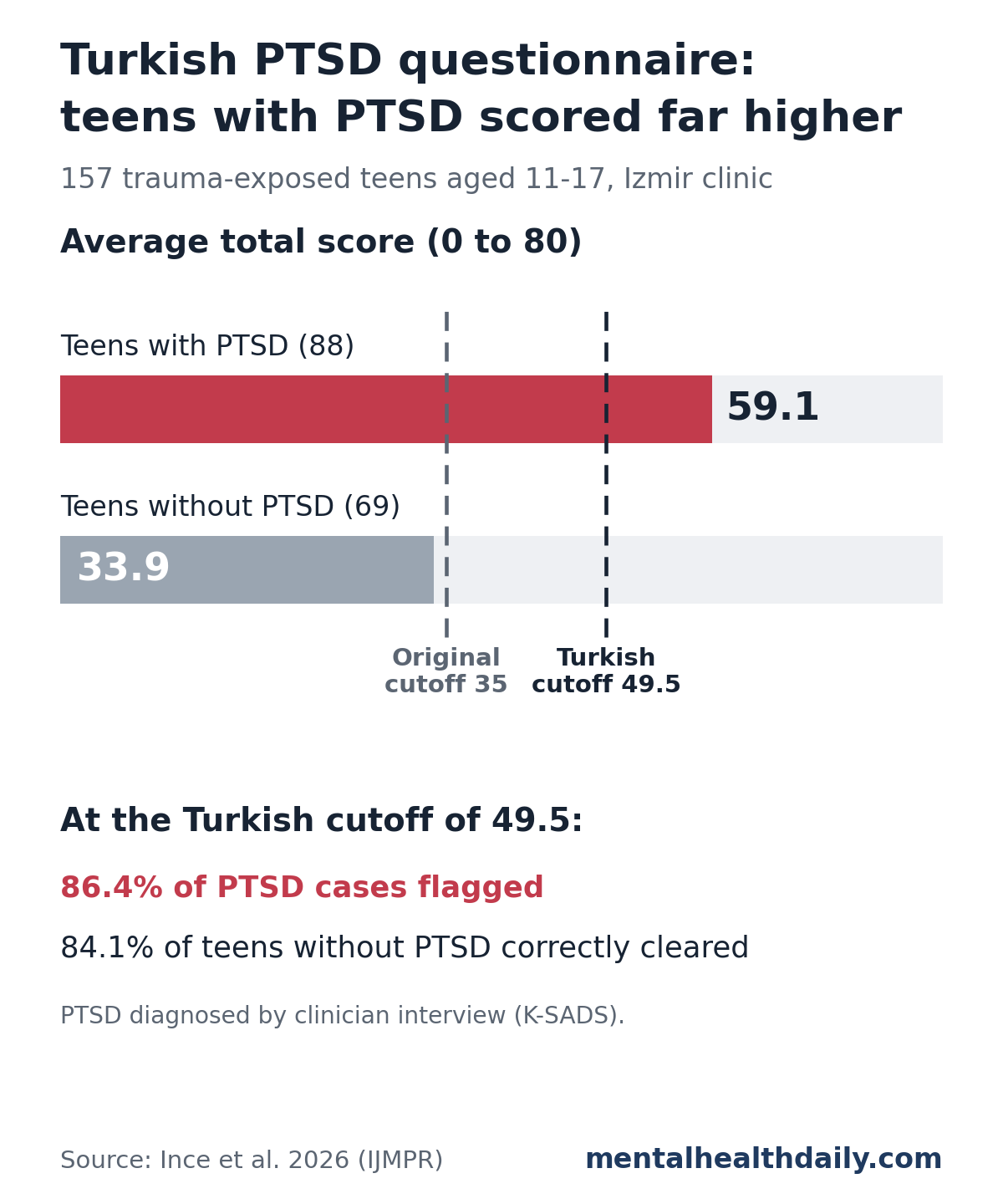
Best cutoff: a score of 49.5 or higher gave the best balance, with 86.4% sensitivity (PTSD cases correctly flagged) and 84.1% specificity (teens without PTSD correctly cleared).1
Symptom-rule method: scoring the questionnaire by DSM-5 symptom rules instead of a total cutoff caught 80.6% of PTSD cases and correctly cleared 78.2% of teens without PTSD.1
The researchers suggest that using the original cutoff of 35 with Turkish teens could label too many as likely PTSD. An earlier Turkish clinic study of 208 children and teens also found high accuracy (AUC 0.94 in the 64 children who had a diagnostic interview), and the Izmir team notes it reported 96% sensitivity but 75% specificity at the cutoff of 35.13
Both teams treat the questionnaire as a screening and severity measure. A diagnosis still rests on a clinician’s full evaluation, ideally with a structured interview.1
Reliability and Structure of the Turkish Questionnaire
Internal consistency: items within each symptom group moved together well (Cronbach’s alpha 0.774 to 0.931). Avoidance was lower at 0.651, partly because that group has only 2 items.1
Two-week retest: when 30 teens repeated the questionnaire, total scores were fairly stable (ICC 0.707, where 1.0 means identical scores). Stability was good to excellent for avoidance, negative mood, and arousal, but only moderate for intrusion (0.483) and dissociation (0.436).1
The researchers suggest intrusion symptoms such as nightmares and flashbacks may simply rise and fall with recent reminders. They advise clinicians to follow total and group scores rather than changes on single items.1
Agreement with other measures: total scores correlated strongly with a separate PTSD severity scale (Spearman’s ρ = 0.750), and the dissociation items correlated moderately with a separate dissociation scale (ρ = 0.547).1
Structure: a 5-factor model — the 4 DSM-5 symptom groups plus dissociation — fit the data well on most standard indices.1
Higher PTSD Scores Linked to Problems at Home, School, and With Friends
Each 1-point increase in total score was linked to higher odds of impairment in all 4 areas. Scaled to a 10-point difference, which is easier to picture, the odds rose about:1
- Developmental progress: 2.5-fold (odds ratio 1.097 per point)
- Home: 2.2-fold (1.084 per point)
- Peers: 2-fold (1.071 per point)
- School: 1.8-fold (1.063 per point)
When the 4 symptom groups were entered together, different groups stood out for different parts of life:1
- Negative thoughts and mood (D): peer problems (OR 1.205 per point) and developmental problems (OR 1.155)
- Arousal and reactivity (E): home problems (OR 1.144) and school problems (OR 1.131)
- Avoidance (C): home problems (OR 1.250)
- Intrusion (B): no independent link to any area
The pattern is consistent with a study of 3,400 Norwegian and 747 US youth aged 7 to 17. There, negative beliefs, emotional numbing, loss of interest, and concentration problems accounted for the largest share of impairment.4
One difference: avoidance was linked to home problems in the Turkish sample, which the earlier study did not find.1
Self-Harm and Depression Were More Common in Teens With PTSD
Self-harm was reported by 14 of the 88 teens with PTSD (15.9%) and by none of the 69 without it. Major depression was also far more common in the PTSD group: 42.0% vs. 4.3%.1
If you or a teen you know is thinking about self-harm or suicide, reach out now. In the US, call or text 988 (Suicide & Crisis Lifeline); elsewhere, contact local emergency services or a crisis line.
Limitations of This Turkish PTSD Screening Study
- One sample for building and testing the cutoff: the 49.5 cutoff was chosen and evaluated in the same 157 teens, so accuracy in a new group will likely be somewhat lower.
- Clinic setting: more than half the sample had PTSD; accuracy may differ in schools or community screening, where PTSD is rarer.
- Snapshot design: symptoms and impairment were measured at the same visit, so the study shows links, not that symptoms caused the problems.
- Same-interview impairment ratings: a clinician rated daily functioning right after hearing about symptoms, which may strengthen the links.
- Mostly girls, mostly sexual abuse: 84% were female and most index events were sexual abuse, so results may not carry over to boys or to other kinds of trauma.
- Small retest group: stability estimates came from 30 teens at a single clinic in Izmir.
What This Means for PTSD Screening in Turkish Teens
For clinics in Turkey, the Turkish PTSD-RI-5 is a well-supported way to measure PTSD symptoms in trauma-exposed teens aged 11 to 17. A total near or above 49.5 is a strong flag for a full PTSD evaluation, and the 35 cutoff may overcall in this population until larger studies settle the best threshold.1
Scores also carry information beyond the diagnosis. Teens with higher totals, and especially higher negative-mood and arousal scores, were more likely to be struggling at home, at school, and with friends.1
References
- Ince M, Durak FS, Ince B, Steinberg A. Turkish UCLA PTSD-RI-5: validation and the role of symptom severity in functional impairment. International Journal of Methods in Psychiatric Research. 2026;35:e70101. doi:10.1002/mpr.70101
- Kaplow JB, Rolon-Arroyo B, Layne CM, et al. Validation of the UCLA PTSD Reaction Index for DSM-5: a developmentally informed assessment tool for youth. Journal of the American Academy of Child and Adolescent Psychiatry. 2020;59(1):186–194. doi:10.1016/j.jaac.2018.10.019
- Kucukardali RS, Karal BN, Steinberg AM, Orengul AC. Psychometric evaluation of the UCLA PTSD Reaction Index (PTSD RI-5) in a Turkish clinical sample of trauma-exposed children. European Journal of Psychotraumatology. 2025;16(1):2465082. doi:10.1080/20008066.2025.2465082
- Bartels L, et al. The differential impact of the DSM-5 post-traumatic stress symptoms on functional impairment in traumatized children and adolescents. European Child & Adolescent Psychiatry. 2024;33(5):1573–1581. doi:10.1007/s00787-023-02266-w