
Children and teens in cancer treatment who felt their family worked well together reported fewer sleep problems, in a 2026 study of 518 young patients in China.1 Lower depression and anxiety accounted for a sizable share of that link.
Research Highlights
- Better family functioning, fewer sleep problems: each 1-point rise on a 0–10 family functioning scale was linked to 0.109 fewer sleep-problem areas out of 5 (95% CI −0.165 to −0.053), after adjusting for family resilience and background factors.1
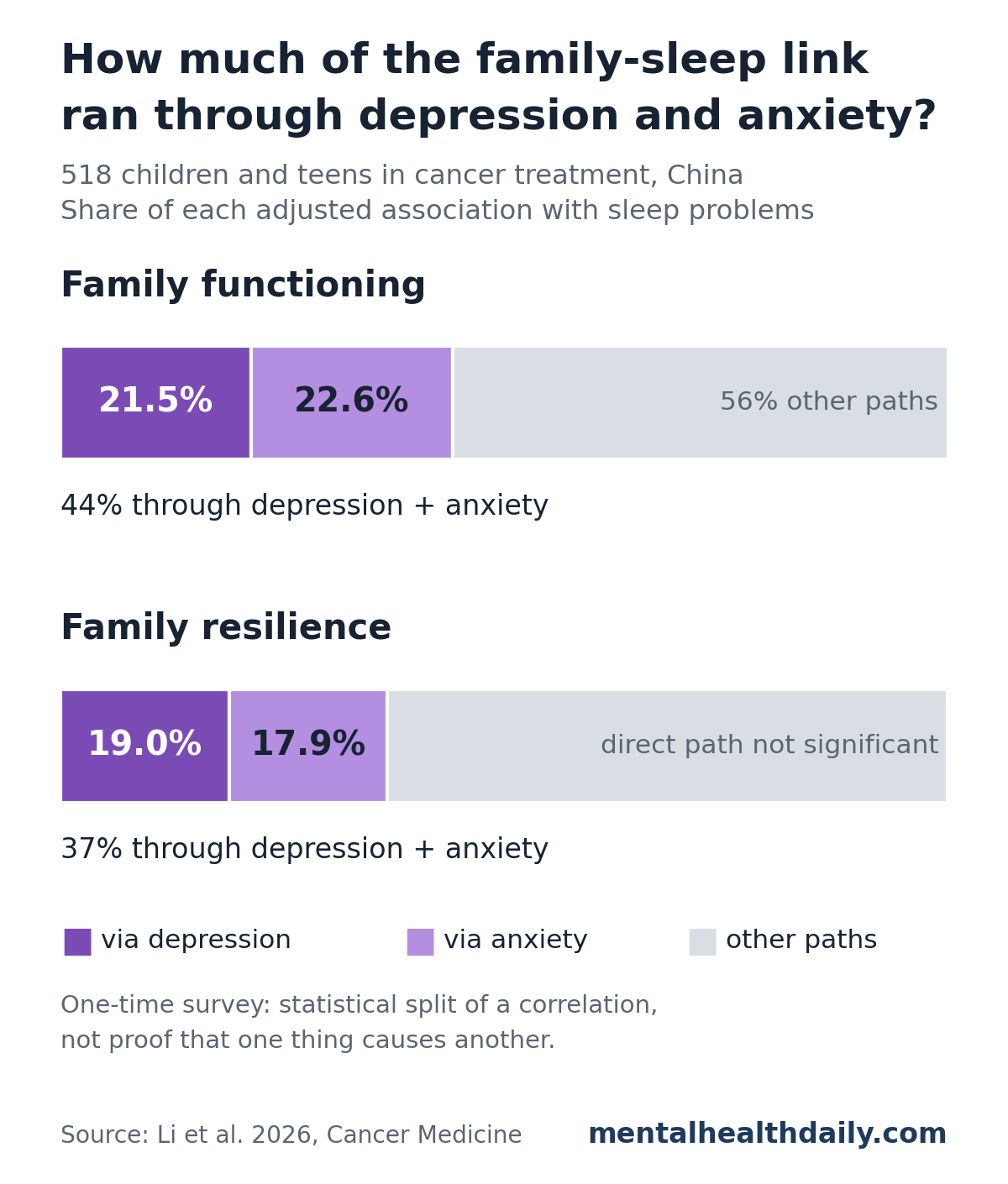
- Depression and anxiety explained about 44%: statistically, about 22% of that link ran through depression and 23% through anxiety; the rest remained a direct link.1
- Family resilience had an indirect mood-related link: its smaller link with sleep (B = −0.026) was no longer significant once depression and anxiety were added, while about 37% ran through those symptoms.1
- Young patients in active treatment: ages 7 to 17, about half with leukemia, most surveyed within 6 months of diagnosis.1
- One-time survey: all measures came from the same questionnaire session, so the study cannot show which came first.1
Sleep Problems Are Common in Children With Cancer
Between 40% and 80% of children and teens with cancer have sleep problems, according to earlier studies cited in the 2026 paper. Poor sleep can make treatment harder to follow and lowers quality of life, and for some it continues into survivorship.1
A 2021 review of pediatric cancer sleep research listed many contributors: the cancer and its treatment, family and psychosocial factors, mood, and coping skills.2 Because these overlap, it is hard to tell which ones a care team could actually help with.
Li et al., a team from Beijing Children’s Hospital and the Communication University of China, looked at 2 family factors together and asked how much of their link with sleep ran through depression and anxiety.
How the Study Measured Family Life, Mood, and Sleep
The 518 participants came from the Chinese Childhood Cancer Survivorship Wellbeing Cohort, a multicenter study that began in 2021. Everyone was in active cancer treatment and completed questionnaires at the study’s first visit; children under 12 had help from trained research staff.1
- Who: 448 children aged 7–14 and 70 teens aged 15–17; 301 boys and 217 girls.
- Cancers: leukemia (258), lymphoma (100), and solid tumors (160).
- Timing: 315 (60.8%) were surveyed within 180 days of diagnosis.
- Excluded: children with a psychiatric disorder, brain metastases, communication disorders, or other major chronic illnesses.
The study compared 2 related but different family factors:
- Perceived family functioning is how satisfied a child feels with everyday family life. It was measured with the Family APGAR, a 5-question scale (adaptation, partnership, growth, affection, resolve) scored 0 to 10, with higher scores meaning better functioning.
- Family resilience is a family’s ability to stay committed, feel in control, and adapt under long-term stress. It was measured with the 20-item Family Hardiness Index.
Depression and anxiety were measured with the Chinese pediatric PROMIS scales, which are standardized symptom questionnaires where 50 is the average and higher means more symptoms.1
Sleep was measured with the BEARS screening tool. It asks yes-or-no about 5 areas: Bedtime problems, Excessive daytime sleepiness, night Awakenings, Regularity and duration of sleep, and Snoring. The score is the number of problem areas, from 0 to 5.1 BEARS was first tested as a quick sleep screen in pediatric primary care.3
Family Functioning Was Linked to Fewer Sleep Problems
In simple correlations, both family factors were linked to fewer sleep problems (family functioning r = −0.240; family resilience r = −0.222) and to lower depression and anxiety. Depression and anxiety were each linked to more sleep problems (r = 0.314 and 0.309).1
The main analysis entered both family factors at once and adjusted for age, sex, household income, cancer type, and time since diagnosis. Researchers then used a mediation model, a statistical method that splits an association into a part that runs through other measured variables (here, depression and anxiety) and a direct part that does not.
Family functioning: each 1-point higher APGAR score was linked to 0.109 fewer sleep-problem areas. That breaks down as:1
- Through depression: B = −0.024 (21.5% of the total)
- Through anxiety: B = −0.025 (22.6%)
- Direct link: B = −0.061 (55.9%), still significant (95% CI −0.118 to −0.004)
The direct link suggests family functioning relates to sleep in other ways too. The researchers point to bedtime routines, a sense of safety, parent–child time before sleep, and practical caregiving as possibilities, though the study did not measure these.1
Family Resilience Had an Indirect Link With Sleep Through Depression and Anxiety
Family resilience had a smaller adjusted link with sleep problems (B = −0.026 per point on the hardiness index, 95% CI −0.044 to −0.010). About 37% of it ran through depression and anxiety, split almost evenly between the two.1
Once depression and anxiety were in the model, the direct link between resilience and sleep shrank and was no longer significant (B = −0.017, 95% CI −0.034 to 0.0004). The researchers describe resilience as a more distant family resource whose link with sleep shows up mostly through the child’s emotional state.1
Sensitivity check: when the sleep score was reanalyzed as a count (a Poisson model), the indirect links through depression and anxiety held for both family factors.1
Divorce, Income, and Time Since Diagnosis
- Divorced parents: the 40 children with divorced parents had higher average depression (54.1 vs 50.7) and anxiety (50.7 vs 47.6) scores than the 478 with married parents. They also reported lower family functioning and resilience.
- Household income: children from lower-income families reported more sleep-problem areas on average (1.52 vs 1.30).
- Early treatment: being within 180 days of diagnosis was linked to more sleep problems in the adjusted model.
Each of these comes from the same one-time survey, so they describe groups that may need closer attention rather than causes.1
Limitations of This Pediatric Cancer Sleep Study
Evidence strength: this was a cross-sectional study, meaning everything was measured at a single point in time. It can show which factors go together, but not which came first. The mediation model is a statistical breakdown of a correlation, not proof that improving family life would lower anxiety and then improve sleep.
- Direction could run the other way. Poor sleep can worsen mood, and an anxious, exhausted child may see family life less positively. The researchers name reverse or two-way links as plausible.
- Everything was self-reported. A child’s general outlook can color answers on every questionnaire and inflate the links, although a statistical check suggested this was not a major problem.
- Sleep was screened, not measured. BEARS counts problem areas; there were no sleep diaries, wrist-worn activity trackers, or sleep studies.
- Treatment details were missing. Chemotherapy regimen, treatment intensity, disease stage, and relapse were not fully available, so some confounding may remain.
- Modest effects. The model with depression and anxiety explained 15% of the variation in sleep scores.
- One country, selected sample. Children with psychiatric disorders or brain metastases were excluded, and all were in mainland China.
What This Means for Families and Care Teams
Sleep, mood, and family life look worth checking together during pediatric cancer treatment. The researchers suggest that oncology teams routinely ask about sleep across these 5 areas and screen for depression and anxiety.1
- Ask about sleep and mood together. A child reporting several sleep problems or high anxiety may benefit from a referral to a psychologist or other mental health professional.
- Watch the early months. The first months after diagnosis may be a useful time to check on family needs, mood, and sleep.
- Offer family support where it is thin. Social workers and psychologists can help families facing financial strain, heavy caregiving loads, or limited outside support.
Whether family-focused support actually improves children’s sleep has not been tested here. The researchers call for longitudinal studies and intervention trials to answer that.1
References
- Li Z, Hu C, Yao L, Wang Y, Yang Z, Wang X, Ni X. Perceived family functioning, family resilience, and multidimensional sleep problems among Chinese children and adolescents with cancer: the indirect association of depression and anxiety. Cancer Medicine. 2026;15:e72248. doi:10.1002/cam4.72248
- Sheikh IN, Roth M, Stavinoha PL. Prevalence of sleep disturbances in pediatric cancer patients and their diagnosis and management. Children. 2021;8(12):1100. doi:10.3390/children8121100
- Owens JA, Dalzell V. Use of the ‘BEARS’ sleep screening tool in a pediatric residents’ continuity clinic: a pilot study. Sleep Medicine. 2005;6(1):63–69. doi:10.1016/j.sleep.2004.07.015