In a 2026 study of 138 teens with ADHD at a clinic in Turkey, school discipline, frequent absences, family factors and gaps in ADHD treatment were far more common in those who also had conduct disorder.1
A machine-learning model built from school, family and treatment records rarely flagged the wrong teen, but it missed about 4 in 10 of the teens with conduct disorder.
Research Highlights
- High overall accuracy, moderate sensitivity: a 20-variable model sorted 87% of teens correctly (AUC 0.90), clearing 98 of 100 teens with ADHD alone but flagging only 22 of 38 who also had conduct disorder.1
- School problems stood out: disciplinary punishment (60.5% vs. 17%) and frequent absences (47.3% vs. 12%) were far more common in teens with both conditions.1
- Family and treatment history mattered too: lower maternal education, friends who smoked, breaks from ADHD medication and a later ADHD diagnosis all ranked among the strongest signals.1
- Early, single-clinic result: the researchers say the model is not a diagnostic tool and cannot predict which children with ADHD will later develop conduct disorder.1
What Conduct Disorder Is and Why It Matters in ADHD
ADHD (attention-deficit/hyperactivity disorder) is a neurodevelopmental condition marked by inattention, impulsivity and hyperactivity. It is one of the most common mental health diagnoses in children and teens.
Conduct disorder is a diagnosis for a lasting pattern of serious behavior problems: aggression toward people or animals, destroying property, repeated lying or stealing, and major rule-breaking such as skipping school or running away. It goes beyond ordinary teenage defiance.1
The two conditions often overlap. A 2025 meta-analysis of 121 studies covering 39,894 young people with ADHD estimated that 10.7% also had conduct disorder, with higher rates in boys.2
Teens with both conditions tend to have more aggression, a weaker response to treatment and a harder path into adulthood than teens with ADHD alone, which is why clinicians want to recognize the combination early.1
How the Erciyes University Team Built the Model
A team led by Büşra Çağır at Erciyes University in Kayseri, Turkey, recruited adolescents aged 11 to 18 from the university’s child and adolescent psychiatry clinic between August 2024 and February 2025. A child psychiatrist confirmed every diagnosis using DSM-5 criteria.1
- Sample: 138 teens, 100 with ADHD only and 38 with ADHD plus conduct disorder; both groups averaged about 13.5 years old
- Exclusions: teens with any other psychiatric or medical diagnosis, or significant intellectual disability
- Information collected: 99 variables, including family background, school history, ADHD treatment, peer behavior and questionnaires completed by teens and parents on empathy, resilience, bullying, attachment and childhood trauma
Machine learning here means computer programs that learn patterns from examples. The team ranked all 99 variables by how strongly they separated the two groups, then trained six kinds of models on the top 10, 20, 30, 50 or all 99 variables, for 30 combinations in total.1
They checked each one with five-fold cross-validation: the data are split into five parts, each model learns on four parts and is scored on the fifth, and this repeats until every teen has been scored by a model that did not train on them.1
School Discipline and Absences Stood Out in Teens With Conduct Disorder
The two groups were similar in age, and the share of boys was higher in the conduct disorder group (86.8% vs. 72%) without reaching statistical significance. The clearest differences came from school, family and treatment history.1
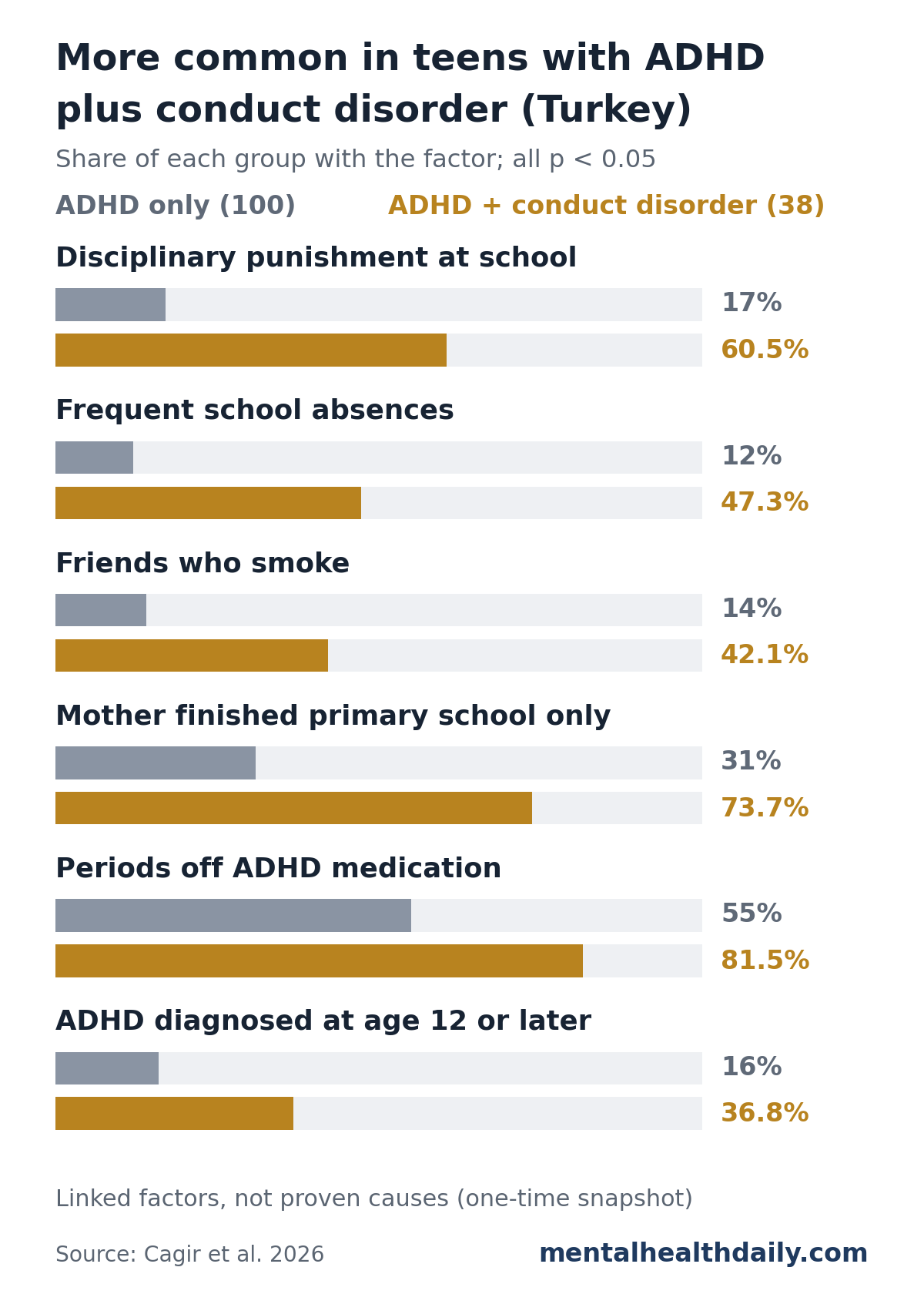
Family history of criminal involvement was also more common in the conduct disorder group (15.7% vs. 1%). No mother in that group had a university education, compared with 34% of mothers in the ADHD-only group.1
When the researchers compared three different ranking methods, a consistent set of factors rose to the top:1
- Family: lower maternal education (top-ranked by all three methods), family criminal history and physical abuse
- School: disciplinary punishment and frequent absences
- Peers: friends who smoked or got into trouble
- ADHD care: breaks from medication and a diagnosis at age 12 or later
- Early development: infant sleep problems and a history of speech delay, which ranked high in two of the three methods
Cause and effect can run both ways. School punishment, absences and peer problems may be part of conduct disorder itself rather than causes of it, and a one-time snapshot cannot sort out which came first.1
How Well the Model Flagged Conduct Disorder in Teens With ADHD
The researchers singled out a support vector machine (SVM; a method that draws the best dividing line between two groups) using the top 20 variables, because it had the highest accuracy and F1-score (a combined measure of catching cases and avoiding false alarms) of all 30 combinations.1
- Overall accuracy: 87% of teens sorted correctly (95% CI 81% to 92%)
- AUC 0.90: AUC (area under the curve) measures how well a model ranks one group above the other, where 0.5 is a coin flip and 1.0 is perfect
- Specificity 98%: 98 of 100 teens with ADHD alone were correctly left unflagged
- Sensitivity 58%: 22 of 38 teens with conduct disorder were flagged and 16 were missed (95% CI 42% to 74%)
Because ADHD-only teens outnumbered the conduct disorder group 100 to 38, the 87% accuracy is driven largely by how well the model recognized the larger group. Sensitivity is the weaker number, and it is the one that matters most for catching teens who need extra support.1
Fewer variables worked better. The same SVM trained on all 99 variables flagged only 3 of 38 conduct disorder cases (sensitivity 7.9%). A top-30 version reached the highest AUC (0.92) but caught under 40% of cases, so no single setup won on every measure.1
Limitations of This ADHD and Conduct Disorder Model
This was an exploratory study, and the researchers describe their accuracy figures as preliminary. Several features of the design mean the model would likely perform worse in practice:1
- Variables chosen with all the data: the top-ranked variables were picked using every teen before cross-validation began, which can make scores look better than they are. A stricter check that re-ranked variables inside each fold appears only in the supplement.
- Many combinations tried: 30 model setups were compared on the same results, with no rule set in advance for choosing the best one.
- No outside validation: the model has not been tested in a new group of teens or at another clinic.
- Small conduct disorder group: only 38 teens, about 7 or 8 per cross-validation fold, which is why the sensitivity estimate is so uncertain.
- Existing diagnoses only: the model sorted teens who already had a diagnosis. It cannot say which children with ADHD will go on to develop conduct disorder.
- A cleaner sample than most clinics: teens with anxiety, depression or other diagnoses were excluded, though these often travel with ADHD.
What These Findings Mean for Teens With ADHD and Their Families
The factors that stood out are things clinicians can already see: trouble at school, missed classes, gaps in ADHD treatment, a late diagnosis and the teen’s friendships. Çağır and colleagues suggest these could prompt closer follow-up and future parent- and school-based programs.1
Medication breaks and a late diagnosis were more common in the conduct disorder group, but this study cannot show that steadier treatment would have prevented conduct disorder. Those patterns may instead mark a harder clinical course from the start.1
For families, a teen with ADHD who is facing repeated school discipline, skipping school or drifting toward risky friendships is worth raising with their clinician. Diagnosis still rests on a full clinical assessment, and the researchers see models like this one as a support for that judgment, not a replacement.1
References
- Çağır B, Kurban R, Özmen S. Machine learning–based classification of conduct disorder comorbidity in youth with ADHD. Brain and Behavior. 2026;16:e71784. doi:10.1002/brb3.71784
- Njardvik U, Wergeland GJ, Riise EN, Hannesdottir DK, Öst LG. Psychiatric comorbidity in children and adolescents with ADHD: a systematic review and meta-analysis. Clinical Psychology Review. 2025;118:102571. doi:10.1016/j.cpr.2025.102571