hit counter

Prior Cocaine Use Disrupts Orbitofrontal Hidden-State Coding

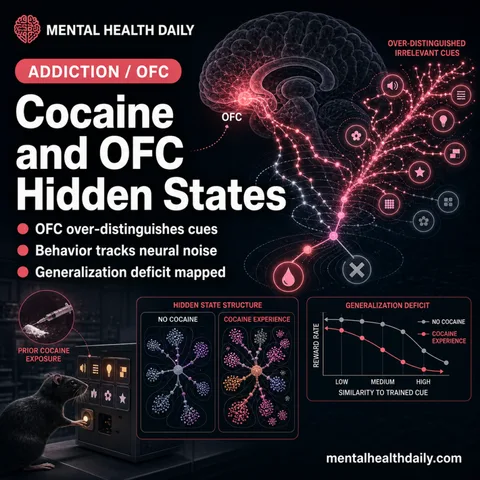
MHD featured image for Prior Cocaine Use Disrupts Orbitofrontal Hidden-State Coding.

A 2026 eLife study recorded 3,881 lateral orbitofrontal cortex units in rats and found that prior cocaine use made the OFC over-distinguish task positions that controls treated as functionally equivalent. The headline result was not gross task failure: cocaine-experienced rats still performed the odor task, but their OFC ensembles showed higher S1-vs.-S2 decoding than sucrose …

Read more

Drug Addiction Linked to Cortical Thinning in 65 of 68 Brain Regions

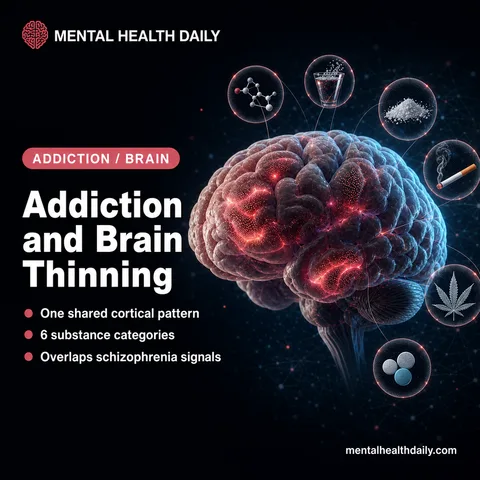
Photoreal illustration of a human brain with cortical regions highlighted across substance categories, representing the cross-substance morphometric pattern in addiction.

Whether alcohol, cocaine, nicotine, and cannabis damage the same brain regions or different brain regions has been hard to settle in the addiction-imaging literature. A 2026 ENIGMA Addiction analysis by Georgiadis et al. — pooling 4,733 brains across 51 sites — now has an answer. Research Highlights Across 2,782 people with substance use disorder (SUD) …

Read more

Ketamine Addiction After One Therapeutic Dose: How Rare Is It?

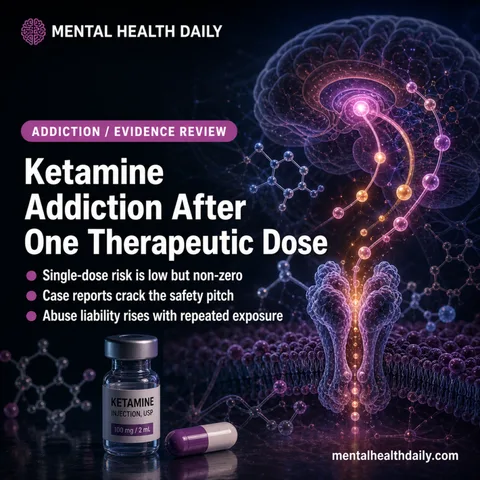
Stylized illustration evoking the tension between ketamine's clinical promise for depression and its abuse liability, framed in muted rose and amber tones for the addiction topic.

Ketamine and its S-enantiomer esketamine (sold as Spravato) are now established treatments for treatment-resistant depression and acute suicidality. The standard safety pitch from sponsors and clinics: at single sub-anesthetic doses, in supervised settings, addiction risk is minimal. A new case report in BJPsych Open documents a patient for whom that pitch failed catastrophically — and …

Read more

Internet Addiction Linked to 5-HT2A Receptor Polymorphism: Serotonin HTR2A Gene rs6313 (2024 Study)

In the digital age, Internet Addiction Disorder (IAD) emerges as a complex interplay of technology, psychology, and genetics. This intricate relationship underscores the need for a multidisciplinary approach to understanding and addressing IAD. A recent study analyzed the genetic underpinnings of internet addiction and discovered a strong link with the serotonin 2A receptor gene (HTR2A) …

Read more

Non-Medical Fentanyl Use: Drug Addiction Insights (2024 Review)

Fentanyl, a synthetic opioid exponentially stronger than morphine, has transitioned from an unwanted contaminant in the illicit drug market to a sought-after substance among people who use drugs (PWUD). This shift underscores a critical change in drug use patterns, motivations, and the associated demographic and socioeconomic factors contributing to its rising preference. Highlights: Fentanyl’s Potency: …

Read more

CNQX as a Potential Drug Addiction Treatment via AMPA & Kainate Receptors (Glutamate) (2023 Study)

The journey to overcome addiction is fraught with challenges, not least due to the limited options available for pharmacological intervention. In recent research, the focus has shifted toward understanding the role of glutamate, a key neurotransmitter in the brain, in the development and persistence of addictive behaviors. One compound, CNQX, which antagonizes certain glutamate receptors, …

Read more