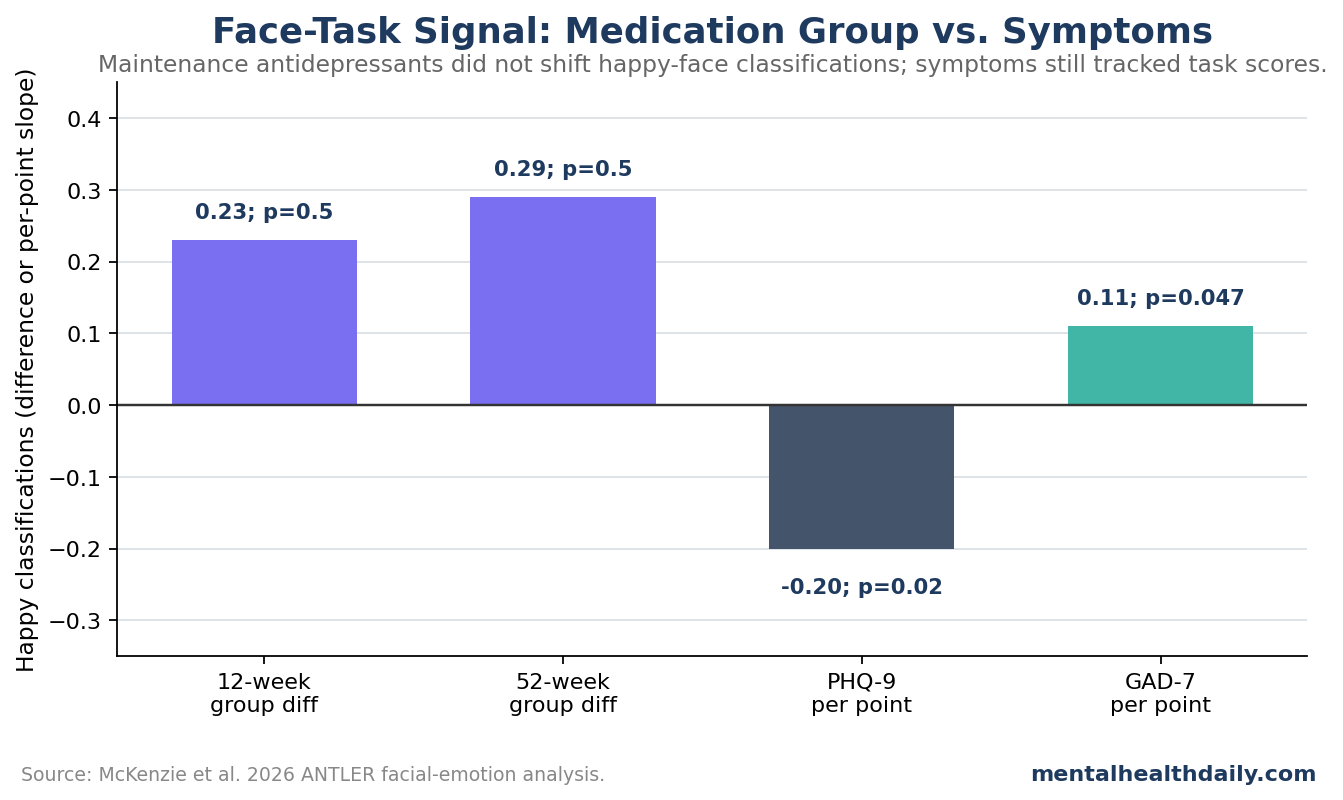
A 2026 ANTLER mechanistic analysis found no evidence that maintaining antidepressants preserved a happier facial-emotion recognition pattern compared with placebo substitution at 12 weeks (adjusted mean difference 0.23, 95% CI −0.5 to 1.0, p = 0.5) or 52 weeks (0.29, 95% CI −0.5 to 1.2, p = 0.5).
Research Highlights
- No 12-week maintenance advantage: discontinuation vs. maintenance differed by only 0.23 happy-face classifications on a 0-45 task, with p = 0.5.1
- No 52-week maintenance advantage: the adjusted mean difference was 0.29 classifications at 52 weeks, again with p = 0.5.
- Depression symptoms still tracked bias: each PHQ-9 point was associated with 0.20 fewer happy classifications cross-sectionally and 0.09 fewer longitudinally.
- Anxiety moved the other way: each GAD-7 point was associated with 0.11 more happy classifications, a small positive association with p = 0.047.
- Mechanism is narrower than the model: 462 task completers make this harder to dismiss as a tiny laboratory null, but the task tested facial emotion recognition, not every antidepressant mechanism.
Facial emotion recognition tasks ask participants to classify faces that shift between expressions, in this case from happy to sad. The cognitive neuropsychological model of antidepressants predicts that medication can shift emotional processing toward more positive interpretations before mood changes become obvious.
McKenzie et al. tested that mechanism in a long-term clinical context.
Trial comparison: ANTLER compared maintenance antidepressant treatment with placebo substitution in adults with recurrent depression who were currently well, then measured whether the groups differed on the happy-vs.-sad face task at baseline, 12 weeks, and 52 weeks.
462 Participants Completed at Least 1 Face Task
The original trial randomized 478 adults with recurrent depression. The facial-emotion analysis included 462 participants who completed at least 1 computerized task. Faces morphed from happy to sad, and the primary outcome was the number of faces classified as happy out of 45.
The comparison was clinically useful because participants were not starting treatment from scratch. They were already well enough to enter a relapse-prevention trial, which let the researchers ask whether ongoing medication maintained a positive emotional-processing bias.
- Maintenance group: continued antidepressant medication.
- Discontinuation group: moved toward placebo substitution.
- Primary task: count of happy classifications from 0 to 45.
- Symptom measures: PHQ-9 for depression and GAD-7 for anxiety.
Maintenance Antidepressants Did Not Preserve a Happy-Face Bias
At both follow-ups, the discontinuation group had a slightly higher estimated happy-face score than the maintenance group after adjustment. The differences were small and statistically unconvincing.
That direction is important. The result was not a hidden benefit for maintenance antidepressants that failed to reach significance. Point estimates leaned the other way, but by less than 1 happy classification on a 45-trial task, and confidence intervals easily included no meaningful difference.
The longitudinal model reached the same practical answer. Including participants with partial task data did not reveal a medication-group effect, and adherent-sample analysis did not rescue the emotional-bias prediction.
Symptoms Were Still Linked to Emotional Interpretation
The null treatment-group result did not mean the task was biologically empty. Depressive symptoms were associated with fewer happy classifications. Cross-sectionally, each PHQ-9 point was linked to 0.20 fewer happy responses; longitudinally, each point was linked to 0.09 fewer happy responses.
Anxiety showed a small positive association. Each GAD-7 point was linked to 0.11 more happy classifications. That pattern is not the simple "all distress makes faces look sadder" story, and it reinforces why single emotional-processing tasks should not be treated as universal mood biomarkers.
Prior work still supports the broader connection between antidepressants, symptoms, and emotional processing. Ahmed et al. reported emotional-processing effects in secondary analyses of the PANDA sertraline trial,2 and Bone et al. linked happy and sad facial-expression recognition to depressive symptom severity over time.3 ANTLER narrows the claim: maintenance treatment in remitted recurrent depression did not preserve a measurable happy-face advantage.
Laboratory Mechanism Did Not Generalize Cleanly to Maintenance Care
SSRIs, selective serotonin reuptake inhibitors, increase serotonin signaling by blocking serotonin reuptake. The emotional-bias model proposes that downstream mood benefit partly emerges because patients process social and emotional information less negatively, creating better learning conditions over weeks.
That model remains plausible for early treatment, acute dosing studies, or other task domains. ANTLER tested a different setting: people with recurrent depression who were currently well and deciding whether medication should continue. In that setting, facial emotion recognition did not behave like a sustained medication signature.
Evidence-strength note: this was a prespecified mechanistic analysis inside a randomized trial, so the medication comparison is stronger than a cross-sectional association. It still cannot prove that all antidepressant mechanisms are unrelated to emotional processing, because 1 face task is a narrow window into a broader cognitive system.
Relapse Prevention Needs Markers Beyond Happy-Face Counts
The clinical question in maintenance care is not whether a person can classify more faces as happy. It is whether stopping medication changes relapse risk, functioning, sleep, anxiety, withdrawal symptoms, and the patient's ability to recover if symptoms return.
The face task may still be informative as a symptom-linked measure. PHQ-9 and GAD-7 associations showed the task was not random noise. It simply failed as a maintenance-treatment discriminator in this trial.
Better relapse-prevention markers would probably combine several domains:
- Clinical history: number of previous episodes, severity, suicidality, duration of remission, and prior discontinuation outcomes.
- Current symptom load: residual PHQ-9 and GAD-7 symptoms, sleep disturbance, irritability, and anhedonia.
- Medication burden: side effects, sexual dysfunction, emotional blunting, weight change, drug interactions, and patient preference.
- Behavioral early warning signs: social withdrawal, missed work, reduced activity, and changes in reward behavior.
- Cognitive-emotional tasks: facial recognition may be one part of a larger battery rather than a single decisive marker.
Decision framing: the ANTLER face-task result weakens one proposed maintenance mechanism. It does not erase the possibility that antidepressants prevent relapse through sleep stabilization, anxiety reduction, rumination changes, withdrawal avoidance, or other pathways.
Acute Treatment and Maintenance Treatment Should Not Be Collapsed
Many emotional-processing studies test short-term antidepressant exposure. Those experiments ask whether early pharmacologic changes shift attention, memory, reward, or threat processing before a patient consciously feels better.
Maintenance context: participants in ANTLER had already improved enough to be considered well, and the clinical question was whether continuing medication preserved a protective state.
A mechanism that appears during early treatment may fade, become redundant, or be detectable only under a more stressful emotional task once symptoms are remitted.
Research implication: future maintenance studies should avoid assuming that early-treatment biomarkers remain stable after recovery. A useful long-term marker needs to predict relapse and show how a drug changes emotional processing under clinical conditions.
Task sensitivity also matters. The ANTLER face task used happy-to-sad morphs, so it was optimized for one social-emotional judgment. A patient could show medication-related changes in reward learning, negative memory recall, threat vigilance, or rejection sensitivity while showing no shift on this task.
Clinical translation: the safest conclusion is not that emotional processing is irrelevant to depression. It is that maintenance antidepressant decisions should not lean on a presumed persistent happy-face recognition effect. The measured task did not separate maintenance from discontinuation across 52 weeks.
Withdrawal and relapse also complicate interpretation. People discontinuing antidepressants can experience symptoms that resemble relapse, and people continuing medication can have side effects that change emotional experience. A face-classification score cannot separate those clinical states by itself.
For readers deciding how to interpret the result, the useful comparison is mechanism vs. management. Mechanism research asks how drugs might work; management asks which course protects a particular patient. ANTLER gives a negative result for 1 mechanism marker, while leaving the broader management decision dependent on relapse history and patient-specific tradeoffs.
That distinction keeps the result useful without overstating it. The study trims a mechanism claim; it does not tell stable patients to stop medication.
Evidence-strength note: this was a secondary analysis of a larger discontinuation trial, not a new trial designed only around facial-emotion recognition. That makes the clinical setting valuable, but it also means the task had to compete with many real-world sources of variation: medication history, withdrawal symptoms, residual anxiety, prior relapse burden, and different reasons for wanting to continue or stop treatment.
Biomarker bar: a stronger marker would need to change with treatment, predict relapse before symptoms return, and add information beyond ordinary clinical history.
The ANTLER face-task data did not reach that bar, even though emotional processing remains a plausible depression mechanism in other contexts.
Questions About Antidepressants and Emotion Recognition
Does this mean antidepressants do not prevent relapse?
No. The parent ANTLER trial addressed relapse prevention. This analysis asked whether maintenance treatment preserved a happy-face recognition bias, and it did not find that mechanism.
Could antidepressants affect other emotional-processing tasks?
Yes. Word recall, reward learning, attention, threat processing, and social evaluation tasks may behave differently. ANTLER is strongest against a broad claim that long-term maintenance visibly sustains positive facial-emotion interpretation.
What should clinicians take from the result?
Do not use facial emotion recognition as a stand-alone sign that maintenance antidepressants are biologically active. Symptom history, relapse risk, side effects, patient preference, and prior discontinuation attempts remain more practical decision inputs.
References
- Do Antidepressants Change Our Interpretations of Facial Emotions? McKenzie N et al. Psychological Medicine. 2026;56:e132. doi:10.1017/s0033291726104000
- The Effect of Sertraline on Emotional Processing: Secondary Analyses of the PANDA Randomised Controlled Trial. Ahmed N et al. Psychological Medicine. 2022;52(13):2814-2821. doi:10.1017/s0033291720004985
- Variation in Recognition of Happy and Sad Facial Expressions and Self-Reported Depressive Symptom Severity: A Prospective Cohort Study. Bone JK et al. Journal of Affective Disorders. 2019;257:461-469. doi:10.1016/j.jad.2019.06.025
- Antidepressant Drug Action: Early Changes in Emotional Processing. Harmer CJ et al. British Journal of Psychiatry. 2009;195(2):102-108. doi:10.1192/bjp.bp.108.051193