
In a 2026 case report from China, a 34-year-old woman with mild intellectual disability was sent for evaluation of possible narcolepsy. Sleep testing and EEG instead showed epilepsy and moderate obstructive sleep apnea.1
Research Highlights
- Narcolepsy was ruled unlikely: she took 9.3 minutes on average to fall asleep during daytime nap tests, with no early REM sleep and no cataplexy or sleep paralysis.1
- Moderate sleep apnea: an overnight sleep study recorded 19.7 breathing events per hour, with oxygen dropping as low as 83%.1
- Nighttime seizures: her 2 episodes of unresponsiveness during sleep fit epilepsy, and both 24-hour EEGs showed seizure-type discharges that increased during sleep.1
- Better after combined treatment: on levetiracetam plus CPAP, no further episodes were reported over 6 months, and her sleepiness score fell from 18 to 6 out of 24.1
- Single case: both treatments started together and follow-up relied on caregiver reports, so the case cannot show which treatment helped.1
Daytime Sleepiness Alone Does Not Diagnose Narcolepsy
Excessive daytime sleepiness means struggling to stay awake and alert during the day. It is common and has many causes, including poor sleep, medications, sleep apnea, and seizures at night.1
Narcolepsy is a brain disorder of sleep-wake control. People with it have sudden, hard-to-resist sleep attacks, and they often slip into REM (dream) sleep abnormally fast. Many also have cataplexy, brief muscle weakness set off by strong emotions such as laughter.
Testing usually centers on the Multiple Sleep Latency Test (MSLT), a series of daytime naps in a sleep lab. Hong et al. list the standard narcolepsy pattern as:1
- Fast sleep onset: an average of 8 minutes or less to fall asleep across the naps.
- Early REM sleep: 2 or more naps where REM sleep starts within minutes of falling asleep (sleep-onset REM periods, or SOREMPs).
Untreated sleep apnea can distort this test. American Academy of Sleep Medicine guidance says people already treated for sleep apnea should use their treatment the night before and during the MSLT naps.2
A Woman With Mild Intellectual Disability and 2 Nighttime Episodes
The patient had lifelong developmental delays. She began speaking at about 3, left school after third grade, and still needed family help with cooking and laundry. Her full-scale IQ was 56, and adaptive testing confirmed mild intellectual disability (lifelong limits in reasoning and everyday skills that begin in childhood).1
She had snored loudly for years, yawned often, and dozed off easily during the day. An outside emergency department had listed “sleep apnea?” and “narcolepsy?” as possibilities.1
Her family described 2 nighttime events, more than 3 years apart:1
- July 2022: abnormal snoring, unresponsiveness, and a little blood-tinged saliva. It passed quickly and was not investigated.
- November 2025: snoring and a pause in breathing, then blue lips and face and no response. Jerking began on one side and spread to both, with stiffening and upturned eyes, for about 2–3 minutes.
- Afterward: she sat up, groped with her hands, and tried to walk without purpose. She then felt tired, dizzy, and nauseated, vomited, and had no memory of the event.
Because of her intellectual disability, she could not describe what she felt before, during, or after these episodes. Nearly all of the history came from her family.1
What Sleep Testing and EEG Showed
Doctors ran 3 kinds of tests: an overnight sleep study, a daytime MSLT after it, and 2 separate 24-hour EEG recordings.1
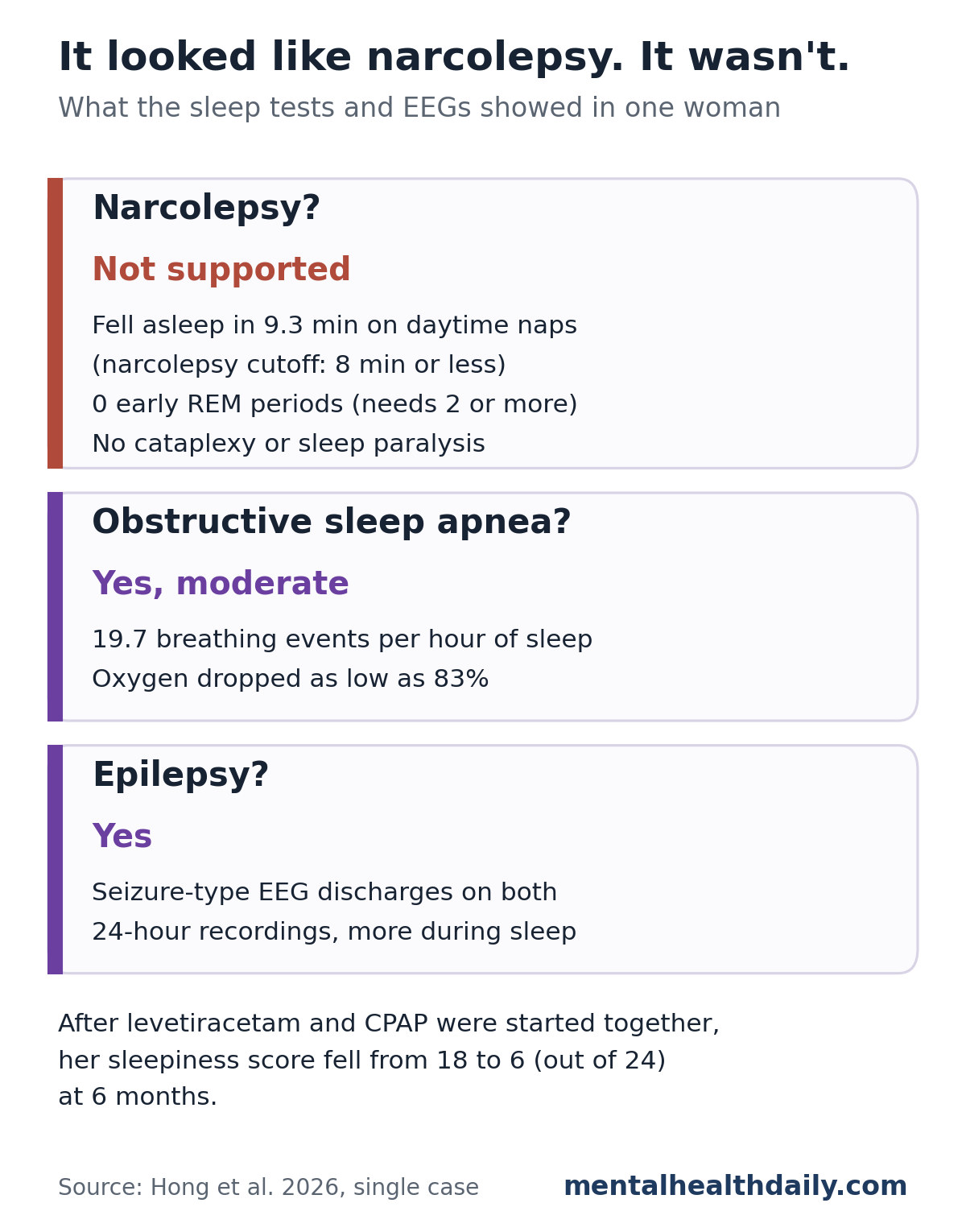
Overnight sleep study: the apnea-hypopnea index (AHI) counts breathing pauses and shallow-breathing episodes per hour of sleep. Hers was 19.7, made up of 68 obstructive apneas, 29 hypopneas, and 68 central apneas. Her oxygen dropped as low as 83%, and she spent 72.1% of the night on her back.1
Together with heavy snoring and frequent breathing-related arousals, that pattern fit moderate obstructive sleep apnea (OSA), in which the upper airway repeatedly collapses during sleep.1
MSLT: she took 9.3 minutes on average to fall asleep across 4 naps, with no SOREMPs. She also had none of the typical REM-related symptoms such as cataplexy, sleep paralysis, or vivid hallucinations while falling asleep or waking up.1
Her sleep apnea was untreated during the MSLT, so the team interpreted that test with caution. They judged narcolepsy unlikely based on the whole clinical picture rather than the nap test alone.1
EEG: both 24-hour recordings showed spike-and-slow-wave discharges, the electrical signature of seizure-prone brain tissue. They were most prominent over the frontal regions, especially on the right, and increased during sleep. A brain MRI found no structural cause.1
The final diagnoses were:1
- Epilepsy with focal to bilateral tonic-clonic seizures: seizures that start in one part of the brain and spread to cause stiffening and jerking on both sides.
- Moderate obstructive sleep apnea.
- Mild intellectual disability.
Her sleepiness was attributed mainly to broken, oxygen-poor sleep from the apnea, possibly made worse by sleep disruption from epilepsy.1
Sleep Apnea and Epilepsy Can Worsen Each Other
Hong et al. describe a two-way loop between the 2 conditions.1
- Apnea to seizures: repeated drops in oxygen, buildup of carbon dioxide, and constant arousals fragment sleep, and lost sleep is a well-known seizure trigger.
- Seizures to apnea: nighttime seizures disrupt sleep, and the drowsy period after a seizure can weaken throat muscle tone and slow the brain’s response to blocked breathing.
The pairing is common. At a Korean university sleep center, 296 of 395 people with epilepsy who had a full-night sleep study (74.9%) were diagnosed with OSA, and about two-thirds of those cases were moderate to severe.3 These were patients referred for sleep testing, so the rate across all people with epilepsy is likely lower.
Does CPAP reduce seizures? CPAP (continuous positive airway pressure) is a bedside machine that blows air through a mask to hold the airway open. Evidence that it improves seizure control is encouraging but limited:
- Korean records study: seizure frequency fell significantly only among the 24 patients who used CPAP consistently. Seizure-free and 50%-reduction rates did not differ significantly from patients who used it poorly or not at all.3
- Randomized pilot trial: in 35 adults with hard-to-control epilepsy and OSA, randomized to real or sham CPAP for 10 weeks, real CPAP lowered breathing events more than sham. Seizures dropped more with real CPAP, but the difference was not statistically significant.4
Central apneas: the sleep study also recorded 68 central apneas, pauses in which the brain briefly stops signaling the body to breathe. Seizures can disturb the brain’s breathing control, and breathing problems around seizures are studied in research on sudden unexpected death in epilepsy (SUDEP). Because no combined video-EEG and sleep study was done, the team could not tell whether her central apneas lined up with seizure activity.1
Treatment With Levetiracetam and CPAP
She started levetiracetam, an antiseizure medicine, at 500 mg twice daily, along with CPAP. She was also advised to lose weight and improve sleep habits.1
Why levetiracetam: for someone who is already very sleepy, has sleep apnea, and has cognitive limits, a heavily sedating seizure medicine could make things worse. The team chose levetiracetam because earlier studies suggest it causes relatively little sedation and has limited effects on sleep and thinking. They noted that irritability and mood changes still need monitoring.1
A 2024 meta-analysis of 16 placebo-controlled trials with 545 participants found levetiracetam was associated with better executive function than placebo, which is consistent with a low cognitive burden.7
At 6 months, based on records and family reports:1
- Nighttime episodes: none reported, with no limb jerking or blue lips.
- Snoring and breathing: much less snoring and more stable breathing, according to her family.
- Sleepiness: her Epworth Sleepiness Scale score, a 0–24 questionnaire on how easily someone dozes off, fell from 18 to 6.
- Daily life: she took part more in family activities.
Both treatments started at the same time, so the case cannot show how much each one contributed.1
Diagnostic Overshadowing in Intellectual Disability
Diagnostic overshadowing happens when clinicians blame new symptoms on a person’s existing disability and miss a separate, treatable condition. For this patient, sleepiness, slowness, and odd nighttime behavior could easily have been put down to her intellectual disability.1
The research on overshadowing is mixed. A 2024 systematic review of 25 studies on psychological disorders in people with intellectual disability found that one-third detected no overshadowing, and it rated the overall evidence as low quality.6 The bias is real in some settings but less universal than often assumed.
Sleep problems are a known gap. A 2024 review in Thorax found that sleep-disordered breathing is thought to be common in children and adults with intellectual disability, but large prevalence studies are lacking and randomized treatment trials are few.5
What caregivers can record: when the patient cannot describe their own symptoms, family observations carry the diagnosis. Hong et al. recommend noting:1
- Whether sleepiness or behavior is new or worse than the person’s usual baseline.
- Breathing changes, snoring, pauses, or blue lips during sleep.
- Repeated, same-pattern limb movements and how long an episode lasts.
- Confusion, wandering, or memory loss afterward.
- A phone video of an episode, if one can be taken safely.
Limits of This Single Case
This is one patient, described retrospectively. It illustrates a diagnostic trap but cannot estimate how often it happens or prove that treatment worked.1
- Combined treatment: levetiracetam and CPAP began together.
- Short follow-up for rare events: she had 2 episodes over more than 3 years, so 6 months without one is encouraging but not strong evidence that seizures are controlled.
- No objective follow-up: she moved out of the province, so there was no repeat sleep study, follow-up EEG, or CPAP usage data.
- No captured episode: no event was recorded on video-EEG, and the sleep study lacked full EEG coverage for seizures.
- MSLT with untreated apnea: the nap test was done before CPAP, which can affect its results.
When Sleepiness Plus Nighttime Episodes Should Prompt Testing
Hong et al. propose a stepwise workup for anyone with daytime sleepiness and unexplained nighttime events, especially people who cannot report their own symptoms:1
- Overnight sleep study for snoring, witnessed pauses, obesity, or low oxygen at night.
- MSLT only if narcolepsy is still suspected, after sleep apnea, short sleep, and medication effects are dealt with.
- EEG (sleep, ambulatory, or video-EEG) for unresponsive episodes, repeated movements, or memory loss afterward.
- Combined video-EEG and sleep study when it remains unclear whether events are breathing-related or seizures.
Their summary: daytime sleepiness is not the same as narcolepsy, and snoring does not rule out epilepsy. When both sleep apnea and epilepsy are present, treating both together makes sense.1
References
- Hong S, Yang L, Ren L, Chen H, Zheng Y, Liu W. Narcolepsy-like presentations in intellectual disability with comorbid epilepsy and obstructive sleep apnea: a case-based diagnostic analysis and literature-informed discussion. Frontiers in Psychiatry. 2026;17:1919011. doi:10.3389/fpsyt.2026.1919011
- Krahn LE, Arand DL, Avidan AY, et al. Recommended protocols for the multiple sleep latency test and maintenance of wakefulness test in adults: guidance from the American Academy of Sleep Medicine. Journal of Clinical Sleep Medicine. 2021;17(12):2489–2498. doi:10.5664/jcsm.9620
- Jo H, Choi S, Kim D, Joo E. Effects of obstructive sleep apnea on epilepsy, and continuous positive airway pressure as a treatment option. Journal of Clinical Medicine. 2022;11(7):2063. doi:10.3390/jcm11072063
- Malow BA, Foldvary-Schaefer N, Vaughn BV, et al. Treating obstructive sleep apnea in adults with epilepsy: a randomized pilot trial. Neurology. 2008;71(8):572–577. doi:10.1212/01.wnl.0000323927.13250.54
- Riha RL, Singh A, Hill EA, Evans H, O’Regan D. Sleep-disordered breathing in children and adults with intellectual disability: mind the gap! Thorax. 2024;79(11):1099–1107. doi:10.1136/thorax-2023-220032
- Dell’Armo K, Tassé MJ. Diagnostic overshadowing of psychological disorders in people with intellectual disability: a systematic review. American Journal on Intellectual and Developmental Disabilities. 2024;129(2):116–134. doi:10.1352/1944-7558-129.2.116
- Lin CY, Chang MC, Jhou HJ. Effect of levetiracetam on cognition: a systematic review and meta-analysis of double-blind randomized placebo-controlled trials. CNS Drugs. 2024;38(1):1–14. doi:10.1007/s40263-023-01058-9