hit counter

Neck-to-Height Ratio Screens Pediatric Sleep Apnea Better Than BMI

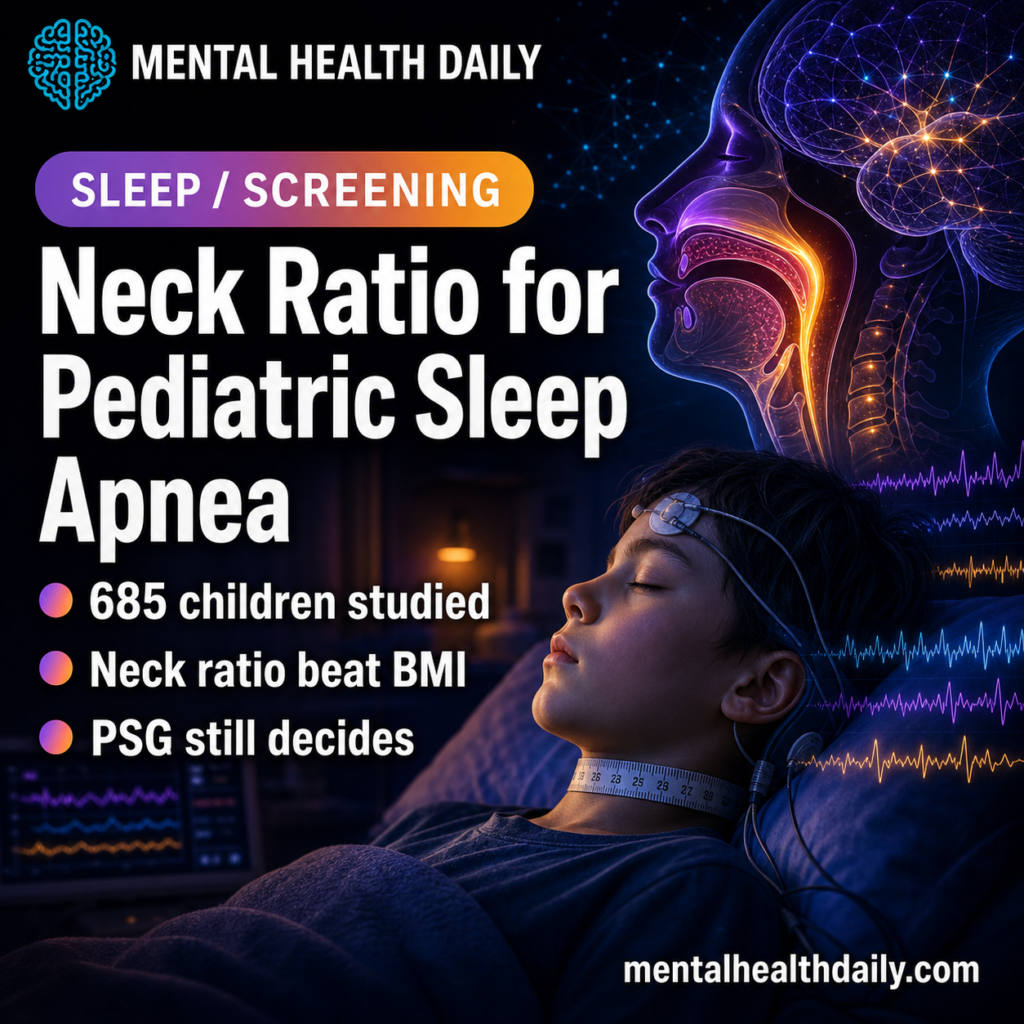
Editorial medical card showing pediatric sleep apnea screening with neck measurement, PSG waveforms, and airway anatomy.

A 2026 polysomnography study involving 685 children found that neck-to-height ratio identified moderate/severe pediatric obstructive sleep apnea better than BMI Z-score, waist-to-height ratio, or hip-to-height ratio. The signal was useful but not diagnostic: neck-to-height ratio reached AUC 0.781 overall, which is strong enough for triage but not strong enough to replace a sleep study.1 Research …

Read more

Smoking Linked to 1.75x Higher Sleep Apnea Severity in Pomerania Study

MHD featured image for smoking history and obstructive sleep apnea severity in a population polysomnography study.

A 2026 population-based polysomnography study involving 1,206 adults found current smokers had 1.75x higher odds of worse obstructive sleep apnea severity than non-smokers or occasional smokers after adjustment for age and body mass index. Former smokers showed almost the same overall signal — 1.76x higher odds than never smokers — but that part of the …

Read more

CPAP Mask Leak Reduced PAP Adherence 7.2% per 10 L/min

MHD featured image for CPAP mask leak, Real Leak, and PAP adherence in obstructive sleep apnea.

A 2026 secondary analysis of the HomePAP trial found that each 10 L/min more unintentional CPAP mask leak was associated with 26.6 fewer PAP minutes per night and 7.2 percentage-point fewer adherent days, but the new Real Leak metric did not significantly outperform ordinary device-reported Average Leak.1 Research Highlights Real Leak tracked poorer adherence: each …

Read more

Genetics of Major Depression Linked to Increased Risk of Obstructive Sleep Apnea (OSA) (2024 Study)

In a new study leveraging Mendelian Randomization, researchers highlight the complex interplay between psychiatric disorders, specifically major depressive disorder (MDD), and obstructive sleep apnea (OSA). This meticulous investigation sheds light on the genetic predispositions that suggest a causal relationship between MDD and increased risk of developing OSA, offering new insights into the bidirectional interconnections of …

Read more