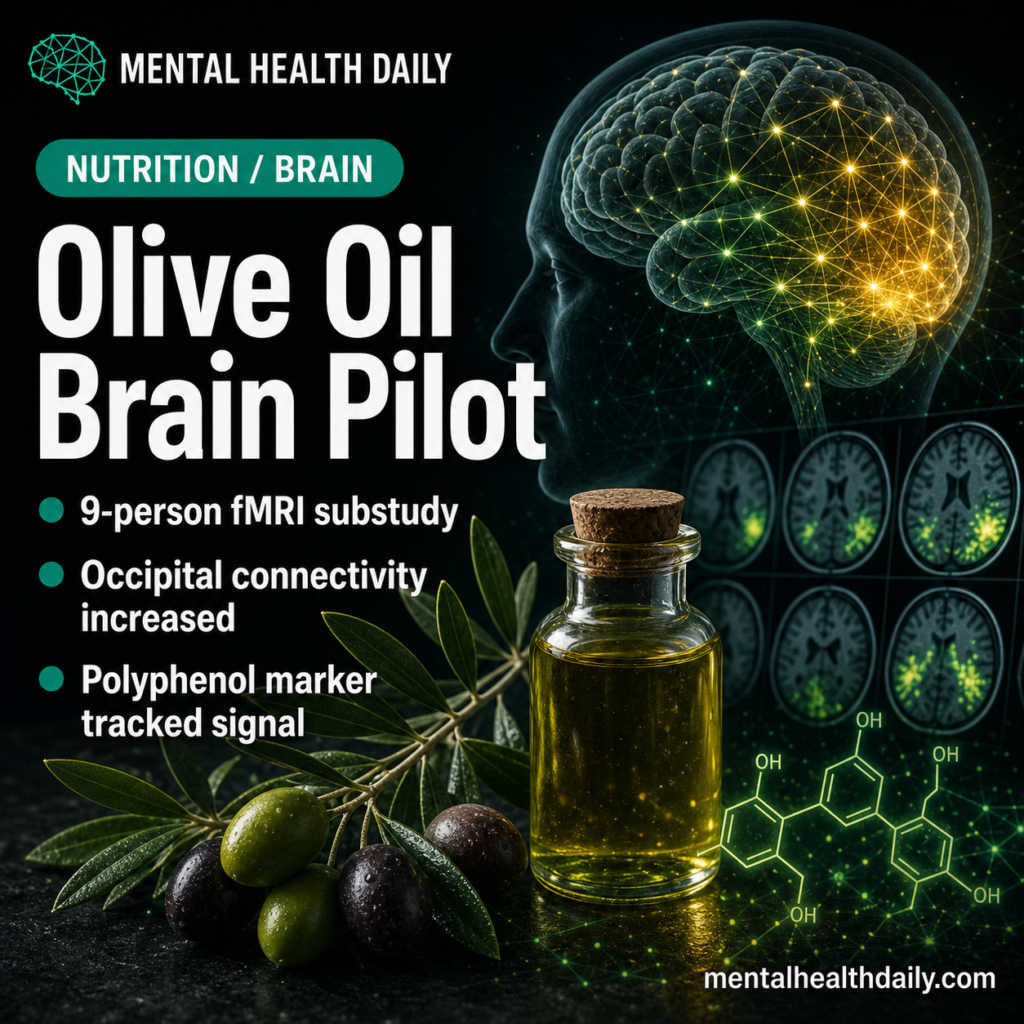
A 9-person randomized crossover neuroimaging substudy found that high-polyphenol extra-virgin olive oil increased occipital resting-state functional connectivity compared with regular olive oil, beta = 0.20, 95% CI 0.03 to 0.37, p = 0.016.1 The result is a measurable brain-signal finding, but the clinical claim stays small: connectivity changed, cognition was not the endpoint.
Research Highlights
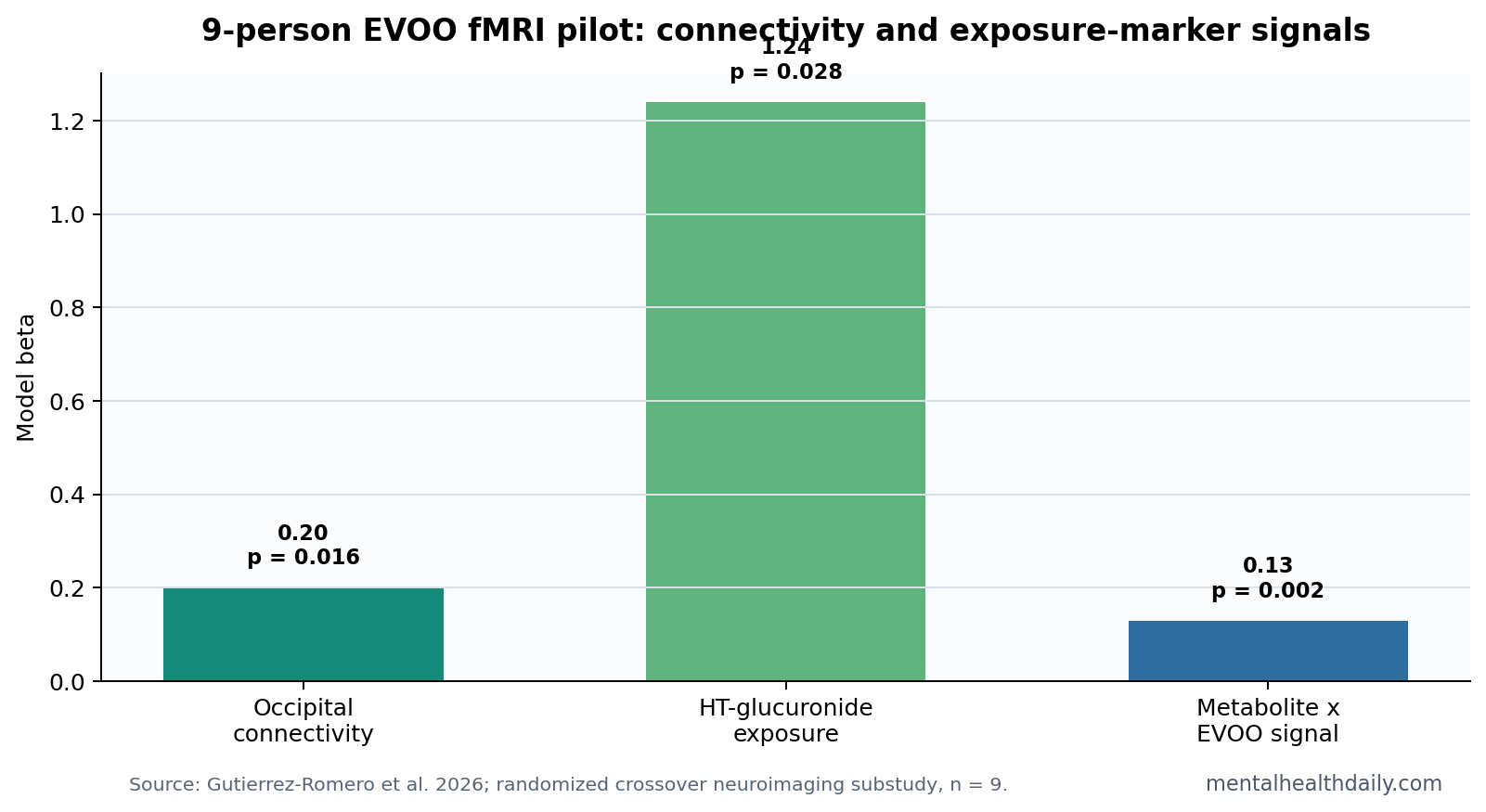
- Connectivity increased: Extra-virgin olive oil raised occipital connectivity vs. regular olive oil, beta = 0.20, 95% CI 0.03 to 0.37, p = 0.016.1
- The fMRI sample was tiny: The neuroimaging substudy included 9 healthy adults drawn from a 28-person randomized crossover trial.1
- Polyphenol exposure was measurable: Urinary HT-glucuronide increased after EVOO, beta = 1.24, 95% CI 0.13 to 2.35, p = 0.028.1
- Metabolite signal tracked brain signal: The intervention-by-HT-glucuronide interaction was beta = 0.13, p = 0.002, linking exposure biology to occipital activation.1
- Cognition was not tested: A 2026 fMRI pilot cannot show dementia prevention, memory improvement, or durable brain protection.
Extra-virgin olive oil (EVOO) is olive oil produced mechanically without chemical refining. Its brain-health interest comes partly from unsaturated fats and partly from phenolic compounds such as hydroxytyrosol, which can generate measurable urinary metabolites after intake.
Resting-state fMRI measures slow, spontaneous blood-oxygen-level signals while a person is not performing a task. Functional connectivity means that activity in different brain areas fluctuates together. It is useful for mechanism studies, but it is not the same thing as better memory or lower dementia risk.
9 fMRI Participants Drove the Brain-Connectivity Result
Gutierrez-Romero et al. nested the imaging work inside the HEVOOC randomized crossover trial. The parent trial enrolled 28 participants, while the neuroimaging substudy analyzed 9 people who completed the scanning protocol.1
Each participant consumed a high-polyphenol EVOO phase and a lower-polyphenol regular olive oil phase. Crossover design helps because each person serves as their own comparison, reducing between-person noise. It does not remove the basic limitation that 9 scanned participants leave very little protection against chance, unmeasured behavior, or scanner-specific quirks.
The exposure contrast was more specific than a usual “olive oil vs. no olive oil” diet study:
- Dose and duration: participants consumed 0.7 g per kg body weight per day of the assigned oil for 4 weeks.
- Washout: the 2 intervention phases were separated by a 4-week washout period, reducing carryover from the first oil phase into the second.
- Polyphenol contrast: the EVOO contained 227.7 mg kg−1 total polyphenols, while the regular olive oil contained 12.3 mg kg−1.1
- Scanned sample: the 9 imaging participants were healthy young adults; the median age was 31 years, and the sample included 5 men and 4 women.1
That design makes the mechanistic question cleaner. The trial was not testing whether people should add calories from oil to an otherwise unchanged diet. It was testing whether a high-phenolic olive-oil condition produced a different short-term brain signal than a much lower-phenolic olive-oil condition under a within-person comparison.
Primary imaging signal: EVOO increased occipital connectivity in the fully adjusted model, beta = 0.20, 95% CI 0.03 to 0.37, p = 0.016, with Cohen’s d = 1.46.1 The effect size looks large, but in a 9-person pilot, large effects can shrink sharply in replication.
Hydroxytyrosol Metabolism Linked Intake to Brain Signal
Hydroxytyrosol is a phenolic compound associated with olive oil. After digestion and metabolism, researchers often measure conjugated forms such as HT-glucuronide in urine as exposure biomarkers.
The study found that urinary log-transformed HT-glucuronide increased after EVOO intake, beta = 1.24, 95% CI 0.13 to 2.35, p = 0.028.1 More important, the interaction between intervention and HT-glucuronide on occipital activation was significant: beta = 0.13, 95% CI 0.05 to 0.21, p = 0.002.
That interaction makes the finding more biologically coherent. A plain between-oil difference could reflect many things. A brain signal that varies with a urinary EVOO metabolite gives the mechanism a stronger anchor, while still remaining a surrogate endpoint.
Occipital Connectivity Is Not a Memory Outcome
The occipital cortex is heavily involved in visual processing. A change in occipital resting-state connectivity may reflect altered neural communication, vascular response, metabolic state, or measurement noise. It does not automatically translate into sharper thinking.
- Supported: high-polyphenol EVOO changed a resting-state fMRI signal in this small crossover substudy.
- Supported: urinary HT-glucuronide increased and statistically interacted with the brain signal.
- Not supported: EVOO improved cognition, prevented dementia, or changed long-term brain aging in these 9 participants.
Older Mediterranean-diet trials make the nutrition question worth asking. PREDIMED-related cognitive analyses suggested that Mediterranean diet supplemented with extra-virgin olive oil or nuts could improve cognitive outcomes in older adults at vascular risk.2 Those studies are clinically closer to cognition, but less direct about acute brain connectivity.
Nutrition Neuroimaging Needs Larger Replication
Evidence-strength note: this was a pilot neuroimaging substudy. It can support a mechanistic hypothesis that EVOO polyphenol exposure affects brain connectivity. It cannot support a supplement-style claim that olive oil treats depression, prevents Alzheimer’s disease, or improves cognition in healthy adults.
The next useful study would enlarge the fMRI sample and connect exposure biomarkers, brain connectivity, vascular markers, and cognitive endpoints in the same protocol, ideally over enough time for nutrition biology to plausibly matter.
Diet advice should stay ordinary: extra-virgin olive oil can be a reasonable part of a Mediterranean-style diet. The brain-connectivity pilot makes that diet pattern more mechanistically interesting, not clinically proven as a brain intervention.
The Control Oil Narrowed the Polyphenol Question
Nutrition studies often compare a food against no intervention, which makes interpretation messy. People who add a healthy food may also change calories, expectations, routines, or other diet components. Comparing high-polyphenol EVOO against lower-polyphenol regular olive oil narrows the question.
Polyphenol contrast: the design did not ask whether any olive oil is better than none. It asked whether the extra phenolic load in EVOO produced a different brain signal than a lower-polyphenol olive oil condition.
That control choice strengthens the mechanism but weakens any dramatic consumer claim. If both arms involve olive oil, the result cannot be used to argue that olive oil as a whole is uniquely responsible. The signal points more specifically toward polyphenol exposure and metabolite-linked brain activity.
HT-glucuronide is useful here because it gives the paper a measurable exposure trail. A trial that only says participants consumed EVOO leaves open whether the active compounds actually increased. A trial that shows urinary HT-glucuronide rising after EVOO gives the brain finding a more concrete biological anchor.
The imaging pipeline also matters for how much weight to put on the result. The researchers used a 3T Siemens PRISMA scanner, collected structural MRI plus resting-state fMRI, and analyzed network patterns with independent component analysis. Motion correction and outlier detection were built into preprocessing, and the group-level imaging comparison used threshold-free cluster enhancement at p < 0.005.1
Those steps make the signal more credible than an uncorrected exploratory scan, but they do not solve the sample-size problem. With 9 scanned participants, a single unusual responder, scanner-state difference, sleep pattern, or unmeasured dietary behavior can still move the estimate. The methods are careful enough to justify replication; they are not large enough to make the effect clinically settled.
What a Larger Olive-Oil Brain Trial Should Measure
The next study should repeat the scan in more people while connecting the fMRI signal to endpoints a reader cares about: memory, attention, processing speed, mood, vascular function, inflammatory markers, and adherence.
- Exposure: urinary phenolic metabolites should confirm who actually absorbed EVOO-derived compounds.
- Brain signal: resting-state connectivity should be pre-specified, with occipital regions tested directly.
- Cognition: memory and executive-function tasks should determine whether connectivity changes mean anything behaviorally.
- Time course: repeated measurements should separate acute metabolic response from durable adaptation.
A larger trial should also include older adults or vascular-risk participants if the goal is cognitive aging. Healthy young adults are useful for clean physiology, but they are a weak test bed for dementia-prevention claims because they start far from the clinical endpoint.
How to Read the Occipital Signal Without Overclaiming
The occipital result is easiest to overread because it sounds concrete: a brain region changed after EVOO. But occipital connectivity can reflect visual-network physiology, vascular response, scanner-state variation, or short-term metabolic effects. It does not point directly to memory circuits.
Appropriate interpretation: EVOO polyphenol exposure produced a measurable resting-state fMRI difference in a visual-network region. That is enough to justify replication and mechanistic follow-up.
Inappropriate interpretation: the result proves that EVOO improves cognition. The substudy did not test memory performance, dementia incidence, depression symptoms, or long-term cognitive aging.
The key boundary is the difference between a biomarker signal and a patient-important outcome. Nutrition neuroscience needs both, but they are not interchangeable.
The strongest reader-facing conclusion is therefore narrow: choose EVOO for ordinary dietary reasons, not because a 9-person fMRI substudy proved brain enhancement or cognitive protection. Replication should decide whether the occipital signal is stable.
Questions About Extra-Virgin Olive Oil and Brain Connectivity
Did the study show that olive oil improved memory?
No. The endpoint was resting-state brain connectivity, not memory, attention, mood, or dementia risk.
Why compare EVOO with regular olive oil?
The comparison helps isolate the polyphenol-rich part of extra-virgin olive oil from olive oil fat intake more generally. Both arms used olive oil, but the phenolic content differed.
Should this change diet advice?
Not by itself. It supports studying high-polyphenol EVOO within broader Mediterranean-diet research, but a 9-person fMRI result is not a treatment recommendation.
References
- Gutierrez-Romero R, et al. Resting-state brain connectivity following extra virgin olive oil intake in healthy adults: a randomized crossover pilot neuroimaging substudy. Food & Function. 2026. doi:10.1039/d5fo05016b
- Valls-Pedret C, et al. Mediterranean diet and age-related cognitive decline: a randomized clinical trial. JAMA Internal Medicine. 2015. doi:10.1001/jamainternmed.2015.1668
- Martinez-Lapiscina EH, et al. Mediterranean diet improves cognition: the PREDIMED-NAVARRA randomized trial. Journal of Neurology, Neurosurgery & Psychiatry. 2013. doi:10.1136/jnnp-2012-304792
- Estruch R, et al. Primary prevention of cardiovascular disease with a Mediterranean diet supplemented with extra-virgin olive oil or nuts. New England Journal of Medicine. 2018. doi:10.1056/nejmoa1800389