A matched case-control study of 50 children with autism spectrum disorder and 50 controls found that newborn amino acid metabolism overlapped with both later autism diagnosis and prenatal air-pollution exposure.1 The central pathway, aspartate and asparagine metabolism, was associated with autism (p = 0.01), pregnancy PM2.5 (p < 0.001), first-trimester PM2.5 (p < 0.001), and non-freeway traffic NOx (p = 0.003).
Research Highlights
- The study was small but biologically specific: researchers compared newborn dried-blood-spot metabolomics in 50 ASD cases and 50 matched controls.1
- Amino acid metabolism carried the strongest shared signal: aspartate and asparagine metabolism was linked with ASD (p = 0.01) and prenatal PM2.5 exposure (p < 0.001).1
- Traffic exposure pointed to the same pathway: non-freeway NOx was associated with aspartate and asparagine metabolism (p = 0.003).1
- The pollutant levels were not trivial: mean pregnancy PM2.5 was 14.03 micrograms per cubic meter, and first-trimester PM2.5 averaged 14.51 micrograms per cubic meter.1
- Prediction is not ready: the metabolome-wide screen retained 54,192 features, but no single feature survived false-discovery-rate correction.1
Autism spectrum disorder is a neurodevelopmental condition involving social-communication differences, restricted interests, repetitive behavior, and sensory features. Metabolomics measures small molecules in biological samples; here, the sample was a newborn dried blood spot collected years before ASD diagnosis.
The study is best read as a mechanism probe. It does not diagnose autism at birth, and it does not prove that one pollutant caused one child’s autism. It asks whether prenatal exposure signals and later ASD diagnosis converge on metabolic pathways present in newborn blood.
100 Newborn Blood Spots Linked ASD and Air-Pollution Pathways
Kang et al. used Kaiser Permanente Southern California birth records from 2007-2009. The researchers selected 50 children later diagnosed with ASD before age 5 and 50 controls matched on birth year, sex, race/ethnicity, and medical center.1
Dried blood spot metabolomics used liquid chromatography-mass spectrometry, a laboratory method that separates molecules and then estimates their mass-to-charge patterns. After filtering, the analysis retained 54,192 metabolomic features across 2 chromatography platforms.
Exposure modeling: PM2.5 means fine particulate matter smaller than 2.5 micrometers, and NOx means nitrogen oxides linked partly to traffic combustion. Mean pregnancy PM2.5 exposure was 14.03 micrograms per cubic meter; first-trimester PM2.5 averaged 14.51; non-freeway NOx averaged 2.07 ppb.1
The researchers used residential histories and high-resolution spatial exposure models rather than asking parents to remember exposure years later. That does not make the exposure estimates perfect, but it is stronger than self-report for a pregnancy-era environmental question. The design also matched cases and controls on birth year, sex, race/ethnicity, and medical center, then adjusted for maternal age, education, income, and hemoglobin level.
Hemoglobin adjustment was included because dried blood spots can vary in blood volume. In metabolomics, that matters: a feature may look higher or lower because the sample contains more or less blood, not because the underlying biology differs. Adjusting for hemoglobin helped reduce that technical artifact.
Aspartate and Asparagine Metabolism Was the Main Shared Signal
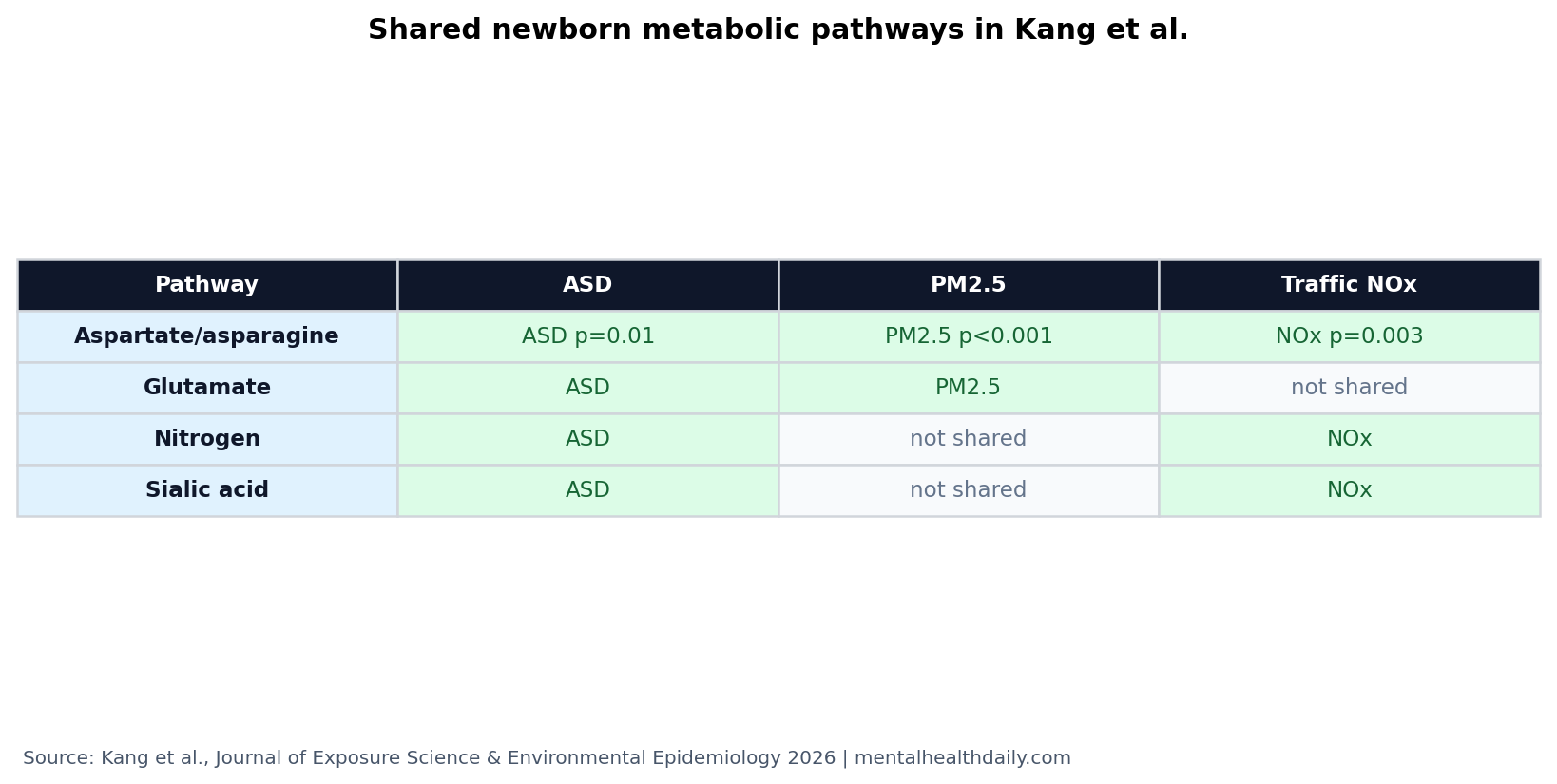
Aspartate and asparagine metabolism refers to pathways handling 2 amino acids involved in nitrogen balance, neurotransmitter-related chemistry, and cellular stress responses. This pathway was associated with ASD at p = 0.01 and with PM2.5 during the whole pregnancy and first trimester at p < 0.001. It was also associated with non-freeway NOx at p = 0.003.1
Specific metabolites implicated in overlapping pathways included L-asparagine, succinate semialdehyde, GABA (4-aminobutanoate), and L-glutamine. GABA is the brain’s main inhibitory neurotransmitter, while glutamine helps shuttle nitrogen and supports neurotransmitter cycling.
Glutamate metabolism overlapped with ASD and PM2.5 exposure, while nitrogen and sialic acid metabolism overlapped with ASD and non-freeway NOx. Sialic acid metabolism involves sugar-like molecules attached to cell surfaces, including developing nervous-system tissue.
Why amino acids are plausible: early brain development depends on excitatory and inhibitory signaling, mitochondrial metabolism, immune signaling, and antioxidant capacity. Aspartate, glutamate, GABA, glutamine, and related nitrogen pathways sit close to those systems. A newborn metabolic signature in these pathways therefore fits a biologically plausible bridge between environmental exposure and neurodevelopmental vulnerability.
Pathway convergence: a single metabolite hit can be noisy in a 100-child screen. Multiple related pathways pointing toward amino acid handling, oxidative stress, and inflammation is still preliminary, but it is more coherent than one isolated peak in a mass-spectrometry plot.
Prior Autism-Air Pollution Evidence Was Epidemiologic
Several earlier studies asked whether prenatal or early-life air pollution exposure is associated with ASD risk. Chun et al. meta-analyzed maternal air pollution exposure studies and reported pollutant-ASD associations across the observational literature.2 Lam et al. similarly reviewed airborne pollutants and ASD in a systematic review and meta-analysis.3
Raz et al. used a nested case-control analysis within the Nurses’ Health Study II cohort and examined particulate matter exposure before, during, and after pregnancy.4 Those studies provided timing and exposure clues, but they did not show what was biologically different in newborns.
Kang et al. therefore adds a different layer: newborn molecular pathways. It moves the question from “is exposure associated with ASD?” toward “which neonatal metabolic systems might sit between prenatal exposure and neurodevelopment?”
That layer is especially useful because ASD diagnosis occurs years after the prenatal exposure window. By the time a child is diagnosed, diet, sleep, medication, therapy access, infections, stress, and development itself can all reshape biology. Newborn blood spots are imperfect, but they move the measurement closer to the exposure period.
Oxidative Stress Is Plausible, But Not Proved as the Cause
Oxidative stress means cellular imbalance between reactive molecules and antioxidant defenses. The pathways highlighted here, especially amino acid, glutamate, nitrogen, and sialic acid metabolism, fit a plausible oxidative-stress and inflammation framework.1
The caution is statistical. No individual metabolomic feature survived false-discovery-rate correction, a method used to reduce false positives when thousands of features are tested. The pathway-level findings are more coherent than a single biomarker claim, but the pilot study should not be oversold as a screening test.
Evidence-strength note: this was a small matched case-control study. It can support biological plausibility and candidate pathway generation. It cannot establish causality, identify a diagnostic newborn marker, or determine whether reducing one pollutant during one trimester would change a child’s outcome.
Public-health read: the paper supports cleaner prenatal air as a reasonable population goal without turning metabolomics into a blame tool. ASD is highly heterogeneous, with genetic, developmental, and environmental contributors. A pollution-linked metabolic pathway can be one contributor in some pregnancies without explaining autism as a whole.
Replication target: larger birth cohorts should measure prenatal pollution, newborn metabolomics, genetics, maternal health, and developmental follow-up together. Replication should also test whether the same amino acid pathways appear in different regions with different pollution mixtures, because PM2.5 and traffic NOx are proxies for complex chemical exposures rather than single molecules.
Measurement caveat: pathway enrichment depends on imperfect metabolite annotation. Untargeted metabolomics detects features first and names molecules later, often with uncertainty. A pathway can look enriched because several related features point in the same direction, but targeted assays are needed to quantify specific metabolites such as L-asparagine, GABA, succinate semialdehyde, or L-glutamine with stronger chemical certainty.
Signal vs. certainty: independent exposure and diagnosis analyses converged on a plausible amino acid metabolism cluster. A larger replication could turn that cluster into a stronger mechanism, especially if it also measures inflammation markers, placental function, maternal nutrition, and genetic liability.
Clinical translation should also be staged. First comes replication of the pathway pattern; then targeted metabolite measurement; then testing whether those metabolites mediate exposure-risk associations; only after that would newborn prediction or intervention studies make sense.
That sequence matters because pathway overlap is not the same thing as individual-level prediction. A 100-child study can show that ASD status, pregnancy PM2.5, first-trimester PM2.5, and non-freeway NOx touched related metabolic systems.
It cannot tell parents that one exposure caused one diagnosis, or clinicians that one newborn metabolite profile should change care. The most defensible use is to sharpen the next cohort study: measure exposure more precisely, quantify named metabolites directly, and test whether the same amino acid signal survives adjustment for maternal, genetic, and neighborhood factors.
Questions About Prenatal Air Pollution and Autism Metabolism
Does this study prove air pollution causes autism?
No. It links prenatal exposure estimates, newborn metabolic pathways, and later ASD diagnosis in a 100-child matched design. That supports a possible biological pathway, not proof of causation for individual children.
What did the newborn blood spots add?
They gave the researchers a biological snapshot near birth, before ASD diagnosis. That helps separate early-life pathway signals from changes that appear after years of development, treatment, diet, or behavior.
What should readers take from the PM2.5 and NOx findings?
Pollution reduction remains a public-health target, especially during pregnancy, but this paper should be treated as mechanism-building evidence rather than a clinical test.
Does the metabolic signal point to one autism pathway?
No. The strongest overlap involved amino acid metabolism, but ASD is biologically heterogeneous. The study narrows a candidate pathway for replication; it does not reduce autism to one pollutant, one metabolite, or one pregnancy mechanism.
References
- Kang N, Yang Z, Petrick LM, et al. Newborn metabolomics linking prenatal air pollution exposure and autism spectrum disorder risk in children. Journal of Exposure Science & Environmental Epidemiology. 2026. doi:10.1038/s41370-026-00897-0
- Chun H, Leung C, Wen SW, McDonald J, Shin HH. Maternal exposure to air pollution and risk of autism in children: a systematic review and meta-analysis. Environmental Pollution. 2020. doi:10.1016/j.envpol.2019.113307
- Lam J, Sutton P, Kalkbrenner A, et al. A systematic review and meta-analysis of multiple airborne pollutants and autism spectrum disorder. PLOS ONE. 2016. doi:10.1371/journal.pone.0161851
- Raz R, Roberts AL, Lyall K, et al. Autism spectrum disorder and particulate matter air pollution before, during, and after pregnancy. Environmental Health Perspectives. 2015. doi:10.1289/ehp.1408133