Sexual fantasies are not distributed randomly, but the pattern is subtler than popular personality stereotypes imply. In 5,225 adults, conscientiousness and agreeableness tracked lower fantasy frequency, while negative emotionality—especially the depression facet—tracked higher fantasy frequency across multiple fantasy domains.1
Research Highlights
- 5,225-person sample: Cannoot et al. analyzed adults with mean age 58.30 years; 56.5% were men, making this less of a college-student sexuality sample than many older papers.1
- Conscientiousness and agreeableness down: higher scores on those traits were associated with fewer exploratory, intimate, impersonal, and sadomasochistic fantasies.1
- Depression facet up: the depression facet of negative emotionality showed the largest positive links with fantasy frequency, including a total bivariate correlation around r = 0.384.1
- Open-mindedness mostly flat: despite the intuitive idea that open people fantasize more, open-mindedness was mostly unrelated after accounting for covariation with other traits, age, and gender.1
- Clinical interpretation starts with normalization: Sexual fantasies are common. Personality can help explain variation, but these correlations do not make fantasy frequency a pathology marker by itself.2,3
The paper does not give a horoscope for sexual fantasy. Most effects are modest, and the researchers were clear that many statistically significant correlations were small because the sample was large enough to detect tiny effects. Its value is moving the topic away from embarrassment and toward individual differences.
Sexual fantasy sits at the intersection of imagination, desire, inhibition, mood, shame, relationship context, and personality. That makes it easy to over-pathologize. It also makes it easy to flatten into “everyone does it, nothing to see here.” The better read is that fantasies are common, heterogeneous, and psychologically patterned without being inherently clinical.
5,225 Adults, 4 Fantasy Domains, and 15 Personality Facets
The study by Cannoot, Moors, and Chopik analyzed associations between Big Five traits, Big Five facets, and sexual fantasy frequency. The sample included 5,225 adults, mean age 58.30 years, with 56.5% men.1
The design is easiest to read as a study snapshot:
- Personality model: Big Five traits—extraversion, agreeableness, conscientiousness, negative emotionality, and open-mindedness—plus 15 lower-level facets.
- Fantasy domains: exploratory, intimate, impersonal, and sadomasochistic fantasies, plus composite frequency.
- Analytic approach: bivariate correlations first, then regressions controlling for other traits, age, and gender; partial correlations were extracted from those models.
- Power: with N = 5,225, the study could detect correlations as small as r = 0.039 with 80% power, so magnitude mattered more than mere statistical significance.1
A very large sample turns small effects into significant p-values. The interpretation should therefore focus less on whether a correlation passed P < 0.05 and more on which patterns were consistent, interpretable, and not washed away when traits were modeled together.
The age profile also changes the interpretation. A mean age above 58 makes this less of a college-student sexuality paper and more of an adult individual-differences paper. That does not make it representative of all adults, but it does reduce the usual overreliance on young convenience samples.
Conscientiousness and Agreeableness Pointed Downward
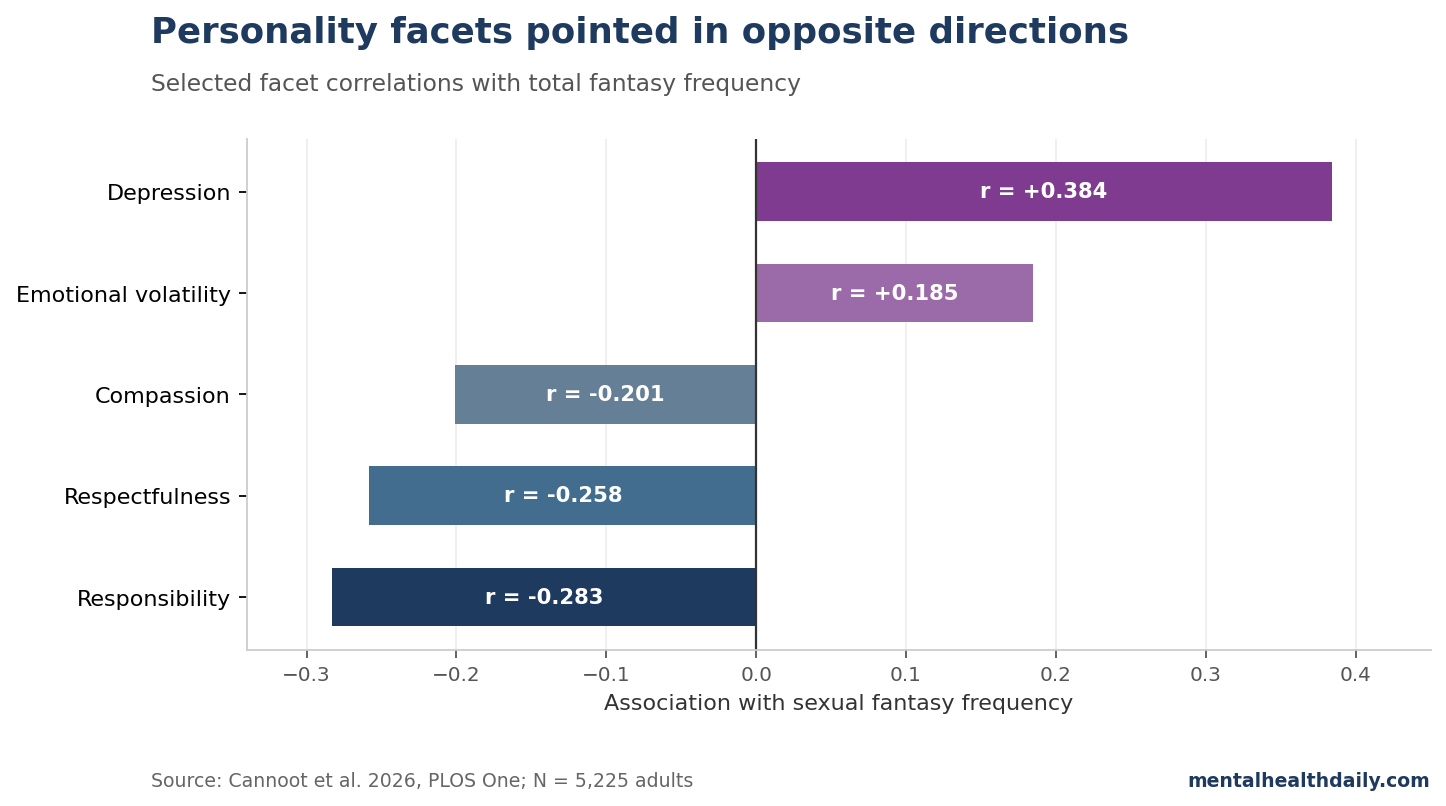
The most consistent broad trait was conscientiousness. People higher in conscientiousness reported fewer fantasies across all 4 fantasy domains. Agreeableness was the next most consistent downward predictor. The abstract highlights responsibility and respectfulness as the main facet-level contributors: more responsibility and respectfulness, fewer reported fantasies.1
That pattern is not mysterious if the terms are translated. Conscientiousness is about order, self-control, responsibility, and rule-governed behavior. Agreeableness includes compassion, respectfulness, trust, and interpersonal cooperation. A person high in those traits may inhibit, avoid, or simply report fewer fantasies, particularly domains that feel norm-violating or internally inconsistent with their self-concept.
The key word is “report.” Fantasy studies always mix private experience with willingness to disclose. A lower score can mean fewer fantasies, less attention to fantasies, less endorsement of fantasy items, stronger inhibition, or more reluctance to label a thought as erotic. The study measures self-reported frequency, not a direct readout of mental imagery.
Depression Facet Was the Strongest Positive Signal
The strongest positive pattern came from negative emotionality, especially its depression facet. Depression showed the largest positive bivariate correlations with total fantasy frequency and with each fantasy domain. The total fantasy association was around r = 0.384, and the partial correlation after covariate adjustment remained positive at around rp = 0.276.1
Plain English: people with more depressive personality features reported more frequent sexual fantasies. That should not be over-read as “depression causes fantasies” or “fantasies are depressive.” The study is cross-sectional, and the depression facet is a personality facet, not a clinical diagnosis of major depressive disorder.
Possible mechanisms: fantasizing may function as escape, compensatory imagery, emotion regulation, longing for closeness, stimulation during low mood, or higher internal mental activity in people prone to negative affect.
The paper does not separate those pathways. It shows a robust association that deserves interpretation without moralizing.
Open-Mindedness Was Not the Fantasy Engine
The surprising negative space in the paper is open-mindedness. It would be easy to predict that people higher in openness would report more sexual fantasies because openness is linked to imagination, curiosity, aesthetic sensitivity, and tolerance for unconventional experience. But open-mindedness was mostly unrelated to fantasy frequency once other traits, age, and gender were controlled.1
The data push against the intuitive literary version of the result: imaginative people fantasize more. The strongest pattern instead pointed to self-regulation and negative emotionality. Fantasy frequency may be less about creativity than about inhibition, emotional tone, and how strongly sexual thoughts enter attention.
Lehmiller and Gormezano’s contemporary review makes the broader point: fantasy research is diverse, and fantasy content is shaped by many factors, including gender, orientation, relationship context, novelty, taboo, and individual psychology.3 Personality is one layer, not the master key.
Sexual Fantasies Are Common, Not Automatically Clinical
Leitenberg and Henning’s classic review argued decades ago that sexual fantasy is common and heterogeneous rather than rare or inherently pathological.2 More recent work in older adults also shows that sexual thoughts, intimacy, and sexual activity remain part of psychological life later in adulthood rather than disappearing after youth.4
The Cannoot paper fits that normalization frame. It does not say fantasies are symptoms. It says that people differ in frequency and domain, and those differences correlate with personality traits. The clinical use is not to label fantasies as healthy or unhealthy from content alone; it is to ask how the fantasies function for the person.
A useful clinical distinction: fantasy content can be ego-syntonic, distressing, compulsive, shame-laden, relationship-enhancing, relationship-avoidant, trauma-linked, or simply private entertainment. Frequency alone does not tell you which one it is.
How to Interpret Personality and Sexual Fantasy Clinically
For psychoeducation: start with normalization. Sexual fantasies are common across adulthood. Their presence does not automatically imply dissatisfaction, deviance, trauma, or risk.
For assessment: ask about distress, control, consent, impairment, and meaning. A fantasy that is frequent but not distressing is different from one that feels intrusive, unwanted, compulsive, or tied to shame.
For mood: depressive personality features may travel with more frequent fantasy, but the direction is unresolved. A clinician should avoid turning the association into a causal story without more context.
For couples: fantasy can support desire and intimacy, but disclosure is not universally required. The relevant question is whether secrecy, shame, mismatch, or coercion is harming the relationship, not whether fantasies exist.
For interpretation: the study is strongest as a map of correlates, not a guide to judging any one person’s fantasy life. Cross-sectional personality data cannot tell whether mood, inhibition, relationship context, sexual satisfaction, medication, age, or social desirability came first.
The useful move is pattern recognition: low conscientiousness, low agreeableness, and depressive affect may mark people for whom fantasy frequency has a different emotional or regulatory role than it does for someone whose fantasies are occasional and non-distressing.
Personality appears to shape the texture of sexual imagination without turning fantasy frequency into a diagnostic shortcut.
Questions About Personality and Sexual Fantasies
Do conscientious people have fewer sexual fantasies?
In this study, yes. Higher conscientiousness was consistently associated with lower fantasy frequency across several fantasy domains, with responsibility as an important facet-level contributor.1
Does depression cause sexual fantasies?
No causal claim follows from this cross-sectional study. The depression facet of negative emotionality was associated with more frequent fantasizing, but the study cannot determine direction, mechanism, or clinical diagnosis.
Are sexual fantasies unhealthy?
Not by default. Fantasy is common and can be neutral, pleasurable, relationship-supportive, or distressing depending on context. The clinical question is function and distress, not mere presence.2,3
Was openness linked to more fantasies?
Surprisingly, not much. Open-mindedness showed minimal relationships with fantasy frequency after covariates were considered, despite the intuitive link between openness and imagination.1
What should not be inferred from the personality links?
The correlations should not be used to rank people as sexually healthier, riskier, or more mature. They describe average trait-pattern differences in fantasy frequency, not consent, behavior, satisfaction, relationship quality, or clinical impairment.
References
- Associations Between Big Five Personality Traits, Facets, and Sexual Fantasies. Cannoot E, Moors AC, Chopik WJ. PLOS One. 2026;21(2):e0329745. doi:10.1371/journal.pone.0329745
- Sexual Fantasy. Leitenberg H, Henning K. Psychological Bulletin. 1995;117(3):469–496. doi:10.1037/0033-2909.117.3.469
- Sexual Fantasy Research: A Contemporary Review. Lehmiller JJ, Gormezano AM. Current Opinion in Psychology. 2023;49:101496. doi:10.1016/j.copsyc.2022.101496
- Sexual Activity, Sexual Thoughts, and Intimacy Among Older Adults: Links With Physical Health and Psychosocial Resources for Successful Aging. Kolodziejczak K, Rosada A, Drewelies J, et al. Psychology and Aging. 2019;34(3):389–404. doi:10.1037/pag0000347
- Aggression-Related Sexual Fantasies: Prevalence Rates, Sex Differences, and Links With Personality, Attitudes, and Behavior. Bondu R, Birke JB. Journal of Sexual Medicine. 2021;18(8):1383–1397. doi:10.1016/j.jsxm.2021.06.006