A 7-day mind-body retreat study in 20 healthy adults found pre/post shifts across fMRI brain networks and plasma biology, with p values as low as 0.000003.1 Those numbers are striking, but the design was observational, so the honest reading is biological signal without causal isolation.
Research Highlights
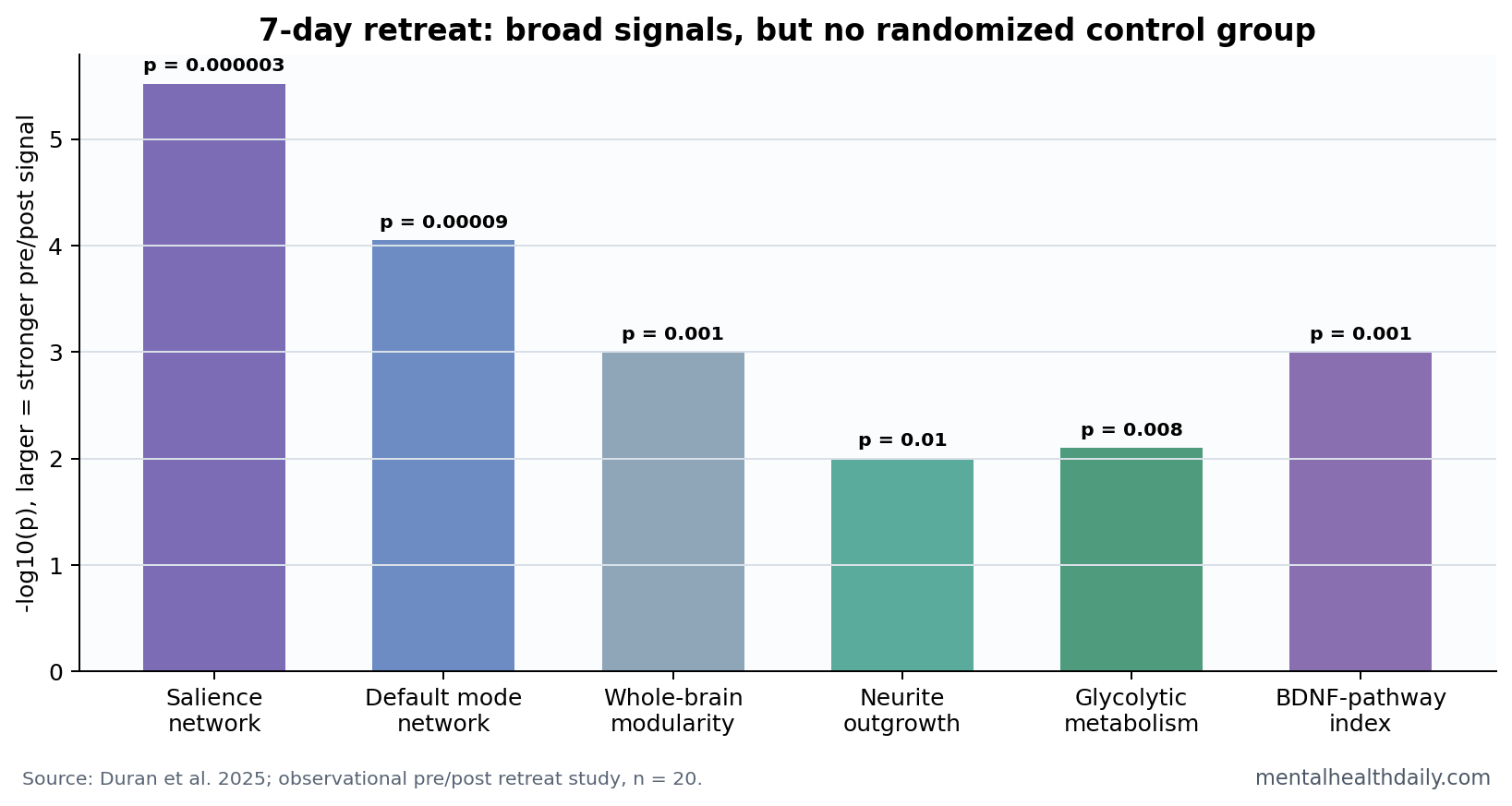
- Neural signal was broad: Meditation-state fMRI showed lower functional integration in the default mode network (p = 0.00009) and salience network (p = 0.000003) in 19 analyzed participants.1
- Network topology shifted: Meditation decreased whole-brain modularity (p = 0.001) and increased global efficiency (p = 0.000002), suggesting less segregated brain-network organization during the meditation state.1
- Plasma effects were multi-layered: Post-retreat plasma increased neurite outgrowth (p = 0.01), glycolytic metabolism (p = 0.008), and a BDNF-pathway index (p = 0.001).1
- Causal certainty was limited: The 20-person pre/post design had no randomized control group, so retreat setting, expectancy, sleep, diet, movement, and social context remain plausible contributors.1
- Clinical claims would be premature: The study involved healthy retreat participants, not patients with depression, anxiety, PTSD, or chronic stress symptoms.1
BDNF means brain-derived neurotrophic factor, a growth-supporting signaling system often discussed in neuroplasticity research. Functional integration describes how strongly a brain network works as a coordinated system; lower integration during meditation can mean that the network is less internally locked together in that state.
Duran et al. studied a package, not a single ingredient. Participants completed a 7-day intervention that combined mind-body reconceptualization, meditation, and open-label placebo healing in a retreat setting. That package is exactly why the findings are interesting and exactly why simple causal language would overstate the evidence.
20 Participants Came From a 561-Person Retreat Pool
The study randomly selected 20 healthy participants from 561 retreat participants. The sample included 14 women, and mean age was 46.35 years. Resting and meditation fMRI data were analyzed in 19 participants, while plasma assays used all 20.1
Open-label placebo means participants knew the treatment was framed as placebo-like or expectancy-mediated rather than hidden deception. In this retreat, open-label placebo was not tested against meditation alone, education alone, or a structurally matched retreat control.
That design can detect whether biology changed during the retreat window. It cannot determine whether the active ingredient was meditation, expectancy, social bonding, altered sleep, diet, reduced work demands, physical activity, novelty, or some combination of all of them.
Default Mode and Salience Network Integration Decreased
The default mode network is a set of brain regions often active during self-referential thought, memory, and internally directed attention. The salience network helps detect behaviorally relevant internal and external signals. During meditation, both networks showed lower functional integration, with the default mode network result at p = 0.00009 and the salience network result at p = 0.000003.1
Whole-brain graph metrics pointed in the same direction. Modularity describes how strongly the brain separates into distinct communities; global efficiency describes how easily information could move across the network as a whole. Meditation decreased modularity (p = 0.001) and increased global efficiency (p = 0.000002).1
Those findings fit adjacent meditation-network work. Van Lutterveld et al. reported meditation-associated network integration changes, De Filippi et al. reported meditation-induced connectivity effects, and Sezer and Sacchet reviewed autonomic patterns in advanced and long-term meditation.234 The new study adds unusual plasma biology and still leaves controlled meditation trials necessary.
Post-Retreat Plasma Changed Cell and Pathway Assays
The plasma experiments were the most unusual part of the paper. Researchers treated cell systems with pre-retreat and post-retreat plasma. Post-retreat plasma increased PC12 neurite outgrowth (p = 0.01), enhanced glycolytic metabolism (p = 0.008), and upregulated a BDNF-pathway index (p = 0.001).1
Neurite outgrowth is a laboratory measure of how far neuron-like cells extend projections. It is not the same as proving new brain connections formed in a person, but it can suggest that circulating factors after the retreat changed how cells behaved in vitro.
- Growth signal: post-retreat plasma increased neurite outgrowth in a cell assay.
- Energy signal: post-retreat plasma enhanced glycolytic ATP production without a simple increase in total ATP production.
- Pathway signal: the BDNF-related protein index moved upward even though BDNF itself was not the whole story.
Plasma Assays Need Direct Replication
The plasma results are intriguing because they move beyond self-report and scanner-state description. A blood sample taken after the retreat changed how cultured cells behaved. That is a stronger biological claim than saying participants felt transformed after an intensive week.
Replication needs a cleaner design. Plasma collected from a meditation-only group, an active retreat-control group, and a normal-life control group would help separate the retreat environment from the contemplative practice. A design with repeated plasma draws could also show whether the signal appears during the retreat, after sleep recovery, or only after the full intervention package.
Assay interpretation: cell-culture effects are indirect. A post-retreat plasma sample can alter a cell assay without proving that the same process happened inside the participant’s brain. The result is still valuable because it gives future trials specific pathways to pre-register: neurite outgrowth, glycolytic metabolism, BDNF-related proteins, inflammatory balance, endogenous opioid markers, and tryptophan metabolism.
The strongest next study would measure symptoms and biology together. If the same participants show improved stress symptoms, changed network metrics, and pre-specified plasma pathway shifts against an active control, the causal claim becomes much stronger.
Multiplicity risk: multi-omics studies measure many proteins, metabolites, and pathway indices at once. That approach is useful for discovery, but it increases the chance that some findings look impressive before independent confirmation. The most defensible follow-up would choose a smaller set of pathways from this paper and test them in advance.
The paper’s strongest contribution is therefore a map of where to look. It says a retreat package can coincide with changes in network topology and circulating biological signals. It does not say which ingredient drove each change, how long the changes lasted, or whether the same biology appears in people seeking treatment for a mental-health condition.
The Study Shows Change, Not Treatment Efficacy
The main risk is turning a pre/post biological paper into a clinical promise. A retreat can change biomarkers for many reasons. A participant may sleep differently, eat differently, move differently, receive more social contact, spend less time online, expect benefit, and practice meditation for hours. Those are not trivial confounds; they are part of the intervention environment.
Evidence-strength note: this was an observational pre/post study in healthy adults. It can show that measured brain and plasma variables changed across a retreat week. It cannot show that the same package treats depression, anxiety, trauma symptoms, neurodegeneration, or chronic stress disorders.
The study also had a disclosed conflict that readers should understand without melodrama: one contributor was employed by a company offering the retreats.1 That does not invalidate the data. It raises the importance of independent replication with control arms.
Independent replication should also include ordinary-person feasibility. The retreat studied here was intensive. A person managing work, caregiving, depression, panic symptoms, pain, or financial stress may not be able to reproduce a 7-day intervention environment. If the biology depends on immersion, the intervention may be less scalable than a brief meditation app or outpatient class.
Better Trials Would Separate Retreat Ingredients
A stronger design would randomize participants to meditation, open-label placebo education, a wellness retreat without meditation, and a waitlist or daily-life control. Repeated sampling would help separate immediate meditation-state changes from slower sleep, diet, or expectation effects.
For now, the useful conclusion is narrower: intensive mind-body retreat participation was accompanied by measurable neural and plasma shifts. The causal mechanism remains unresolved.
That narrower conclusion is still useful. Many mind-body studies rely almost entirely on questionnaire change. This one gives future researchers concrete fMRI, cell-assay, protein-pathway, and metabolite targets to test in a cleaner trial.
Clinical relevance would depend on whether those biological targets move with patient-centered outcomes.
- Outcome anchors: symptom scales, sleep measurement, medication tracking, adverse-event reporting, and follow-up after the retreat environment ends.
- Clinical test: people with depression, anxiety, PTSD, or chronic stress would need to be studied directly rather than inferred from healthy retreat participants.
Follow-up timing would be critical. A biological shift measured immediately after an immersive week may fade quickly, persist only with continued practice, or reflect short-term removal from ordinary stressors.
Durability separates a retreat-state signal from a treatment-relevant signal.
That gap is the main clinical unknown.
Without those anchors, a plasma pathway shift can be interesting biology while still failing to become useful care.
Questions About Mind-Body Retreat Biology
Did the retreat prove meditation increases BDNF?
No. A BDNF-pathway index increased, but the study did not isolate meditation from the rest of the retreat package, and BDNF itself was not a simple standalone result.
Do the fMRI findings mean the brain improved?
No direct clinical endpoint showed improvement. The findings mean network organization differed during meditation and across the retreat window.
Is this relevant to mental health?
Yes, as mechanism-generating evidence. It is not evidence that a 7-day retreat treats a diagnosed psychiatric disorder.
References
- Duran AJ, et al. Neural and molecular changes during a mind-body reconceptualization, meditation, and open label placebo healing intervention. Communications Biology. 2025. https://doi.org/10.1038/s42003-025-09088-3
- van Lutterveld R, et al. Meditation is associated with increased brain network integration. NeuroImage. 2017. PubMed search
- De Filippi E, et al. Meditation-induced effects on whole-brain structural and effective connectivity. Brain Structure and Function. 2022. PubMed search
- Sezer I, Sacchet MD. Advanced and long-term meditation and the autonomic nervous system: a review and synthesis. Neuroscience and Biobehavioral Reviews. 2025. PubMed search