A 2025 preregistered meta-analysis found that temporary social media abstinence did not significantly improve positive affect, negative affect, or life satisfaction across 10 adult experiments involving 4,674 participants.1 The result does not prove that every break is useless, but it challenges the generic “digital detox” claim that simply logging off reliably improves mood.
Research Highlights
- Pooled effects were near zero: Social media abstinence had no significant effect on positive affect (g = 0.03), negative affect (g = −0.01), or life satisfaction (g = 0.03) in the 2025 meta-analysis.1
- The evidence base was small but targeted: Lemahieu et al. synthesized 10 peer-reviewed adult experiments, 4,674 participants, and 38 effect sizes focused specifically on abstinence, not general “reduced use.”1
- Break length did not rescue the claim: Abstinence periods ranged from 1 to 28 days, but duration was not associated with positive affect (p = 0.76), negative affect (p = 0.54), or life satisfaction (p = 0.70).1
- Prior single studies pointed in different directions: Tromholt’s 1-week Facebook experiment reported higher well-being in the abstinence group than in the control group, while other abstinence studies found null or lower life-satisfaction effects.2,3,4
- The practical target is narrower than “log off”: Digital detox reviews have argued for testing moderators, mechanisms, and more specific behavior changes rather than treating temporary abstinence as a universal mental-health fix.5,6
Social media abstinence means temporarily stopping use of social media platforms such as Facebook, Instagram, TikTok, or similar networking sites. The intervention sounds clean because it removes the suspected exposure entirely: no feed, no notifications, no comparison loop, no public performance, and no algorithmic pull.
That clean logic is also the problem. Social media can produce stress, upward social comparison, fear of missing out, procrastination, sleep displacement, or exposure to conflict. It can also provide social contact, humor, group belonging, event information, identity support, and low-friction contact with friends. A complete break removes both sides at once.
10 Experiments Found No Reliable Well-Being Gain
Lemahieu et al. searched PubMed, Scopus, Web of Science, Communication Source, Cochrane Library, and Google Scholar for adult experiments that required complete social media abstinence and measured positive affect, negative affect, or life satisfaction.1
Positive affect means pleasant emotional states such as enthusiasm, energy, and alertness. Negative affect means unpleasant emotional states such as sadness, fear, anger, or distress. Life satisfaction is a broader judgment of how satisfied a person is with life overall.
The final meta-analysis included 10 peer-reviewed papers and 38 effect sizes. Most studies used short abstinence periods: the range was 1 to 28 days, and 7 days was the most common duration. All studies involved adults, several recruited students, and approximately 65% of extracted participants were female.1
The pooled results were small enough that a normal reader should treat them as no clear average effect:
- Positive affect: g = 0.03, 95% CI −0.11 to 0.16, p = 0.69.
- Negative affect: g = −0.01, 95% CI −0.13 to 0.10, p = 0.78.
- Life satisfaction: g = 0.03, 95% CI −0.17 to 0.22, p = 0.75.
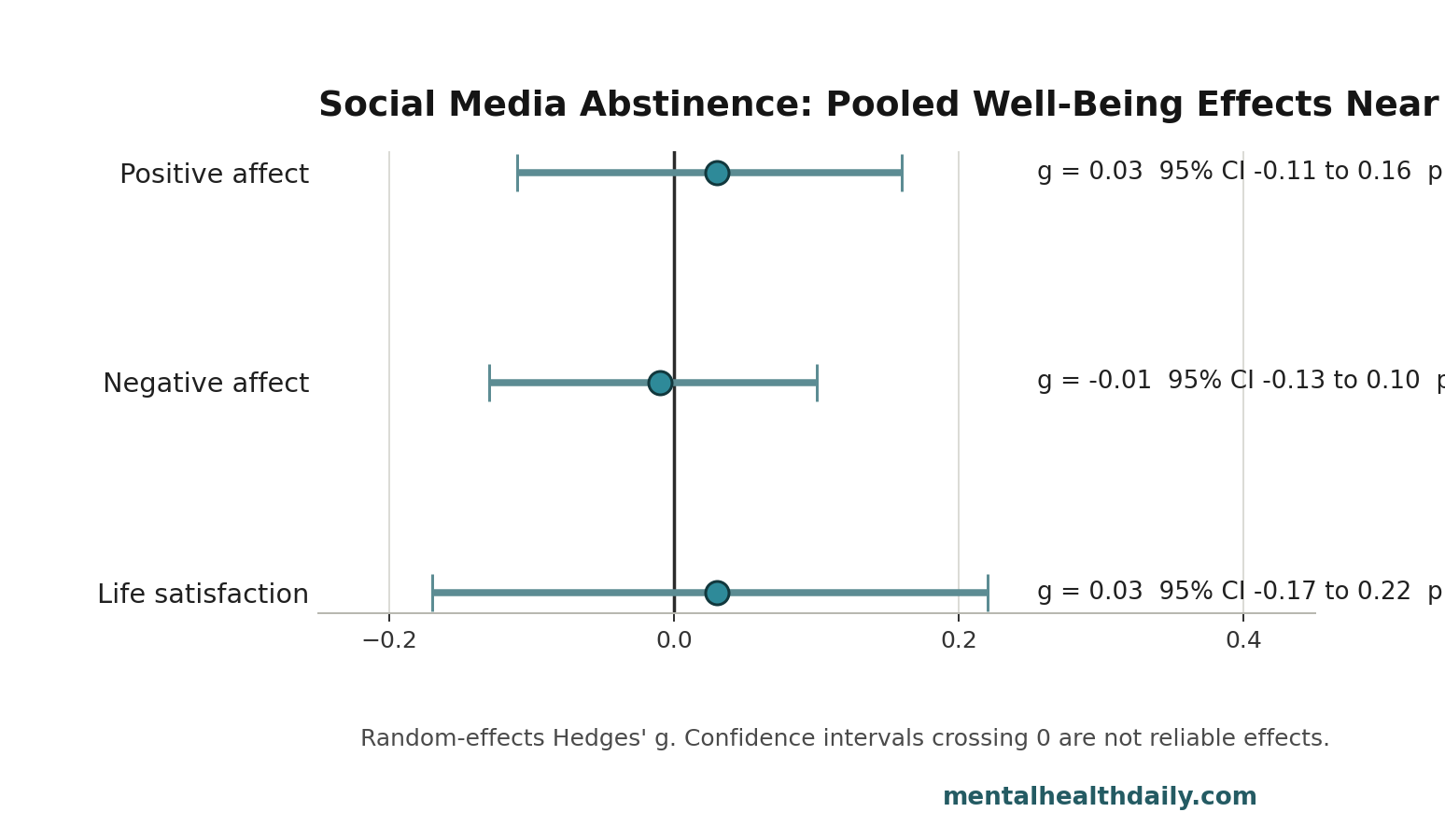
Hedges’ g is a standardized mean difference: it expresses the difference between groups in standard-deviation units, with a correction for smaller samples. Values around 0.03 or −0.01 are tiny. The confidence intervals also crossed zero for all 3 outcomes, meaning the pooled data did not rule in a reliable benefit or harm.
Why Earlier Facebook Break Studies Looked More Positive
The meta-analysis did not appear out of nowhere. It sits on top of a small experimental literature in which some platform breaks looked beneficial and others did not.
Tromholt’s 2016 Danish Facebook experiment is the classic positive case. In that 1-week experiment, people assigned to stop using Facebook reported higher life satisfaction and more positive emotions than people who kept using Facebook.2 That result fits the popular detox story: remove the feed, reduce comparison, and mood improves.
Other experiments were less cooperative. Hanley et al. tested a 1-week vacation from Facebook and Instagram and did not find a clear life-satisfaction effect in the later synthesis.3 Vanman et al. found that giving up Facebook could lower life satisfaction in some conditions, even while the intervention also tested stress and well-being outcomes.4
The divergence is not mysterious. Platform, person, motive, compliance, and baseline use probably matter. A person using Instagram mainly for comparison may benefit from a break. A person using a private group for illness support may lose something useful. A person who deletes the app but keeps checking through a browser may not experience the intended exposure change at all.
Duration Was Not the Missing Dose Signal
If detox logic were mostly dose-dependent, longer breaks should produce stronger improvements. Lemahieu et al. tested that directly with meta-regression, a method that asks whether a study-level feature predicts the size of the effect across studies.1
The duration models were flat:
- Positive affect: gamma = 0.0032 per abstinence day, SE = 0.0103, p = 0.76, R2 = 0%.
- Negative affect: gamma = −0.0056 per abstinence day, SE = 0.0088, p = 0.54, R2 = 0%.
- Life satisfaction: gamma = 0.004, SE = 0.01, p = 0.70, R2 = 0%.
In plain English, a longer abstinence window did not explain better mood or life-satisfaction outcomes in the available experiments. That does not settle whether a 3-month platform deletion changes a person’s life. It does say that, within the 1- to 28-day experimental range, break length was not the hidden reason the overall effect looked small.
Heterogeneity Says “For Whom?”, Not “Everyone Should Detox”
Heterogeneity is the degree to which study results disagree beyond ordinary sampling noise. Lemahieu et al. reported moderate to substantial heterogeneity: I2 = 60.7% for positive affect, 63.7% for negative affect, and 58.8% for life satisfaction.1 That pattern argues against a single detox rule.
Several study differences could plausibly change the result:
- Platform mix: Facebook-only abstinence is not the same intervention as stopping Instagram, TikTok, Reddit, Snapchat, and messaging-adjacent platforms at once.
- Baseline pattern: Passive scrolling, compulsive checking, work-related use, social support, and entertainment use probably have different mental-health meanings.
- Compliance: Some studies relied on self-report, while others used researcher monitoring or objective use measures.
- Outcome timing: Momentary mood during the break can move differently from global life satisfaction at the end of the week.
- Replacement behavior: A break filled with sleep, exercise, or in-person contact is not the same as a break filled with boredom or isolation.
Radtke et al.’s digital-detox review made the same broad point before this meta-analysis: the field needed sharper moderators, mechanisms, and behavior targets for disconnection interventions.5 Ferguson’s broader meta-analytic review also found no significant mental-health impact when social-media reduction experiments were pooled across intervention types.6
What This Means for People Considering a Social Media Break
The evidence does not justify selling temporary abstinence as a reliable treatment for low mood, anxiety, or poor life satisfaction. It also does not justify the opposite overcorrection: that social media breaks never help anyone. The right inference is narrower.
Use a break as a diagnostic experiment. A 7-day break can show whether a specific platform is tied to sleep loss, procrastination, comparison spirals, argument loops, or compulsive checking. Track mood alongside time, attention, sleep, conflict exposure, and daily routine.
Change the mechanism you actually want to change. If notifications are the problem, turn off notifications. If late-night scrolling is the problem, set a device cutoff. If comparison content is the problem, unfollow or block the accounts driving comparison. If social support is the useful part, preserve direct messaging or group contact rather than deleting every platform.
Clinical problems need more than abstinence. Depression, anxiety, loneliness, trauma exposure, compulsive use, and self-harm risk should not be reduced to platform exposure alone. Social media can amplify distress, but it can also be a surface where distress shows up. Treating the underlying problem is different from taking away the surface.
Evidence Strength and Limits
This was a preregistered systematic review and meta-analysis, which is stronger than picking whichever single experiment matches the preferred story. The analysis separated positive affect, negative affect, and life satisfaction instead of collapsing everything into a vague mental-health bucket.1
The evidence base is still thin. Only 10 studies entered the meta-analysis. Most abstinence periods were short. Adult samples from developed countries dominated the evidence. Adolescent effects, clinically distressed users, people with problematic social-media use, and people exposed to online harassment may not follow the same average pattern.
The strongest current conclusion is calibrated: temporary social-media abstinence is not a broadly proven well-being intervention. A break may help when it removes a concrete stressor and gets replaced by something better. As a generic prescription, the pooled evidence is close to zero.
Questions About Social Media Abstinence and Well-Being
Does this mean social media is harmless?
No. The meta-analysis tested temporary abstinence effects on positive affect, negative affect, and life satisfaction. It did not prove social media has no effect on sleep, attention, body image, political conflict, harassment exposure, addiction-like use, or adolescent development.
Should people still try a social media break?
A short break can be useful if the goal is self-experimentation: checking whether a platform is stealing sleep, time, attention, or emotional bandwidth. The evidence does not support promising that the average adult will feel happier after a temporary abstinence period.
Why might a detox fail to improve mood?
The break removes harms and benefits at the same time. Some people lose comparison pressure; others lose social contact, entertainment, group belonging, or convenient communication. Replacement behavior also matters: abstinence filled with boredom is not the same intervention as abstinence replaced with sleep or in-person connection.
Is reducing use different from abstaining completely?
Yes. Complete abstinence is a blunt intervention. Targeted reduction can keep useful contact while removing the part causing trouble, such as notifications, late-night use, specific accounts, or passive scrolling. The 2025 meta-analysis focused on complete abstinence, not personalized reduction plans.
References
- Lemahieu L, Vander Zwalmen Y, Mennes M, Koster EHW, Vanden Abeele MMP, Poels K. The effects of social media abstinence on affective well-being and life satisfaction: a systematic review and meta-analysis. Scientific Reports. 2025;15:7581. doi:10.1038/s41598-025-90984-3
- Tromholt M. The Facebook experiment: quitting Facebook leads to higher levels of well-being. Cyberpsychology, Behavior, and Social Networking. 2016;19(11):661-666. doi:10.1089/cyber.2016.0259
- Hanley SM, Watt SE, Coventry W. Taking a break: the effect of taking a vacation from Facebook and Instagram on subjective well-being. PLOS ONE. 2019;14:e0217743. doi:10.1371/journal.pone.0217743
- Vanman EJ, Baker R, Tobin SJ. The burden of online friends: the effects of giving up Facebook on stress and well-being. Journal of Social Psychology. 2018;158(4):496-508. doi:10.1080/00224545.2018.1453467
- Radtke T, Apel T, Schenkel K, Keller J, von Lindern E. Digital detox: an effective solution in the smartphone era? A systematic literature review. Mobile Media & Communication. 2022;10(2):190-215. doi:10.1177/20501579211028647
- Ferguson CJ. Do social media experiments prove a link with mental health: a methodological and meta-analytic review. Psychology of Popular Media. 2024. doi:10.1037/ppm0000541