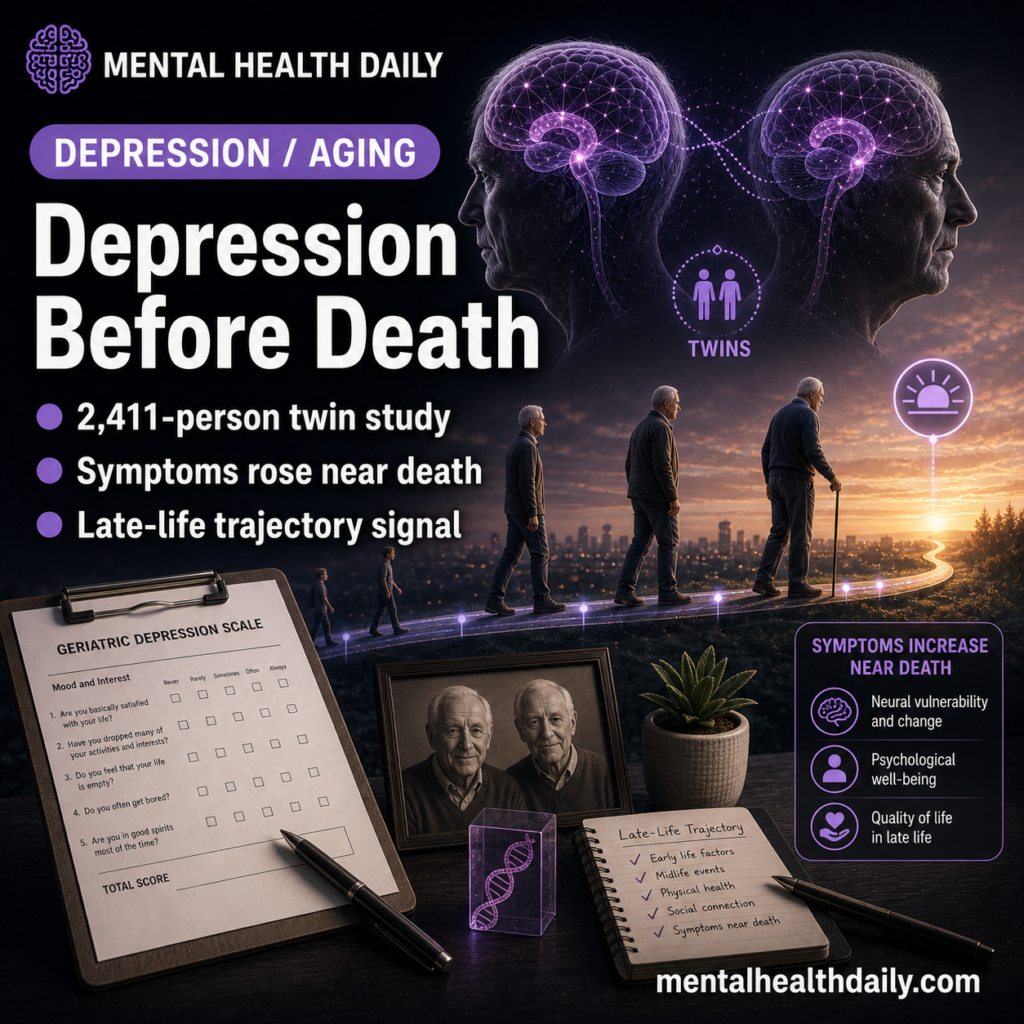
In a 2,411-person multinational twin-consortium study, depressive symptoms increased significantly as death approached. The strongest design check compared twins directly: twins who died had larger terminal symptom increases than co-twins who survived at least 4 more years.
Research Highlights
- Terminal mood change was visible: Petkus et al. found accelerated depressive-symptom increases roughly 4.3 years before death in deceased participants from 5 twin studies across Sweden, Denmark, and Australia.1
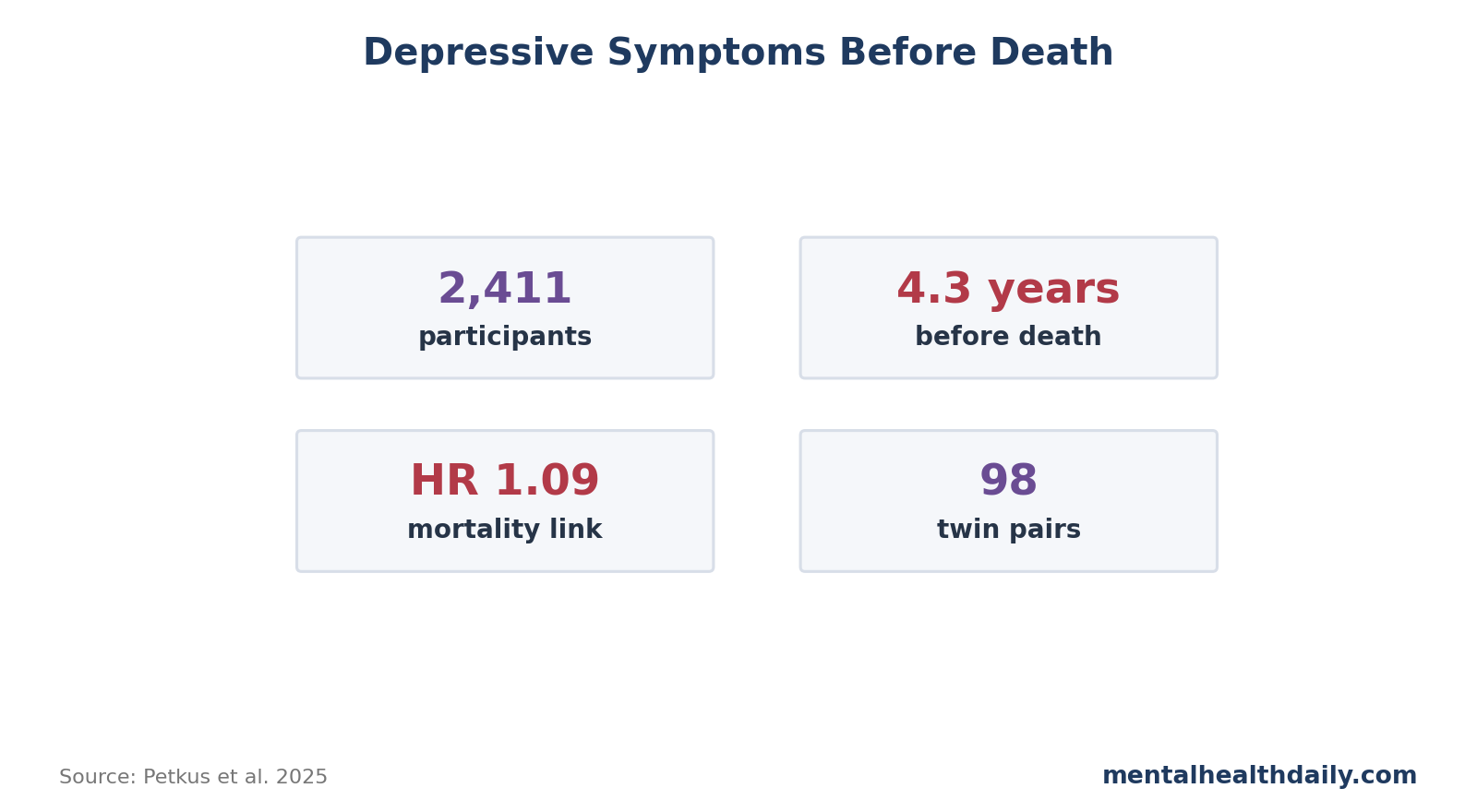
- Post-70 symptom slope predicted mortality: each 1-standard-deviation (SD) increase in annual depressive-symptom slope after age 70 was associated with higher death risk, HR = 1.09, 95% CI [1.01, 1.17].
- Co-twin comparison strengthened the signal: among 98 discordant twin pairs, the deceased twin had 5.46 T-score units higher symptoms at death and faster post-changepoint increase than the surviving co-twin.
- Men showed a stronger terminal rise: deceased men had larger annual post-changepoint increases than deceased women, β = 0.54, 95% CI [0.02, 1.10], p = 0.029, though the gender-by-mortality interaction was borderline.
- Evidence strength is longitudinal but not causal: the 5-study design supports terminal decline in mood, but it does not prove depression itself causes death or identify the medical driver of the symptom rise.
Late-life depressive symptoms can signal end-of-life vulnerability as well as psychiatric symptom burden. Accelerating symptoms in older adults should prompt more careful medical, functional, social, sleep, pain, and grief assessment.
2,411 Participants Were Followed Across About 12 Years
Consortium source: Petkus et al. analyzed data from the Interplay of Genes and Environments across Multiple Studies (IGEMS) consortium.1 Participants came from 5 twin studies in Sweden, Denmark, and Australia. To be included, participants needed at least 3 depressive-symptom assessments; deceased participants also needed at least 1 observation within 3 years of death.
Sample size: the sample included 2,411 community-dwelling people, baseline age 29 to 95 years. Average age at initial depressive-symptom assessment was 68.98 years, SD = 13.51. Participants completed an average of 5.22 depressive-symptom assessments over about 12 years of follow-up.
The researchers harmonized symptoms across multiple depression measures. Harmonization means converting different scales into a common metric so longitudinal change can be compared across studies. That approach is necessary in large consortium work, but it also means the result is about depressive-symptom burden rather than a uniform diagnosis of major depressive disorder.
Depressive-Symptom Acceleration Began About 4.3 Years Before Death
Model setup: the central model was a piecewise linear multilevel model with a random changepoint. A changepoint is the estimated moment when the slope of symptoms changes. In plain English, the model asks when the depressive-symptom line bends upward.
Near-death level: deceased participants had higher depressive symptoms near death. At 1 year before death, symptoms were 3.68 T-score units higher than the comparable final-assessment level in non-deceased participants, 95% CI [2.74, 4.62], p < 0.001. A fuller model estimated the deceased-group difference at 4.82 T-score units, 95% CI [3.80, 5.85], p < 0.001.
The timing also differed. For non-deceased participants, the changepoint occurred 7.42 years before last assessment, 95% CI [−8.49, −6.36]. For deceased participants, the model shifted that point by 3.16 years, putting the average terminal change around 4.3 years before death. After the changepoint, deceased participants had a much steeper annual symptom increase than non-deceased participants, β = 1.11, 95% CI [0.90, 1.32], p < 0.001.
Mortality model: depressive-symptom level and slope also predicted death risk. Each 1 T-score unit higher depressive-symptom level at a given time was associated with 1.02 times greater risk of death, 95% CI [1.01, 1.03].
Each 1 SD steeper annual symptom increase after age 70 was associated with HR = 1.09, 95% CI [1.01, 1.17]. When the researchers excluded assessments within 3 years of death, that post-70 slope association weakened to HR = 1.01, 95% CI [0.94, 1.10].
Co-Twin Controls Reduced the “Shared Family Background” Explanation
Co-twin sample: the strongest piece of the design was the co-twin control analysis. The researchers identified 98 twin pairs in which 1 twin died and the co-twin survived at least 4 more years. The analysis included 32 monozygotic pairs, 60 same-sex dizygotic pairs, and 6 opposite-sex dizygotic pairs.
Family-background control: twins partly control for birth cohort, family background, and genetics. Monozygotic twins share essentially all segregating DNA; dizygotic twins share about half. If terminal depressive-symptom rise appeared only because some families have higher lifelong depression risk, the co-twin contrast should weaken the signal.
Co-twin result: the deceased twin had 5.46 T-score units higher depressive symptoms at death than the co-twin who survived, 95% CI [2.80, 8.12], p < 0.001. The deceased twin also had a greater post-changepoint annual symptom increase, β = 0.84, 95% CI [0.43, 1.26], p < 0.001.
Causal limit: the co-twin result supports a proximity-to-death signal, not a claim that depressive symptoms caused death.
Terminal Depression Is Not Ordinary Late-Life Depression Alone
Late-life depression already has a broad clinical base. Fiske et al. reviewed depression in older adults and emphasized that older patients may show cognitive changes, somatic symptoms, loss of interest, insomnia, disability, and medical burden rather than only sadness.2 Sutin et al. previously reported that depressive symptoms change across adulthood and increase in later life.3
The Petkus et al. result separates 2 patterns that often get mixed together:
- Age-related symptom pattern: depressive symptoms may change across adulthood because of health, disability, isolation, sleep, bereavement, or social role changes.
- Terminal decline pattern: symptoms rise more steeply as death approaches, suggesting proximity to death carries additional information beyond age alone.
Clinical implication: a new upward bend in depressive symptoms at age 82 should not be waved away as ordinary aging. It may be depression, grief, pain, sleep fragmentation, cognitive decline, medication adverse effects, functional loss, vascular disease, cancer, inflammatory illness, caregiver strain, or early palliative needs. Psychiatric assessment and medical assessment belong together.
Men May Have a Stronger Terminal Mood Increase
Sex-difference context: the study also tested sex differences. Women generally report more depressive symptoms across much of the life span; Salk et al. meta-analyzed national samples and found reliable gender differences in depression diagnoses and symptoms.4 In late life, those differences often narrow.
Male terminal slope: Petkus et al. found that deceased men had larger annual depressive-symptom increases after the changepoint than deceased women, β = 0.54, 95% CI [0.02, 1.10], p = 0.029. Deceased men did not differ from deceased women in estimated symptom level 1 year before death, β = 0.69, 95% CI [−0.76, 2.14], p = 0.175.
The gender-by-mortality interaction for the post-changepoint slope was p = 0.061, so the sex-specific conclusion should stay cautious. The directional pattern is still clinically plausible: men may report lower depressive symptoms during ordinary late life, then show sharper increases when mortality-related physical, functional, or dependency changes accumulate.
Limitations of This Terminal-Decline Analysis
The outcome was depressive symptoms, not uniform major depression. The study harmonized several scales. That supports consortium-scale modeling but does not identify which participants met diagnostic criteria.
Cause of death was not the main driver tested. The result shows proximity to all-cause death. It does not separate cancer, cardiovascular disease, dementia, frailty, suicide, infection, or other pathways.
Medical mechanisms remain unresolved. Pain, sleep, disability, inflammation, cognitive impairment, bereavement, and medication changes could all contribute to terminal symptom rise.
The co-twin sample was smaller. The 98-pair analysis is valuable, but it has less precision than the full 2,411-person model.
Clinical follow-up should also distinguish terminal mood acceleration from treatable depression. The pattern may signal proximity to death at the population level, but an individual older adult still deserves assessment for pain, sleep, bereavement, cognitive change, medication effects, isolation, and medical illness.
That distinction protects care quality: terminal-pattern research should prompt better evaluation and support, not fatalistic dismissal of late-life depressive symptoms.
Screening should therefore trigger action and support rather than stop at risk labeling.
Questions About Depressive Symptoms Before Death
Does depression cause death in this study?
No. The study found that steeper depressive-symptom increases predicted mortality and that symptoms accelerated before death. It did not prove that depression itself caused death.
Should depressive symptoms in older adults be treated as medical warning signs?
Often, yes. A new or accelerating symptom pattern should trigger assessment for depression and for medical, cognitive, medication, pain, sleep, functional, and social drivers.
Why are twins useful here?
Twins help separate terminal change from shared family background. If the twin who died showed sharper symptom increase than the genetically and familially similar co-twin who survived, proximity to death becomes a stronger explanation.
How should a new late-life depressive-symptom rise be handled?
In later life, a sharp rise in depressive symptoms deserves active investigation. It may signal treatable depression, but it may also mark worsening health, frailty, pain, sleep disruption, cognitive decline, or unmet end-of-life support needs.
References
- Terminal Increases in Depressive Symptoms in a Multinational Twin Consortium. Petkus AJ et al. Psychological Science. 2025;36(8):637-655. doi:10.1177/09567976251351022
- Depression in Older Adults. Fiske A et al. Annual Review of Clinical Psychology. 2009;5:363-389. doi:10.1146/annurev.clinpsy.032408.153621
- The Trajectory of Depressive Symptoms Across the Adult Life Span. Sutin AR et al. JAMA Psychiatry. 2013;70(8):803-811. PubMed:23760442
- Gender Differences in Depression in Representative National Samples: Meta-Analyses of Diagnoses and Symptoms. Salk RH et al. Psychological Bulletin. 2017;143(8):783-822. doi:10.1037/bul0000102
- Inquiry Into Terminal Decline: Five Objectives for Future Study. Gerstorf D, Ram N. The Gerontologist. 2013;53(5):727-737. PubMed:23704220
- Late-Life Decline in Well-Being Across Adulthood in Germany, the United Kingdom, and the United States: Something Is Seriously Wrong at the End of Life. Gerstorf D et al. Psychology and Aging. 2010;25(2):477-485. PubMed:20545432