A 2026 randomized exploratory pilot found that a single 24-minute yoga session did not significantly lower salivary cortisol or salivary alpha-amylase compared with quiet sitting in 19 stressed adults.1 The acute yoga signal was physiological but not the simple stress-biomarker drop that wellness claims often imply.
Research Highlights
- Biomarker claim failed: Yoga did not significantly outperform quiet sitting for salivary cortisol or alpha-amylase in 19 randomized adults.1
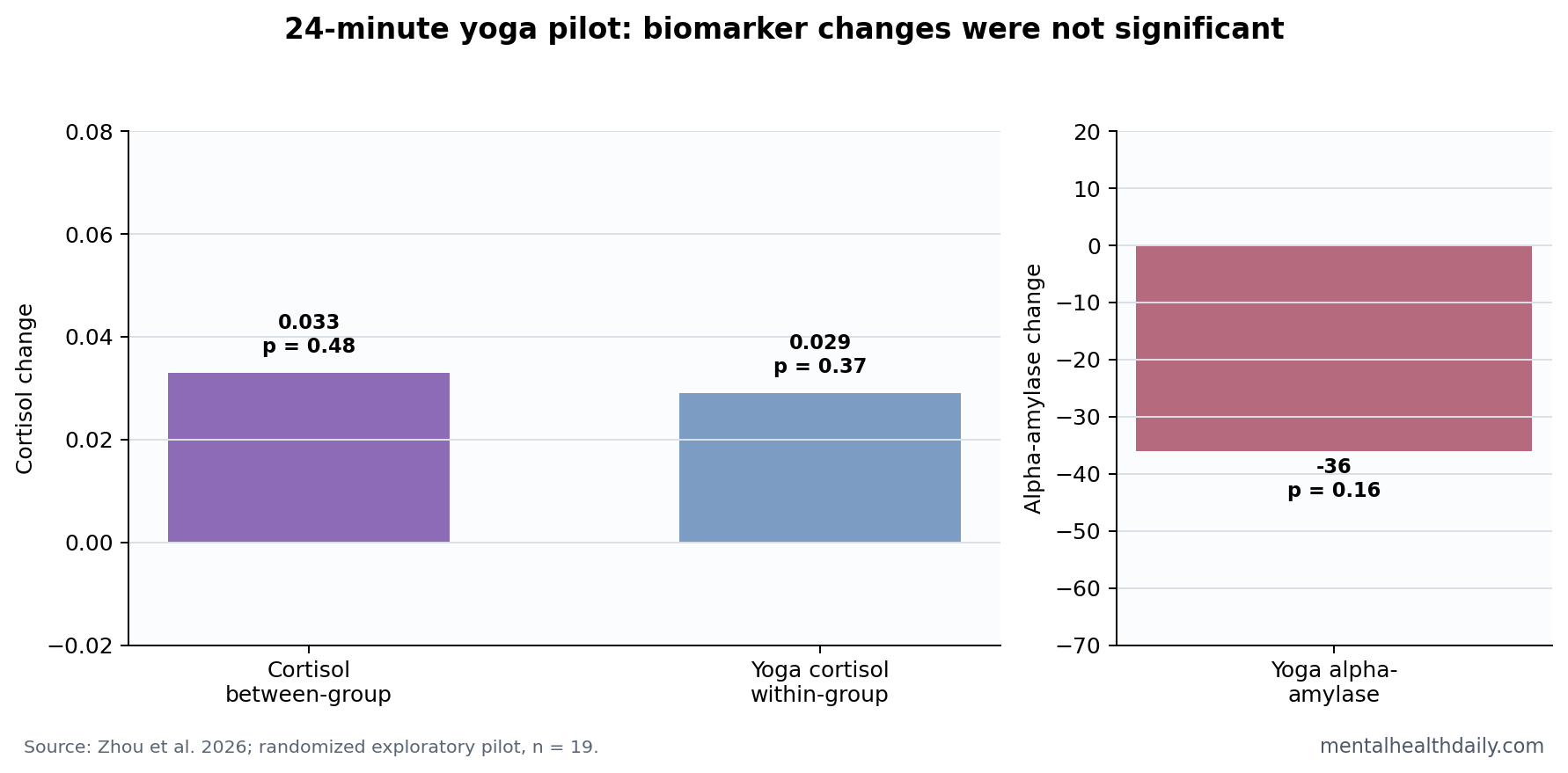
- Cortisol difference was small: The between-group cortisol change was 0.033, 95% CI -0.057 to 0.12, p = 0.48.1
- Alpha-amylase did not confirm stress reduction: The yoga group’s alpha-amylase change was -36, SE 24, p = 0.16.1
- Heart rate increased during poses: The cardiovascular signal fit mild physical exertion rather than immediate relaxation.1
- EEG findings were exploratory: Individual single-channel EEG traces suggested heterogeneous stress and concentration responses in a very small subset.1
Salivary cortisol is a hormone marker often used as a rough index of hypothalamic-pituitary-adrenal axis activity, the body’s main stress-response system. Salivary alpha-amylase is an enzyme often used as a proxy for sympathetic nervous-system activity, the fast arousal system involved in fight-or-flight responses.
Those markers are imperfect, but they are more concrete than asking whether a short wellness session “felt relaxing.” Zhou et al. tested a narrow question: did one brief beginner yoga session produce immediate biomarker changes beyond quiet sitting?
19 Stressed Adults Were Randomized to Yoga or Quiet Sitting
The pilot enrolled university-affiliated adults with self-reported daily stress and no prior guided yoga experience. Researchers randomized 10 people to immediate yoga and 9 to quiet sitting. The yoga session lasted 24 minutes and included breathing, postures, and meditation.1
The primary endpoint was change in salivary cortisol. Secondary endpoints included salivary alpha-amylase, Apple Watch heart-rate data in a subset, and commercial single-channel EEG-derived emotional indices for stress, calmness, and concentration.1
Exploratory pilot means the study was designed to test feasibility and generate estimates, not to deliver a definitive clinical answer. With 19 participants, a null biomarker finding could reflect no acute effect, a timing problem, measurement noise, or insufficient power.
Cortisol and Alpha-Amylase Did Not Clearly Move
The main result was straightforward: no significant between-group differences appeared for salivary cortisol or alpha-amylase.1 For cortisol, the between-group change was 0.033, 95% CI -0.057 to 0.12, p = 0.48. The yoga group’s immediate cortisol change was 0.029, SE 0.03, p = 0.37. The yoga group’s alpha-amylase change was -36, SE 24, p = 0.16.
Those values do not prove yoga has no stress effect. They do show that this specific 24-minute beginner session did not produce a statistically clear immediate saliva-biomarker reduction against quiet sitting.
That calibration is useful because yoga research is easy to overstate. Longer programs may reduce perceived stress, improve mood, and help some people build routines. A single short session is a different claim, especially when biomarkers are the target.
Heart Rate Rose During the Posture Phase
Heart-rate data were available during yoga practice for 12 participants after combining the immediate-yoga group with waitlist participants who later received yoga.1 The yoga condition increased heart rate during postures and kept it mildly elevated during meditation compared with the breathing phase.
That is not a failure. It is a reminder that yoga is not always a pure relaxation intervention. Postures require muscular work, balance, and attention. In beginners, even gentle movement can produce mild cardiovascular activation.
Interpretive key: an acute heart-rate increase during yoga mainly shows that the body was doing physical work. If the question is relaxation biology, the timing of measurement needs to distinguish exertion from later downshift.
Single-Channel EEG Added Hints, Not Proof
The EEG analysis was even smaller. Yoga-condition EEG data came from 5 participants, and the device used proprietary emotional indices for stress, calmness, and concentration.1
Some individual traces suggested reduced stress or increased concentration. But group-level between-condition differences for stress, concentration, and calmness were not significant. The researchers also noted that the construct validity of the commercial single-channel EEG algorithm for absolute stress, calmness, and concentration scores is not fully established.1
- Useful: EEG may help describe phase-by-phase responses during breathing, postures, and meditation.
- Weak: 5 participants cannot support broad claims about brain-state changes.
- Needed: larger samples, validated EEG outcomes, and pre-specified interpretation rules.
Longer Yoga Evidence Does Not Rescue the Acute Claim
Broader yoga literature supports the possibility that yoga can reduce stress, especially when interventions are repeated over time. Schleinzer et al. reviewed yoga effects on stress in stressed adults and found evidence consistent with stress benefit across the wider literature.2 Prior cortisol-focused and pregnancy-yoga studies also tested biomarker or immediate stress pathways.34
That adjacent literature does not make the 2026 pilot positive. It changes the interpretation: the null biomarker result is not a reason to dismiss yoga as a practice, but it does push back against a narrow claim that one 24-minute session reliably lowers stress hormones.
Evidence-strength note: this was a randomized exploratory pilot with 19 participants, smaller wearable subsets, and no long-term follow-up. It can test feasibility and acute physiology. It cannot answer whether regular yoga improves chronic stress, anxiety, sleep, or depression.
Acute Yoga May Need Delayed Measurement
The timing problem is central. Cortisol does not always peak or fall exactly when a short intervention ends. A movement-plus-meditation session can include brief exertion, attentional demand, and later recovery. If saliva is collected too early, it may miss a delayed downshift.
The better next trial would include several post-session samples, a larger randomized sample, a matched active control, and validated self-report plus physiological outcomes. It should also separate yoga components:
- Breathing: slow respiratory practice may affect arousal differently from movement.
- Postures: physical exertion can raise heart rate even if mood improves later.
- Meditation: attentional practice may change concentration before biomarkers shift.
- Recovery window: delayed cortisol and alpha-amylase sampling may be more informative than immediate sampling alone.
How to Read This Pilot if You Use Yoga for Stress
The practical read is not “yoga does nothing.” It is narrower: one short beginner session did not clearly lower the measured saliva stress biomarkers compared with quiet sitting.
If yoga helps a person feel calmer, move more comfortably, or build a repeatable routine, that subjective benefit can still be real. But the biomarker language should stay disciplined. A person can enjoy yoga without claiming that 24 minutes reliably suppresses cortisol.
Comparator: quiet sitting is not an inert control for stress physiology. It can reduce stimulation, lower task demand, and give participants a short recovery window.
If yoga is compared with quiet sitting rather than a demanding task, the bar is not whether people felt better than baseline. The bar is whether yoga added measurable biomarker change beyond a quiet pause, and this 19-person pilot did not show that.
Longer-program mechanisms: practice, expectation, social support, breathing regularity, physical conditioning, and improved sleep may still reduce perceived stress over time. Those mechanisms do not require an immediate saliva-marker drop after the first session.
For now, the clean claim is narrower: acute beginner yoga produced cardiovascular and individual EEG changes, but the group-level cortisol and alpha-amylase evidence did not confirm fast biological stress reduction.
2 claims: one claim is experiential: a person may feel calmer, less tense, or more regulated after guided movement. The other claim is endocrine: cortisol or salivary alpha-amylase fell because the intervention rapidly downshifted stress biology.
Zhou et al. tested the second claim against quiet sitting, and the measured saliva outcomes did not confirm it. That does not negate the first claim, but it keeps the biological language honest.
Sample size is the other constraint. With 10 participants assigned to yoga and 9 assigned to quiet sitting, even a moderate effect could be missed or exaggerated. The pilot is best read as a feasibility and calibration study: it shows how to collect saliva, heart-rate, and EEG signals around a short session, while warning against strong cortisol claims from a single underpowered experiment.
Measurement timing: cortisol and alpha-amylase do not necessarily peak or fall at the exact moment a short practice ends. A future acute-yoga trial would need more repeated saliva samples, a larger randomized sample, and a comparator that separates quiet rest from movement, breathing, expectation, and instructor attention.
That design would answer a more useful question than whether yoga is generally “relaxing.” It would test which component produces which signal: subjective calm, heart-rate change, sympathetic salivary markers, or delayed endocrine recovery. The 2026 pilot is valuable because it makes those next measurements harder to hand-wave.
Questions About Acute Yoga and Stress Biomarkers
Did the yoga session reduce cortisol?
Not significantly in this pilot. The between-group cortisol comparison was p = 0.48, and the yoga group’s immediate cortisol change was also not significant.
Does increased heart rate mean yoga was stressful?
No. Heart rate rose during postures, which is expected during mild physical exertion. That does not prove harmful stress or relaxation failure.
Should people stop using yoga for stress?
No. The study only tested one brief session in 19 adults. It argues against overclaiming immediate biomarker effects, not against longer yoga practice or individual benefit.
References
- Zhou Z, et al. Acute Physiological and Emotional Responses to a Brief 24-Minute Yoga Session: Randomized Exploratory Pilot Study With Waitlist Comparison. JMIR Formative Research. 2026. https://doi.org/10.2196/87077
- Schleinzer A, Moosburner A, Anheyer D, Burgahn L, Cramer H. Effects of yoga on stress in stressed adults: a systematic review and meta-analysis. Frontiers in Psychiatry. 2024. https://doi.org/10.3389/fpsyt.2024.1437902
- Pascoe MC, et al. Yoga and salivary cortisol reduction. Current Psychology. 2023. https://doi.org/10.1007/s12144-021-02036-4
- Kusaka M, Matsuzaki M, Shiraishi M, Haruna M. Immediate stress reduction effects of yoga during pregnancy. Women and Birth. 2016. https://doi.org/10.1016/j.wombi.2016.04.003