
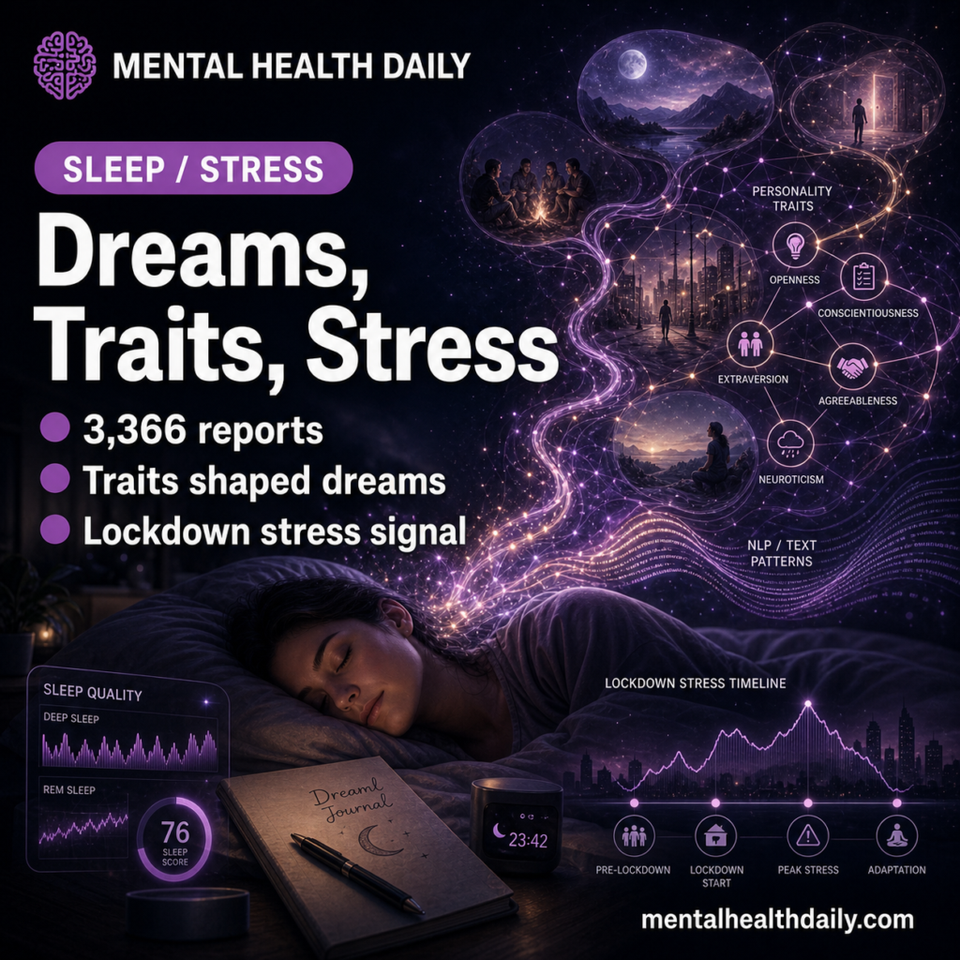
Dreams transform waking life rather than replaying it directly. In a 2026 Communications Psychology study of 3,366 reports, dreams were more visual, spatial, social, and bizarre than waking reports, while attitude toward dreaming, mind-wandering tendency, sleep quality, and COVID lockdown stress each left measurable fingerprints on dream content.1
Research Highlights
- Dreams were not random word salad. Compared with waking reports, dreams shifted toward perceptual scenes: more visual detail, space, locations, animals, objects, physical appearance, and abrupt setting changes.1
- The main dataset was unusually broad for dream research. It included 207 Italian adults, 3,366 dream and waking-experience reports, 15 days of diary data, and psychometric, cognitive, and sleep measures.1
- Stable traits shaped semantic content. Positive attitude toward dreams, mind-wandering propensity, and subjective sleep quality selectively predicted dream features such as bizarreness, emotional arousal, spatial content, and visual perception.1
- COVID lockdown changed dream semantics. In an independent 80-participant lockdown dataset, dreams contained more limitation, emotional arousal, social interaction, body, work, setting, fantasy, and drama content.1
- Clinical use is cautious. In a 3,366-report dataset, dream content reflected stress and sleep state, but it did not function as a diagnostic test for depression, PTSD, or anxiety by itself.
The useful correction is simple: dreams look like transformed waking material, filtered through sleep-state physiology, personality-like traits, memory systems, and current stress.
3,366 Reports Mapped Dream Semantics Prospectively
Elce et al. used natural language processing (NLP; computational analysis of text meaning) to quantify the semantic content of dream and waking reports. The main dataset was collected from March 2020 through March 2024. Participants completed a 15-day protocol with morning dream reports, waking-experience reports, actigraphy, questionnaires, and cognitive testing.1
The study snapshot sets the scale because most dream-content research is either small, retrospective, or heavily dependent on human-coded themes:
- Main sample: 207 Italian adults after exclusions from an initial 217-person sample.
- Main report set: 3,366 dream and waking-experience reports.
- Protocol: 15 days of prospective reporting, with morning dream reports collected immediately after awakening.
- Trait measures: attitude toward dreaming, trait anxiety, visual imagery, mind wandering, sleep quality, chronotype, daytime sleepiness, cognitive testing, and dream-recall questionnaires.
- Lockdown dataset: an independent 80-participant COVID-19 lockdown sample collected in April and May 2020.1
The paper combined 2 text-analysis layers. One used large language model-assisted ratings of hypothesis-driven semantic dimensions such as bizarreness, emotional arousal, self-reference, space, and social interaction. The second used a data-driven lexical-domain approach, which grouped words into content domains such as animals, objects, locations, healthcare, jobs, and timing.1
That hybrid approach is the strength. Human scoring preserves face validity, but it is slow and hard to scale. Pure word counts scale, but can miss meaning. Combining LLM-assisted semantic ratings with lexical domains gives the paper a bridge between classic dream coding and modern text analysis.
Dreams Were More Visual, Spatial, and Bizarre Than Waking Reports
The dream-versus-wake contrast was the sharpest result. Relative to waking reports, dreams moved away from self-referential, thought-centered narratives and toward perceptual, scene-like experiences. They contained more spatial features, visual perception, social interactions, setting changes, and bizarreness.1
The lexical-domain analysis made that difference concrete. Dreams more often contained references to physical appearance, geometry, animals, locations, objects, architecture, transportation, and nature. Waking reports, by contrast, were heavier on timing, healthcare, communication, education, technology, humanities, concerns, and food.1
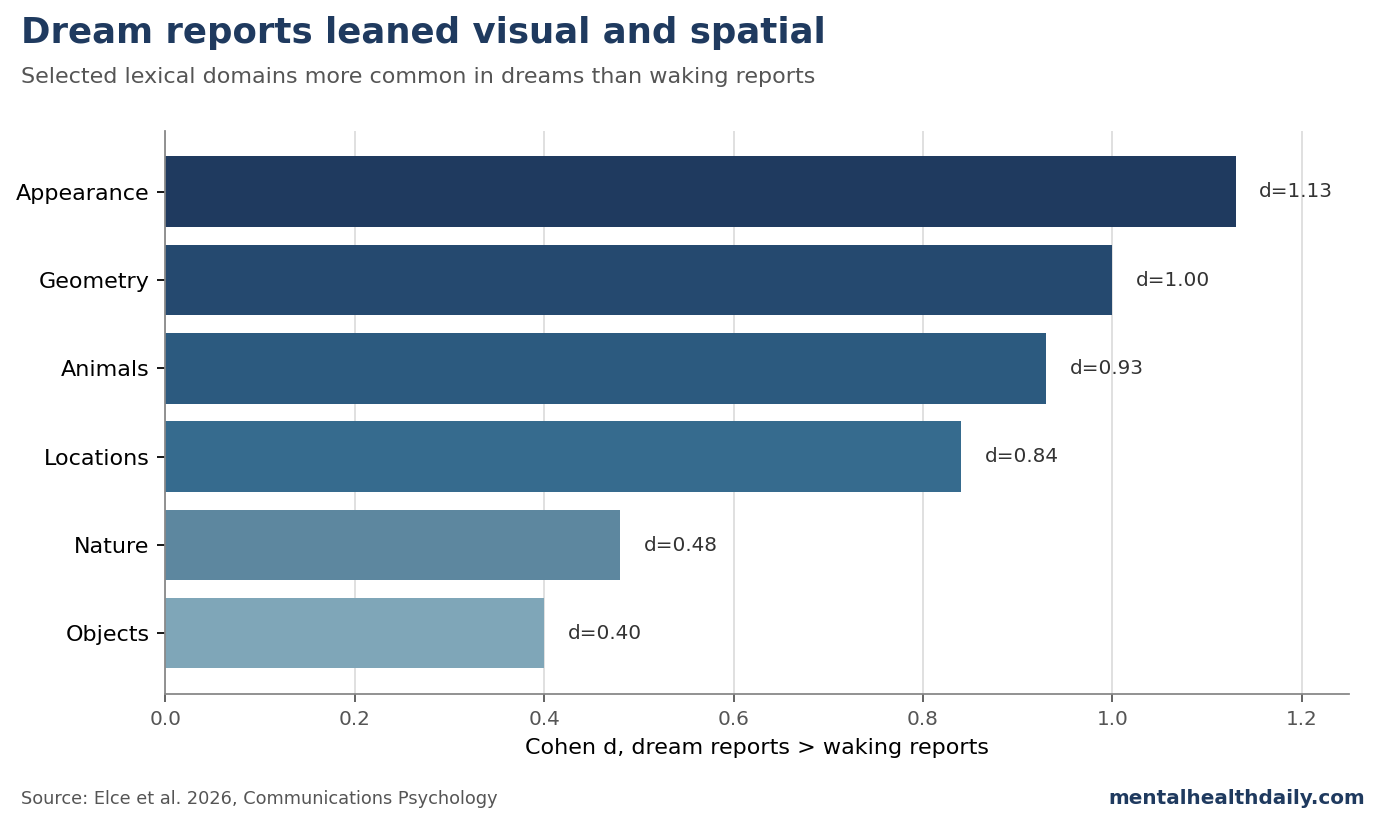
This pattern fits older cognitive-neuroscience accounts of dreaming. Domhoff and Fox argued that dreaming is tied to the default network, a set of brain regions involved in internally generated thought, memory, simulation, and self-related cognition.2 The new paper does not prove the default-network model, but it gives the content-level result that such models would predict: dreams are internally generated scenes, not simple diary entries.
Mind Wandering and Sleep Quality Changed Dream Bizarreness
Several traits selectively predicted dream features beyond general verbosity or language style. A more positive attitude toward dreaming predicted higher emotional arousal, bizarreness, spatial features, visual perception, geometric patterns, and navigation in nature. Lower subjective sleep quality, lower vulnerability to cognitive interference, and greater mind-wandering propensity each contributed to heightened dream bizarreness.1
Mind wandering is the especially interesting bridge. Christoff et al. define mind wandering as spontaneous thought: cognition that moves through internally generated material rather than staying locked to the current task.4 If waking mind wandering is a daytime cousin of dreaming, then people who mind-wander more should plausibly show more setting shifts or bizarre transitions during sleep. That is exactly the kind of relationship the Elce paper observed.
Plain English: the dreaming brain seems to remix waking material more aggressively in some people than in others. People who treat dreams as meaningful, whose thoughts drift more easily during the day, or whose sleep quality is poorer may produce dream reports that feel more vivid, strange, spatial, or emotionally charged.
COVID Lockdown Dreams Carried More Constraint and Emotion
The lockdown analysis is the piece most likely to be overinterpreted, so it needs calibration. The researchers compared dreams collected during the first Italian COVID-19 lockdown with temporally matched post-restriction data and then examined changes across 2020–2024.
During lockdown, dream reports had more references to limitations (d = 0.46), social interactions (d = 0.48), settings (d = 0.41), body (d = 0.36), emotional arousal (d = 0.50), fantasy (d = 0.50), drama (d = 1.09), jobs (d = 0.88), and timing (d = 0.51).1
The causal claim should stay narrow: these analyses identify associations between a large external stressor, time, and dream content. The direction is sensible. Lockdown compressed space, changed work, heightened bodily threat, increased uncertainty, and restricted movement. The dream reports picked up limitation, arousal, and scene-level disruption.
The longitudinal signal was also useful. Over time, dream bizarreness decreased, emotional valence became more positive, arousal decreased, and references to limitations and society diminished. The paper interprets this as partial normalization as pandemic-related stressors faded.1
Dream Content Is a Stress Signal, Not a Diagnosis
Dreams can be clinically informative, especially when they become nightmares, trauma replays, insomnia triggers, or distressing recurring themes. Levin and Nielsen’s review of disturbed dreaming and PTSD framed nightmares as part of a broader affect-distress system, where emotional regulation and threat memory can become dysregulated.3
Clinically, dream content works better as pattern recognition than diagnosis. Bizarre, vivid, or lockdown-themed dreams can signal stress load, sleep fragmentation, emotional arousal, medication effects, substance changes, withdrawal, trauma activation, or poor sleep quality without proving psychosis, trauma, or psychiatric pathology by themselves.
Sleep itself also changes social and emotional function. Ben Simon and Walker showed that sleep loss can increase social withdrawal and loneliness, which is a reminder that dream content sits inside a larger sleep-wake system.5 If sleep deteriorates, waking mood and dream phenomenology can shift together.
How to Interpret Dream Content Clinically
For ordinary vivid dreams: treat them as mental content shaped by memory, emotion, sleep state, and personality-like traits. They deserve curiosity, not automatic pathologizing.
For nightmares: frequency, distress, sleep avoidance, trauma replay, daytime impairment, and safety risk matter more than the dream’s symbolic meaning. The clinical question is what the dream does to sleep and functioning.
For stress monitoring: sudden increases in threat, limitation, confinement, bodily danger, or emotional intensity can be useful signals when they track a real-life stressor. They are not proof, but they are data.
For interpretation: dream reports are filtered through recall, language, expectation, and attitude toward dreaming. Someone who values dreams may report richer content without necessarily having a more disturbed sleep brain.
Clinical boundary: the useful question is how dream changes affect sleep and daytime function. A person with vivid but non-distressing dreams may need no intervention. A person who avoids sleep, wakes panicked, uses substances to suppress dreaming, or has trauma replay needs a different assessment because the dream pattern is now changing behavior.
That keeps dream discussion anchored to impairment. Content alone is less important than distress, recurrence, avoidance, safety risk, and whether sleep becomes restorative again.
A dream diary can help when it tracks frequency, awakenings, emotion, and next-day effects.
Those details turn recall into clinical context.
Questions About Dream Content and Stress
Did the study prove dreams replay daily life?
No. It found both continuity and discontinuity. Dreams reflected waking concerns and external stress, but they transformed them into more visual, spatial, bizarre, and scene-like narratives.1
What traits predicted dream content?
Attitude toward dreaming, mind-wandering propensity, subjective sleep quality, cognitive interference vulnerability, visuospatial memory, and age each showed selective associations with dream features.1
Did COVID lockdown affect dreams?
Yes, in this dataset. Lockdown dreams showed more references to limitation, emotional arousal, settings, social interaction, body, fantasy, drama, jobs, and timing, followed by gradual normalization across later years.1
Can dream content diagnose mental illness?
Not by itself. Dream content can reflect stress and sleep disturbance, but diagnosis depends on symptoms, impairment, safety, duration, and clinical context.
References
- Individual Traits and Experiences Predict the Content of Dreams. Elce V, Bontempi G, Scarpelli S, et al. Communications Psychology. 2026;4:69. doi:10.1038/s44271-026-00447-2
- Dreaming and the Default Network: A Review, Synthesis, and Counterintuitive Research Proposal. Domhoff GW, Fox KCR. Consciousness and Cognition. 2015;33:342–353. doi:10.1016/j.concog.2015.01.011
- Disturbed Dreaming, Posttraumatic Stress Disorder, and Affect Distress: A Review and Neurocognitive Model. Levin R, Nielsen TA. Psychological Bulletin. 2007;133(3):482–528. doi:10.1037/0033-2909.133.3.482
- Mind-Wandering as Spontaneous Thought: A Dynamic Framework. Christoff K, Irving ZC, Fox KCR, Spreng RN, Andrews-Hanna JR. Nature Reviews Neuroscience. 2016;17:718–731. doi:10.1038/nrn.2016.113
- Sleep Loss Causes Social Withdrawal and Loneliness. Ben Simon E, Walker MP. Nature Communications. 2018;9:3146. doi:10.1038/s41467-018-05377-0