hit counter

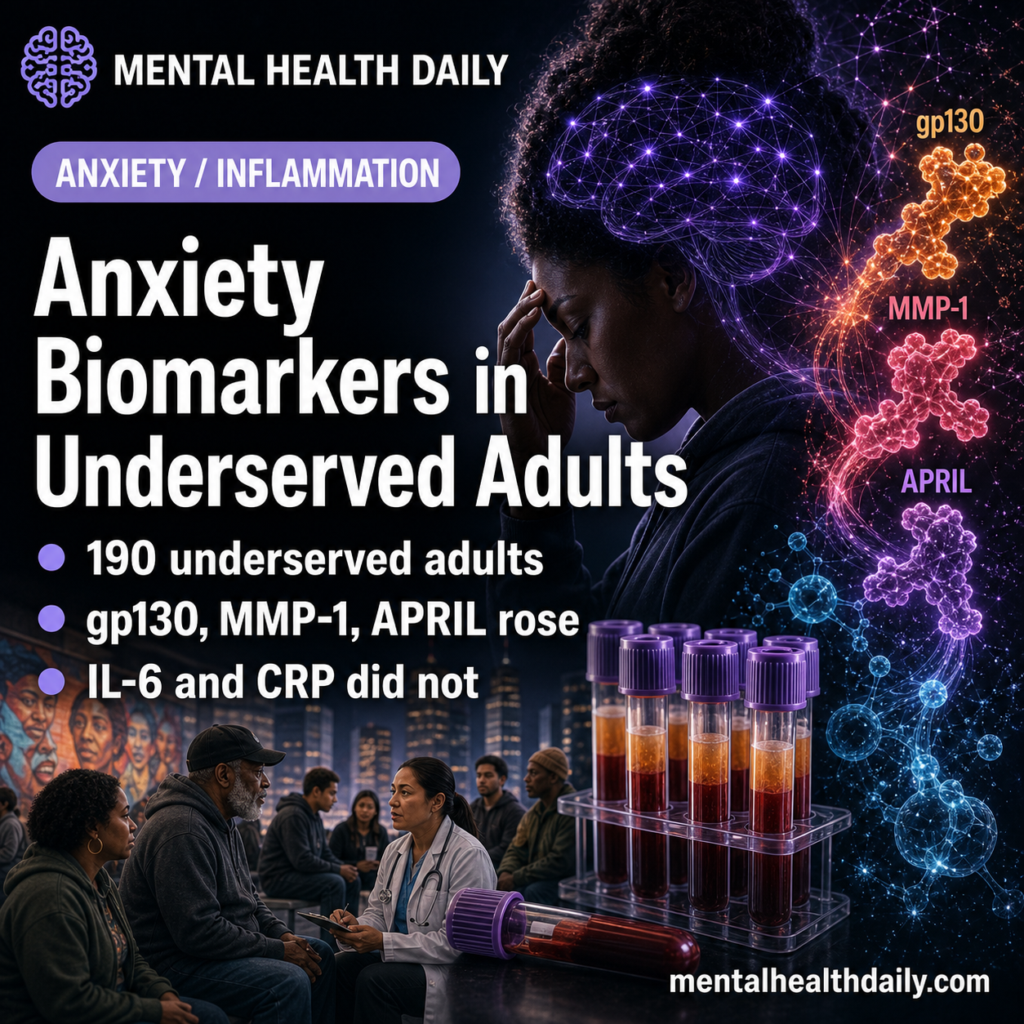
Anxiety Biomarkers: gp130, MMP-1, APRIL in 190 Adults

Stylized illustration of an anxious silhouette overlaid with vials and three biomarker labels (gp130, MMP-1, APRIL), representing the inflammation-anxiety biomarker associations in the Cancer Disparities Research Network cohort.

The link between psychological stress and chronic inflammation is well-documented — what’s been less clear is which specific inflammatory proteins move with anxiety in real-world community samples. A 2026 analysis from Loomans-Kropp et al. measured a 33-marker panel in 190 minoritized and medically underserved adults from the Cancer Disparities Research Network and identified three biomarkers …

Read more

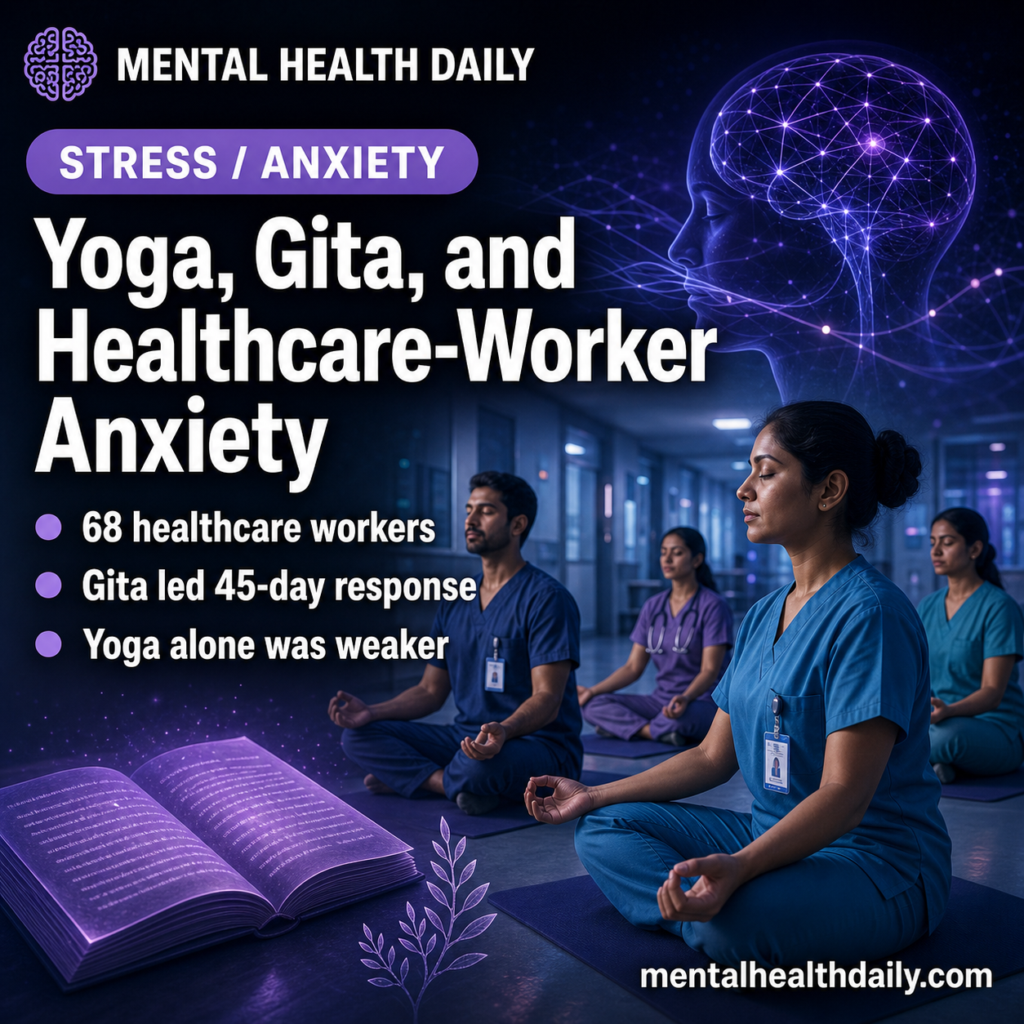
Bhagavad Gita and Yoga Reduced Healthcare-Worker Anxiety in 68-Person Trial

MHD featured image for yoga, Bhagavad Gita teaching, and healthcare-worker anxiety.

A 68-person randomized trial in Indian healthcare workers found a narrow but useful pattern: combined yoga plus Bhagavad Gita teaching beat usual care immediately on GAD-7 anxiety scores (p = 0.009), while Gita teaching alone beat usual care at 45 days (p = 0.047).1 Yoga alone improved within its own arm, but it did not …

Read more

5 Music Therapy Sessions Reduced Psychiatric Stress

MHD featured image for music therapy frequency and psychiatric inpatient stress.

A 2026 randomized trial of 74 psychiatric inpatients found that 5 consecutive MIDI-assisted group music therapy sessions reduced DASS-21 stress more than 1 session during the same hospital week, but the frequency advantage did not extend to anxiety, depression, life satisfaction, or immediate session-impact ratings. Research Highlights Stress separated by frequency: 5 sessions produced a …

Read more

Stress Internalization Predicts Memory Decline in Older Chinese Americans

Editorial card showing an older Chinese American adult and a memory-decline trajectory, illustrating the PINE cohort finding that stress internalization predicts cognitive decline.

A 2025 longitudinal analysis of 1,528 older Chinese Americans by Chen et al. in the Journal of Prevention of Alzheimer’s Disease says something more specific than “stress causes Alzheimer’s”: it isn’t the count of stressors that tracks memory decline — it’s a latent trait the authors call stress internalization, a bundle of high perceived stress, …

Read more

Pets May Help Reduce Anxiety & Depression in Young Adults: Effects of Dog & Cat Ownership (2024 Study)

In the kaleidoscope of mental health solutions, companion animals emerge as silent yet profoundly impactful healers, particularly for the youth navigating the tumultuous journey from adolescence to adulthood. The bond between young adults and their furry companions—dogs and cats alike—extends beyond mere companionship, touching the realms of emotional and psychological well-being. A recent study evaluates …

Read more

Psychological Burnout & Increased Risk of Cardiovascular Disease (CVD) (2024 Review)

Burnout, once a fringe topic relegated to the backburners of occupational health discussions, has emerged as a critical public health crisis with far-reaching consequences. Beyond its immediate toll on mental health and workplace productivity, burnout’s insidious effects extend to one of the body’s most vital systems: the cardiovascular system. Highlights: Elevated Risk: Individuals experiencing burnout …

Read more

Effects of Stress & Negative Life Events on Brain Structure Connectivity in Adolescents (2024 Study)

Adolescence marks a pivotal era of transformation, where the brain undergoes significant development, shaping the trajectory of an individual’s emotional and psychological maturity. Recent studies, including one leveraging data from the IMAGEN Consortium, have evaluated how negative life events during these formative years can subtly yet significantly alter the structural connectivity of the adolescent brain. …

Read more