A 2026 PREDIMED-Plus cohort analysis linked higher olive-oil intake with 2-year cognitive preservation in 656 older adults, with each 10 g/day increment associated with higher global cognition change compared with lower intake (beta 0.044 z-score; 95% CI 0.013 to 0.075; p = 0.006).1 The more specific signal favored virgin olive oil and gut-microbiome diversity, while common olive oil moved in the less favorable direction.
Research Highlights
- Global cognition tracked olive oil: In 656 adults followed for 2 years, each 10 g/day increment in total olive oil was linked to higher global cognition change compared with lower intake (beta 0.044; p = 0.006).1
- Virgin olive oil outperformed common olive oil: Higher virgin olive oil intake was associated with more favorable global, general, executive, and language cognitive changes across tertiles (all p-trend < 0.05).1
- Common olive oil had the less favorable pattern: Common olive oil was linked to lower alpha diversity and less favorable executive-function and language change (p-trend < 0.05).1
- Adlercreutzia was a possible mediator: The bacterial genus explained 20% of the total association with general cognitive function in one mediation model (p = 0.016).1
- Causality remains unproved: This was a prospective observational analysis, not a randomized 2-year olive-oil assignment trial.1
Alpha diversity means within-person microbial richness and evenness: a rough index of how varied the gut microbial community is. Adlercreutzia is a bacterial genus that can participate in polyphenol and isoflavone metabolism, which makes it biologically plausible in diet-microbiome research but not a proven brain-treatment target.
Ni et al. studied adults aged 55 to 75 years with overweight or obesity and metabolic syndrome. Participants provided stool samples, food-frequency data, and neuropsychological testing at baseline and 2-year follow-up.1
656 Adults Had Stool and Cognitive Data Over 2 Years
The analysis came from a random PREDIMED-Plus subsample. Mean age was 65.0 years, 47.9% were women, and the cohort had metabolic risk at baseline. Cognitive testing produced composite scores for global cognition, general cognition, executive function, attention, and language.1
Prospective cohort means diet and microbiome measures were assessed before the 2-year cognitive change outcome, which is stronger than a one-time cross-sectional snapshot. It still does not randomly assign people to virgin olive oil, common olive oil, or no olive oil.
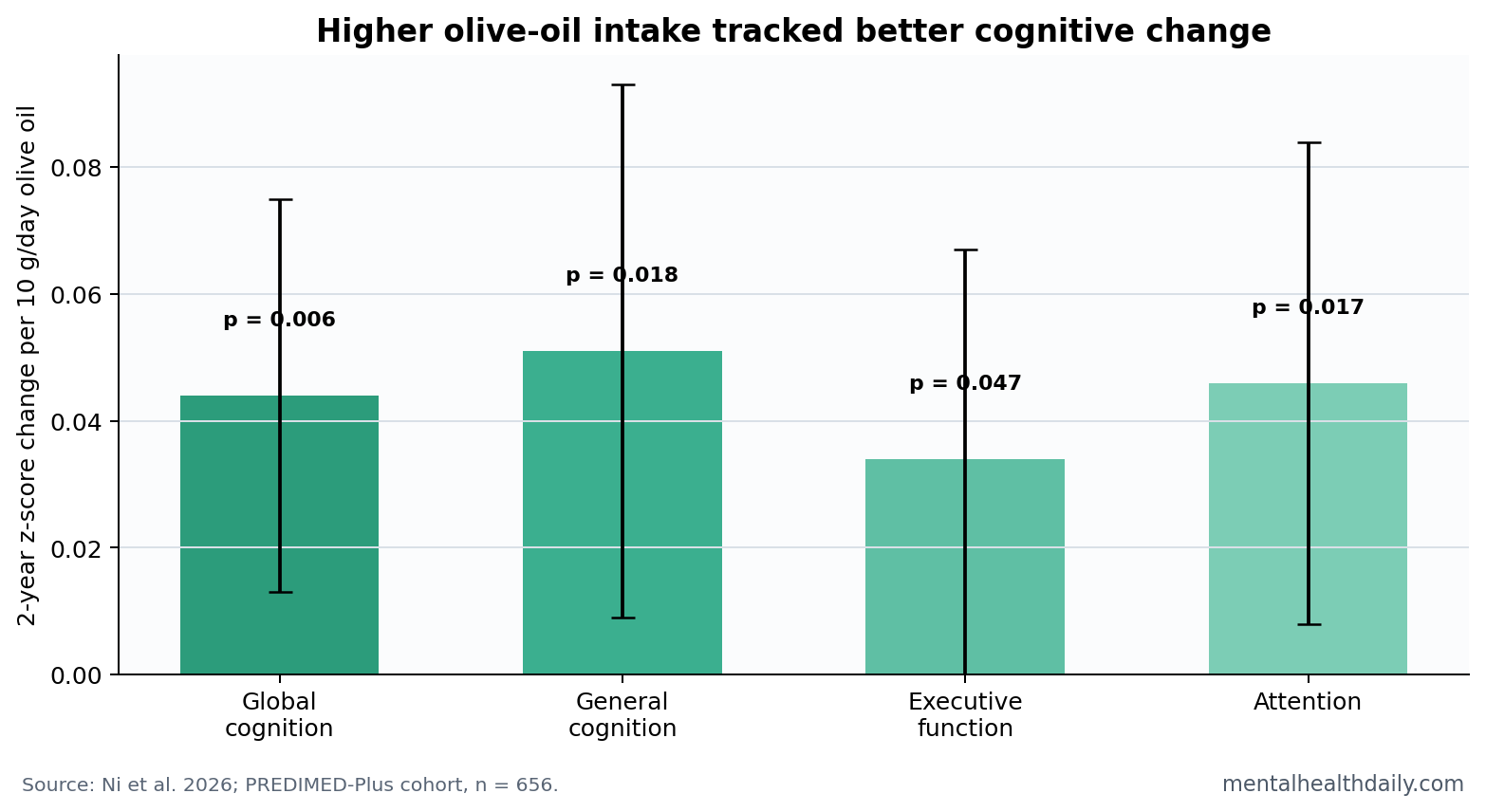
10 g/day More Olive Oil Tracked Better Cognitive Change
In multivariable models, each 10 g/day increment in total olive oil was associated with better global cognitive change (beta 0.044 z-score; 95% CI 0.013 to 0.075; p = 0.006), general cognitive function (0.051; 95% CI 0.009 to 0.093; p = 0.018), executive function (0.034; 95% CI 0.000 to 0.067; p = 0.047), and attention (0.046; 95% CI 0.008 to 0.084; p = 0.017).1
Virgin olive oil showed similar favorable dose-response patterns for global cognition, general cognition, executive function, and language. Common olive oil showed the opposite pattern for some domains: higher intake was associated with lower alpha diversity and less favorable executive-function and language change.1
The distinction is plausible because virgin olive oil contains more phenolic compounds than more refined common olive oil. Still, olive-oil subtype can also tag diet quality, cooking habits, income, education, and health behavior.
Gut Diversity Was Part of the Cognitive Claim
Total and virgin olive oil were linked to microbiome differences. Higher virgin olive oil intake was associated with higher Chao1 and inverse Simpson diversity indices. Common olive oil showed lower alpha diversity and different beta-diversity clustering.1
Beta diversity describes how different microbial communities are from one another. It is useful when the question asks whether the whole community structure differs across diet groups.
Adlercreutzia drew attention because it appeared in mediation results. In the total-olive-oil model, its indirect effect for general cognitive function was beta 0.008, 95% CI 0.002 to 0.017, p = 0.016, accounting for 20% of the total effect.1
Mediation models are easy to oversell. They estimate whether the statistical association between an exposure and an outcome is partly routed through an intermediate variable. In this case, the intermediate variable was a microbial feature, not a directly manipulated pathway.
Reader translation: the analysis is compatible with a gut-brain pathway, especially for virgin olive oil. It is also compatible with a healthier overall dietary pattern producing both a richer microbiome and better cognitive scores.
That distinction is why the common olive oil result is useful. If all olive oil were simply acting as calories from fat, the subtype split would be less informative. The less favorable common-olive-oil pattern suggests that refinement level, phenolic content, and the dietary context around the oil deserve attention.
Population context: these were adults with metabolic syndrome and excess weight, a group already at higher risk for vascular and metabolic contributors to cognitive aging. In that setting, a small z-score difference may reflect multiple pathways at once: better lipid profile, lower inflammation, improved insulin signaling, microbial metabolites, and the broader food pattern that travels with virgin olive oil.
Scale of effect: beta 0.044 z-score per 10 g/day is small for an individual person. Cohort-level prevention often works through small shifts spread across many people and many years. The study is more relevant to long-term risk management than to short-term memory improvement.
Adjacent Trials Keep the Diet-Cognition Signal Plausible
The 2026 cohort fits a wider Mediterranean-diet literature. Valls-Pedret et al. reported cognitive advantages in a Mediterranean-diet randomized trial, Martinez-Lapiscina et al. specifically examined virgin olive oil supplementation and long-term cognition in PREDIMED-Navarra, and Kaddoumi et al. tested extra-virgin olive oil in mild cognitive impairment with brain-barrier outcomes.234
Those studies do not make this microbiome mediation causal. They make the directional finding less isolated. Virgin olive oil is not appearing from nowhere as a single favorable association in one dataset; it sits inside a diet-cognition literature where Mediterranean patterns repeatedly look better than more refined or lower-quality dietary patterns.
Evidence-strength note: the present study can support a prospective association and a plausible mediation hypothesis. It cannot prove that Adlercreutzia causes cognitive preservation or that adding 10 g/day of virgin olive oil will slow dementia.
How to Use the Finding Without Overclaiming It
The useful dietary implication is modest and practical: when olive oil is already part of the diet, virgin olive oil looks more brain-favorable than common olive oil in this cohort. The cohort does not make extra oil on top of an otherwise poor diet equivalent to a Mediterranean pattern.
For cognitive aging, the more defensible package is still dietary pattern plus cardiometabolic risk control: vegetables, legumes, fish, nuts, lower refined carbohydrate load, physical activity, blood-pressure control, and weight/metabolic management. Virgin olive oil may be one useful piece of that package.
A clinician or reader could treat the result as a hierarchy of claims:
- Best supported: Mediterranean-style dietary patterns remain reasonable for cardiometabolic and cognitive-aging risk management.
- Supported but narrower: virgin olive oil looks more favorable than common olive oil in this 2-year cohort.
- Promising but early: gut microbial composition, including Adlercreutzia, may explain part of the cognitive association.
- Unproved: changing one bacterial genus or adding olive oil alone prevents dementia.
That hierarchy keeps the study useful. It gives readers a direction without turning an observational microbiome result into a supplement claim. If choosing between refined common olive oil and virgin olive oil inside a Mediterranean-style pattern, the data lean toward virgin olive oil. If choosing between adding oil and improving the whole diet, the whole diet remains the stronger target.
Comparator logic: the practical question is not virgin olive oil vs. nothing in isolation. It is often virgin olive oil vs. refined oils, butter, ultra-processed dressings, or a low-quality diet pattern. Cognitive-aging claims become more credible when the replacement food and the whole dietary context are named.
Dose context also matters. A 10 g/day increment is roughly a small culinary change, not a license to add unlimited fat calories without considering total diet quality.
The replacement food determines the practical meaning.
That context prevents diet advice from becoming a single-food slogan.
The next useful study would randomize olive-oil subtype inside a controlled dietary pattern, measure stool microbiome repeatedly, and follow cognition long enough to detect meaningful change. That design would test whether the subtype signal survives when background diet is balanced across groups.
Until then, the microbiome result should be read as a plausible bridge between diet quality and cognitive aging. It is a lead for research and a modest nudge for food choice, not a stand-alone treatment claim.
Questions About Olive Oil, Gut Microbes, and Cognition
Did virgin olive oil prevent dementia?
No. The study measured 2-year cognitive z-score changes, not dementia incidence.
Was common olive oil harmful?
The data showed less favorable associations for common olive oil, but observational subtype comparisons can reflect broader diet and lifestyle differences.
Should Adlercreutzia be treated as a supplement target?
No. The mediation result is interesting but early. It is not a clinical target or a probiotic recommendation.
References
- Ni J, et al. Total and different types of olive oil consumption, gut microbiota, and cognitive function changes in older adults. Microbiome. 2026. https://doi.org/10.1186/s40168-025-02306-4
- Valls-Pedret C, et al. Mediterranean diet and age-related cognitive decline: a randomized clinical trial. JAMA Internal Medicine. 2015. PubMed search
- Martinez-Lapiscina EH, et al. Virgin olive oil supplementation and long-term cognition: the PREDIMED-Navarra randomized trial. Journal of Nutrition, Health and Aging. 2013. PubMed search
- Kaddoumi A, et al. Extra-virgin olive oil enhances the blood-brain barrier function in mild cognitive impairment: a randomized controlled trial. Nutrients. 2022. PubMed search