
An 11-person case series tested delayed-release apple cider vinegar capsules in young adults who had gained weight while taking psychotropic medications, and metabolic markers carried more signal than weight loss.
Research Highlights
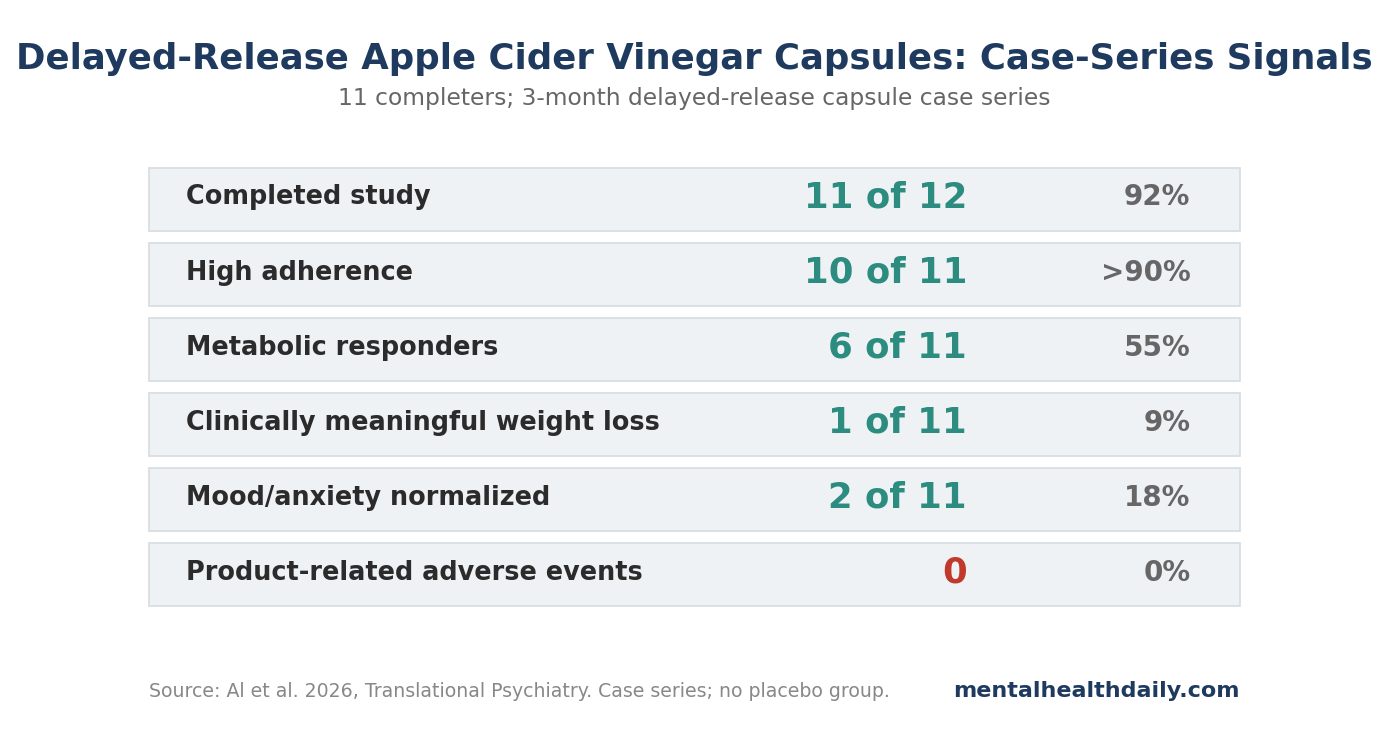
- Feasibility was the strongest result: 11 of 12 enrolled participants completed the study, 10 of 11 completers missed 5 or fewer doses, and no product-related adverse events were reported.1
- Weight loss was limited: only 1 participant had clinically meaningful weight loss, dropping 7.6 kg and moving from body mass index (BMI; weight adjusted for height) 31.2 to 28.7 kg/m².
- Lipid changes drove the metabolic signal: 6 participants were classified as metabolic responders, mostly because low-density lipoprotein (LDL; cholesterol linked to higher cardiovascular risk) or total cholesterol improved.
- Microbiome results were exploratory: stool sequencing in 10 paired samples suggested shifts in gut bacteria and inferred functions, including enrichment of butyrate-producing taxa, but the case-series design cannot prove acetate caused those changes.
- Trial readiness is the main result: this 11-person paper supports testing delayed-release apple cider vinegar capsules in a randomized trial; it does not support using them as proven treatment for psychotropic medication-related weight gain.
For many people, psychotropic medications create serious metabolic problems. Antipsychotics, mood stabilizers, and some antidepressants can raise weight, lipids, glucose risk, and cardiovascular burden, and those effects can reduce willingness to stay on medication.23
Al et al. tested a different kind of adjunct: enteric-coated apple cider vinegar capsules designed to deliver acetate to the gut. Acetate is a short-chain fatty acid (SCFA; a small molecule made by gut bacteria during fiber fermentation) that can affect microbial ecology and host metabolism.
11 Young Adults Completed 3 Months of Delayed-Release Capsules
The 2026 case series enrolled 12 people and analyzed 11 completers. Participants were 22-32 years old, were taking psychotropic medications for affective disorders, and reported medication-linked weight gain. Every completer began with BMI above 30 kg/m², with average pre-intervention BMI 35.6 kg/m².
The intervention was not ordinary liquid vinegar. Participants took delayed-release apple cider vinegar capsules for 3 months, after a baseline phase and before a 1-month follow-up phase. The delayed-release design was meant to reduce rapid upper-gut absorption and expose the lower gut microbiota to acetate-containing material.
A compact study snapshot makes the design easier to read:
- Population: young adults with mood or anxiety disorders who linked weight gain to psychotropic medication use.
- Intervention: delayed-release apple cider vinegar capsules, 2 doses per day, 3 capsules per dose.
- Completion: 11 of 12 enrolled participants finished the protocol.
- Adherence: 10 of 11 completers missed 5 or fewer doses.
- Main measures: weight, BMI, blood pressure, lipid markers, depression scores, anxiety scores, and stool microbiome sequencing.
For feasibility, the result was favorable. Participants rated capsule-taking ease at 3.3 on a 1-4 scale, where 4 meant easiest, and overall study participation at 3.7. No product-related adverse events were reported.
Lipids Improved More Often Than Weight
The weight-loss result was narrow. Only participant #11 met the study threshold for clinically meaningful weight reduction, dropping from 88.7 kg to 81.1 kg and from BMI 31.2 to 28.7 kg/m².1 The other 10 completers did not show meaningful weight change.
The lipid results were stronger, though still uncontrolled. The researchers classified 6 of 11 completers as metabolic responders: 5 because lipid markers improved and 1 because BMI improved. No participant shifted from healthy to unhealthy lipid levels during the study.
The most concrete lipid changes were:
- Total cholesterol: 3 participants moved below the 5.2 mmol/dL clinical-risk threshold.
- HDL cholesterol: 1 participant moved from an abnormal HDL value of 1.48 mmol/dL to a normal value of 1.77 mmol/dL. HDL is often called “good” cholesterol because higher values tend to track lower cardiovascular risk.
- LDL cholesterol: all but 2 participants had lower LDL after the intervention, and 3 moved below the 2.6 mmol/dL risk threshold or close to it.
- Responder definition: the researchers counted LDL improvement as clinically meaningful when it crossed below 2.6 mmol/dL or fell by at least 15%.
That LDL threshold is worth separating from the weight claim. The intervention did not produce broad weight loss. It produced a small case-series signal that some lipid profiles improved while weight mostly stayed stable.
Evidence strength: very low for efficacy, stronger for feasibility. This was an uncontrolled 11-person case series, so it can show that the capsule protocol was tolerable and worth testing, but it cannot prove that delayed-release apple cider vinegar caused the lipid, mood, anxiety, or microbiome changes.
Microbiome Changes Were Plausible but Not Proof of Mechanism
The researchers used 16S ribosomal RNA sequencing (16S rRNA sequencing; a method for profiling bacterial groups from genetic marker sequences) on stool samples. Among the 10 participants with paired stool samples, dominant genera included:
- Bacteroides: a common gut genus involved in carbohydrate metabolism and bile-acid-related pathways.
- Blautia: a genus often discussed in metabolic and inflammatory gut-microbiome research.
- Faecalibacterium: a butyrate-producing genus often treated as a marker of gut microbial health.
- Agathobacter: another butyrate-linked genus in the Lachnospiraceae family.
- Bifidobacterium: a genus commonly discussed in probiotic, fiber, and gut-barrier research.
Baseline differences between people were large. Timepoint alone did not significantly explain beta diversity, meaning the overall between-sample microbial distance showed no clear group-level shift after capsules. But interindividual beta diversity decreased after the intervention (Tukey test p = 0.04), suggesting the microbiomes became more similar to one another after supplementation.
Alpha diversity, a within-sample diversity measure, did not significantly change across the full sample. The responder analysis was more suggestive: 4 of 13 alpha-diversity metrics had p values below 0.05 for the timepoint-by-responder comparison, with metabolic responders trending toward increased diversity.
The mechanism is plausible because short-chain fatty acids sit at the intersection of gut microbial metabolism, immune signaling, appetite, insulin regulation, and lipid handling.6 But the study measured relative bacterial composition and inferred function, not direct acetate exposure in tissues or causal metabolic pathways.
Psychotropic Medications Can Raise Weight and Lipids
Medication side effects: Metabolic side effects can make otherwise effective psychiatric drugs harder to stay on. A major World Psychiatry review by Correll et al. summarized the physical-disease burden linked to antipsychotics, antidepressants, and mood stabilizers in schizophrenia, depression, and bipolar disorder.3
A 2024 network meta-analysis in bipolar disorder likewise found that metabolic effects vary by antipsychotic and mood stabilizer, which makes drug choice and monitoring matter.2
Prior vinegar evidence: Apple cider vinegar has a separate metabolic literature, but it is mixed and usually not psychiatric. A 2021 systematic review and meta-analysis reported effects on lipid profiles and glycemic parameters across randomized trials, but the studies varied in design, dose, and population.4 A small clozapine pilot study tested apple vinegar in schizophrenia and constipation/metabolic outcomes, but that was not enough to settle efficacy.7
Gut-brain caution: Dilmore et al. reported that medication use was associated with distinct microbial features in anxiety and depression, meaning psychiatric medication exposure itself may shape gut profiles.5
Dalile et al. showed in a randomized trial that colon-delivered short-chain fatty acids attenuated cortisol response to psychosocial stress in healthy men, supporting a gut-to-stress-biology route.6 Neither paper proves apple cider vinegar capsules treat psychotropic weight gain.
Limitations of This Case Series
No placebo group. Without randomization, blinding, or placebo capsules, the study cannot separate the intervention from time, expectancy, repeated contact with researchers, diet changes, activity shifts, sleep fluctuation, or medication changes.
Small and heterogeneous sample. The final sample had 11 completers on varied psychiatric medications. A result in 6 metabolic responders can justify a trial, but it cannot estimate a stable response rate.
Mood and anxiety results are secondary. Nine of 11 participants improved on mood and/or anxiety scores, and 2 moved from abnormal to below-threshold values. Those outcomes are especially vulnerable to expectancy and study-contact effects.
The microbiome method has limited resolution. 16S rRNA sequencing can profile bacterial groups, but it does not give full strain-level function. The functional analysis inferred metagenomes from taxonomy, so it cannot replace shotgun metagenomic sequencing.
Acetate was not isolated. Apple cider vinegar contains other bioactive compounds, including polyphenols. The study did not measure acetate bioavailability or tissue exposure, so it cannot prove acetate was the active component.
Questions About Apple Cider Vinegar and Psychotropic Weight Gain
Does this mean apple cider vinegar treats antipsychotic or antidepressant weight gain?
No. This case series found feasibility and selected metabolic improvements, but only 1 participant had clinically meaningful weight loss. A randomized placebo-controlled trial is needed before treating this as an evidence-based intervention.
Was delayed-release apple cider vinegar safe in this study?
In this 11-person completer sample, no product-related adverse events were reported. Vinegar products can still interact with gastrointestinal symptoms, glucose control, potassium balance, and medication routines in susceptible people.
Which result is most worth following up?
The lipid signal is more interesting than the weight signal. Several participants improved LDL or total cholesterol while body weight mostly stayed stable, which suggests the next trial should measure lipids, insulin/glucose markers, body composition, diet, medication exposure, and gut microbiome changes together.
Should people on psychotropics try this on their own?
This paper is too early for that conclusion. People taking psychotropic medications should prioritize standard metabolic monitoring, medication review, nutrition, activity, sleep, and evidence-based options for antipsychotic-associated weight gain. Vinegar capsules remain experimental for this specific use.
References
- A Case-Series of Oral Acetate Supplementation for Gut Microbiota Alteration and Metabolic Improvement in Patients with Affective Disorders on Psychotropics. Al KF et al. Translational Psychiatry. 2026. doi:10.1038/s41398-026-04046-x
- Effect of Antipsychotics and Mood Stabilisers on Metabolism in Bipolar Disorder: A Network Meta-Analysis of Randomised-Controlled Trials. Kong L et al. EClinicalMedicine. 2024;71:102581. doi:10.1016/j.eclinm.2024.102581
- Effects of Antipsychotics, Antidepressants and Mood Stabilizers on Risk for Physical Diseases in People with Schizophrenia, Depression and Bipolar Disorder. Correll CU et al. World Psychiatry. 2015;14(2):119-136. doi:10.1002/wps.20204
- The Effect of Apple Cider Vinegar on Lipid Profiles and Glycemic Parameters: A Systematic Review and Meta-Analysis of Randomized Clinical Trials. Hadi A et al. BMC Complementary Medicine and Therapies. 2021;21:179. doi:10.1186/s12906-021-03351-w
- Medication Use Is Associated with Distinct Microbial Features in Anxiety and Depression. Dilmore AH et al. Molecular Psychiatry. 2025. doi:10.1038/s41380-024-02857-2
- Colon-Delivered Short-Chain Fatty Acids Attenuate the Cortisol Response to Psychosocial Stress in Healthy Men: A Randomized, Placebo-Controlled Trial. Dalile B et al. Neuropsychopharmacology. 2020;45(13):2257-2266. doi:10.1038/s41386-020-0732-x
- Effect of Apple Vinegar Intake on Metabolic Parameters and Constipation in Patients with Schizophrenia Treated with Clozapine: A Pilot Study. Hjorth P et al. Nordic Journal of Psychiatry. 2021;75(2):152-154. doi:10.1080/08039488.2020.1799432