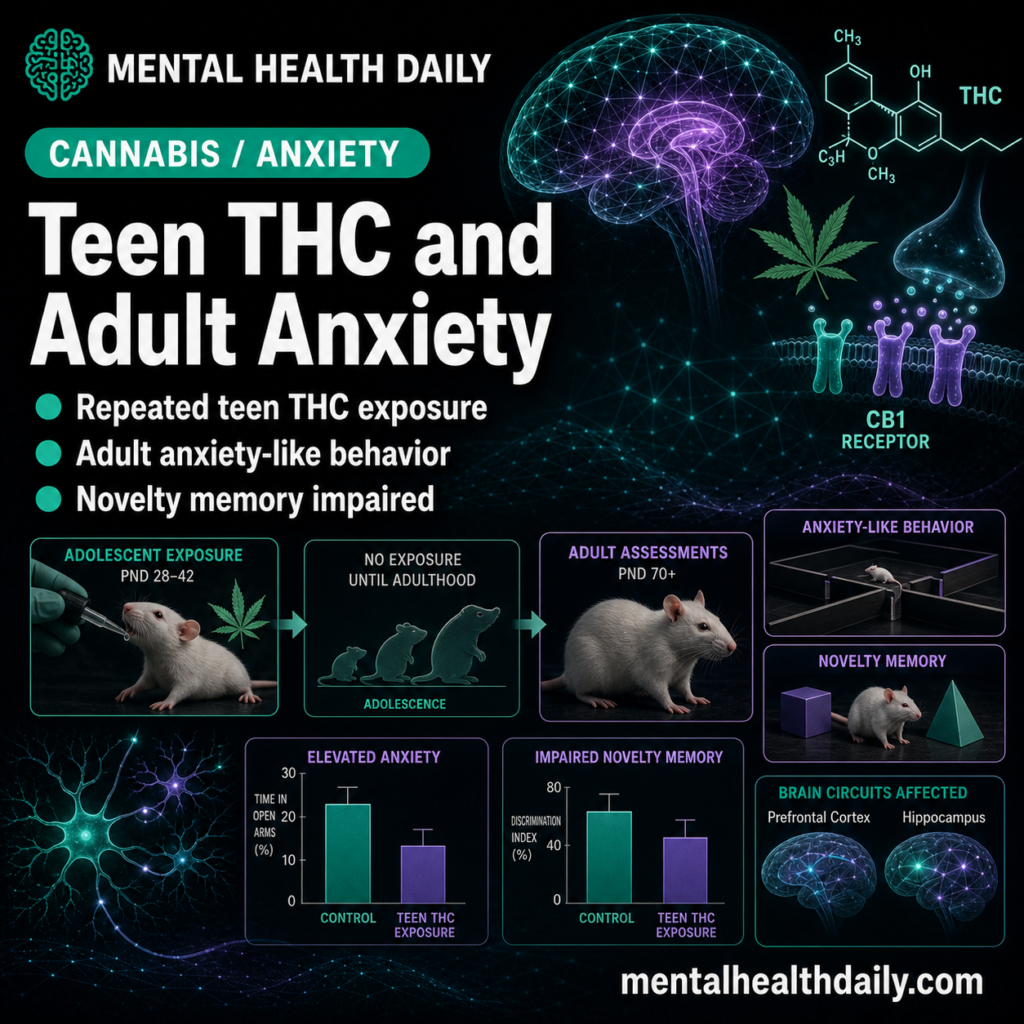
A 2026 rat study found that 21 days of late-adolescent tetrahydrocannabinol (THC) exposure produced adult anxiety-like behavior in the elevated plus maze and weaker novel object recognition than vehicle exposure. The controlled animal result gives a biologically anchored model for why repeated high-THC exposure during development remains a real concern.1
Research Highlights
- Late-adolescent THC exposure was modeled: male Sprague-Dawley rats received THC 5 mg/kg/day from postnatal day 42 to 62, roughly a late-adolescent developmental window in rats.1
- Blood THC reached human-relevant levels: 1 hour after injection, blood THC reached 75.0 ng/mL on day 1 and 80.0-92.4 ng/mL after repeated exposure.1
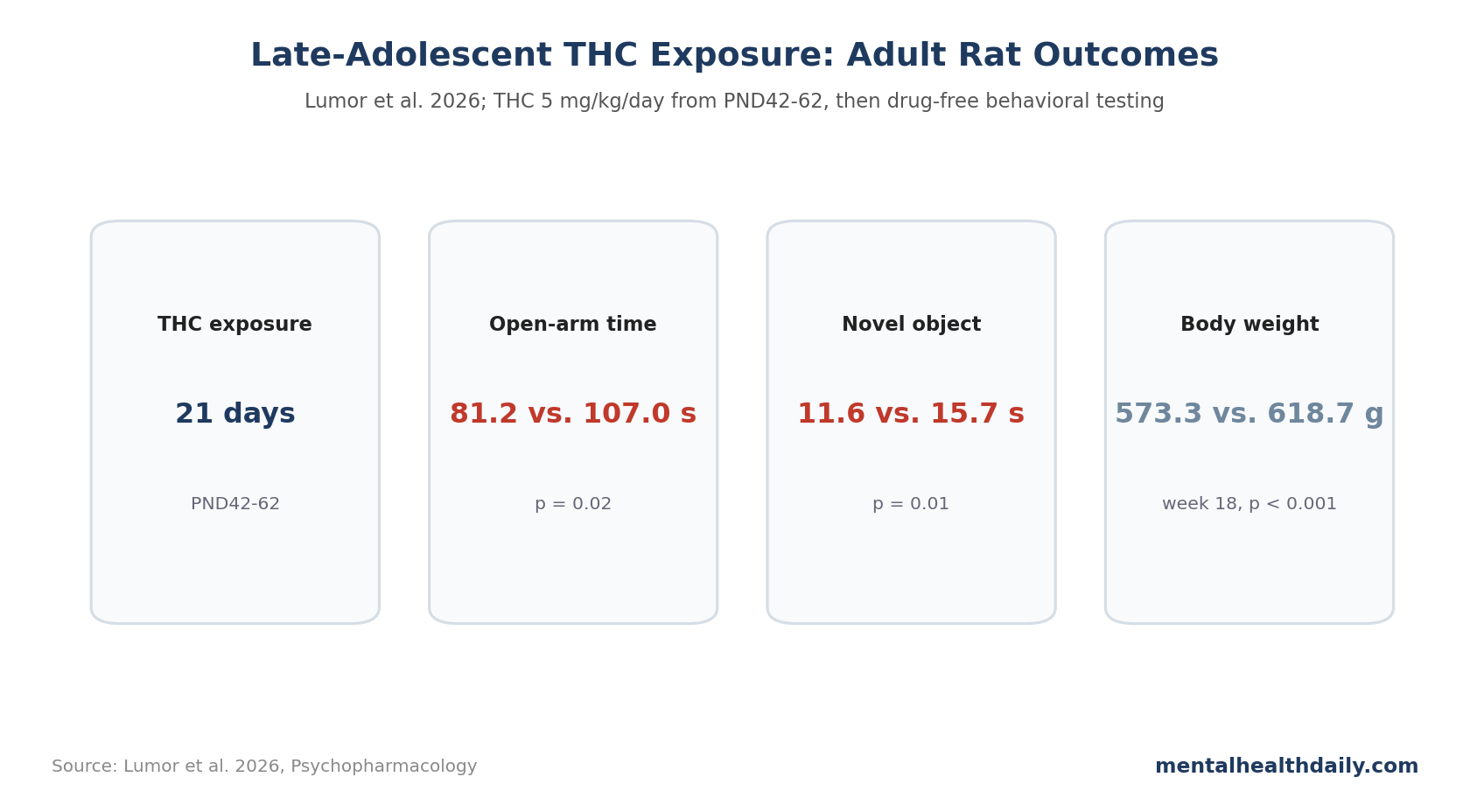
- Adult anxiety-like behavior emerged: THC-exposed rats spent less time in open arms of the elevated plus maze (81.2 vs. 107.0 seconds; p = 0.02).1
- Novel object recognition was impaired: THC-exposed rats explored the novel object less (11.6 vs. 15.7 seconds; p = 0.01), with a 50% reduction in novelty preference.1
- Spatial memory was less definitive: Morris water maze results did not show a clean overall impairment, so the cognitive signal was strongest for recognition memory rather than broad learning failure.1
The study did not show that THC made every adult rat anxious and cognitively impaired. It showed a mixed pattern: 1 anxiety assay moved, 1 did not; 1 memory test moved clearly, another was mixed.
That pattern is still meaningful because adolescent cannabis exposure is not one thing. Dose, THC potency, cannabidiol (CBD) content, sex, age window, stress exposure, and abstinence duration can all change the result.
PND42-62 THC Modeled Repeated Late-Adolescent Exposure
Lumor et al. randomized male Sprague-Dawley rats to THC or vehicle. The THC group received 5 mg/kg/day for 21 consecutive days from postnatal day (PND) 42 to 62; PND is the animal's age in days after birth.1
The study began with 21 THC-exposed rats and 15 vehicle-exposed rats. A subgroup of 6 THC-exposed animals provided blood and brain tissue data. Behavioral testing used 15 animals per group, with specific outlier exclusions depending on the assay.
The design separated active intoxication from later behavior. Anxiety-like behavior and cognitive testing happened after at least 9 drug-free days, separating the adult behavioral findings from acute intoxication during testing.
- Exposure window: PND42-62, a rat late-adolescent period.
- Dose: THC 5 mg/kg/day by subcutaneous injection.
- Assays: elevated plus maze, light-dark transition, novel object recognition, and Morris water maze.
- Pharmacology check: blood and brain THC metabolites were measured rather than assumed.
The dose produced blood THC concentrations the researchers described as comparable to human cannabis users. That does not make the model identical to smoking, vaping, or edible use, but it does prevent the easy dismissal that the exposure was pharmacologically irrelevant.
THC Levels Were High Enough to Treat the Model Seriously
Blood THC was measurable at user-relevant levels: 1 hour after the first injection, blood THC reached 75.0 ± 8.2 ng/mL. After repeated exposure, 1-hour post-injection values ranged from 80.0 to 92.4 ng/mL across days 7, 14, and 21.1
Residual exposure persisted between doses: residual THC 24 hours after injection ranged from 16.9 to 21.6 ng/mL. The metabolite THC-COOH rose above 11-hydroxy-THC after repeated exposure, and brain THC 1 hour after the final injection reached 162.2 ± 6.6 ng/g.
Those numbers are important because adolescent THC animal papers can be hard to interpret if the exposure is too low, too high, or not measured. Here, the pharmacokinetic layer gives the behavioral results a firmer anchor.
Growth effects were not transient: after 4 days, THC-treated rats weighed 7% less than vehicle animals (p = 0.009). Around day 18, the gap reached about 12% (p < 0.001). At 18 weeks, long after dosing stopped, THC-exposed rats weighed 573.3 g vs. 618.7 g in the vehicle group (p < 0.001).1
Weight is not the main mental-health outcome, but it is not noise. Developmental drug exposure that persistently changes growth can also change activity, motivation, stress physiology, endocrine function, and behavior-test interpretation.
Elevated Plus Maze Moved; Light-Dark Transition Did Not
The strongest anxiety-like finding came from the elevated plus maze, a standard rodent test based on open-arm avoidance. Rodents generally avoid exposed open arms when anxiety-like behavior is higher.
THC-exposed rats spent less time in open arms than vehicle rats:
- Open-arm time: 81.2 vs. 107.0 seconds, t(25.15) = 2.56, p = 0.02.
- Open-arm entries: 14.1 vs. 17.7 entries, p = 0.06.
- Latency to first open-arm entry: no significant group difference.
- Total distance traveled: no significant group difference reported.
Less open-arm time means the THC-exposed rats behaved as if the exposed arms were more threatening. The p = 0.06 entry result pointed in the same direction but did not cross the conventional p < 0.05 threshold.
The light-dark transition test did not show significant differences in time spent in the light compartment, number of light-compartment entries, or latency to first light entry. That is not a contradiction so much as a measurement warning: anxiety-like behavior is not one perfectly stable trait across every rodent assay.
Novel Object Recognition Was the Clearest Cognitive Hit
The novel object recognition result was more direct than the spatial-memory result. In phase 2, THC-exposed rats spent less time exploring the novel object than vehicle animals: 11.6 ± 1.1 vs. 15.7 ± 0.8 seconds, p = 0.01.1
The study also reported a 50% reduction in novelty preference in THC-exposed rats (p = 0.001), plus a lower discrimination index: −0.08 vs. 0.09, p = 0.01.
Novel object recognition is not an IQ test. It is a memory and attention assay based on whether an animal spends more time with a new object after being familiarized with other objects. Lower novelty preference can reflect weaker recognition memory, altered curiosity, reduced exploration, or motivational differences.
The researchers tested whether the recognition signal was simply anxiety in disguise. Novelty preference did not significantly correlate with open-arm time in the elevated plus maze (r = 0.265, p = 0.38). That does not fully separate anxiety from cognition, but it argues against a simple one-variable explanation.
Spatial Memory Results Were Mixed, Not Globally Impaired
The Morris water maze did not show an overall group difference in learning across acquisition days: F(1,38) = 2.08, p = 0.16. On day 2, THC-exposed rats had a shorter path distance to the platform than vehicle rats, but the vehicle group showed more consistent improvement across later days.1
The best interpretation is narrower than “THC caused broad cognitive decline.” Recognition memory showed a clean signal; spatial learning and short-term retention were less definitive.
That distinction fits the wider cannabis-cognition literature. Human meta-analyses often find small-to-moderate cognitive associations with adolescent or heavy cannabis use, but effect sizes shrink after abstinence and confounding control.2,3
Animal models help because dose, age window, sex, and environment can be controlled. But the translation still has limits: rats do not choose cannabis, do not have human social context, and receive controlled THC without the full mix of cannabis constituents.
Teen THC Risk Depends on Potency, Timing, and Biology
Several adjacent papers converge on the same general concern: adolescent cannabinoid exposure can leave durable behavioral or neural effects in rodents, especially in prefrontal, hippocampal, GABAergic, dopamine, and endocannabinoid systems.4,5
The modern public-health problem is potency. Average THC content in many markets is far higher than older cannabis, while CBD exposure is often low. THC and CBD are not interchangeable; a teen using high-THC products daily is not exposed to the same pharmacology as occasional low-potency cannabis.
For readers, the risk pattern is straightforward:
- Earlier and heavier exposure is the higher-risk pattern. The developmental window matters.
- High-THC products are not benign because cannabis is “natural.” The active compound has measurable brain and behavior effects.
- Animal data do not equal destiny. They identify plausible mechanisms and risk windows, not individual fate.
- CBD content, sex, stress, sleep, and psychiatric vulnerability may modify risk. Those variables need cleaner study designs.
Limitations of This THC Rat Study
- Male rats only. Sex differences are central in adolescent cannabinoid research, so the findings cannot be assumed to generalize to females.
- Injection is not human use. Subcutaneous THC produces controlled exposure, but it is not smoking, vaping, or edible consumption.
- Pure THC is not whole cannabis. Human products contain many cannabinoids and terpenes, often with variable CBD content.
- Behavior assays are proxies. Elevated plus maze and novel object recognition map to anxiety-like and memory-related behavior, not human diagnoses.
- One dose window: 5 mg/kg/day from PND42-62 is informative, but it does not define a full dose-response curve.
Questions About Teen THC and Brain Development
Does this prove teen cannabis causes anxiety disorders?
No. It is a controlled rat model showing later anxiety-like behavior after adolescent THC exposure. Human anxiety disorders require different evidence.
Why use “teen THC” if the study was in rats?
Because the modeled exposure window is late adolescence. The body text keeps that distinction explicit so the title is searchable without pretending the study was a human teen trial.
Was cognition broadly impaired?
No. Novel object recognition was impaired; Morris water maze spatial learning was mixed and did not show a clean overall group effect.
What does this rat study add to teen THC risk?
Repeated high-THC exposure during development can leave measurable adult behavioral effects in a controlled animal model. That supports caution around frequent teen high-THC use, especially when potency is high and use is early or heavy.
References
- Long-term effects of adolescent THC exposure on anxiety-like behavior and cognitive function in male rats. Lumor LS, et al. Psychopharmacology. 2026. doi:10.1007/s00213-026-07067-y
- Association of cannabis with cognitive functioning in adolescents and young adults. Scott JC, et al. JAMA Psychiatry. 2018;75:585-595. doi:10.1001/jamapsychiatry.2018.0335
- The short-term and long-term effects of cannabis on cognition. Kroon E, et al. Current Opinion in Psychology. 2021;38:49-55. doi:10.1016/j.copsyc.2020.07.005
- Adolescent THC exposure causes enduring prefrontal cortical disruption of GABAergic inhibition and subcortical dopamine dysregulation. Renard J, et al. Scientific Reports. 2017;7:11420. doi:10.1038/s41598-017-11645-8
- Changes in hippocampal morphology and neuroplasticity induced by adolescent THC treatment are associated with cognitive impairment in adulthood. Rubino T, et al. Hippocampus. 2009;19:763-772. doi:10.1002/hipo.20554