A 2026 fMRI study found language and theory-of-mind activation already separated in 54 child sessions from ages 3-9, with strict child overlap near zero in the left superior temporal lobe (Dice 0.015) and no evidence that the 2 systems disentangled with age.1 The result pushes against a simple developmental story in which language grows out of a shared social-reasoning processor and only later splits into its own cortical network.
Research Highlights
- Early separation was visible: Hiersche et al. analyzed 54 usable child sessions from 42 children ages 2.97-9.07 years and found language and theory-of-mind activation already separated in the superior temporal lobe.1
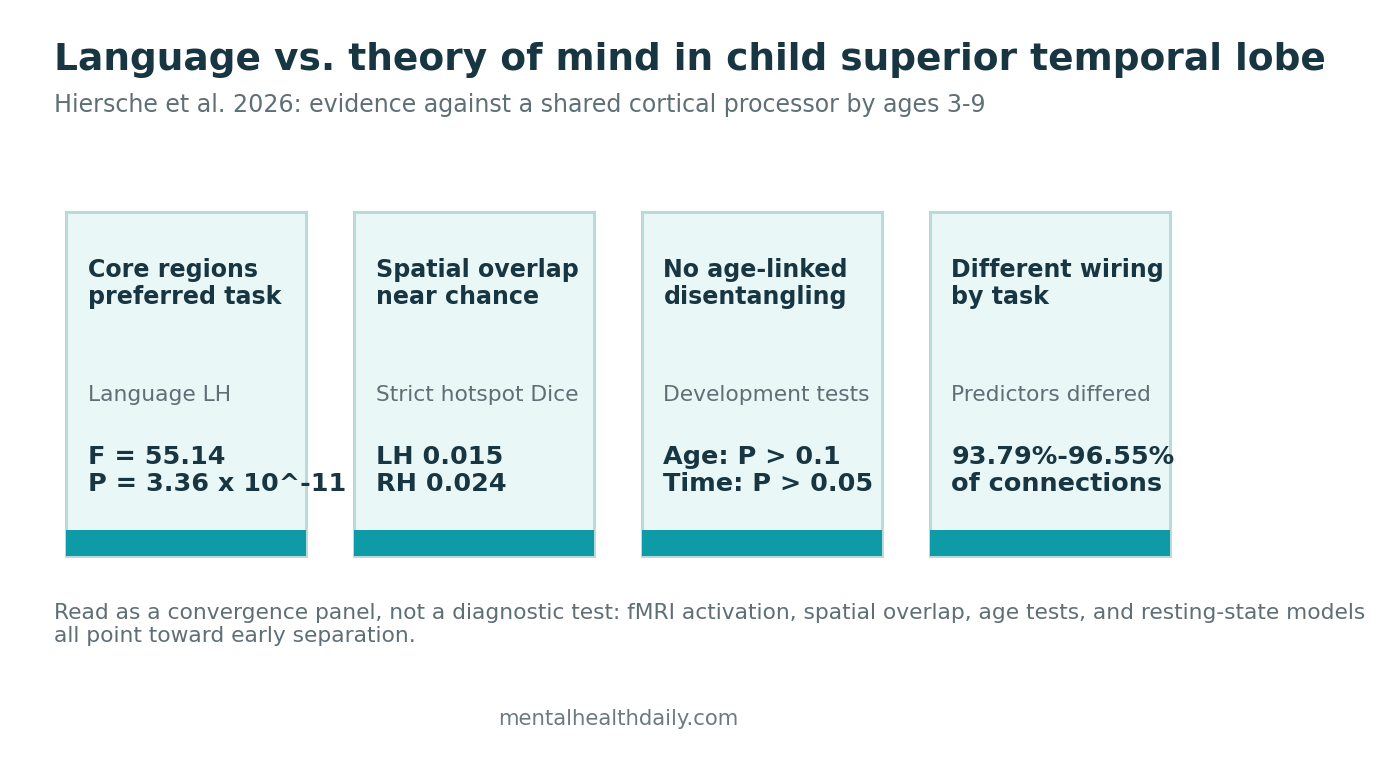
- Core child regions preferred their own task: child left-language regions showed F(1,103) = 55.14, P = 3.36 x 10^-11, while child right-theory-of-mind regions showed F(1,97) = 23.62, P = 4.51 x 10^-6.1
- Spatial overlap stayed low: at the strict 1% hotspot threshold, child Dice overlap was 0.015 in the left superior temporal lobe and 0.024 in the right superior temporal lobe.1
- Disentangling did not appear with age: overlap was not correlated with age at any threshold (all P > 0.1) and did not change across longitudinal timepoints (all P > 0.05).1
- Connectivity fingerprints also split: 93.79%-96.55% of child connectivity predictors differed between language and theory-of-mind models after correction, meaning the wiring patterns were not interchangeable.1
Theory of mind means inferring another person’s beliefs, desires, intentions, or emotions. It is central to social cognition because a child can hear the same words and still need to infer what the speaker knows, wants, or falsely believes.
The superior temporal lobe is a side-of-the-brain cortical region that includes areas involved in auditory language, speech, social perception, and mental-state reasoning. Hiersche et al. focused there because it is the place where overlap between language and theory-of-mind systems would be most plausible if both functions began from a common social-communication substrate.1
54 Child Sessions Showed Separate Language and Mentalizing Signals
Hiersche et al. recruited children and adults for functional MRI tasks designed to localize language and theory-of-mind responses inside each person’s brain.1 The final cross-sectional child sample included 54 usable sessions from 42 children, with a mean age of 6.33 years and a range from 2.97 to 9.07 years. The adult replication sample included 28 adults.
Functional MRI measures blood-oxygen-level changes that track local neural activity indirectly. It cannot prove what a region is necessary for, but it can show whether a region responds more to one mental task than another under controlled conditions.
The study used 2 child-tolerable tasks. The language localizer used meaningful sentences vs. nonsense or acoustically matched speech. The theory-of-mind task used the short animated film Partly Cloudy, with timepoints coded for mentalizing content vs. physical pain content.
Functional regions of interest (fROIs) are subject-specific brain patches selected because they respond reliably to a task in that person. This matters because language and social-cognition regions are not perfectly aligned across people; group-average maps can blur neighboring systems into artificial overlap.
Children showed the same broad pattern as adults: core language regions responded more to language, and core theory-of-mind regions responded more to mentalizing. In children, the left-language region had a strong task effect, F(1,103) = 55.14, P = 3.36 x 10^-11, with post-hoc d = 1.02. The right-language region also differentiated language from mentalizing, F(1,105) = 17.17, P = 6.94 x 10^-5.
The theory-of-mind regions showed the mirror pattern. Child left-theory-of-mind regions preferred mentalizing over language, F(1,97) = 6.82, P = 0.010, and child right-theory-of-mind regions showed a stronger task effect, F(1,97) = 23.62, P = 4.51 x 10^-6. Marginal regions such as angular gyrus were less clean, but the core network split was already present.
Brain Hotspots Did Not Look Like a Shared Social-Language Map
The stronger test was spatial overlap. If language and theory-of-mind functions were pulling from the same developing tissue, the most language-responsive and most mentalizing-responsive voxels should overlap more than chance, especially in younger children.
Dice overlap is a 0-to-1 spatial-overlap score: 0 means no overlap, and 1 means complete overlap. Hiersche et al. calculated overlap across several hotspot thresholds and used spin tests to ask whether true overlap exceeded what would be expected by chance after preserving spatial structure.1
At the strict 1% hotspot threshold, child overlap was tiny: left superior temporal lobe Dice 0.015 and right superior temporal lobe Dice 0.024. At the more liberal 30% threshold, overlap rose to 0.299 on the left and 0.313 on the right, but most children still showed overlap no different from chance: 90.7% on the left and 96.3% on the right.
The cross-hemisphere version was also important. Rajimehr et al. had reported complementary hemispheric lateralization of language and social processing in adults, raising a possible homotopy idea: language might be the left-hemisphere counterpart of a right-hemisphere social system.2 Hiersche et al. tested that directly by comparing left-hemisphere language hotspots with right-hemisphere theory-of-mind hotspots.
Children again showed little evidence for shared spatial architecture. At the strict 1% threshold, left-language vs. right-theory-of-mind overlap was 0.012, and 92.6% of children had overlap no different from chance. At the 30% threshold, overlap was 0.262, and 100% of children were still in the chance-like range.
No Age-Linked Disentangling Appeared From 3 to 9
A developmental disentangling model predicts a visible age gradient: younger children should show more cross-task response or more overlap, while older children should show less. Hiersche et al. looked for that pattern in both cross-sectional and longitudinal data.
They did not find it. Selectivity to the non-preferred task did not decline with age in the core regions, with all core-region age tests P > 0.1. Spatial overlap was not correlated with age at any threshold, also all P > 0.1. In children with repeated scans, overlap did not decrease across timepoints, all P > 0.05.1
Evidence-strength note: this is not proof that language and mentalizing are separate from birth. The youngest usable children were about 3 years old, and the study cannot see infant cortical organization. The narrower conclusion is still strong: by the age when false-belief reasoning is still emerging, the superior temporal lobe already shows separate language and mentalizing responses.
Richardson et al. fit this picture from the social-cognition side. Their developmental fMRI study found theory-of-mind brain responses from age 3 to 12, supporting the idea that mentalizing regions are not waiting until late childhood to become organized.3 Hiersche et al. add the language comparison: the early social-brain signal does not appear to be the same signal as high-level language.
Different Connectivity Fingerprints Supported the 2 Functions
Connectivity fingerprints are patterns of links between a target region and the rest of the brain. The working idea is that a region’s connections help constrain what function it can develop: a patch connected strongly to language-network nodes may become language-selective, while a patch connected strongly to mentalizing nodes may become theory-of-mind-selective.
Hiersche et al. trained models that used resting-state connectivity to predict each person’s task activation in the superior temporal lobe. In children, connectivity predicted left-language activation with mean correlation 0.32 and predicted theory-of-mind activation with mean correlations 0.41 on the left and 0.44 on the right.1
The models were not interchangeable. In children, 96.55% of left-hemisphere predictors and 93.79% of right-hemisphere predictors differed between language and theory-of-mind models after Bonferroni-Holm correction. Applying the wrong task’s weights made prediction significantly worse in every child model, including a 0.60 mean performance drop for right-hemisphere theory-of-mind activation.
What separated the models: language activation leaned on connectivity with other language-network regions, including left inferior frontal regions. Theory-of-mind activation leaned more on connectivity with mentalizing regions such as temporoparietal junction and precuneus.
Paunov et al. provide the adult network context. Language and theory-of-mind networks can be functionally distinct while synchronizing during rest and language comprehension.4 That makes the Hiersche et al. result less paradoxical: separate systems can coordinate during communication without being the same cortical processor.
Behavioral Links Do Not Require One Shared Brain System
Language and theory of mind clearly interact in behavior. Children talk about desires and beliefs, syntax helps carry embedded mental-state claims, and social reasoning often depends on understanding what someone said. Developmental studies have repeatedly linked language ability and false-belief performance.
Neural overlap is a different claim. Shain et al. found no evidence that adult language regions carry theory-of-mind reasoning, even though language often carries mental-state content.5 Hiersche et al. extend that separation downward into early childhood.
The practical interpretation is not that language has no role in social cognition. A child can use language to explain beliefs, track stories, ask questions, and learn social concepts. The point is more specific: the cortical machinery responding to high-level language does not appear to be the same machinery responding to mentalizing, even when both skills are still maturing.
Clinical boundary: these findings should not be turned into a diagnostic shortcut for autism, developmental language disorder, aphasia, or social-communication impairment. The study used research fMRI tasks and group-level statistics, not a clinical classifier.
Questions About Language, Theory of Mind, and Child Brain Development
Does this mean language and social cognition are unrelated?
No. The evidence says their superior-temporal activation patterns are separable, not that the skills are unrelated. Children can still use language to learn, explain, and practice mental-state reasoning.
What is the strongest number in the study?
The most direct spatial measure is the child 1% hotspot overlap: Dice 0.015 in the left superior temporal lobe and 0.024 in the right superior temporal lobe, both close to no overlap.
Did the brain systems become more separate with age?
No clear age-linked disentangling appeared. Overlap was not correlated with age at any threshold, all P > 0.1, and repeated child scans did not show decreasing overlap over time, all P > 0.05.
Can this prove the systems are innate?
No. The earliest usable data were from children around age 3, and fMRI cannot prove developmental origin. The study shows early separation by preschool age, not separation from birth.
References
- Hiersche KJ, Osher DE, Saygin ZM. Functional dissociation of language and theory of mind in the developing superior temporal lobe. Communications Biology. 2026;9:558. doi:10.1038/s42003-026-10040-2
- Rajimehr R, Firoozi A, Rafipoor H, Abbasi N, Duncan J. Complementary hemispheric lateralization of language and social processing in the human brain. Cell Reports. 2022;41(6):111617. doi:10.1016/j.celrep.2022.111617
- Richardson H, Lisandrelli G, Riobueno-Naylor A, Saxe R. Development of the social brain from age 3 to 12 years. Nature Communications. 2018;9:1027. doi:10.1038/s41467-018-03399-2
- Paunov AM, Blank IA, Fedorenko E. Functionally distinct language and Theory of Mind networks are synchronized at rest and during language comprehension. Journal of Neurophysiology. 2019;121(4):1244-1265. doi:10.1152/jn.00619.2018
- Shain C, Paunov A, Chen X, Lipkin B, Fedorenko E. No evidence of theory of mind reasoning in the human language network. Cerebral Cortex. 2022. doi:10.1093/cercor/bhac505