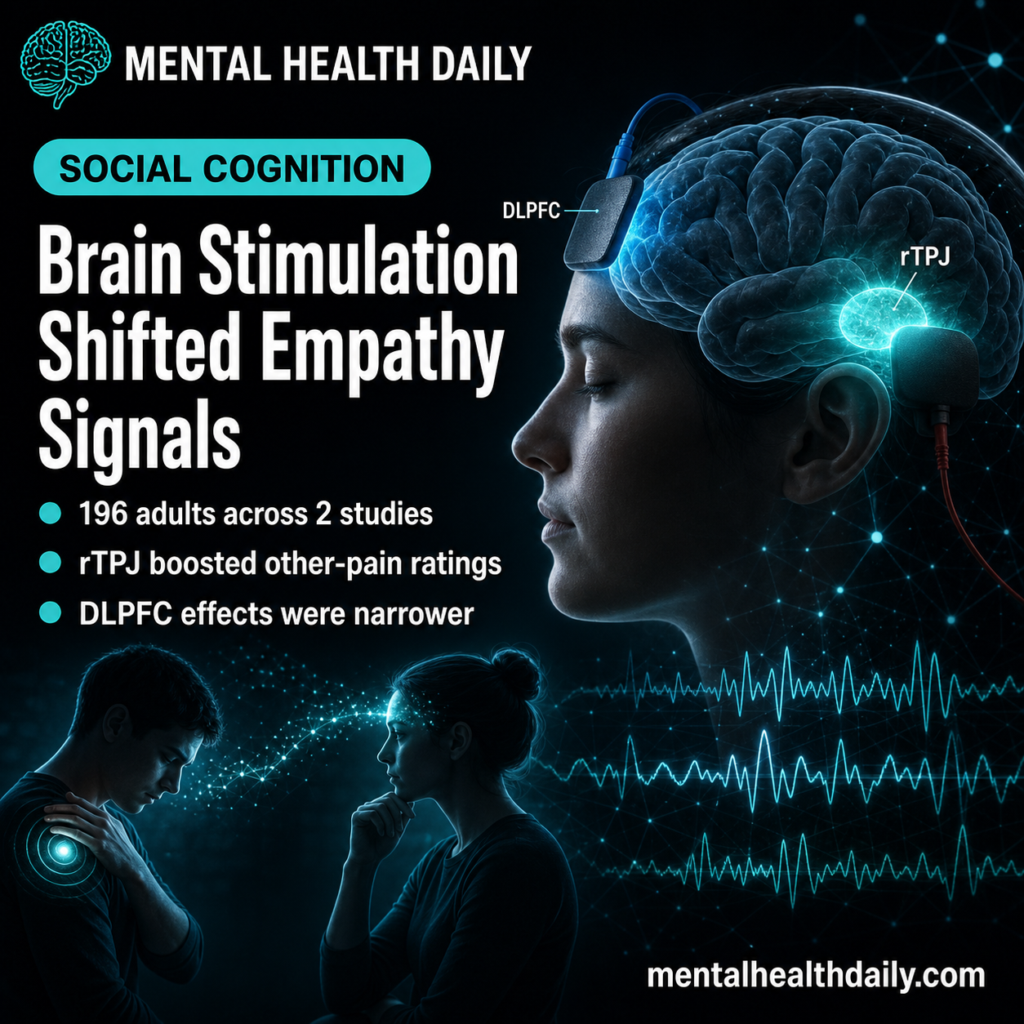
A 2026 Psychological Medicine study involving 196 healthy adults found that transcranial direct current stimulation over the right temporoparietal junction increased cognitive empathy signals across pain and video tasks, while left dorsolateral prefrontal cortex stimulation produced narrower and less consistent effects.1 The useful finding is anatomical calibration: rTPJ looked more like an other-state representation target, not a generic empathy dial.
Research Highlights
- rTPJ carried the strongest signal: In Study 1, real rTPJ-tDCS increased other-unpleasantness AUC versus sham, p = 0.020, while lDLPFC stimulation did not show the same behavioral effect.1
- EEG moved in the same direction: rTPJ stimulation increased early and late late-positive-potential responses to pain cues, with post hoc p = 0.001 and p = 0.002.1
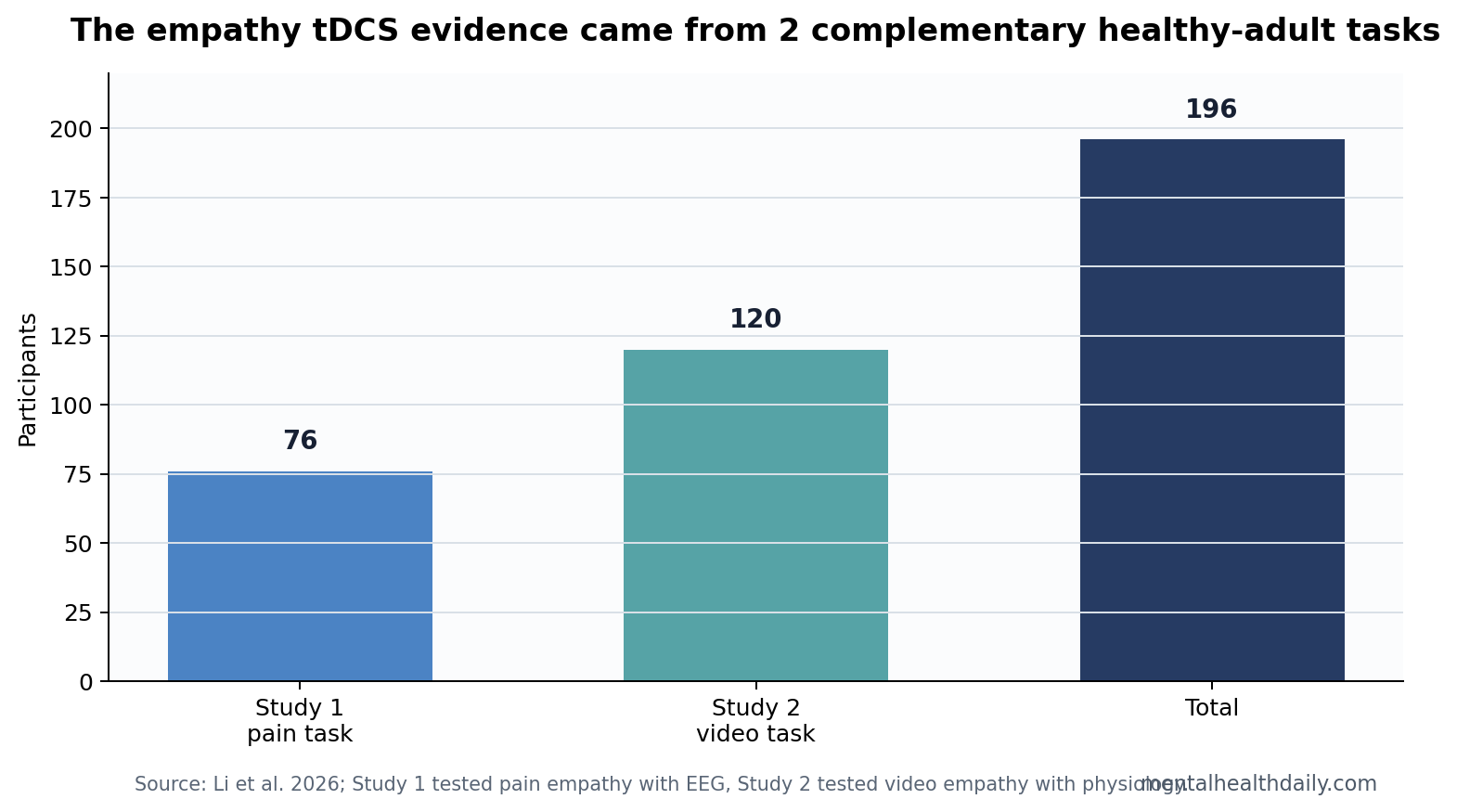
- The sample was split across 2 tasks: Study 1 included 76 adults in picture-based pain empathy, and Study 2 included 120 adults in autobiographical video empathy.1
- DLPFC was not a broad enhancer: lDLPFC-tDCS selectively affected self-related or regulatory dimensions and reduced decoding accuracy in some machine-learning analyses rather than simply improving empathy.1
- Clinical translation is premature: These were short-term laboratory effects in healthy adults, not a 2026 treatment trial for autism, psychosis, brain injury, or personality disorders.
Transcranial direct current stimulation (tDCS) is a noninvasive stimulation method that applies weak electrical current through scalp electrodes to shift the excitability of nearby brain networks. It does not force a behavior; it slightly biases the probability that a network will respond during a task.
Cognitive empathy means representing another person’s state, such as understanding how much pain someone else feels. Affective empathy means sharing or feeling emotional distress oneself. That split is central because a stimulation target can improve one dimension while leaving the other unchanged or even less separable.
rTPJ Stimulation Increased Other-Pain Ratings
Li et al. tested 2 stimulation targets: the right temporoparietal junction (rTPJ), a social-cognition region involved in perspective-taking, and the left dorsolateral prefrontal cortex (lDLPFC), a control-network region involved in regulating emotion and attention.1 Study 1 randomized 80 adults into target groups, excluded 4, and analyzed 76 participants, with 38 assigned to each target.
Participants completed picture-based somatic-pain and affective-pain tasks after real and sham stimulation. They rated their own unpleasantness and the protagonist’s unpleasantness on a 0-10 scale. The other-unpleasantness score was the cleaner cognitive-empathy readout because it asked how the person in the image felt, not how distressed the observer felt.
Real rTPJ stimulation increased other-unpleasantness AUC compared with sham, p = 0.020. The same comparison was not significant for lDLPFC stimulation, p = 0.604. Area under the curve (AUC) here means how well ratings separated pain from nonpain images across response thresholds; higher AUC means better discrimination of another person’s pain state.
Late Positive Potential Data Supported the rTPJ Result
Late positive potential (LPP) is an EEG response that grows when emotionally salient visual information holds attention. In pain-empathy tasks, a stronger pain-minus-nonpain LPP is usually read as stronger neural differentiation of another person’s pain cue, not as proof of compassion or real-world helping.
Li et al. found target-by-stimulation effects in both early and late LPP windows. Early LPP showed F(1,74) = 4.60, p = 0.035; late LPP showed F(1,74) = 4.93, p = 0.029. Post hoc tests put the effect on rTPJ stimulation: real rTPJ-tDCS increased early LPP versus sham, p = 0.001, and late LPP versus sham, p = 0.002.1
The somatic-pain task was especially clear. Late LPP showed a target-by-stimulation interaction, F(1,74) = 9.27, p = 0.003, with real rTPJ stimulation increasing late LPP versus sham, p = 0.004. lDLPFC stimulation did not show that same somatic-pain LPP separation, p = 0.180.
Reader translation: the stimulation target that should help represent another person’s state also strengthened the brain signal that separated painful from nonpainful scenes. That is more coherent than a lone self-report effect.
DLPFC Effects Looked More Regulatory Than Empathy-Boosting
The lDLPFC result is where popular “brain stimulation increases empathy” framing would overstate the paper. lDLPFC is plausible for emotion regulation because it helps people modulate attention and distress. But the 2026 experiments did not show a broad DLPFC-driven empathy enhancement.
Machine-learning analyses trained on LPP and behavioral features found that rTPJ stimulation improved classification of painful versus nonpainful states, whereas lDLPFC stimulation consistently reduced accuracy compared with sham in the same broad decoding frame.1 The daily-life inference is narrow: the laboratory signal was not a simple DLPFC-driven empathy improvement.
Coll’s pain-empathy synthesis emphasized why this distinction matters empirically: pain empathy includes appraisal of another person’s state, emotional sharing, attention, and regulation, and those components do not have to move together.2 A regulatory target may reduce self-distress without increasing other-focused understanding.
Video Empathy Extended the rTPJ Pattern
Study 2 used autobiographical narrative videos rather than static pain pictures. A separate sample of 120 healthy adults was assigned to lDLPFC, rTPJ, or sham stimulation and completed the task before and after stimulation. Participants rated content understanding, emotion understanding, emotional resonance, and personal distress.
rTPJ stimulation increased the subjective sense of understanding another person’s content and emotion. lDLPFC stimulation was more selective and aligned more closely with self-related emotional modulation. The task difference is useful because static pain images can exaggerate reflexive cue detection, while narrative videos require a more sustained model of what another person is experiencing.
Kubit and Jack’s social-cognition model placed rTPJ inside a network for representing other minds rather than merely reacting to emotional cues.3 The Li experiments fit that model: rTPJ effects generalized better across picture and video contexts than lDLPFC effects did.
Averaging rTPJ and DLPFC Would Hide the Main Result
Many neuromodulation studies become hard to interpret because different stimulation targets are pooled under one “prefrontal” or “social brain” label. Li et al. avoided that mistake by testing 2 regions with different computational roles. The rTPJ target was tied to representing another person’s state; the lDLPFC target was tied to regulation and control.
Target-specific inference: rTPJ stimulation increased the other-oriented part of the pain task and improved separation of pain versus nonpain states in decoding analyses. lDLPFC stimulation did not show the same broad pattern and may have changed how self-related arousal was regulated during the task.
That split makes the finding more useful than a pooled “tDCS worked” conclusion. A pooled conclusion would treat 2 different brain targets as if they were interchangeable and would blur cognitive empathy with affective distress. The 2026 data instead support a narrower map: rTPJ for understanding another person’s state; lDLPFC for control processes that may matter only when the clinical problem is excessive self-distress.
The distinction also protects against a common clinical mistake. A person can be overwhelmed by another person’s pain and still understand it accurately, or can understand the pain accurately without feeling much personal distress. Those are different treatment targets, and a stimulation protocol should not use one questionnaire score as a stand-in for both.
That is the practical contribution of the 2-target design: it gives future studies a cleaner starting hypothesis instead of another undifferentiated stimulation trial.
What a tDCS Empathy Study Can and Cannot Support
Supported: short-term rTPJ-tDCS can increase specific cognitive-empathy readouts in healthy adults, including other-pain discrimination and some narrative-understanding ratings. The EEG data make the result harder to dismiss as rating noise.
Not supported: a clinical protocol for empathy-related deficits. The study did not test autistic people, people with schizophrenia, people with traumatic brain injury, offenders, couples, clinicians, or any real-world helping outcome. Yang et al. also emphasized that stimulation effects in social cognition vary by target, task, and outcome.4
Best inference: if a future clinical tDCS program targets empathy, it should define the empathy component first. rTPJ is a better candidate for other-state representation; DLPFC may be more relevant when the target is regulating one’s own distress during exposure to another person’s pain.
Design caution: the result also depends on the tasks chosen. Other-pain ratings, video empathy, and late positive potential (LPP; an EEG signal linked to motivated attention) are useful laboratory readouts, but they are still proxies.
Next-trial bar: a stronger trial would test whether the same rTPJ pattern survives longer follow-up, repeated stimulation sessions, sham-controlled blinding checks, and behavior that matters outside the lab.
That is why the study is best read as target-mapping evidence rather than treatment evidence. It narrows the brain-region hypothesis and outcome vocabulary, but it does not yet prove that a stimulation protocol can change social functioning in a diagnosed population.
Questions About tDCS for Empathy
Does this mean tDCS can make people more compassionate?
No. The study measured laboratory empathy signals, not compassion, morality, or helping behavior. Better other-pain discrimination is narrower than being a better person.
Was rTPJ better than lDLPFC?
For cognitive empathy in these tasks, yes. rTPJ produced the more coherent pattern across ratings, EEG, and decoding. lDLPFC may still matter for regulating self-distress, but this study did not support it as the main other-focused empathy target.
Could this become a treatment?
Only after disorder-specific trials. A healthy-adult stimulation effect can identify a plausible brain target, but it does not establish dose, durability, safety, clinical responder groups, or real-world functional benefit.
References
- Li X, et al. Modulating empathy with tDCS: dissociable roles of rTPJ and lDLPFC. Psychological Medicine. 2026. doi:10.1017/s0033291726104218
- Coll MP. Meta-analysis of ERP investigations of pain empathy underlines methodological issues in ERP research. Neuroscience and Biobehavioral Reviews. 2018. doi:10.1016/j.neubiorev.2018.01.002
- Kubit B, Jack AI. Rethinking the role of the rTPJ in attention and social cognition in light of the opposing domains hypothesis. Frontiers in Human Neuroscience. 2013;7:323. doi:10.3389/fnhum.2013.00323
- Yang H, et al. Noninvasive brain stimulation and social cognition: target-specific effects on empathy-related processing. Social Cognitive and Affective Neuroscience. 2024. doi:10.1093/scan/nsae057