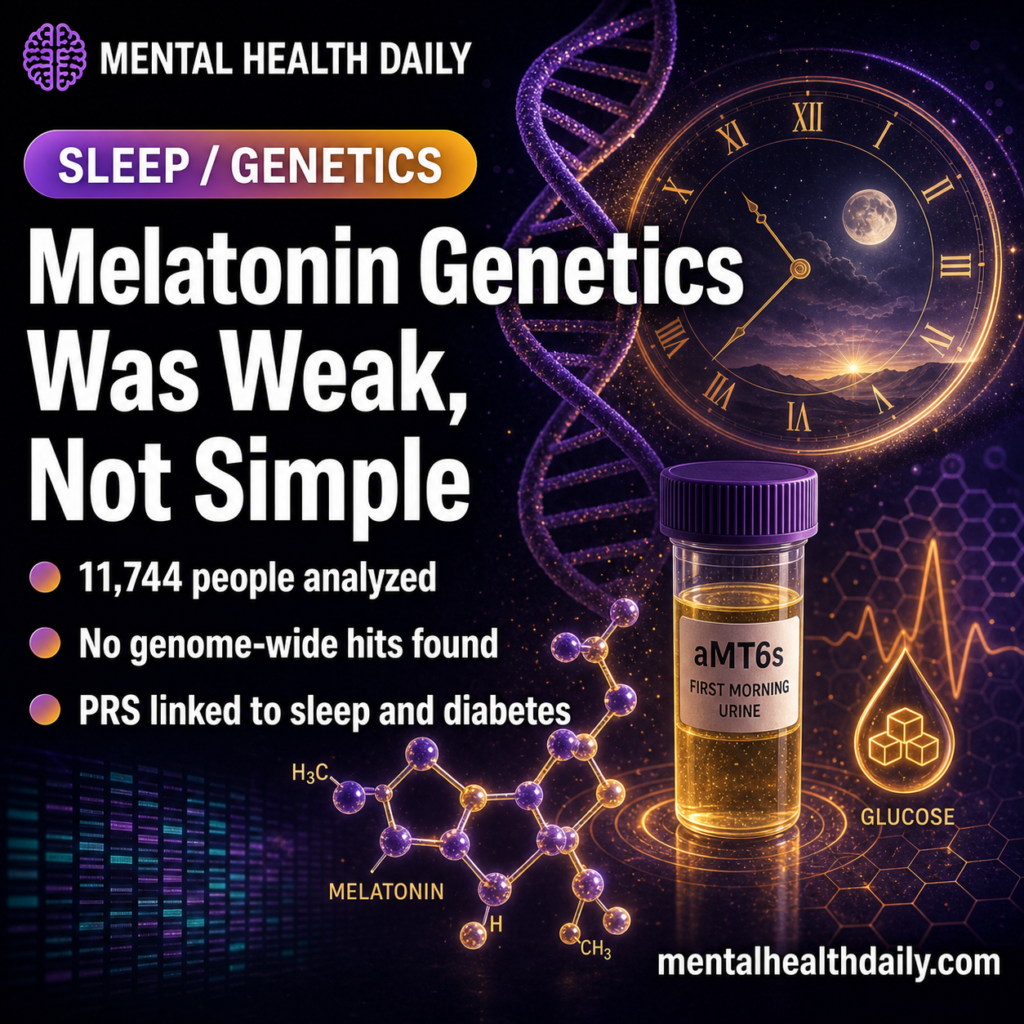
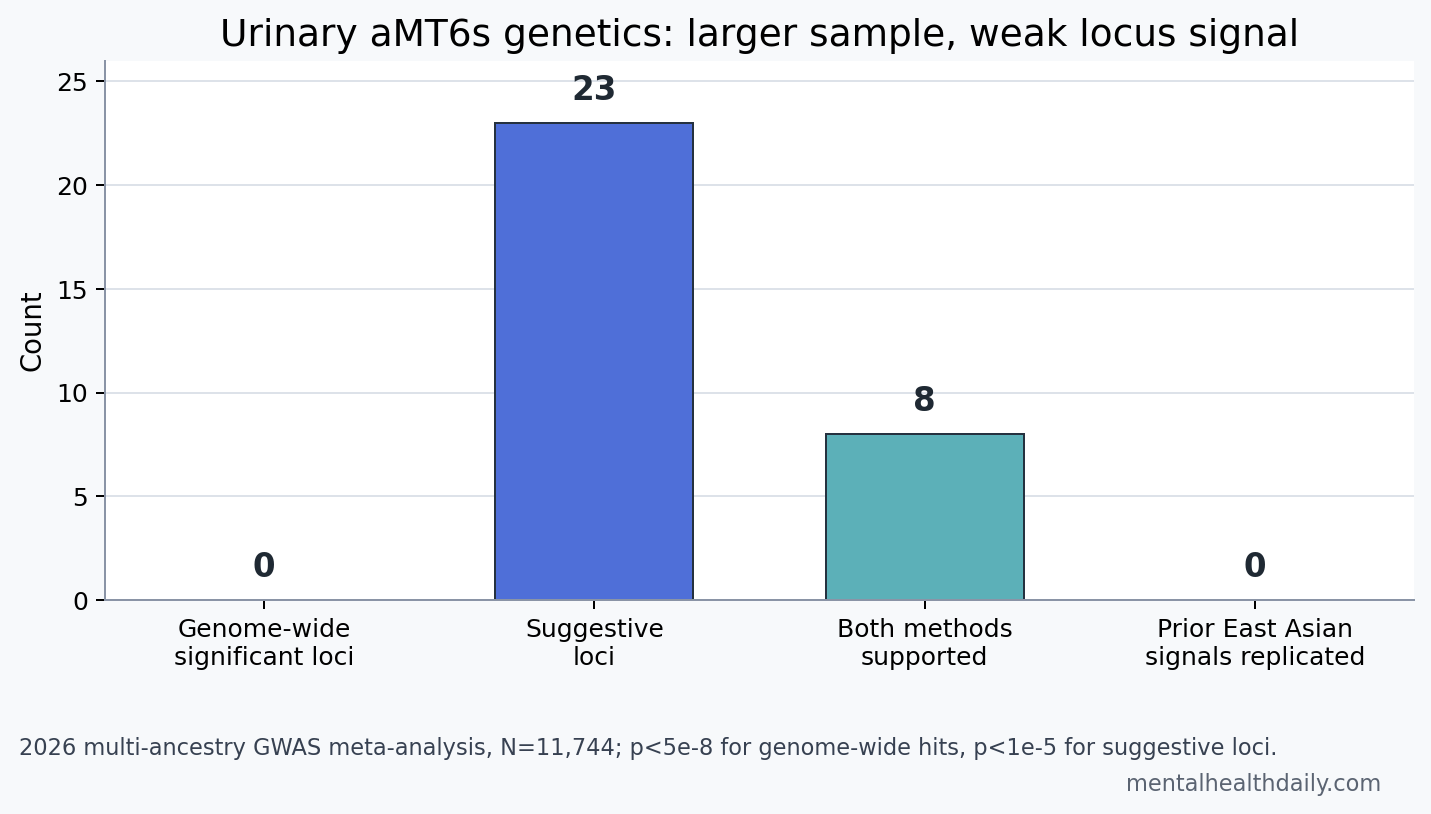
A 2026 multi-ancestry genome-wide association study of urinary aMT6s, a melatonin metabolite used as a proxy for overnight melatonin secretion, found 0 genome-wide significant loci in 11,744 people, even though 23 variants reached suggestive significance and 8 were supported by 2 analytic methods.
Research Highlights
- No common variant dominated: the 2026 GWAS meta-analysis involving 11,744 participants found 0 loci at the standard genome-wide threshold of p < 5 × 10⁻⁸.
- Suggestive signals were still present: 23 loci reached p < 1 × 10⁻⁵, and 8 loci appeared in both the fixed-effects METAL analysis and the ancestry-aware MR-MEGA analysis.
- Replication was weak: the earlier 2,373-person East Asian aMT6s GWAS reported suggestive hits, but the 11,744-person 2026 study did not replicate those signals.
- Polygenic scores pointed toward sleep and metabolism: PRS follow-up linked the aMT6s genetic score with sleep duration (padj = 8.0 × 10⁻⁹) and type 2 diabetes (padj = 9.8 × 10⁻⁸) in UK Biobank analyses.
- Genetic correlation stayed unconfirmed: European-ancestry linkage disequilibrium score regression found no significant genetic correlation with sleep traits or type 2 diabetes, including type 2 diabetes rg = 0.0665, p = 0.666.
6-sulfatoxymelatonin (aMT6s) is the main urinary breakdown product of melatonin, the hormone that helps mark biological night. Researchers often measure overnight or first-morning urinary aMT6s because direct melatonin sampling is inconvenient, timing-sensitive, and hard to scale across large cohorts.
The new analysis is useful because it makes a simple story less plausible. Melatonin biology clearly sits near sleep timing, circadian rhythm, immune signaling, and metabolic regulation, but the genetics of urinary aMT6s did not behave like a trait driven by a few easy common variants.
11,744-Person aMT6s GWAS Found 0 Genome-Wide Significant Loci
Zebrowska et al. combined urinary aMT6s genome-wide association data from 5 cohorts: Taiwan Biobank, Nurses’ Health Study I and II, Osteoporotic Fractures in Men, and the Multiethnic Cohort. The total sample included 11,744 participants with genetically assigned ancestry categories that were 59% European, 20.2% East Asian, 12.7% Japanese American, 3.7% African, 2.5% Native Hawaiian, and 1.9% Latino.
Genome-wide association study (GWAS) means researchers scan millions of genetic variants across the genome and ask whether any variant tracks with a measured trait. For urinary aMT6s, the trait was standardized melatonin metabolite output, adjusted for creatinine so urine dilution did not dominate the signal.
The headline result was negative in the strict statistical sense: neither METAL, a fixed-effects meta-analysis tool, nor MR-MEGA, a meta-regression method that models ancestry-related heterogeneity, found a genome-wide significant locus. At the usual GWAS threshold, p < 5 × 10⁻⁸, the count was 0.
That does not make the study empty. At the looser suggestive threshold, p < 1 × 10⁻⁵, 23 loci appeared, and 8 were supported by both analytic approaches. The strongest shared signals included loci near RBM6/RBM5, SOX5, FAM110B, ZIC1, PIK3CG, SLIT3, PLD1, and C12orf55.
Low Power Explains Some of the Negative Result
Power is the chance that a study will detect a real effect if that effect exists. In this study, power was high only for variants with relatively large effects on urinary aMT6s.
Formal calculations made the constraint explicit:
- 0.10% variance explained: only 2.2% power at p < 5 × 10⁻⁸.
- 0.20% variance explained: 27.4% power at p < 5 × 10⁻⁸.
- 0.34% variance explained: roughly the effect size needed for 80% power.
For a complex biological output like melatonin secretion, a common variant explaining 0.34% of variance is not guaranteed. Many endocrine and behavioral-adjacent traits are spread across numerous small-effect loci, and measurement noise makes detection harder.
aMT6s measurement adds another layer. Cohorts differed by urine timing, assay platform, creatinine adjustment details, age structure, sex composition, and ancestry mix. The investigators standardized values within cohorts, but z-scoring can align scale without making overnight urine, first-morning urine, laboratory platforms, and cohort demographics biologically identical.
Prior East Asian aMT6s Signals Did Not Replicate
Liu et al. published the direct predecessor in 2022: a Taiwan Biobank GWAS of melatonin secretion involving 2,373 East Asian participants. That study found no genome-wide significant loci but reported 5 suggestive loci.
The 2026 analysis tested whether those earlier suggestive signals held up in a larger and more diverse dataset. They did not. The new paper reported that the previous East Asian suggestive variants were not replicated, including in restricted subset analyses.
Interpretation: this is not a clean contradiction of the earlier paper. Suggestive GWAS hits are often unstable, especially when the discovery sample is modest and the trait is noisy. The better reading is that urinary aMT6s genetics remains unresolved, and the earlier hits should not be treated as durable biomarker loci until larger ancestry-specific samples confirm them.
Ancestry Heterogeneity May Be Biology or Instability
Several suggestive variants showed different effect estimates across ancestry groups, including patterns where the Taiwan Biobank estimate pointed in a different direction from estimates in other cohorts. That could mean melatonin metabolite genetics differs by population context.
It could also mean the analysis was underpowered in smaller strata. African, Native Hawaiian, and Latino ancestry groups together represented a small minority of the total sample, while European and East Asian groups carried most of the statistical weight. Differences in allele frequency, linkage disequilibrium, age, sex mix, urine collection protocol, and laboratory measurement can all mimic or magnify heterogeneity.
Ancestry-aware meta-regression helps because it models effect differences instead of pretending every cohort is exchangeable. It does not solve unequal sample size or phenotype harmonization. The study’s useful warning is therefore methodological: multi-ancestry does not automatically mean ancestry-portable.
PRS Links to Sleep Duration and Diabetes Need Calibration
Polygenic risk score (PRS) means a weighted sum of many variants, used as a genetic proxy for a trait. Zebrowska et al. built aMT6s PRSs and tested them in Mass General Brigham Biobank and UK Biobank, even though those validation datasets did not have measured urinary aMT6s.
That last clause is the main caveat. The PRS was not directly validated as a predictor of the melatonin metabolite in those biobanks. It was used as an exposure in downstream association analyses.
The associations were still interesting. In cross-ancestry UK Biobank analyses, aMT6s PRS signals associated with sleep duration, short sleep duration, blood vitamin D, morningness, and type 2 diabetes. Reported Bonferroni-corrected PheWAS signals included sleep duration at padj = 8.0 × 10⁻⁹ and type 2 diabetes at padj = 9.8 × 10⁻⁸.
But linkage disequilibrium score regression did not support a strong genome-wide genetic correlation. Sleep-trait genetic correlations ranged from about rg = −0.3 to 0.2, with none statistically significant. Type 2 diabetes was also nonsignificant, rg = 0.0665, p = 0.666.
Clinical implication: the PRS results should be treated as hypothesis generation, not as a melatonin-genetics test for sleep duration, diabetes, or chronotype. They suggest where biology might connect. They do not provide a usable risk score.
Melatonin Biology Still Connects Sleep and Metabolism
The weak GWAS result should not be misread as evidence that melatonin is irrelevant. Bojkowski et al. established urinary aMT6s as a practical melatonin-secretion marker decades ago. Experimental and epidemiological work has continued to tie melatonin timing to circadian rhythm, shift work, sleep, and metabolic physiology.
Lyssenko et al. found that MTNR1B variation associated with type 2 diabetes and impaired early insulin secretion, placing melatonin signaling near glucose regulation. Qian et al. later showed that simulated night shift could create an unusual 24-hour melatonin rhythm with daytime and nighttime peaks, a plausible route from circadian disruption to metabolic stress.
Sleep-psychiatry genetics also remains adjacent. Ferguson et al. studied circadian rhythmicity in 71,500 UK Biobank participants and reported polygenic associations with mood instability. Urinary aMT6s remains a circadian biomarker rather than a psychiatric test, but melatonin genetics belongs near sleep timing, mood vulnerability, and metabolic risk.
What This aMT6s Study Can and Cannot Support
This was an exploratory, power-limited genetic discovery study. It can support several cautious claims:
- Common large-effect urinary aMT6s loci were not evident: 0 genome-wide significant loci appeared in 11,744 people.
- Small-effect polygenic architecture is plausible: 23 suggestive loci and low heritability estimates point toward many small signals rather than 1 strong locus.
- Population context may matter: ancestry-related heterogeneity appeared, but smaller strata and measurement differences make causal interpretation premature.
- Sleep and metabolism remain biologically adjacent: PRS signals touched sleep duration and diabetes, while older melatonin-signaling work supports the general pathway.
It cannot support melatonin testing for personalized sleep care, diabetes prediction, or psychiatric risk stratification. The paper’s best contribution is negative calibration: even a larger multi-ancestry sample did not turn urinary aMT6s into a simple genetic biomarker.
Questions About Melatonin aMT6s Genetics
What does aMT6s measure?
aMT6s is 6-sulfatoxymelatonin, the main urinary metabolite of melatonin. Overnight or first-morning urine aMT6s is commonly used as a practical marker of nocturnal melatonin secretion.
Did this study find a melatonin gene?
No. The 2026 study found 0 genome-wide significant urinary aMT6s loci. It found 23 suggestive loci, but those are not definitive genetic discoveries.
Does the PRS result mean melatonin genetics causes diabetes?
No. The type 2 diabetes signal came from downstream PRS association testing, and LDSC did not find a significant genome-wide genetic correlation with type 2 diabetes. It is a lead for replication, not causal evidence.
Why does ancestry matter here?
Genetic effect estimates can differ across populations because of allele frequencies, linkage disequilibrium patterns, environmental context, measurement differences, and sample size. The 2026 study saw heterogeneity, but it could not cleanly separate biology from instability.
References
- Zebrowska M, Zhang Z, Chuang G-T, et al. Multi ancestry genome wide association meta analysis of urinary aMT6s levels. Scientific Reports. 2026. https://doi.org/10.1038/s41598-026-49491-2
- Bojkowski CJ, Arendt J, Shih MC, Markey SP. Melatonin secretion in humans assessed by measuring its metabolite, 6-sulfatoxymelatonin. Clinical Chemistry. 1987;33(8):1343-1348. https://doi.org/10.1093/clinchem/33.8.1343
- Liu PH, Chuang G-T, Hsiung CN, et al. A genome-wide association study for melatonin secretion. Scientific Reports. 2022;12(1):8025. https://doi.org/10.1038/s41598-022-12084-w
- Ferguson A, Lyall LM, Ward J, et al. Genome-wide association study of circadian rhythmicity in 71,500 UK Biobank participants and polygenic association with mood instability. EBioMedicine. 2018;35:279-287. https://doi.org/10.1016/j.ebiom.2018.08.004
- Lyssenko V, Nagorny CLF, Erdos MR, et al. Common variant in MTNR1B associated with increased risk of type 2 diabetes and impaired early insulin secretion. Nature Genetics. 2009;41(1):82-88. https://doi.org/10.1038/ng.288
- Qian J, Morris CJ, Phillips AJK, et al. Unanticipated daytime melatonin secretion on a simulated night shift schedule generates a distinctive 24-h melatonin rhythm with antiphasic daytime and nighttime peaks. Journal of Pineal Research. 2022;72(3):e12791. https://doi.org/10.1111/jpi.12791