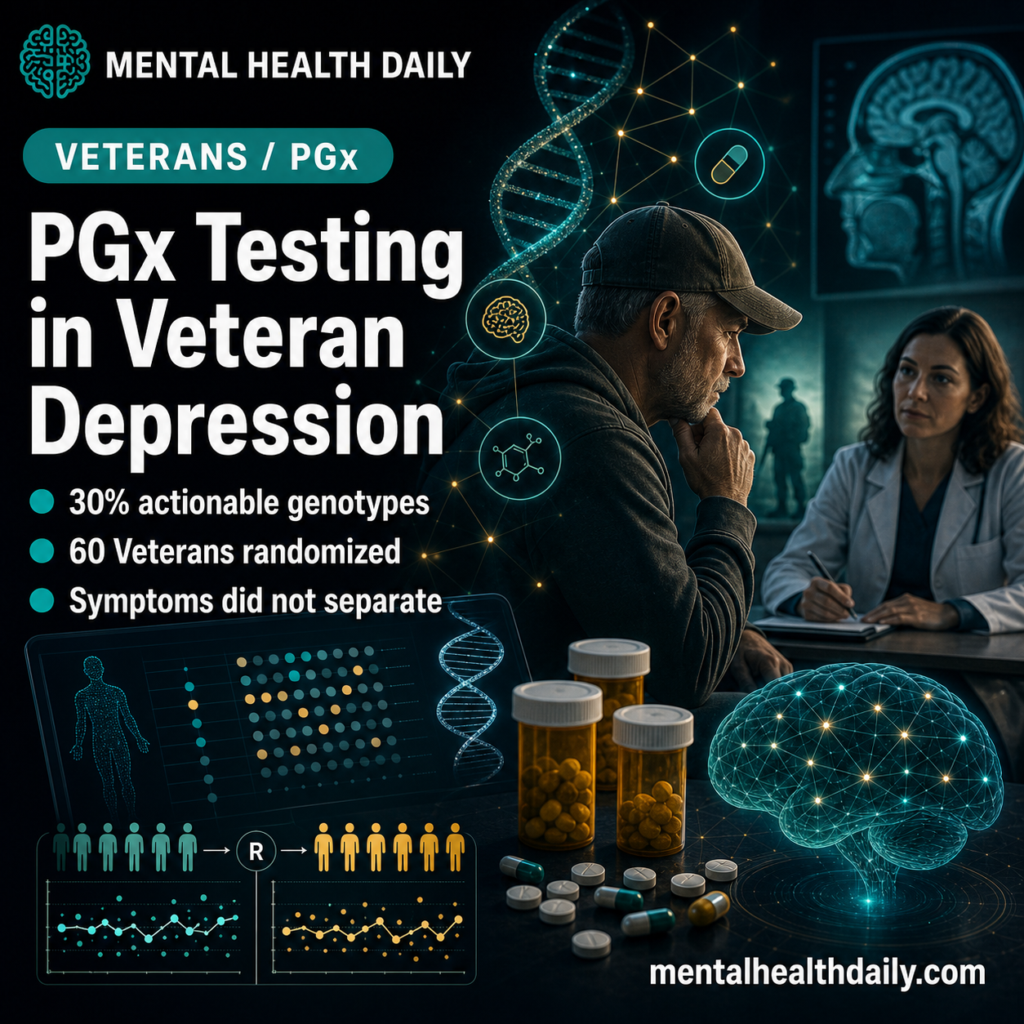
A 12-week randomized pilot trial in 60 Veterans with depression and psychiatric polypharmacy found that 30% had an actionable antidepressant gene-drug interaction, but immediate access to pharmacogenomic results did not clearly change prescribing or Patient Health Questionnaire-9 depression scores compared with delayed access.1
Research Highlights
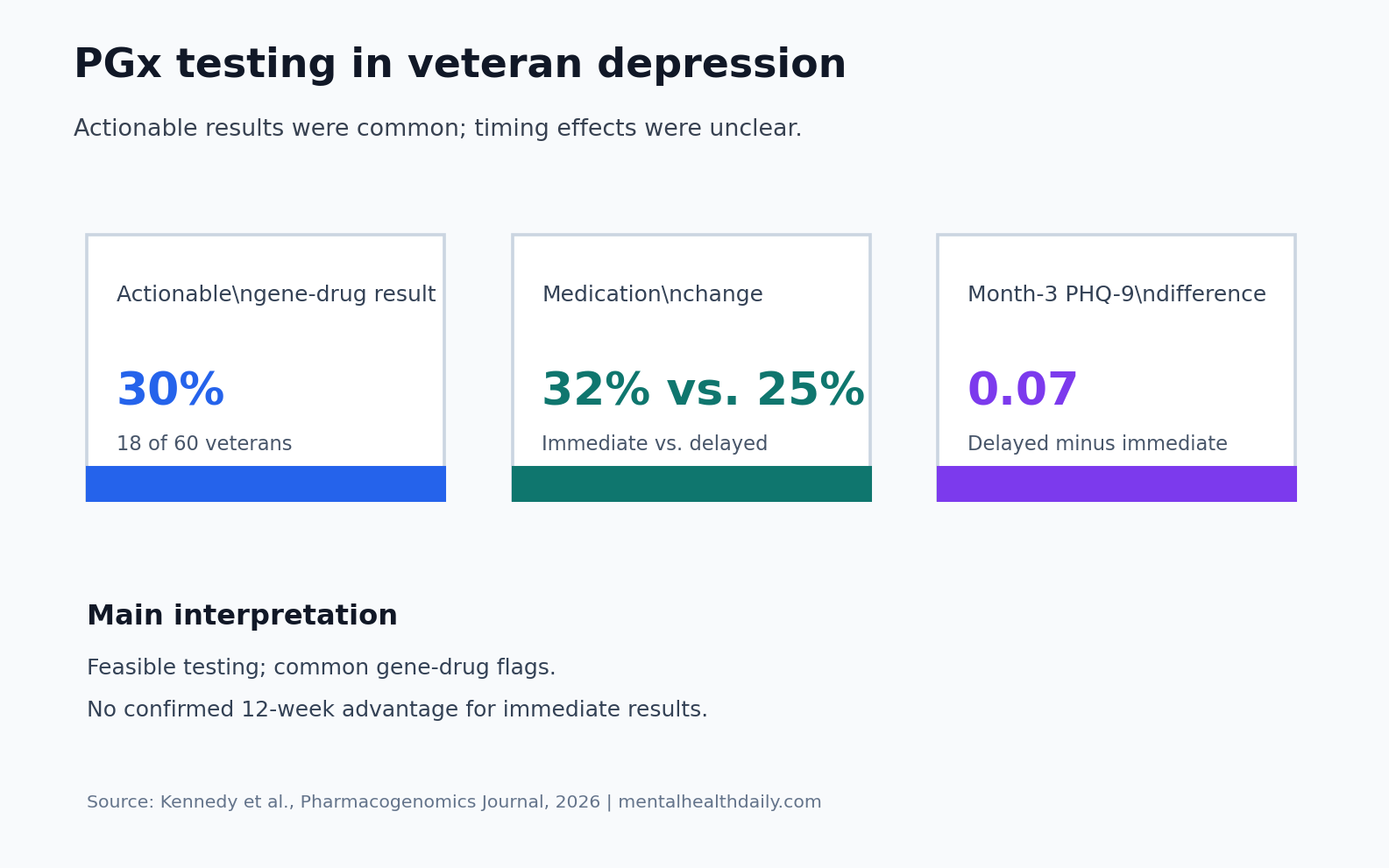
- Actionable PGx results were common: 18 of 60 Veterans, or 30%, had a gene-drug interaction flagged by the Sanford pharmacogenomic panel.1
- Medication changes did not clearly separate: 9 of 28 Veterans in the immediate-testing arm and 8 of 32 in the delayed-testing arm changed medication, an odds ratio of 1.42 with a wide 95% confidence interval from 0.46 to 4.38.1
- The actionable-genotype subgroup leaned in the expected direction: 5 of 8 immediately tested Veterans with actionable results changed medication vs. 4 of 10 in the delayed arm, but the estimate was statistically uncertain.1
- PHQ-9 scores did not show a timing advantage: the group-by-time test was not significant (p = 0.27), and the month-3 delayed-minus-immediate estimate was only 0.07 points on a 27-point scale.1
- The clinical claim stays narrow: PGx testing looks more defensible as targeted prescribing support in complex medication cases than as a reliable 12-week depression-outcome improver.2,3
Pharmacogenomic testing means checking inherited variants in drug-metabolizing or drug-response genes to estimate whether a medication is more likely to be underdosed, overdosed, poorly tolerated, or flagged for a closer prescribing review. In antidepressant care, the most familiar signals involve cytochrome P450 enzymes such as CYP2C19, which helps metabolize selective serotonin reuptake inhibitors (SSRIs) including sertraline, escitalopram, and citalopram.
The appeal is obvious because depression prescribing often proceeds by trial and error. A gene-drug report promises a more organized way to avoid medications that may fail because of unusual metabolism. The Kennedy et al. trial tests the harder question: does making that report available immediately change actual medication decisions or depression symptoms in Veterans already taking multiple psychiatric drugs?
60 Veterans Were Randomized to Immediate vs. Delayed PGx Results
Kennedy et al. randomized 60 Veterans to receive pharmacogenomic results immediately or after the 12-week trial. Participants were 18 to 80 years old, had a Patient Health Questionnaire-9 score above 9, and were taking at least 1 antidepressant on the Sanford Pharmacogenomics Panel plus at least 1 other psychotropic medication.1
The Patient Health Questionnaire-9 (PHQ-9) is a 9-item depression symptom scale scored from 0 to 27, with higher scores indicating more severe symptoms. Baseline PHQ-9 scores were in the moderate-to-severe range: 16.1 in the immediate-testing group and 16.8 in the delayed-testing group.1
Completion was high for a pragmatic pilot: 59 participants completed the month-1 assessment, 56 completed month 2, 58 completed month 3, and all 60 contributed at least 2 follow-up assessments, reducing concern that attrition alone drove the null symptom result.1
30% Had Actionable Antidepressant Gene-Drug Interactions
The trial deliberately selected for patients more likely to generate useful pharmacogenomic information: Veterans with depression plus psychiatric polypharmacy and at least 1 antidepressant covered by the panel. That enrichment worked. The researchers found actionable gene-drug interactions in 18 of 60 participants, or 30%, compared with roughly 20% in earlier Veterans Affairs pharmacogenomic work.1,4
The rate was nearly identical across arms: 8 of 28 Veterans in the immediate-testing group and 10 of 32 in the delayed-testing group had an actionable result. One participant had 2 actionable interactions.1
Most flagged medications were ordinary antidepressants, not rare edge cases. Sertraline accounted for 10 flagged interactions, escitalopram for 4, doxepin for 3, and citalopram for 2. CYP2C19 rapid-metabolizer status accounted for 14 of the actionable findings, meaning the enzyme profile suggested faster-than-usual metabolism that can lower exposure to some antidepressants at standard doses.1
Medication Changes Were Numerically Higher, But Not Confirmed
If pharmacogenomic testing changes care, a prescribing signal should appear before a symptom signal. The immediate-testing arm did move numerically in the expected direction, but the trial was too small to confirm that the difference was reliable.
- All randomized participants: 9 of 28 Veterans in the immediate-testing group had a medication change vs. 8 of 32 in the delayed-testing group (OR 1.42, 95% CI 0.46 to 4.38; p = 0.54).1
- Participants with actionable results: 5 of 8 immediately tested Veterans changed medication vs. 4 of 10 delayed-tested Veterans (OR 2.50, 95% CI 0.37 to 16.89).1
- Timing of medication change: among participants who changed medication, median time to change was 66 days in the immediate arm and 59.5 days in the delayed arm (HR 0.77, 95% CI 0.30 to 1.97).1
A 95% confidence interval gives the range of values compatible with the observed data under the model. These wide intervals leave room for a real prescribing effect, no effect, or a larger effect than the point estimate. Immediate PGx access may have nudged prescribing among Veterans with actionable results, while the pilot cannot establish a dependable prescribing advantage.
PHQ-9 Scores Did Not Separate Over 12 Weeks
Depression symptoms did not show a clear immediate-testing advantage. The group-by-time test for PHQ-9 scores was not significant (GEE chi-square = 2.59, p = 0.27). The delayed-minus-immediate differences were −1.08 points at month 1, 0.74 points at month 2, and 0.07 points at month 3.1
The month-3 estimate is the most important clinical anchor because it is the end of the pilot follow-up. A 0.07-point difference on a 27-point depression scale is too small to support a meaningful symptom separation between immediate and delayed testing.
Evidence-strength note: this was a feasibility-grade pragmatic pilot, not a definitive efficacy trial. It supports the idea that targeted PGx testing can find actionable results in Veterans with complex medication regimens. It does not show that immediate access to results improves depression symptoms over 12 weeks.
GUIDED and PRIME Care Keep the PGx Claim Narrow
The Kennedy trial fits a broader antidepressant pharmacogenomics pattern: gene-drug information is biologically real, but symptom-outcome gains are smaller and less consistent than commercial testing language often implies.
GUIDED randomized 1,167 adults with major depressive disorder to combinatorial pharmacogenomic-guided treatment or treatment as usual. The trial missed its primary symptom-improvement endpoint at 8 weeks, but response and remission favored guided care on secondary outcomes: remission was 15.3% vs. 10.1%, and response was 26.0% vs. 19.9%.2
PRIME Care randomized 1,944 Veterans Affairs patients to immediate pharmacogenomic testing or usual care with delayed results. Testing reduced prescribing of medications with predicted gene-drug interactions, but the main remission result at 24 weeks was essentially flat: 28.0% vs. 28.5%.3
Those 2 large trials make the Kennedy result easier to interpret. PGx information can alter prescribing, especially when the report identifies a concrete medication risk. The harder claim is that testing reliably improves depression outcomes on its own.
In real care, symptoms also depend on dose optimization, adherence, psychotherapy access, substance-use treatment, sleep, medical comorbidity, suicide-risk management, follow-up frequency, and whether the patient can safely switch from a medication that may be partly helping.
PGx Testing Is Best Framed as Targeted Prescribing Support
For a patient starting a first antidepressant with no unusual side effects, PGx testing may add less than careful measurement-based care: regular symptom tracking, dose adjustment, side-effect review, and follow-up. For a patient with multiple medication failures, unusual adverse effects, or complex psychotropic polypharmacy, a PGx report can identify a metabolism problem that ordinary observation may not reveal.
The Kennedy sample sits closer to the second use case. These were Veterans with depression, active symptoms, antidepressant exposure, and at least 1 additional psychotropic medication. Finding actionable results in 30% of that group is clinically meaningful even if immediate reporting did not separate PHQ-9 scores over 12 weeks.
The calibrated bottom line: use PGx testing to clarify medication selection, dose caution, and avoidable gene-drug conflicts in higher-burden cases. Do not sell it as a stand-alone answer to depression remission.
Questions Veterans and Clinicians Ask About PGx Testing
Did immediate PGx testing improve depression scores in the Veteran pilot trial?
No confirmed PHQ-9 advantage appeared over 12 weeks. The group-by-time test was not significant, and the month-3 difference was 0.07 points.1
Does a gene-drug interaction mean the medication is wrong?
Not automatically. A gene-drug interaction means the medication deserves closer interpretation in light of metabolism, dose, side effects, prior response, available alternatives, and the risk of destabilizing a partially helpful regimen.
Who is most likely to benefit from PGx testing?
The strongest use case is a patient with multiple antidepressant failures, unusual side effects, complex psychotropic polypharmacy, or a current antidepressant with a known pharmacogenomic warning. The evidence is weaker for universal testing before a first antidepressant.
Why can PGx change prescribing without changing symptoms?
Changing away from a flagged medication is only one part of depression care. Symptom improvement also depends on the replacement medication, adherence, dose, follow-up, comorbid conditions, psychotherapy access, sleep, substance use, and the time needed for a new regimen to work.
References
- Kennedy MR, Hauser AS, Keller C, et al. A pilot study of pharmacogenomic testing as a tool to enhance depression care in Veterans. The Pharmacogenomics Journal. 2026;26:14. https://doi.org/10.1038/s41397-026-00406-4
- Greden JF, Parikh SV, Rothschild AJ, et al. Impact of pharmacogenomics on clinical outcomes in major depressive disorder in the GUIDED trial. Journal of Psychiatric Research. 2019;111:59–67. https://doi.org/10.1016/j.jpsychires.2019.01.003
- Oslin DW, Lynch KG, Shih MC, et al. Effect of pharmacogenomic testing for drug-gene interactions on medication selection and remission of symptoms in major depressive disorder. JAMA. 2022;328(2):151–161. https://doi.org/10.1001/jama.2022.9805
- Ramsey LB, Brown JT, Vear SI, et al. Veterans Affairs Pharmacogenomic Testing for Veterans clinical program. Pharmacogenomics. 2021;22(9):549–559. https://doi.org/10.2217/pgs-2020-0173
- Bousman CA, Arandjelovic K, Mancuso SG, Eyre HA, Dunlop BW. Pharmacogenetic tests and depressive symptom remission: a meta-analysis of randomized controlled trials. Pharmacogenomics. 2019;20(1):37–47. https://doi.org/10.2217/pgs-2018-0142