Cognitive disengagement syndrome, the daydreaming, foggy, slowed-down pattern once called sluggish cognitive tempo, overlapped strongly with ADHD symptoms in a large Iranian survey of teens and adults. Even so, about half of the people with the highest scores on one measure did not score high on the other.1
Research Highlights
- Strong overlap with ADHD: among 2,012 people who filled out both questionnaires, total scores for cognitive disengagement syndrome (CDS) and ADHD correlated at r = .69.1
- Partly separate high scorers: of the people in the top 10% for CDS symptoms, 49% were also in the top 10% for ADHD symptoms. The rest scored high on CDS alone.1
- Slowness and daydreaming set CDS apart: people high only on CDS stood out for mental slowness and mind-wandering, while people high only on ADHD stood out for attention problems.1
- More common in younger people and females: in the full sample of 8,075, 9.1% of 15- to 17-year-olds scored above the study’s high-symptom cutoff, compared with 1% to 2% of people aged 35 to 55. Females had 1.46 times the odds of males.1
- Volunteer sample, not prevalence: participants were recruited by convenience and word of mouth, and “high” meant high compared with the rest of this sample. The 5.8% figure is not a rate of CDS in Iran.1
What Cognitive Disengagement Syndrome Is
Cognitive disengagement syndrome (CDS) describes people who drift away from what is going on around them. Researchers called it sluggish cognitive tempo from the 1980s until the field recently switched to the new name. Typical symptoms include:1,2
- Excessive daydreaming: getting lost in thought or a private inner world
- Mental fog: feeling confused or “in a fog”
- Slowed thinking and behavior: being slow to process information or to get moving
- Drowsiness: seeming sleepy or low in energy during the day
- Low engagement: tuning out of tasks and conversations
CDS is not a diagnosis in the DSM-5-TR or ICD-11, the 2 main psychiatric classification systems. It is a research construct, and a central question is whether it is simply part of ADHD (attention-deficit/hyperactivity disorder) or something related but separate.1
Daydreaming and losing focus sound a lot like the inattentive side of ADHD. Yet earlier studies have linked CDS symptoms more closely to anxiety, depression, social withdrawal and sleep problems, and ADHD symptoms more closely to impulsivity and acting out.1,3
How the Iranian CDS Survey Worked
Karim Abdolmohamadi et al. collected questionnaires from 2021 to 2024 in Tehran, Tabriz, Mashhad and Isfahan. Recruitment ran through schools, universities, workplaces, public centers and online links shared from person to person; about 70% of forms were completed online.1
- Main sample: 8,075 valid responses from people aged 15 to 55 (average age 24.8; 70.8% female)
- ADHD subsample: 2,012 of them also completed an ADHD questionnaire
- Exclusions: people who said they had a history of major psychiatric disorder, plus incomplete or careless responses
CDS symptoms were measured with the Persian version of the Adult Concentration Inventory, a 16-item self-report scale built to capture CDS symptoms that are distinct from ADHD inattention.1,4 Its 3 parts cover attention problems, slowness, and imagination or mind-wandering. Total scores run from 0 to 48; the sample averaged 17.1.1
ADHD symptoms were measured with the Adult ADHD Self-Report Scale (ASRS), an 18-item World Health Organization questionnaire about inattention and hyperactivity/impulsivity.5 Both tools were used as symptom scales, not diagnostic tests.1
Why 5.8% Is Not a CDS Prevalence Rate
There is no clinically validated cutoff for the adult CDS questionnaire, so the researchers defined “elevated” symptoms relative to the sample itself:1
- Top 5% of scores (34 or higher): 466 people, or 5.8%
- Average plus 1.5 standard deviations: 667 people, or 8.3%
- Top 10% of scores (30 or higher): 909 people, or 11.3%
A 95th-percentile cutoff places roughly 5% of any sample above it by definition. These figures describe who scored highest among the volunteers; they do not estimate how many Iranians have CDS, and no one was interviewed or assessed for impairment.1
The more useful information is who landed above the line. Using the top-5% cutoff:1
- Ages 15–17: 9.1%
- Ages 18–24: 6.0%
- Ages 25–34: 5.4%
- Ages 35–44: 1.2%
- Ages 45–55: 1.6%
Females were above the cutoff more often than males (6.4% vs. 4.3%). In a model including both factors, being female was linked to 46% higher odds (odds ratio 1.46), and each additional year of age to about 6% lower odds (odds ratio 0.94). Age and sex together explained about 9% of the variation, so most of what separated high scorers lay elsewhere.1
The older groups were small (333 and 185 people, with 4 and 3 high scorers), and a one-time survey compares different people at different ages. It cannot show that CDS symptoms fade as a person gets older.1
CDS and ADHD Symptoms Correlated Strongly but Not Completely
In the 2,012 people who completed both questionnaires, the correlation between total CDS and total ADHD scores was r = .69. On a scale where 0 means no relationship and 1 means perfect agreement, .69 means people who reported more of one set of symptoms usually reported more of the other.1
The overlap was uneven across ADHD’s 2 symptom groups:1
- CDS total with ADHD inattention: r = .70
- CDS total with ADHD hyperactivity/impulsivity: r = .53
- CDS mind-wandering scores with ADHD inattention: r = .35
To see whether high scorers were the same people, the researchers marked anyone in the sample’s top 10% on each questionnaire as “high” (30 or more on the CDS scale, 59 or more on the ADHD scale).1
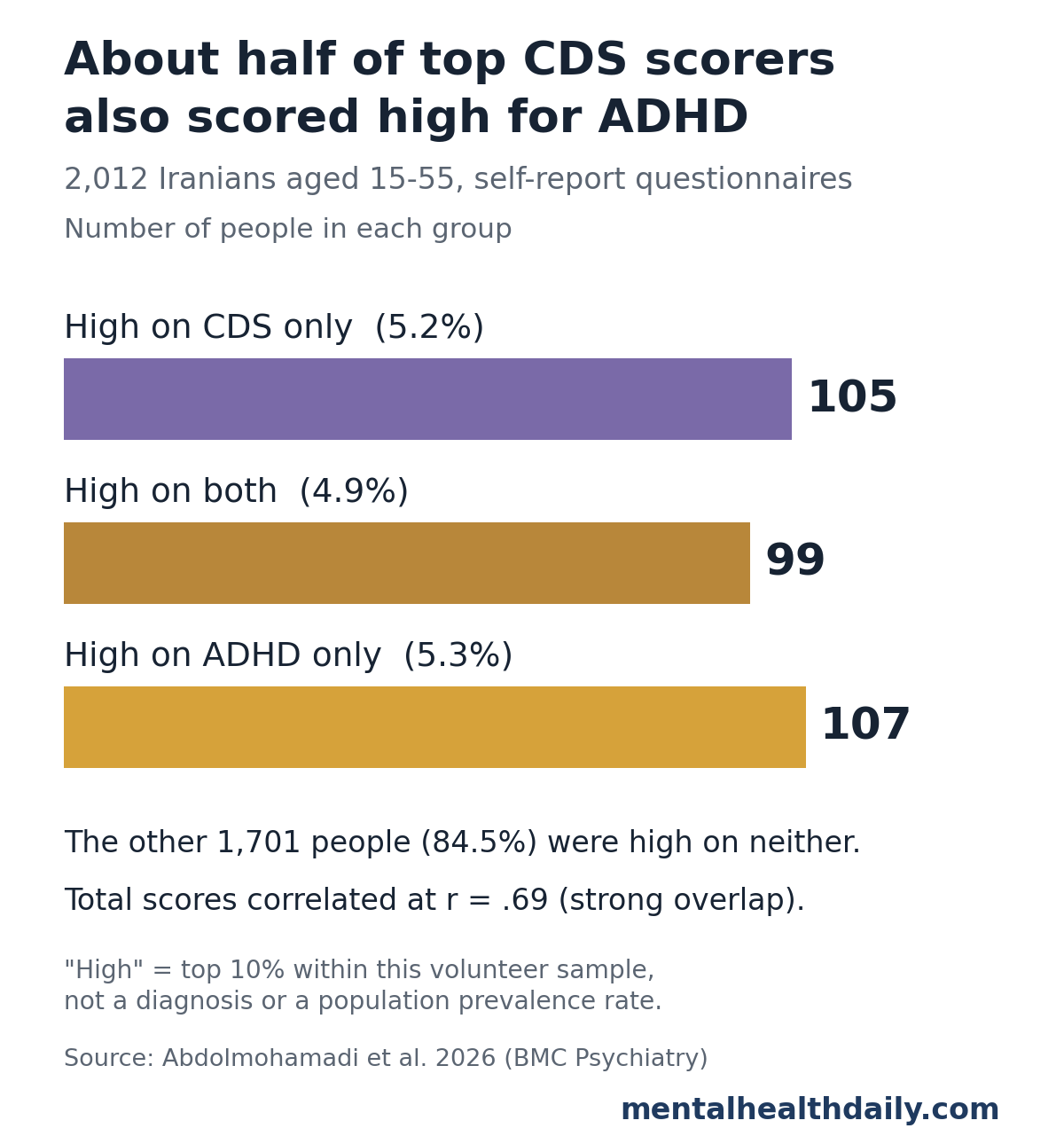
Of 204 people high on CDS, 99 (49%) were also high on ADHD. Of 206 people high on ADHD, 99 (48%) were also high on CDS. So roughly half of each high-scoring group would have been missed by looking at the other questionnaire alone.1
Slowness and Daydreaming Separated CDS-Only From ADHD-Only Profiles
The researchers then compared the 105 people high only on CDS with the 107 high only on ADHD, using a discriminant function analysis, a method that finds the combination of scores that best sorts people into 2 groups. The scores tested were the 3 parts of the CDS questionnaire plus age and sex.1
- Pointed toward CDS-only: slowness (weight 0.79) and imagination or mind-wandering (0.66)
- Pointed toward ADHD-only: the CDS questionnaire’s attention-problem items (−0.61)
- Mattered little: age (−0.15) and sex (0.08)
That combination sorted 95.3% of people into the right group, and 93.9% when each person was classified using a model built without them (a check called leave-one-out cross-validation). Every CDS-only person was classified correctly, as were 87.9% of ADHD-only people in the cross-validated version.1
How to read the accuracy: the groups were defined by the same questionnaires that supplied the sorting scores, which tends to inflate accuracy. The researchers describe it as evidence that the 2 symptom profiles look different on self-report, not as a way to diagnose either condition.1
Earlier Studies Found a Similar CDS-ADHD Pattern
The Iranian numbers are consistent with a 2016 meta-analysis of 73 papers on sluggish cognitive tempo. Across factor-analysis studies with more than 19,000 people, 13 CDS symptoms consistently grouped together apart from ADHD symptoms.2
That meta-analysis also found the same uneven overlap:2
- Adults: correlation with ADHD inattention r = 0.72, with hyperactivity-impulsivity r = 0.46
- Children: r = 0.63 with inattention, r = 0.32 with hyperactivity-impulsivity
It concluded there was not yet enough evidence to describe CDS in diagnostic terms, a position the Iranian team also takes.1,2
A nationally representative U.S. study of 2,056 children, rated by their mothers, used top-5% cutoffs and found a similar split. About 2.6% were high on CDS only, 4.5% on ADHD only, and 2.4% on both. The CDS-only children had more anxiety, depression, shyness and sleep problems than the ADHD-only children.3
Where the Iranian results differ: the 2016 meta-analysis found a tiny tendency for boys to score higher in childhood, no sex difference in adults, and a slight rise with age.2 The Iranian survey found higher scores in women and in younger people. The researchers note similar female-leaning results in Turkey and South Korea, but a sample that was 71% female and recruited by word of mouth makes this the least settled part of the study.1
Limitations of This Iranian CDS Survey
- Volunteer sample: convenience and snowball recruitment, mostly young and female; findings may not apply to Iran as a whole or to other countries.
- Self-report only: no clinical interviews, no reports from family or teachers, and no measures of how much symptoms interfered with daily life.
- Sample-based cutoffs: “elevated” meant high relative to this group, not a clinical threshold.
- Unchecked health history: psychiatric history was self-reported, and sleep, medical or psychiatric problems people did not know about could have raised scores. Drowsiness and fog overlap with poor sleep.
- One point in time: the survey cannot show cause and effect or how symptoms change with age.
- No brain or cognitive testing: slowed thinking was self-reported, not measured with processing-speed or attention tasks.
What This Means for People Who Daydream and Feel Foggy
CDS-type symptoms often travel with ADHD, but not always. In this survey, about half of the people with the most CDS symptoms did not have unusually high ADHD scores. A person whose main problem is drifting off, feeling foggy and moving slowly may not fit the restless, impulsive picture many people associate with ADHD.1
No formal diagnosis exists yet. CDS is still being defined as a research concept. Persistent daytime fog and sleepiness can also come from sleep problems, depression, medical conditions or medication side effects, so they are worth raising with a doctor, especially when they affect school or work.1
Better studies are the next step. The researchers call for representative samples, clinical interviews, long-term follow-up and objective tests of attention and processing speed to learn whether the self-reported differences show up in how people actually think and function.1
References
- Abdolmohamadi K, Brand S, Alimohamadi A, Sadeghi-Bahmani D. Symptom epidemiology, demographic correlates, and differentiation between cognitive disengagement syndrome symptoms and ADHD symptoms in a large nonprobability sample of Iranian adolescents and adults. BMC Psychiatry. 2026;26:705. doi:10.1186/s12888-026-08346-w
- Becker SP, Leopold DR, Burns GL, Jarrett MA, Langberg JM, Marshall SA, McBurnett K, Waschbusch DA, Willcutt EG. The internal, external, and diagnostic validity of sluggish cognitive tempo: a meta-analysis and critical review. Journal of the American Academy of Child and Adolescent Psychiatry. 2016;55(3):163–178. doi:10.1016/j.jaac.2015.12.006
- Burns GL, Becker SP. Sluggish cognitive tempo and ADHD symptoms in a nationally representative sample of U.S. children: differentiation using categorical and dimensional approaches. Journal of Clinical Child and Adolescent Psychology. 2021;50(2):267–280. doi:10.1080/15374416.2019.1678165
- Becker SP, Burns GL, Garner AA, Jarrett MA, Luebbe AM, Epstein JN, Willcutt EG. Sluggish cognitive tempo in adults: psychometric validation of the Adult Concentration Inventory. Psychological Assessment. 2018;30(3):296–310. doi:10.1037/pas0000476
- Kessler RC, Adler L, Ames M, Demler O, Faraone S, Hiripi E, Howes MJ, Jin R, Secnik K, Spencer T, Ustun TB, Walters EE. The World Health Organization Adult ADHD Self-Report Scale (ASRS): a short screening scale for use in the general population. Psychological Medicine. 2005;35(2):245–256. doi:10.1017/S0033291704002892