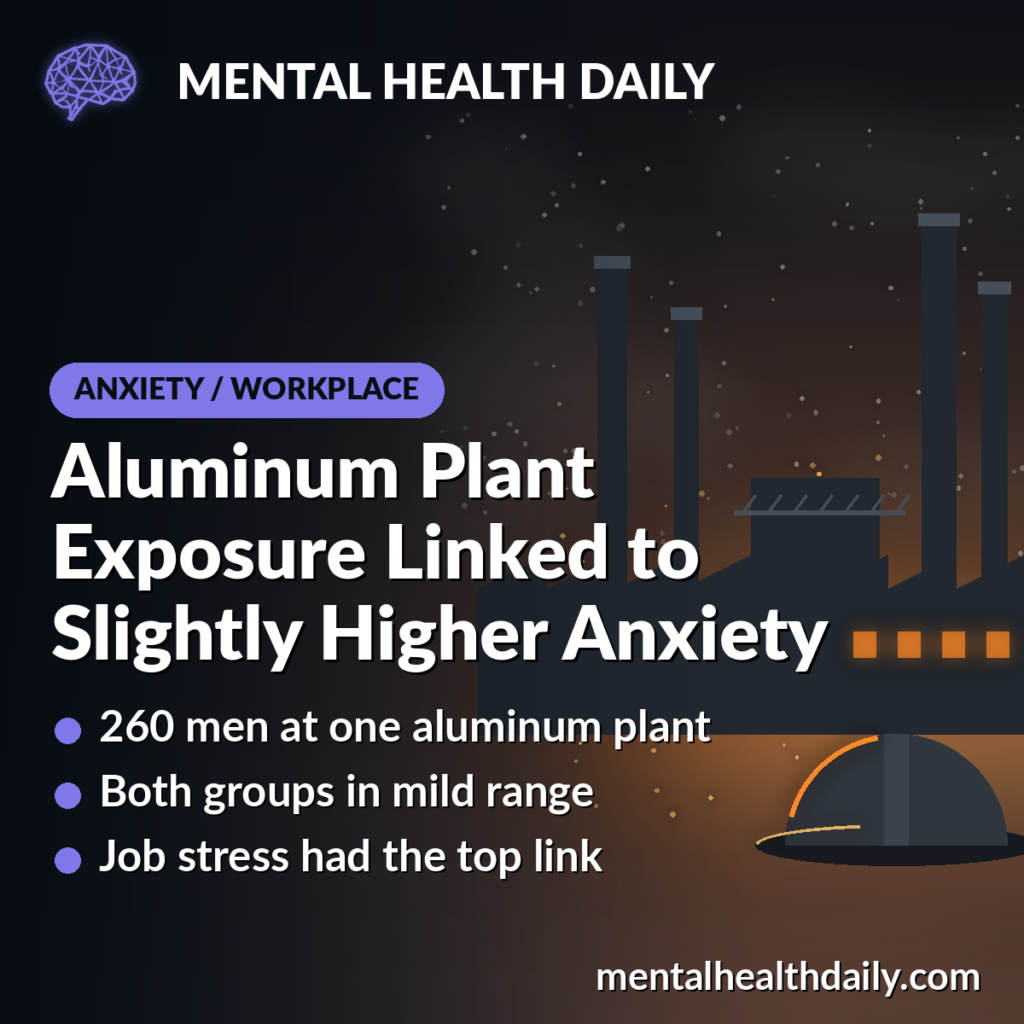
Men working in the smelting, anode and casting areas of an Iranian aluminum plant reported slightly more anxiety than office and security staff at the same plant. Higher levels of PAH and aluminum markers in their urine went with higher anxiety scores, even after accounting for job stress.1
Research Highlights
- A small anxiety gap: 130 exposed workers averaged 10.74 on the Beck Anxiety Inventory, vs. 8.88 for 130 office and security staff — a 1.86-point difference (95% CI 0.46 to 3.27, p = 0.010). Both averages sit in the mild range.1
- Much higher exposure markers: exposed workers had about 2.8 times the urinary 1-hydroxypyrene (a PAH marker) and about 4.5 times the urinary aluminum of the comparison group.1
- Both markers tracked anxiety: in a model that also included job stress, smoking, age and years on the job, urinary 1-hydroxypyrene (β = 0.204) and urinary aluminum (β = 0.177) were each linked to higher anxiety.1
- Job stress had the strongest link: total job stress (β = 0.295) outweighed either chemical marker, and smoking (β = 0.202) was about as strong as the PAH marker.1
- Consistent with population data: in 4,026 US adults, higher urinary PAH metabolites were also linked to more days of feeling anxious.2
What PAHs and 1-Hydroxypyrene Are
Polycyclic aromatic hydrocarbons (PAHs) are a large family of chemicals formed when coal, oil, wood, tobacco or other organic material burns incompletely. They show up in smoke, soot, vehicle exhaust and charred food, and in much higher amounts in some heavy industries.1
Aluminum production is one of those industries. Its high-temperature smelting steps release PAHs into the workroom air, with especially high levels in Soderberg-type smelters. Workers breathe them in and absorb them through the skin.1
1-Hydroxypyrene (1-OHP) is what the body turns pyrene, one common PAH, into before excreting it in urine. Because pyrene travels with the rest of the PAH mix, urinary 1-OHP is a standard, noninvasive way to estimate how much PAH a person has recently absorbed from all routes combined.1
Aluminum itself is the second exposure. Dust and fumes from smelting and casting can be inhaled, and urinary aluminum reflects recent body burden in occupational settings.1
How the Aluminum Plant Study Was Set Up
Mohammad Zare et al. compared 2 groups of male employees at a single aluminum production plant in Iran. Of 270 men invited, 260 (96.3%) completed the questionnaires and gave urine samples.1
- Exposed group (130): workers from anode production, the pot-rooms where aluminum is smelted, and casting.
- Comparison group (130): administrative and security staff who did not work in the smelting process, matched to the exposed workers on age and years employed.
- Exposure measures: personal air samples for benzo[a]pyrene (a well-studied, highly toxic PAH), plus end-of-week urine tests for 1-OHP and aluminum.
- Anxiety: the Beck Anxiety Inventory (BAI), a 21-item questionnaire about how much common anxiety symptoms bothered the person over the past week. Scores run from 0 to 63.
- Job stress: the Job Content Questionnaire, which scores job demands, how much control a worker has, and support from supervisors and coworkers.
Men with a major psychiatric or neurological diagnosis, those taking regular medication for anxiety or depression, and those with major chronic diseases were excluded. Smoking rates were nearly identical: 54 smokers in the exposed group and 53 among the office and security staff.1
Exposed Workers Scored 1.86 Points Higher on the Anxiety Scale
Exposed workers averaged 10.74 on the BAI, compared with 8.88 for the office and security staff. The 1.86-point difference was statistically significant (95% CI 0.46 to 3.27, p = 0.010).1
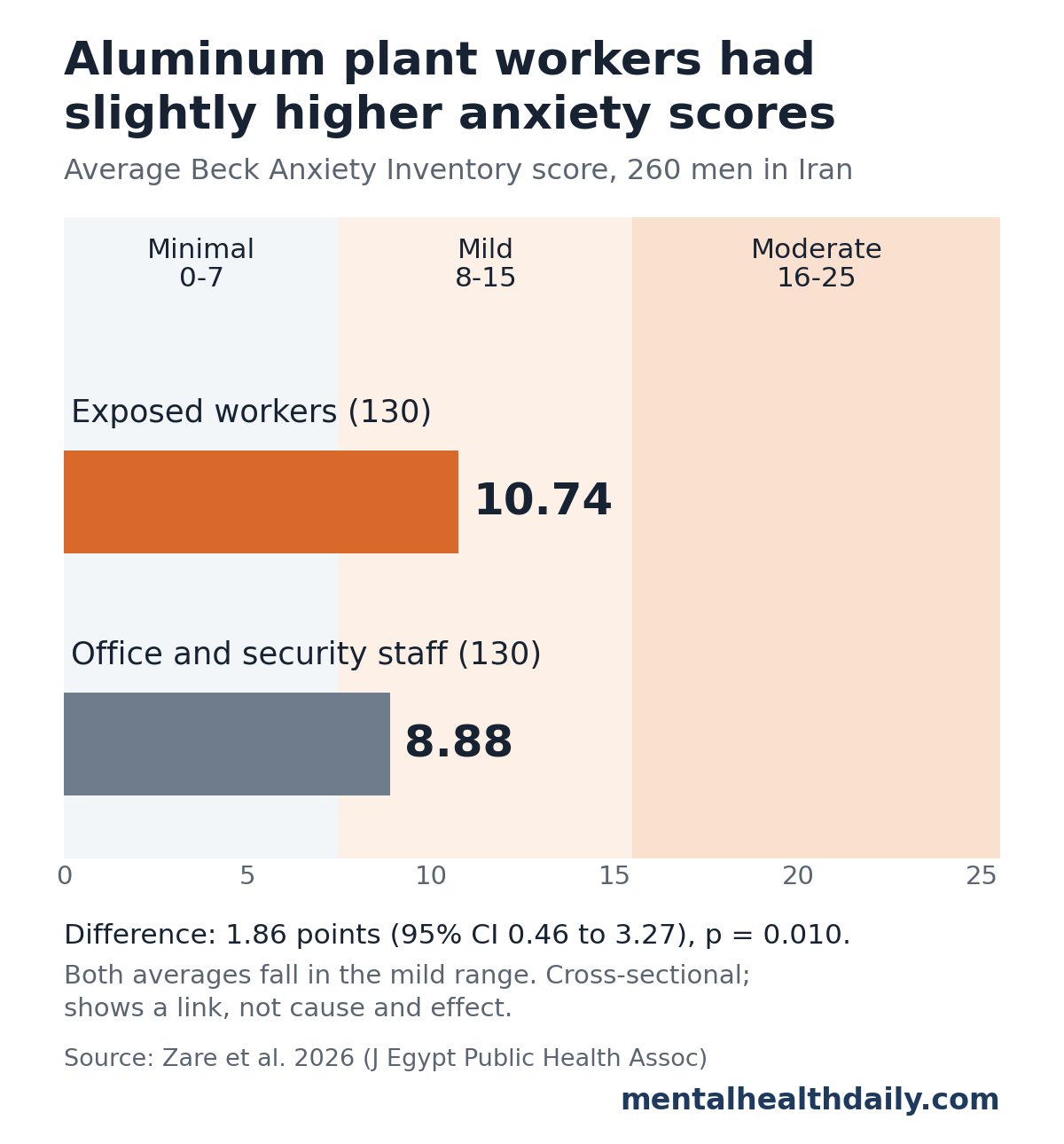
Size of the difference: on standard BAI cutoffs, 8 to 15 counts as mild anxiety, and both groups’ averages fall inside that band. The researchers call the gap “modest in absolute terms” and note that it may not reflect clinically significant anxiety for most of the workers.1
Scores were more spread out among exposed workers (standard deviation 6.18 vs. 5.28), and some of them scored well above the mild range. A group average can hide a smaller number of men with real anxiety problems, which is why the researchers favor screening in high-exposure jobs.1
Exposure markers differed far more than anxiety did:1
- Urinary 1-OHP: 7.30 vs. 2.59 µmol/mol creatinine
- Urinary aluminum: 33.45 vs. 7.35 µg/g creatinine
- Airborne benzo[a]pyrene: 2.27 µg/m³ in the exposed group; below the detection limit for office and security staff
Urinary PAH and Aluminum Markers Were Linked to Anxiety, Alongside Job Stress
Across all 260 men, urinary 1-OHP had the strongest single correlation with anxiety (r = 0.505), followed by job stress (r = 0.435) and urinary aluminum (r = 0.417). Airborne benzo[a]pyrene had a weaker link (r = 0.249).1
Those correlations overlap, because the same men tended to have high levels of both markers and more job stress. The researchers therefore put everything into one regression model to see which factors still carried weight when the others were held constant.1
In that model, 4 factors were each independently linked to higher BAI scores:1
- Total job stress: β = 0.295, p < 0.001
- Urinary 1-OHP: β = 0.204, p = 0.013
- Smoking: β = 0.202, p = 0.003
- Urinary aluminum: β = 0.177, p = 0.009
Age and years on the job were not significant. Together, the 6 factors explained 38.4% of the variation in anxiety scores (R² = 0.384).1
Reading the betas: a standardized β puts each factor on the same scale, so a larger number means a stronger link. In raw units, each extra 1 µmol/mol creatinine of 1-OHP went with about 0.26 more BAI points, and each extra 10 µg/g creatinine of aluminum with about 0.6 more points.1
Job stress did not explain away the chemical links. Exposed workers did report more job stress (52.45 vs. 47.45), but when the researchers tested whether stress was the route through which exposure related to anxiety, it was not. Chemical markers and job stress each had their own link to anxiety.1
Why PAHs and Aluminum Might Affect Anxiety
The proposed biology rests mainly on animal and cell studies cited by the researchers:1
- Inflammation and oxidative stress: benzo[a]pyrene raised inflammatory signals and oxidative damage in brain support cells (astrocytes), and long-term dosing produced anxiety-like behavior in animals.
- Brain chemistry: aluminum disrupted glutamate and acetylcholine signaling and increased oxidative stress in nerve tissue in experimental studies.
- Shared pathways: because both exposures act on inflammation and oxidative stress, the researchers suggest their effects could add up.
There is human evidence that aluminum affects the nervous system in workers. A 2007 meta-analysis of 9 occupational studies (449 exposed workers, 315 controls) found that aluminum-exposed workers performed worse on cognitive and motor tests, with the clearest effect on a speed-based digit symbol test (d = −0.43).3 That work measured thinking speed, though, not anxiety.
Other Studies Linking PAH Exposure to Anxiety and Mental Health
US population data: a 2025 analysis of 4,026 adults in the National Health and Nutrition Examination Survey (NHANES) found that 8 of 9 urinary PAH metabolites were linked to reporting 7 or more anxious days a month. For 1-hydroxypyrene, the odds ratio was 1.16 per log-unit rise (95% CI 1.04 to 1.29), and a combined score for all 9 PAHs gave 1.15 (1.04 to 1.28).2 That survey was also cross-sectional.
Oil spill workers: after the 2010 Deepwater Horizon spill, the GuLF STUDY compared 8,968 clean-up workers with 2,225 people who trained but were not hired. Clean-up work was linked to more probable depression (prevalence ratio 1.22) and PTSD (1.35).4
Once the GuLF researchers accounted for specific clean-up job experiences, only the highest hydrocarbon exposure remained linked to PTSD. That study measured depression and PTSD, not anxiety, and it shows how hard it is to separate chemical exposure from the stress of the work itself.4
Job stress: a meta-analysis of longitudinal studies found consistent evidence that high job demands, low control over work and effort-reward imbalance predict later common mental disorders.5 The strong job-stress link in the aluminum plant fits that body of work.
Smoking: tobacco smoke is itself a PAH source, and smoking and anxiety are often linked, though a systematic review found inconsistent evidence on which comes first.6
Limitations of This Aluminum Worker Anxiety Study
This is a cross-sectional study: anxiety and exposure were measured once, at the same time, so it shows a link and cannot show that PAHs or aluminum caused anxiety. Specific limits:1
- Different jobs, not just different exposure: the comparison group did office and security work. Education, income, shift work, sleep, alcohol use and physical demands may differ between the groups, and the researchers did not measure most of these.
- One urine sample: a single end-of-week measurement reflects recent exposure, not years of cumulative dose.
- Self-reported anxiety: the BAI is a symptom questionnaire, not a diagnosis, and many of its items are physical symptoms such as feeling hot, shaky or short of breath.
- Healthy worker effect: men who became ill or very anxious may have already left or moved to lower-exposure jobs, which could make the difference look smaller than it is.
- Narrow sample: one plant, men only, and people taking anxiety or depression medication were excluded.
What This Means for Aluminum and Smelter Workers
Exposure control is already justified. Benzo[a]pyrene and other PAHs are established cancer hazards, so cutting smelter exposure does not depend on this anxiety finding.1
Job stress deserves equal attention. It had the strongest link to anxiety in this plant, and the researchers recommend reducing psychosocial work stressors alongside chemical exposures.1
Screening may help catch the minority with higher scores. The researchers suggest adding mental health checks to the urine and air monitoring that high-exposure plants already do. Workers who notice persistent worry, tension or physical anxiety symptoms can raise them with an occupational health clinic or their own doctor.
Everyday contact with aluminum, such as cookware, foil or cans, was not studied and involves far lower exposure than smelter work.
References
- Zare MR, Kakhaki HES, Zare M, Ahmadi MS, Ardakani MB. Assessment of anxiety risk association with PAHs and aluminum co-exposure in an aluminum production facility. Journal of the Egyptian Public Health Association. 2026;101:27. doi:10.1186/s42506-026-00233-2
- Cui S, Wu J, Li X, Zhang X, Nie Z, Li Y, Xiang W, Jiang X. Association between polycyclic aromatic hydrocarbons and anxiety in US adults: National Health and Nutrition Examination Survey (NHANES) 2007 to 2012. Medicine (Baltimore). 2025;104(28):e42900. doi:10.1097/MD.0000000000042900
- Meyer-Baron M, Schäper M, Knapp G, van Thriel C. Occupational aluminum exposure: evidence in support of its neurobehavioral impact. Neurotoxicology. 2007;28(6):1068–1078. doi:10.1016/j.neuro.2007.07.001
- Kwok RK, McGrath JA, Lowe SR, Engel LS, Jackson WB 2nd, Curry MD, Payne J, Galea S, Sandler DP. Mental health indicators associated with oil spill response and clean-up: cross-sectional analysis of the GuLF STUDY cohort. Lancet Public Health. 2017;2(12):e560–e567. doi:10.1016/S2468-2667(17)30194-9
- Stansfeld S, Candy B. Psychosocial work environment and mental health—a meta-analytic review. Scandinavian Journal of Work, Environment & Health. 2006;32(6):443–462. doi:10.5271/sjweh.1050
- Fluharty M, Taylor AE, Grabski M, Munafò MR. The association of cigarette smoking with depression and anxiety: a systematic review. Nicotine & Tobacco Research. 2017;19(1):3–13. doi:10.1093/ntr/ntw140