Adults with type 2 diabetes who also had ADHD died at a higher rate than those without ADHD in a 2026 study of 1.9 million adults newly diagnosed with diabetes across 7 countries. They did not, however, have more heart attacks, strokes or cardiovascular deaths.1
Research Highlights
- Higher death rate with ADHD: after adjusting for age, sex and year of diagnosis, adults with ADHD had 2.42 times the all-cause death rate (95% CI 1.72–3.41). After adjusting for psychiatric history and medications, the hazard ratio was 1.71 (1.21–2.43).1
- No overall rise in heart attacks or strokes: the pooled hazard ratio for major heart and stroke events was 1.04 (0.81–1.35), though results varied widely by country.1
- ADHD medication showed no overall link: among 33,301 adults with ADHD, periods on medication were not linked to more heart events or deaths than periods off it.1
- A signal in younger adults: in people diagnosed with diabetes at 18–44, medication periods were linked to a 58% higher rate of heart attack, stroke or cardiovascular death (HR 1.58, 1.18–2.10). No such link appeared at 45 and older.1
- Observational data: the study used national health records, so it shows links, not cause and effect, and it lacked data on smoking, weight and blood sugar control.1
How the 7-Country ADHD and Diabetes Study Worked
Zihan Dong et al. pulled health records from Australia, Denmark, the Netherlands, Norway, Sweden, the United Kingdom and the United States. Each country ran the same preregistered analysis plan on its own data, and the results were then pooled.1
- Who was included: 1,929,027 adults with a first diagnosis of type 2 diabetes (or a first prescription for a non-insulin diabetes drug) between 2010 and 2020, with no earlier heart attack or stroke
- ADHD: 44,748 people (2.3%) had an ADHD diagnosis or an ADHD medication prescription by the end of follow-up
- Follow-up: a median of about 2 to 4 years in the ADHD group and 3 to 5.5 years in the non-ADHD group, depending on the country
- Events: 120,439 people (6.2%) had a major heart or stroke event, and 115,945 (6.0%) died
Type 2 diabetes is the common form of diabetes, in which the body stops responding well to insulin and blood sugar stays high. It is a well-established risk factor for heart disease, stroke and early death on its own.1
The heart outcome was MACE (major adverse cardiac events), a standard combined measure used in diabetes research. Here it meant a heart attack, a stroke or death from cardiovascular disease, whichever came first.
Results are given as hazard ratios (HRs), which compare how often an event happened over time in one group vs. another. An HR of 1.71 means a 71% higher rate; an HR near 1 means no difference.
Adults with ADHD were much younger when diabetes was diagnosed: median ages ranged from 34 to 50 across countries, compared with mostly mid-50s to early 60s in the non-ADHD group. They also had far more psychiatric conditions and used more psychiatric medications.1
ADHD Was Linked to a Higher Death Rate After a Diabetes Diagnosis
The researchers adjusted their results in 3 steps, and the ADHD link to death held up at each one:1
- Age, sex and year of diagnosis: HR 2.42 (1.72–3.41)
- Plus psychiatric history and psychiatric and heart or metabolic medications: HR 1.76 (1.23–2.52)
- Plus diabetes medication use during follow-up: HR 1.71 (1.21–2.43)
So other psychiatric conditions explained part of the gap, but adults with ADHD still had about a 71% higher death rate. The link was significant in Denmark, the Netherlands, Sweden and the US, with fully adjusted HRs from 1.53 to 3.81. It showed up in both men and women.1
Causes of death: the study could not break deaths down beyond cardiovascular ones. Because ADHD was not linked to more heart attacks or strokes, the extra deaths likely came from other causes.
The researchers point to 2 likely routes. Accidents and other unnatural deaths are more common with ADHD in general, and managing diabetes takes daily planning, routine and follow-through, which ADHD symptoms make harder.1
ADHD Was Not Linked to More Heart Attacks or Strokes Overall
Across all 7 countries combined, ADHD was not linked to MACE (HR 1.04, 0.81–1.35), and the estimate moved slightly below 1 after full adjustment (0.90, 0.71–1.13).1
Country results pulled in opposite directions. ADHD was linked to a higher MACE rate in Sweden (HR 1.44) but a lower one in the US (HR 0.73), and countries disagreed far more than chance would explain.1
The researchers suggest a ceiling effect: diabetes already carries such a high cardiovascular risk that ADHD may add little on top. Differences in how each country records ADHD and diabetes could also explain part of the spread.1
ADHD Medication and Heart Risk: No Overall Link, One Age Signal
The second question looked only at the 33,301 adults whose ADHD was recorded by the time of their diabetes diagnosis. The researchers compared stretches of time when each person was filling ADHD prescriptions with stretches when they were not.1
The medications included stimulants (methylphenidate, amphetamine, dexamphetamine and lisdexamfetamine, which raise dopamine and norepinephrine activity in the brain) and the non-stimulants atomoxetine and guanfacine. Stimulants can modestly raise heart rate and blood pressure.
Overall, medication periods were not linked to MACE (HR 1.12, 0.88–1.44) or death (HR 1.00, 0.72–1.39). Countries agreed fairly well on both.1
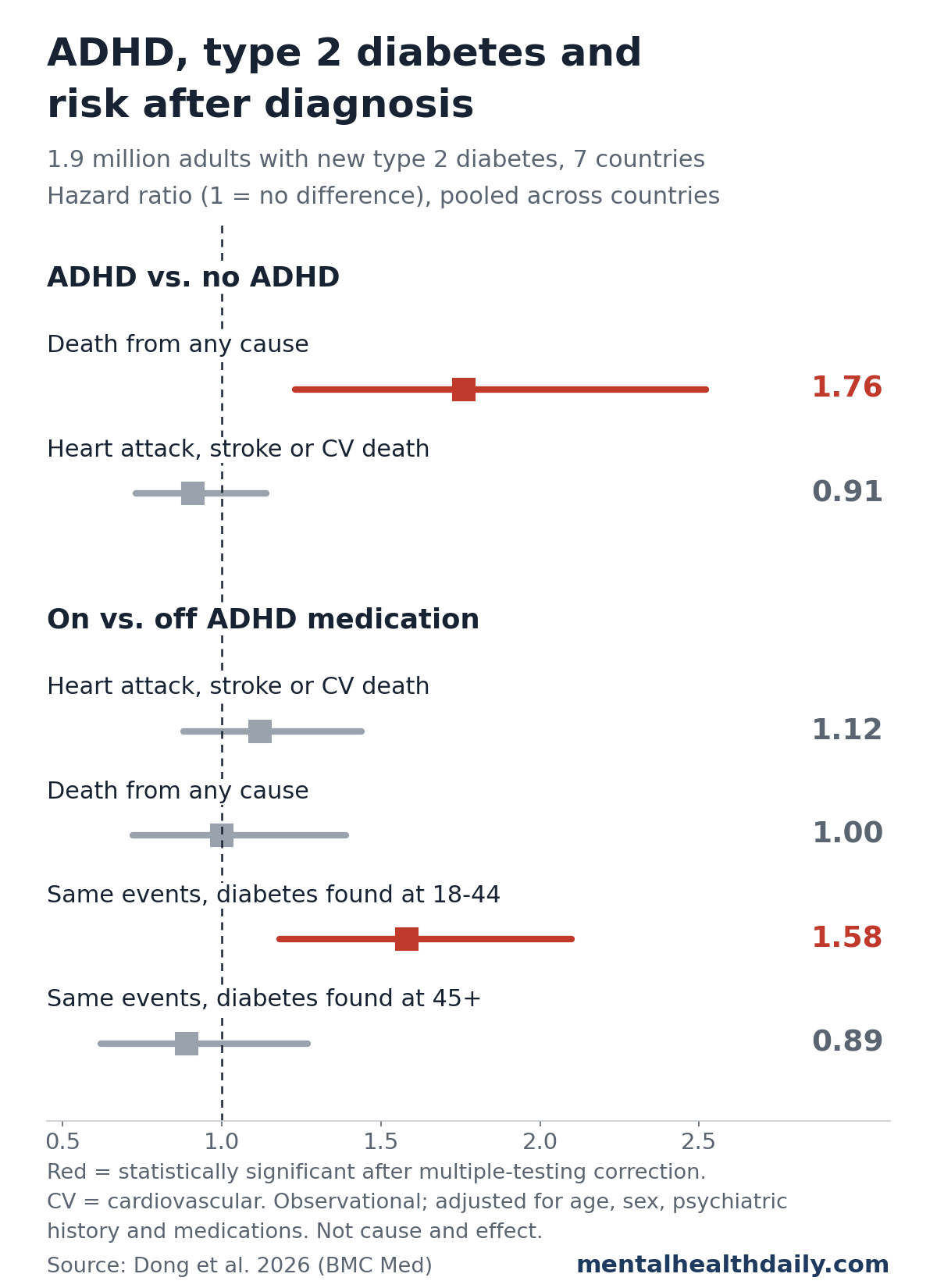
Younger adults: in people diagnosed with diabetes at 18–44, medication periods were linked to a higher MACE rate. In those diagnosed at 45 or older, they were not (HR 0.88, 0.63–1.23).1
The younger-group estimate was similar across all 3 adjustment steps:
- Basic adjustment: HR 1.50 (1.13–1.99)
- Plus psychiatric history and medications: HR 1.58 (1.18–2.10)
- Plus diabetes medications: HR 1.53 (1.14–2.05)
Only the middle estimate passed the study’s strict correction for running many tests at once. The subgroup also rested on just 4 of the 7 countries, because the other 3 countries had no estimate for this group.1
The researchers offer a few explanations. Heart events are rare in younger adults, so any added risk is easier to detect, and diabetes that starts early tends to be more aggressive. Doctors may also prescribe lower doses to older adults.1
Earlier Studies on ADHD, Diabetes and Heart Risk
The 2026 study adds a diabetes-specific view to several large Swedish and international studies:
- ADHD and diabetes risk: a 2023 meta-analysis found that people with ADHD had more than twice the odds of developing type 2 diabetes (adjusted OR 2.29). In Swedish register data, other psychiatric conditions such as depression, anxiety and substance use explained much of that link.2
- ADHD and heart disease: a 2023 meta-analysis covering 18.4 million people linked ADHD to higher cardiovascular disease risk, with an odds ratio of 1.73 in adults.3 That broader measure included conditions beyond heart attack and stroke, which may explain why the diabetes study found no MACE link.
- Long-term medication use: a Swedish study of 278,027 people with ADHD linked each year of ADHD medication use to a 4% higher risk of cardiovascular disease, mainly high blood pressure and artery disease.4
- Medication and death: another Swedish cohort found that starting ADHD medication was linked to lower all-cause mortality over 2 years (HR 0.79), driven by fewer unnatural deaths, with no change in natural-cause deaths.5
Taken together, earlier research links long-term ADHD medication to a modest rise in cardiovascular risk and to fewer accidental and other unnatural deaths. The diabetes study found the cardiovascular side only in younger adults and no overall change in deaths.
Limitations of This ADHD and Diabetes Cohort Study
- Observational design: people who take ADHD medication may differ from those who do not in symptom severity and other ways the records cannot capture (confounding by indication).
- Missing risk factors: there were no data on smoking, body weight, blood pressure, blood sugar control, kidney function or substance use.
- Small medication groups: the researchers note the medication analyses had limited numbers and need replication in larger cohorts.
- Estimated medication use: prescription refill patterns were used to infer when people were taking medication, which can misclassify real use.
- Uneven records: countries differed in how they captured ADHD and diabetes; in Denmark and Australia, ADHD was identified mainly through prescriptions.
- Short follow-up: median follow-up was only a few years, and causes of death beyond cardiovascular ones were not examined.
- High-income countries only: results may not apply to lower-income settings.
What This Means for Adults With ADHD and Type 2 Diabetes
The higher death rate is the clearest finding. It held across all 3 adjustment steps, reached significance in 4 countries and appeared in both men and women. The researchers call for diabetes care and mental health care to work together, so that ADHD is recognized and diabetes self-management gets more support.1
The medication finding is an early signal. It applies to people diagnosed with diabetes before 45 and needs confirmation. The researchers suggest careful prescribing and monitoring of heart health in this group.1
Anyone with ADHD and diabetes who is worried about their heart risk should raise it with their prescriber rather than stopping medication on their own.
References
- Dong Z, Zhou Y, Yao H, Liu S, Astrup A, Engeland A, et al. Major adverse cardiac events and mortality associated with ADHD and its treatment in adults with type 2 diabetes: a multi-national cohort study. BMC Medicine. 2026;24:527. doi:10.1186/s12916-026-05246-4
- Garcia-Argibay M, Li L, Du Rietz E, Zhang L, Yao H, Jendle J, et al. The association between type 2 diabetes and attention-deficit/hyperactivity disorder: a systematic review, meta-analysis, and population-based sibling study. Neuroscience & Biobehavioral Reviews. 2023;147:105076. doi:10.1016/j.neubiorev.2023.105076
- Li L, Yao H, Zhang L, Garcia-Argibay M, Du Rietz E, Brikell I, et al. Attention-deficit/hyperactivity disorder is associated with increased risk of cardiovascular diseases: a systematic review and meta-analysis. JCPP Advances. 2023;3(3):e12158. doi:10.1002/jcv2.12158
- Zhang L, Li L, Andell P, Garcia-Argibay M, Quinn PD, D’Onofrio BM, et al. Attention-deficit/hyperactivity disorder medications and long-term risk of cardiovascular diseases. JAMA Psychiatry. 2024;81(2):178–187. doi:10.1001/jamapsychiatry.2023.4294
- Li L, Zhu N, Zhang L, Kuja-Halkola R, D’Onofrio BM, Brikell I, et al. ADHD pharmacotherapy and mortality in individuals with ADHD. JAMA. 2024;331(10):850–860. doi:10.1001/jama.2024.0851