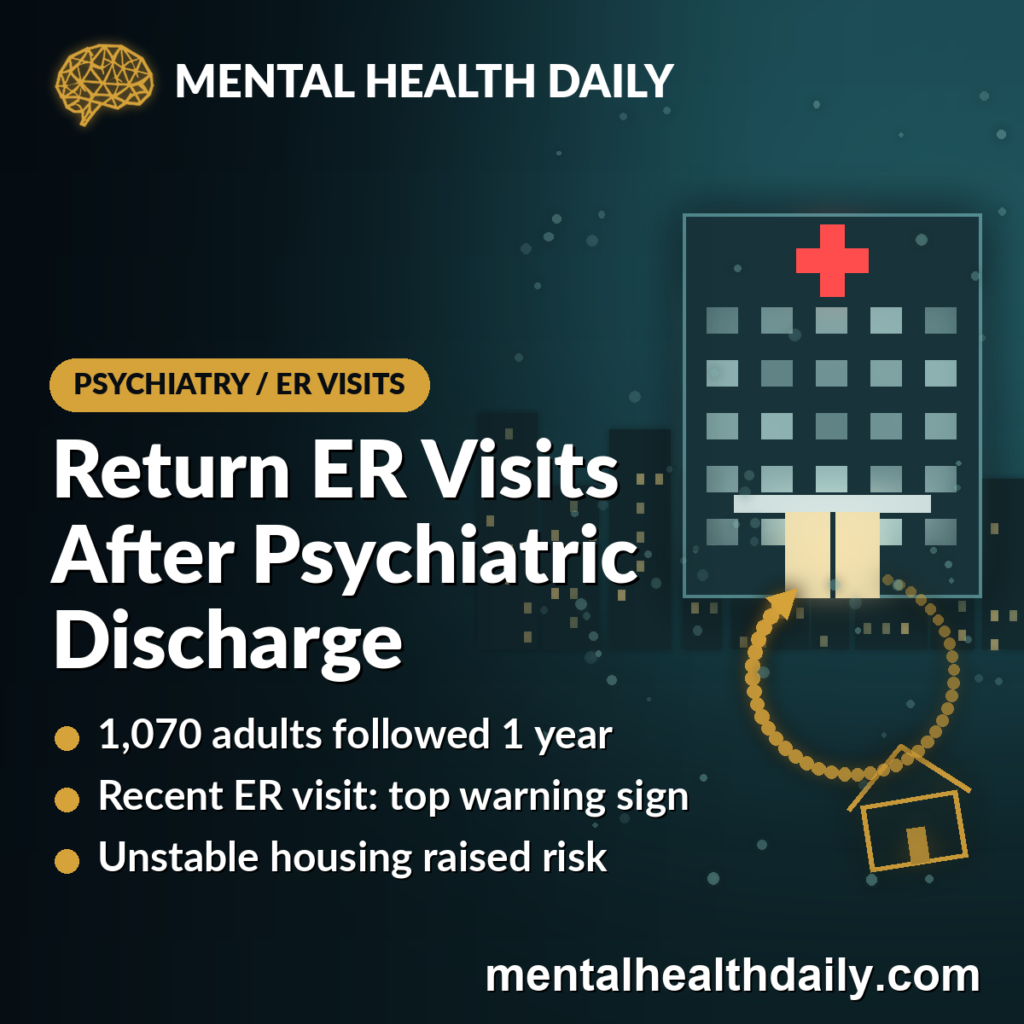
In a 2026 Alberta study of 1,070 adults leaving psychiatric hospital care, 40% returned to an emergency department for mental health reasons within a year. The strongest warning signs were social rather than clinical: a recent emergency visit before admission (3.72 times the odds), unstable housing (2.60 times), and unemployment (1.57 times).1
Research Highlights
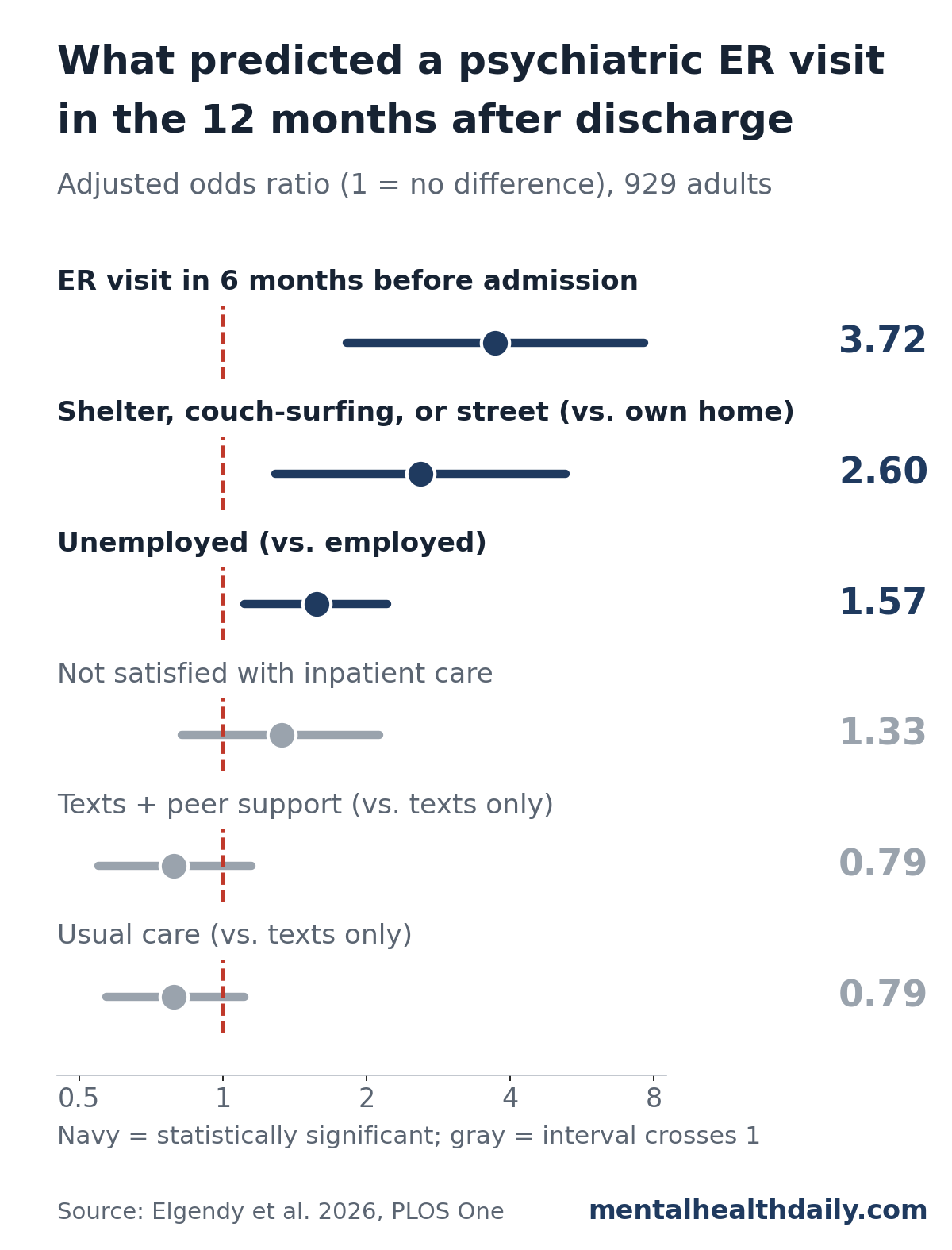
- Recent emergency visits were the strongest signal: people with a psychiatric emergency department (ED) visit in the 6 months before admission had 3.72 times the odds of another visit in the year after discharge (95% CI 1.82–7.63).1
- Housing and work also mattered: living in a shelter, couch-surfing, or on the street carried 2.60 times the odds of a return visit compared with owning a home, and unemployment 1.57 times the odds compared with having a job.1
- Clinical scores did not add much: depression, anxiety, resilience, well-being, diagnosis, and satisfaction with the hospital stay were not significant once the 14 predictor groups were modeled together in 929 people.1
- Risk markers, not forecasts: the full model explained only about 11% of the variation in who returned, so most of what drives a repeat visit was not captured.1
- The same pattern shows up elsewhere: in Ontario, 27.2% of people homeless at discharge visited an ED within 30 days vs. 11.6% of those who were housed.3
The weeks and months after a psychiatric admission are one of the riskiest stretches in mental health care. People leave with new medications, unfinished recovery, and sometimes nowhere stable to go. In New South Wales, Australia, 37% of 35,056 people discharged from a first psychiatric admission presented to an ED at least once within 2 years, and 40% were readmitted.4
A return trip to the ED is not a personal failure. For someone in crisis, it is often the safest available option. The practical question for hospitals is which patients are most likely to need that option again, and what kind of support might make it less necessary.
How the Alberta Psychiatric Discharge Study Worked
Elgendy et al. drew their sample from Text4Support, a larger Alberta trial testing whether supportive text messages, alone or combined with peer support, could ease the transition home after psychiatric hospitalization.1 For this analysis, the researchers treated the whole group as a single cohort and asked which characteristics measured during the hospital stay predicted later ED use.
- Who: 1,070 adults discharged from acute psychiatric units in Edmonton, Calgary, and Grande Prairie between March 2022 and February 2024. Everyone needed a mobile phone and the ability to read English texts.
- Profile: 37% were 25 or younger, 55% were women, 53% were unemployed, and 6% were living in a shelter, couch-surfing, or on the street at the time of the survey.
- Measured in hospital: demographics, housing, employment, satisfaction with inpatient care, and standard questionnaires for depression (PHQ-9), anxiety (GAD-7), resilience, and well-being.
- Outcome: any psychiatric ED visit within 12 months of discharge, taken from linked provincial health records rather than self-report.
- Analysis: multivariable logistic regression, a model that estimates each factor’s link to the outcome while holding the others constant. Results are reported as odds ratios (ORs), where 1 means no difference and 2 means roughly double the odds.
The supportive text messages were daily automated texts for 6 months, written by psychiatrists, psychologists, and people with lived experience, built on cognitive behavioral therapy ideas: coping strategies, hope, medication reminders, and nudges to seek help early.
Peer support added contact with trained workers who had their own experience of mental illness and recovery, who offered emotional support and helped people stay connected to outpatient care and community resources.1
Recent ER Visits, Unstable Housing, and Unemployment Predicted Return Visits
Only 3 factors stood out after adjustment:1
- A psychiatric ED visit in the 6 months before admission: OR 3.72 (95% CI 1.82–7.63, p < 0.001). This was the largest effect in the model.
- Living in a shelter, couch-surfing, or on the street, compared with owning a home: OR 2.60 (95% CI 1.29–5.22, p = 0.008). Renters also leaned higher (OR 1.48), but that estimate was not statistically significant.
- Unemployment, compared with employment: OR 1.57 (95% CI 1.11–2.21, p = 0.010). Students and retirees did not differ from employed participants.
Recent ED use as a marker: past acute-care use is one of the most consistently reported predictors of future visits.5
A recent emergency visit captures many things the questionnaires missed, including how quickly symptoms escalate, whether outpatient care is reachable after hours, and whether the ED has become the default entry point to care. The researchers suggested it may reflect unresolved clinical needs, weak transition support, or unmet social needs.1
Housing and employment as practical barriers: without a stable address, keeping follow-up appointments, storing medications, sleeping well, and being reachable by a community team all get harder. Unemployment can mean no income buffer, no daily structure, and fewer routes into employer-linked benefits. Both are conditions around the person, not traits of the person.
How much the model explained: taken together, all the predictors explained between 8.5% and 11.4% of the variation in who returned to the ED. That is typical for this kind of research, and it means these factors flag higher-risk groups but cannot tell a clinician which individual patient will come back.1
Satisfaction, Depression Scores, and Diagnosis Did Not Predict ER Visits
Inpatient satisfaction: this was a central question for the researchers, because patient experience is increasingly used as a quality measure, and some studies suggest people who feel poorly treated disengage from follow-up care.
In this cohort, 89% said they were satisfied or very satisfied with their stay. People who were not satisfied had somewhat higher odds of a return visit (OR 1.33), but the confidence interval ran from 0.82 to 2.13, so the study could not rule out no effect.1
Symptom scores at discharge: likely depression, likely anxiety, low resilience, and poor well-being all had odds ratios close to 1, and none was significant.1 The researchers wrote that this ran contrary to their expectations.
Diagnosis did matter in other samples: in a 2021 Quebec study of 320 ED patients, Kaltsidis et al. found that clinical need was the strongest correlate of frequent mental health ED use, particularly schizophrenia and personality disorders, alongside past psychiatric hospitalization.5
The Alberta analysis used broad diagnostic categories and measured whether anyone returned at all, not how often, which may blur differences that show up among the most frequent users.
Text Messages and Peer Support: What This Analysis Can and Cannot Say
In the Alberta model, the study group someone was in was not linked to 12-month ED visits. Compared with text messages alone, both usual care and texts plus peer support had odds ratios of 0.79, with intervals crossing 1.1
That result should not be read as proof that the programs failed. The researchers explicitly entered the study group as one of many covariates, not as the main test of whether the interventions worked.
The trial’s own effectiveness analysis, published in 2025, compared the 6 months before and after the index admission. Readmissions fell more with text messaging, with or without peer support, than with usual care (a mean difference of 0.26 admissions), and texts alone reduced time in hospital by an average of 7.28 days.2
Readmission and ED visits are different outcomes, measured over different windows, so the 2 papers are not in direct conflict. Together they suggest light-touch digital support may help keep some people out of hospital beds without clearly changing whether they ever return to an ED during a full year.
Homelessness After Psychiatric Discharge Tracks Higher ER Use Across Canada
The housing finding fits a consistent body of Canadian evidence:
- Ontario, population data: Laliberté et al. identified 2,052 adults who were homeless at psychiatric discharge. Within 30 days, 27.2% visited an ED vs. 11.6% of housed patients, and 17.1% were readmitted vs. 9.8%. Homeless patients were also more than 50% less likely to see a psychiatrist after discharge.3
- Housing First, 5-city randomized trial: in the At Home/Chez Soi trial, homeless adults with serious mental illness who received Housing First — immediate rent-subsidized housing without sobriety or treatment conditions, paired with a mobile treatment team — were far more likely to be stably housed after 1 year (73% vs. 31% with usual services).6
- Housing stability and service use: across 2,039 participants in the At Home/Chez Soi project, Kerman et al. found that people who achieved stable housing used psychiatric inpatient care less over 24 months, whichever group they were in. Self-reported ED use fell in both the Housing First and standard-care groups.7
The Ontario data show the same direction as Alberta over a much shorter window. The Housing First trial shows the predictor is modifiable: housing instability among people with serious mental illness can be sharply reduced when housing is provided directly. No study here establishes how much providing housing at discharge would reduce a person’s future ED visits.
Evidence Strength: Limits of This Alberta Cohort
This is an observational analysis. It can identify groups at higher risk; it cannot show that changing housing or employment would cause fewer ED visits. Several specific limits apply:1
- Small high-risk group: only 66 people were unstably housed, which is why the OR of 2.60 carries a wide interval.
- Missing data: the model included 929 of 1,070 participants, and the paper does not describe how missing values were handled.
- Unmeasured factors: substance use, medication adherence, quality of social support, physical illness, and whether people actually saw an outpatient clinician were not in the model.
- Who could enroll: participants needed a phone and English literacy, so the hardest-to-reach patients were likely underrepresented.
- Reporting inconsistencies: the descriptive table totals 1,101 people rather than 1,070, and it describes prior ED visits over 12 months while the regression uses 6 months. These do not change the direction of the main findings but make exact figures harder to pin down.
- Setting: Canada’s public system removes cost barriers to ED care, so the relative weight of these predictors may differ in insurance-based systems.
Discharge Planning for Patients at Highest Risk of a Return ER Visit
The Alberta findings point toward questions that are quick to ask at discharge and hard to ignore:
- Has this person used the ED recently? A recent visit may justify earlier follow-up, a named contact, or case management rather than a routine appointment weeks out.
- Where will this person sleep tonight and next month? Shelter or couch-surfing at discharge is a signal to involve housing workers before the person leaves, not after a crisis.
- Does this person have income and daily structure? Unemployment may warrant a referral to income support or supported employment programs.
For patients and families, the findings are a reminder that returning to the ED after discharge often reflects what surrounds a person more than what is wrong with them. Asking the discharge team directly about housing, income, and a follow-up plan is reasonable, and using the ED in a crisis remains the right call when safety is at stake.
Questions About Psychiatric ER Visits After Discharge
How common is it to go back to the ER after a psychiatric hospital stay?
Common. In the Alberta cohort, 40% had a psychiatric ED visit within 12 months.1 In New South Wales, 37% presented to an ED within 2 years of a first psychiatric admission.4
Does being unhappy with hospital care make someone more likely to return to the ER?
Not clearly. Dissatisfied patients leaned toward higher odds (OR 1.33), but the difference was not statistically significant once housing, employment, and past ED use were accounted for.1
Did the text messages and peer support reduce ER visits?
This analysis found no link between study group and 12-month ED visits, but it was not designed to test the programs.1
The trial’s main analysis reported fewer readmissions and shorter hospital stays with text support.2
Would giving people housing reduce repeat ER visits?
Plausibly, but not proven for this exact outcome. Housing First sharply improved housing stability in a randomized trial, and participants who became stably housed used less psychiatric inpatient care, yet no trial here directly tested post-discharge housing as a way to prevent return ED visits.6,7
References
- Predictors of psychiatric emergency department visits within twelve months post-inpatient psychiatric discharge in Alberta, Canada. Elgendy HE, et al. PLoS One. 2026;21(7):e0351753. doi:10.1371/journal.pone.0351753
- Effectiveness of Text Messages and Text Messages Plus Peer Support on Psychiatric Readmission and Length of Stay: Outcomes From a Quantitative Stepped-Wedge Cluster Randomized Trial. Agyapong VIO, et al. JMIR Ment Health. 2025;12:e81760. doi:10.2196/81760
- Homelessness at discharge and its impact on psychiatric readmission and physician follow-up: a population-based cohort study. Laliberté V, et al. Epidemiol Psychiatr Sci. 2019;29:e21. doi:10.1017/S2045796019000052
- Emergency department presentation and readmission after index psychiatric admission: a data linkage study. Li X, et al. BMJ Open. 2018;8(2):e018613. doi:10.1136/bmjopen-2017-018613
- Predictors of frequent emergency department utilization for mental health reasons. Kaltsidis G, et al. J Behav Health Serv Res. 2021;48(2):259-273. doi:10.1007/s11414-020-09695-4
- One-year outcomes of a randomized controlled trial of housing first with ACT in five Canadian cities. Aubry T, et al. Psychiatr Serv. 2015;66(5):463-469. doi:10.1176/appi.ps.201400167
- The effects of housing stability on service use among homeless adults with mental illness in a randomized controlled trial of housing first. Kerman N, et al. BMC Health Serv Res. 2018;18. doi:10.1186/s12913-018-3028-7