A 2026 Generation Scotland study linked traumatic physical injury to diagnosis-stratified blood methylation differences in 4,308 people.1 The clearest recurrent-depression signal pointed toward oxytocin signaling and synaptic-plasticity pathways, but the result is still exploratory pathway evidence rather than a blood test for depression or PTSD.
Research Highlights
- Recurrent depression carried the strongest phenotype signal: traumatic injury was associated with recurrent MDD at OR = 2.10 (95% CI 1.33 to 3.33), while single-episode MDD was not clearly elevated at OR = 1.31.
- The discovery sample was large: the methylation analysis used 4,308 Generation Scotland participants, including 394 injury-exposed people in the main discovery structure.
- Oxytocin signaling stood out: 1 nominal methylome-wide injury-by-recurrent-depression signal set mapped to CpG positions enriched in the oxytocin-signaling pathway.
- Downstream validation was indirect: an independent 2,759-person sample connected related pathways with PTSD and recurrent MDD through methylation risk scores, SNP heritability, and trauma-weighted polygenic risk scores.
- Clinical use is premature: the 2026 data support a pathway hypothesis, not a diagnostic marker, treatment-selection assay, or proof that oxytocin treatment should be used after traumatic injury.
DNA methylation is a chemical mark on DNA that can change how genes are regulated without changing the DNA sequence itself. In trauma research, methylation is attractive because it can sit between exposure and later biology: injury, threat perception, inflammation, stress hormones, and psychiatric risk may all leave measurable regulatory traces.
Methylome-wide environment interaction studies test whether the relationship between an exposure and methylation differs across groups. Here, the exposure was self-reported traumatic injury after a serious incident, and the key comparison was whether methylation patterns differed between people with recurrent major depressive disorder and controls.
Recurrent Depression, Not Single-Episode Depression, Carried the Stronger Injury Signal
Marshall et al. used Generation Scotland data to separate controls, people with MDD, and the subgroup with recurrent MDD.1 A diagnosis of MDD came from the Structured Clinical Interview for DSM-IV, while traumatic injury came from fracture history linked to a road traffic accident or another serious incident.
The phenotype result was sharper than a generic “trauma and depression” claim. Traumatic injury was associated with recurrent MDD at OR = 2.10 (95% CI 1.33 to 3.33; p = 0.0016). The broader MDD category was also elevated at OR = 1.67 (95% CI 1.17 to 2.39; p = 0.0048), but single-episode MDD alone was weaker and not statistically confirmed at OR = 1.31 (95% CI 0.78 to 2.20; p = 0.3041).
Reader-facing interpretation: traumatic injury did not map equally onto every depression category. The stronger signal sat in recurrent depression, which fits a model where repeated depressive episodes may mark a more stress-sensitive or biologically loaded subgroup.
Oxytocin Signaling Was the Main Pathway Clue
Oxytocin signaling refers to a hormone-and-receptor system involved in social behavior, stress physiology, attachment, and threat response. It is often oversold as a simple bonding hormone, but in stress-related disorders its effects appear context-dependent and biologically messy.
In the 2026 methylation analysis, nominally significant traumatic-injury-by-recurrent-depression methylation signals were enriched around functional DNA regions, including the first exon, 3-prime untranslated regions, and exon boundaries. Pathway analysis then highlighted oxytocin signaling.
That pattern fits older trauma literature better than a clean treatment story. Oxytocin context: a systematic review found inconsistent results across PTSD and trauma-exposed samples, with differences by sex, trauma type, social context, and measurement method.2
The 2026 study helps explain why: oxytocin-pathway biology may vary by psychiatric subgroup and by the biological layer being measured.
Synaptic Plasticity Makes the Finding More Plausible
Synaptic plasticity means the brain’s ability to strengthen, weaken, or reorganize connections between neurons. Trauma-related symptoms involve emotional memories, threat learning, safety learning, arousal regulation, sleep, and social interpretation.
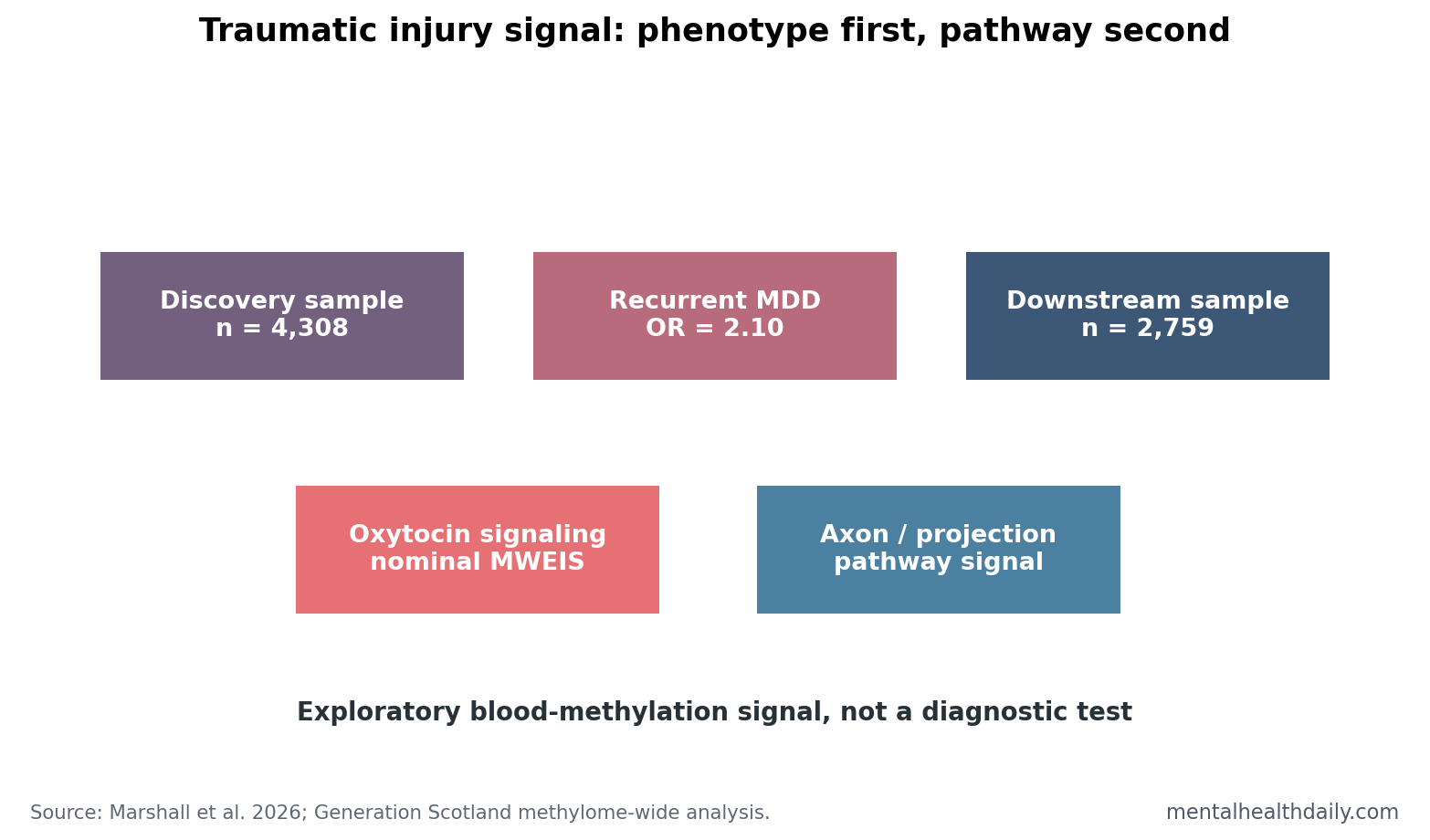
Downstream signal: in the independent 2,759-person sample, pathway-level analyses pointed to axon development and neuron projection organization across methylation risk scores, SNP heritability, and trauma-weighted polygenic risk scores.1
Those are network-level clues about neuronal wiring and plasticity, rather than single-gene answers.
Adjacent PTSD biology points in the same direction. Rosso et al. reported cortical GABA differences in PTSD, placing inhibitory signaling and plasticity inside the trauma phenotype rather than outside it.3 Large-scale PTSD genetic work has also reinforced that trauma-related psychopathology has polygenic architecture rather than 1 dominant risk gene.4
Evidence-strength note: this is an exploratory omics result. Blood methylation can reflect immune, environmental, and developmental signals as well as brain-relevant biology. The study can prioritize pathways for follow-up; it cannot diagnose PTSD, predict who will respond to therapy, or identify an oxytocin drug target by itself.
The Clean Clinical Claim Is About Stratification
The strongest use of this paper is stratification. Traumatic injury is a broad exposure: a fracture after a serious incident can involve pain, surgery, disability, fear, perceived threat, social disruption, and later rumination. Depression after injury is also heterogeneous. Some people have transient distress, while others develop recurrent episodes or PTSD symptoms.
Stratification signal: recurrent depression separated the biology more clearly than single-episode depression. That finding argues against treating all post-injury depression as one biological category.
Treatment boundary: oxytocin signaling in a pathway analysis is far from an intranasal-oxytocin treatment claim. Prior oxytocin-trauma findings are mixed, and social context can change oxytocin’s behavioral effects. The better next step is longitudinal sampling after injury, with repeated symptom measures and methylation assays that can test whether pathway changes precede recurrent depression or merely accompany it.
What Longitudinal Follow-Up Would Need to Prove
A stronger follow-up would start near the injury rather than years later. Researchers would need methylation samples soon after traumatic injury, repeated symptom assessments, pain and disability measures, perceived-threat ratings, treatment exposure, and later structured interviews for recurrent depression and PTSD.
Timing: methylation differences measured after recurrent depression has already developed can reflect many things: the injury, depressive episodes, medication exposure, smoking, inflammation, sleep disruption, and socioeconomic stress. Repeated sampling would help separate early exposure response from later illness burden.
Phenotyping: traumatic injury is not one exposure. A road traffic accident, assault-related fracture, fall, and sports injury can differ in perceived threat, medical complications, disability, social support, and litigation stress. The same fracture code may conceal different psychological exposures.
Treatment context: oxytocin-pathway biology should be tested alongside actual treatment outcomes, not assumed to guide them. If the pathway eventually predicts response, the useful question would be specific: which post-injury patients respond to trauma-focused psychotherapy, antidepressants, social support, sleep treatment, pain rehabilitation, or oxytocin-targeting interventions?
Replication target: the most convincing next signal would not be another broad trauma-versus-control scan. It would be a pre-registered test of the same recurrent-depression subgroup, the same injury definition, and the same oxytocin and synaptic-plasticity pathways in a separate cohort.
That matters because omics studies can generate attractive pathway names from small shifts spread across many CpG sites. A pathway result becomes more useful when the same direction appears across cohorts, time points, tissue-processing choices, and symptom definitions.
Clinical boundary: the pathway language should also stay separate from ordinary trauma care. A patient with depression after a serious injury does not need methylation testing to justify screening, sleep treatment, pain rehabilitation, psychotherapy referral, or medication review. The methylation result is a research clue about why some injury-exposed people may develop recurrent illness, not a prerequisite for taking symptoms seriously.
That distinction keeps the biology useful without turning exploratory methylation into clinical theater.
The current study earns attention because it narrows the biological search space. It does not close the loop from injury to methylation to symptoms to treatment. That next loop is where the clinical value would have to appear.
Immediate clinical use: post-injury care should still focus on symptom screening, pain control, sleep, social support, functional rehabilitation, and evidence-based trauma treatment when PTSD or recurrent depression appears. Methylation-pathway work may eventually improve subgrouping while ordinary clinical steps remain the way to reduce missed depression after injury.
The most useful reader takeaway is therefore balanced: traumatic injury and recurrent depression appear biologically entangled at a pathway level, with oxytocin and synaptic-plasticity systems plausible enough to study further. The numbers support follow-up biology, not a new test or treatment claim yet.
For readers, that means the paper belongs in the “risk biology” category. It strengthens the case for watching mental health after serious injury, especially when depression becomes recurrent, while trauma history remains a clinical exposure, not a methylation diagnosis or treatment selector.
Questions About Trauma, Depression, and Methylation
Does this mean traumatic injury causes recurrent depression through oxytocin?
No. The study found diagnosis-stratified methylation and pathway signals. It did not prove a single causal path from injury to oxytocin signaling to recurrent depression.
Why is recurrent MDD important here?
The recurrent subgroup had the stronger injury association at OR = 2.10, while single-episode MDD was not statistically confirmed. That suggests recurrence may mark a more biologically distinct post-injury depression pattern.
Could this become a blood test?
Not from these data. Blood methylation results need longitudinal replication, stronger predictive performance, and clinical validation before they can be treated as a test.
References
- Marshall S, Walker RM, Campbell A, et al. Methylome-wide association studies of physical injury stratified by depression status assesses exposure by diagnosis effects in oxytocin signaling and synaptic plasticity. Biological Psychiatry: Global Open Science. 2026;6:100710. https://doi.org/10.1016/j.bpsgos.2026.100710
- Donadon MF, Martin-Santos R, Osorio FdeL. The associations between oxytocin and trauma in humans: a systematic review. Frontiers in Pharmacology. 2018. https://doi.org/10.3389/fphar.2018.00154
- Rosso IM, et al. Cortical GABA alterations in posttraumatic stress disorder. Neuropsychopharmacology. 2022. https://doi.org/10.1038/s41386-021-01197-x
- Nievergelt CM, et al. International meta-analysis of PTSD genome-wide association studies identifies sex- and ancestry-specific genetic risk loci. Nature Genetics. 2024. https://doi.org/10.1038/s41588-024-01707-9