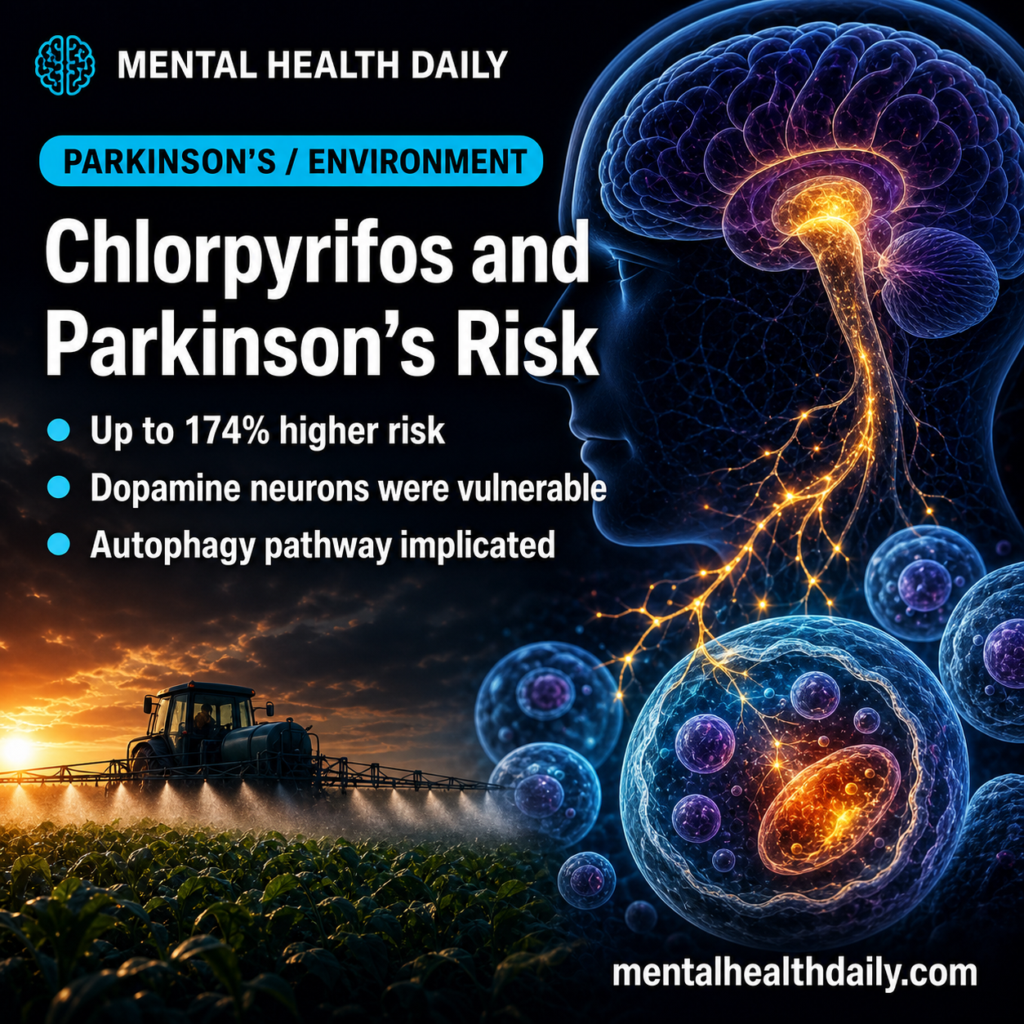
A human, mouse, and zebrafish study linked long-term chlorpyrifos exposure to Parkinson’s disease risk, with the strongest exposure-duration estimate reaching OR 2.74 for workplace proximity across the 1974-to-index-year window.1 The paper is stronger than a single epidemiology result because animal experiments pointed to dopaminergic neuron loss, microglial activation, pathological α-synuclein, and autophagy dysfunction.
Research Highlights
- Risk was highest with long-duration exposure: chlorpyrifos exposure duration near workplaces showed OR 2.74 (95% CI 1.55-4.89) for Parkinson’s disease.1
- Residential exposure also mattered: duration near residential application from 1974 to index year showed OR 2.68 (95% CI 1.58-4.55).1
- Animal models supported plausibility: exposed mice developed motor impairment, dopaminergic neuron loss, microglial activation, and pathological α-synuclein.1
- Autophagy was implicated: zebrafish experiments suggested chlorpyrifos-induced dopaminergic neuron loss depended partly on impaired autophagic flux and synuclein accumulation.1
- The design still needs calibration: human exposure was reconstructed from residential and workplace proximity, not measured as individual blood or tissue chlorpyrifos dose.1
Chlorpyrifos is an organophosphate pesticide formerly used widely in agriculture and other settings. Organophosphates affect cholinesterase biology, but Parkinson’s relevance also involves oxidative stress, mitochondrial vulnerability, protein aggregation, and dopamine-neuron injury.
Parkinson’s disease is a neurodegenerative movement disorder in which dopaminergic neurons in the substantia nigra are especially vulnerable. Dopaminergic neurons produce dopamine, a neurotransmitter essential for movement, motivation, and learning; losing those neurons drives core motor symptoms.
Duration Near Chlorpyrifos Application Reached OR 2.74
Hasan et al. used the Parkinson’s Environment and Genes study in California’s Central Valley. The main human analysis included 824 Parkinson’s disease patients and 821 controls, with exposure estimates based on chlorpyrifos applications near residences and workplaces.1
Odds ratio means the odds of Parkinson’s disease in an exposed group divided by the odds in a comparison group after model adjustment. An OR of 1.00 means no association. OR 2.74 means the modeled odds were 174% higher in the exposed group, though odds ratios differ from absolute risk.
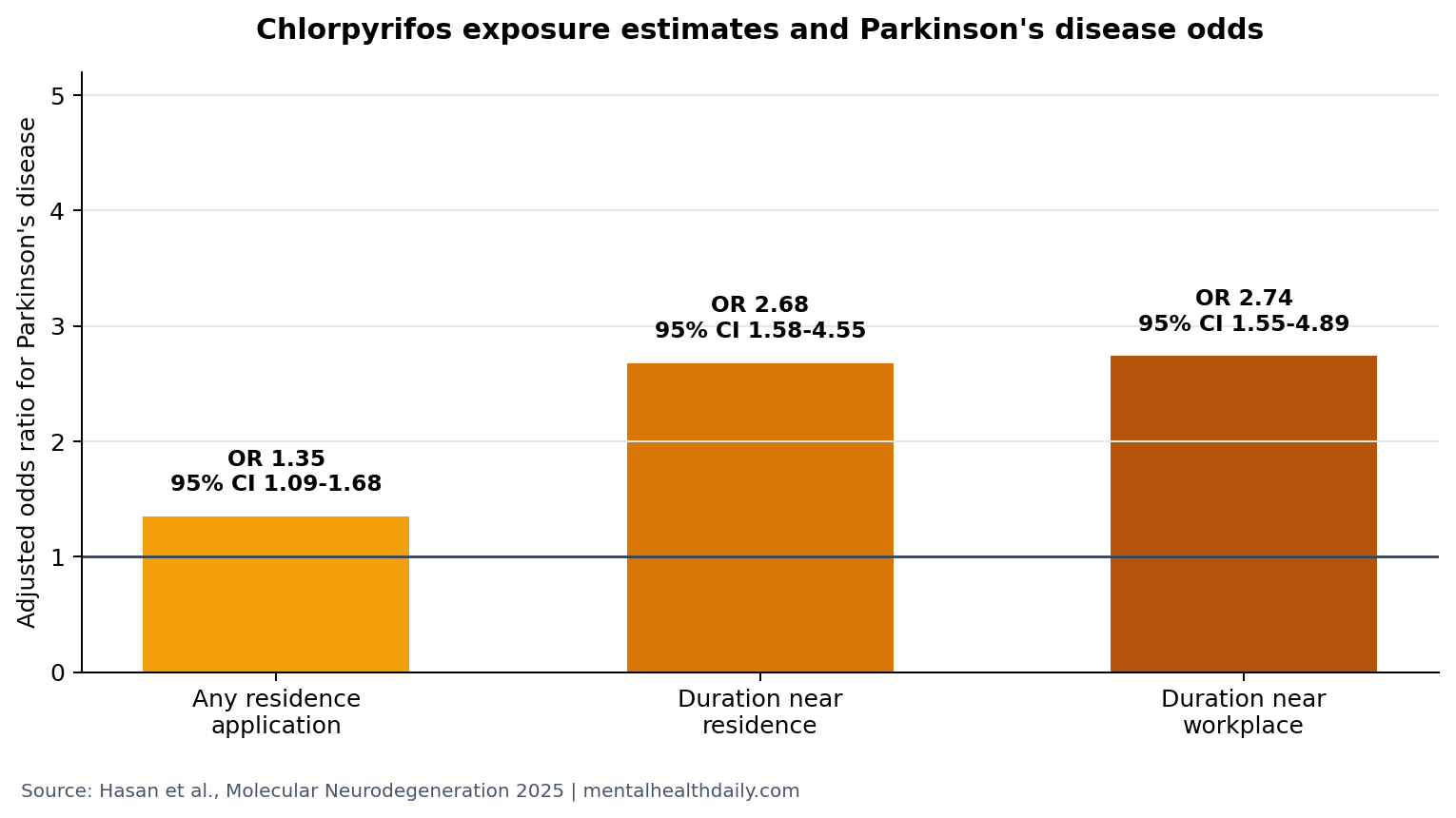
Any residential chlorpyrifos application exposure from 1974 to index year had OR 1.35 (95% CI 1.09-1.68). Duration of exposure across the same window was stronger: OR 2.68 near residences and OR 2.74 near workplaces. Both exposure-duration estimates had confidence intervals clearly above 1.00.1
Mouse Exposure Produced Dopamine-Neuron and Microglial Signals
The animal experiments were designed to ask whether the human association had biological plausibility. Mice exposed to aerosolized chlorpyrifos developed motor impairment, dopaminergic neuron loss, and signs of pathological α-synuclein, the protein that accumulates in Lewy pathology in Parkinson’s disease.1
Microglia are resident immune cells in the brain. In the chlorpyrifos-exposed mice, microglia showed activation-like morphology in vulnerable regions, and inflammatory markers were elevated. That does not prove microglia started the damage, but it places immune activation in the same injury field as dopamine-neuron stress.
The paper’s strength is triangulation: an exposure-risk signal in people, motor and pathology changes in mice, and mechanistic tests in zebrafish. Each layer has limitations, but the layers point in the same direction.
Autophagy Dysfunction Connected Chlorpyrifos to Synuclein Toxicity
Autophagy is a cellular recycling system that helps clear damaged proteins and organelles. Parkinson’s disease biology is sensitive to this pathway because poor protein clearance can favor α-synuclein accumulation and neuronal stress.
In zebrafish, chlorpyrifos-induced dopaminergic neuron loss appeared partly tied to autophagy dysfunction and synuclein accumulation. Knocking down LC3, an autophagy-linked protein, recapitulated dopaminergic neuron loss; restoring autophagic flux reduced neuronal vulnerability.1
Plain-English interpretation: chlorpyrifos exposure aligned with dopamine-neuron, synuclein, and protein-clearance problems already central to Parkinson’s biology.
Prior Pesticide Literature Makes the Signal Less Isolated
Pezzoli and Cereda meta-analyzed pesticide exposure and Parkinson’s disease and found an increased risk signal across the broader pesticide literature.2 That broad class-level evidence has always left a practical question: which chemicals and exposure patterns matter most?
Gatto et al. and Costello et al. used California agricultural exposure geography to examine pesticide-Parkinson’s associations, including chemical-specific and combined-exposure signals.3,4 Hasan et al. add a chlorpyrifos-specific risk estimate and pair it with animal biology.
Public-health implication: the useful output is stronger chemical-specific evidence for exposure reduction, worker protection, environmental monitoring, and mechanistic follow-up in exposed communities.
What This Study Can and Cannot Prove
Supported: long-term chlorpyrifos exposure estimates were associated with higher Parkinson’s disease odds in a large community-based case-control study, and animal models showed plausible dopaminergic and autophagy-linked injury mechanisms.
Not supported: certainty that chlorpyrifos caused every exposed case, a personal risk prediction for one exposed worker, or proof that reversing autophagy dysfunction prevents human Parkinson’s disease. Observational exposure reconstruction can misclassify individual dose.
Best next test: exposed-worker cohorts should combine detailed job history, environmental records, biomarkers of exposure, prodromal Parkinson’s markers, and longitudinal motor and non-motor follow-up. The mechanistic target should include autophagy and α-synuclein handling alongside pesticide category labels.
Long-Term Exposure Windows Fit Parkinson’s Slow Prodrome
Parkinson’s disease usually develops over years before diagnosis. Non-motor features such as constipation, smell loss, REM sleep behavior disorder, mood changes, and subtle motor slowing can appear before a formal clinical label. That long prodromal window makes exposure timing difficult: the biologically relevant period may be years before diagnosis and can extend beyond the year symptoms become obvious.
Hasan et al. handled timing by modeling several exposure windows. The 20-to-10-year pre-index window and the full 1974-to-index-year window both produced elevated risk estimates in several models, while some 10-year estimates were weaker or nonsignificant.1
That timing pattern is clinically important because Parkinson’s disease is often recognized only after compensatory systems have already failed. If the exposure window closest to diagnosis looks weaker than the longer historical window, the cleaner interpretation is not that recent exposure is irrelevant. It is that the study is trying to place a slow neurodegenerative process onto calendar windows reconstructed from home and workplace geography.
Interpretation: the data fit a chronic-exposure model better than an acute-trigger model. Chlorpyrifos exposure may contribute to long biological vulnerability rather than acting like a short-term toxin that immediately produces Parkinson’s disease.
Autophagy Connects Environmental Exposure to Protein Aggregation
The autophagy result is important because Parkinson’s disease is partly a protein-handling disease. Α-synuclein must be produced, folded, trafficked, cleared, or degraded. When clearance systems fail, abnormal protein species can accumulate and stress neurons that already have high energy demands.
Zebrafish experiments gave the paper a cleaner mechanistic handle than the mouse exposure study alone. Knocking down LC3 reproduced dopaminergic neuron loss, while stimulating autophagic flux reduced vulnerability. That does not prove the same pathway explains every human chlorpyrifos-associated case, but it makes the exposure-risk signal biologically coherent.
LC3 is not a household biomarker; it is a protein used inside the autophagy machinery. Its value here is directional. When suppressing an autophagy-linked component mimicked part of the injury pattern, and restoring flux reduced vulnerability, the pesticide signal moved from generic toxicity toward a Parkinson’s-relevant protein-clearance mechanism.
Mechanism in one line: chlorpyrifos exposure appears to push dopamine neurons toward a protein-clearance failure state, and synuclein accumulation then becomes a plausible bridge to Parkinson’s pathology.
Individual Risk Counseling Should Stay Grounded
A person with past chlorpyrifos exposure should not read OR 2.74 as a diagnosis. Odds ratios describe population-level association after adjustment. Absolute risk still depends on age, family history, sex, head injury, other pesticides, smoking history, rural residence, prodromal symptoms, and competing health risks.
The most reasonable individual action is documentation and prevention: record exposure history, reduce ongoing exposure where possible, use protective practices in agricultural work, and mention substantial pesticide exposure during neurological evaluation if symptoms emerge. The paper supports taking exposure history seriously while leaving expensive imaging for symptom-driven neurological evaluation.
For researchers, the stronger move is chemical-specific follow-up. “Pesticides” is too broad when individual compounds can differ in persistence, dose, route, and neuronal mechanism.
For clinicians, the same specificity matters during history-taking. A careful exposure history should name the chemical, job task, years, protective equipment, and whether home or workplace proximity drove the likely exposure.
Those details also help separate agricultural, residential, and mixed exposures. A farmworker who handled pesticide application has a different inference problem than a resident whose exposure came from nearby fields.
Questions About Chlorpyrifos and Parkinson’s Risk
Does chlorpyrifos exposure guarantee Parkinson’s disease?
No. The study reports elevated odds, not certainty. Parkinson’s risk depends on age, genetics, other exposures, head injury, prodromal features, and many factors that no single pesticide estimate captures.
Why did the study use both human and animal evidence?
The human analysis estimates risk in real exposure settings. The animal experiments ask whether the association can be linked to Parkinson’s-relevant biology, including dopamine-neuron loss and synuclein handling.
How should readers interpret the proximity-based exposure estimate?
Exposure reconstruction from application records and proximity to homes or workplaces supports population research, while measured individual dose would be stronger for personal inference.
What should regulators or clinicians take from this?
The evidence supports serious attention to chlorpyrifos as a Parkinson’s risk candidate. It strengthens the case for prevention and exposure documentation rather than a new clinical test.
References
- Hasan W, Singh A, Ritz B, et al. The pesticide chlorpyrifos increases the risk of Parkinson’s disease. Molecular Neurodegeneration. 2025. doi:10.1186/s13024-025-00915-z
- Pezzoli G, Cereda E. Exposure to pesticides or solvents and risk of Parkinson disease. Neurology. 2013. doi:10.1212/wnl.0b013e318294b3c8
- Gatto NM, Cockburn M, Bronstein J, Manthripragada AD, Ritz B. Well-water consumption and Parkinson’s disease in rural California. Environmental Health Perspectives. 2009. doi:10.1093/aje/kwp214
- Costello S, Cockburn M, Bronstein J, Zhang X, Ritz B. Parkinson’s disease and residential exposure to maneb and paraquat from agricultural applications in the Central Valley of California. American Journal of Epidemiology. 2009. doi:10.1093/aje/kwp006