synaptic plasticity
Published research on synaptic plasticity.

A 2026 Generation Scotland study linked traumatic physical injury to diagnosis-stratified blood methylation differences in 4,308 people.1 The clearest recurrent-depression signal pointed tow…
Read article →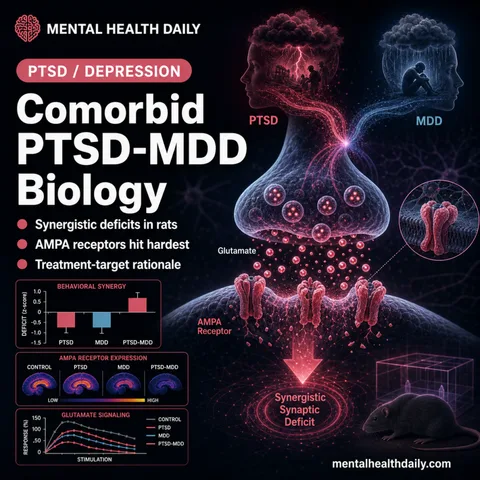
PTSD and major depressive disorder co-occur in roughly half of patients with either diagnosis, and the comorbid presentation is more severe than either alone. The mechanistic question has be…
Read article →
GW043 emerges as a promising new compound in the treatment of depression showcasing rapid and significant antidepressant effects by targeting NMDA receptors (NMDARs). This mechanism offers h…
Read article →
In the complex and evolving field of neuroscience, the role of synaptic plasticity in psychiatric disorders has garnered significant attention. d-Cycloserine (DCS), a partial agonist of the …
Read article →
Researchers have uncovered a critical role for the metabolic enzyme acetyl-CoA synthetase short-chain family member 2 (ACSS2) in depression, identifying it as a novel target for rapid-acting…
Read article →