A 2026 case report described valproate 800 mg/day improving agitation in residual-phase treatment-resistant schizophrenia but being followed by hypoglycemia and pancytopenia; after discontinuation, lithium 600 mg/day at 0.8 mEq/L was associated with BPRS improvement from 80 to 64.1 The calibrated read is mixed: valproate looked behaviorally useful in 1 patient, but the safety signal was serious enough that the lithium response became the clinically cleaner path.
Research Highlights
- Single-case trigger: The report involved 1 49-year-old woman with treatment-resistant residual-phase schizophrenia.1
- Valproate helped but harmed: Valproate 800 mg/day improved irritability and psychomotor agitation, then hypoglycemia and pancytopenia emerged.1
- Lithium was measurable: Lithium 600 mg/day reached a serum level of 0.8 mEq/L and was followed by dangerous-behavior improvement.1
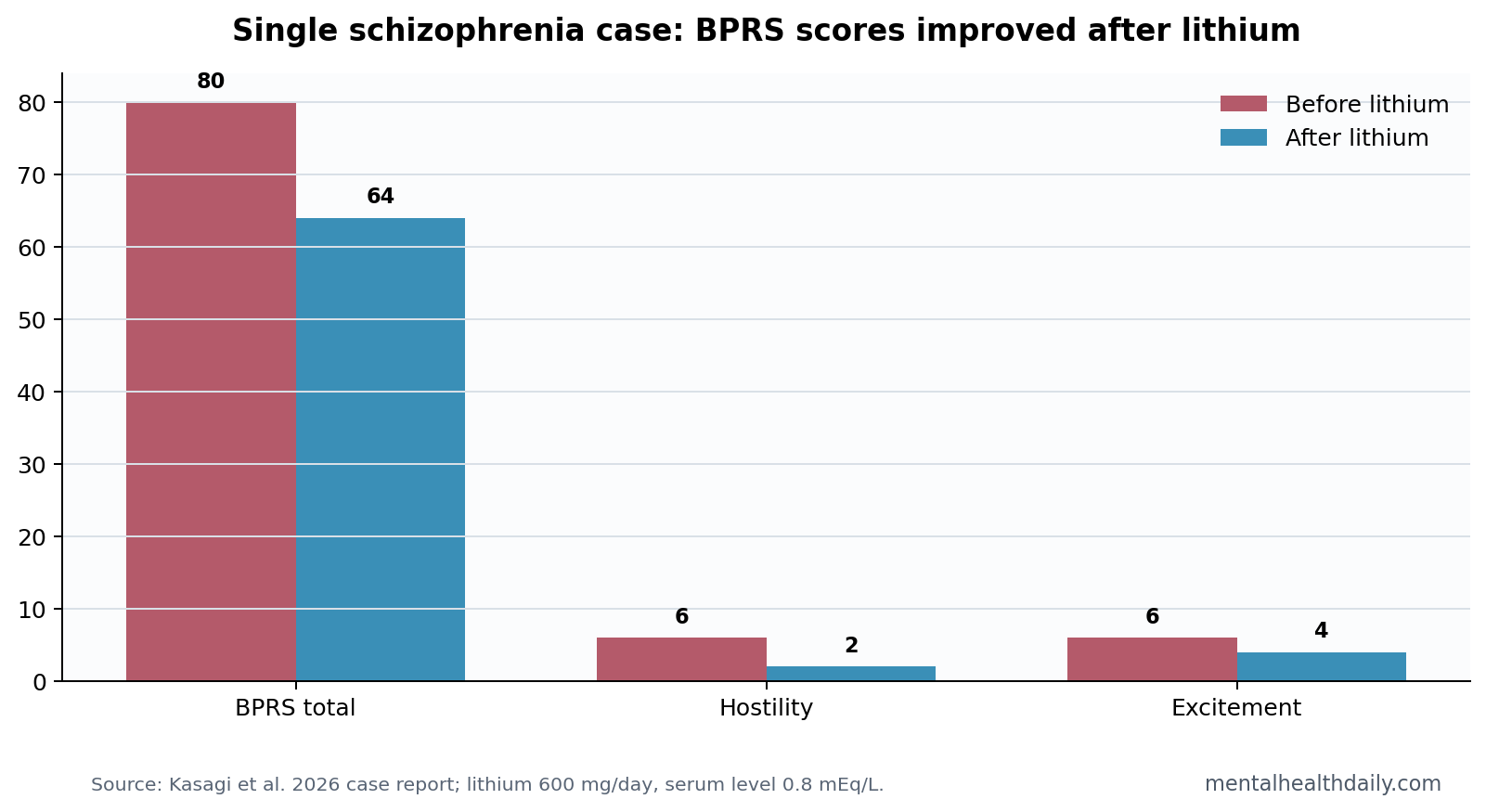
- BPRS improved: Brief Psychiatric Rating Scale total score fell from 80 to 64, with Hostility 6 to 2 and Excitement 6 to 4.1
- Evidence remains weak: A 3-month no-readmission follow-up in 1 case is useful pharmacovigilance, not proof that lithium beats valproate.
Mood stabilizer augmentation means adding a drug such as valproate, lithium, lamotrigine, or carbamazepine to antipsychotic treatment. In schizophrenia, clinicians may consider this when residual agitation, aggression, affective instability, impulsivity, or dangerous behavior persists despite antipsychotic therapy.
Residual-phase schizophrenia refers to a phase in which prominent acute psychosis may be less dominant, but negative symptoms, functional impairment, agitation, or behavioral instability can remain. The target in this case was not ordinary mood disorder treatment; it was dangerous behavior and agitation in a complex schizophrenia course.
Valproate 800 mg/day Improved Agitation Before Serious Adverse Events
Kasagi et al. described a 49-year-old woman with long-standing treatment-resistant schizophrenia and residual-phase behavioral problems.1 Clozapine and electroconvulsive therapy were declined, so the treatment team used mood stabilizer augmentation.
Valproate 800 mg/day improved irritability and psychomotor agitation. The problem was safety. The patient later developed hypoglycemia suggestive of relative carnitine deficiency, followed by pancytopenia. Both adverse events resolved after valproate discontinuation.
Pancytopenia means reduced red blood cells, white blood cells, and platelets. In psychiatric prescribing, that is not a minor laboratory footnote because infection risk, anemia, bleeding risk, and medication discontinuation can follow.
Lithium 600 mg/day Followed With BPRS Improvement From 80 to 64
After valproate discontinuation and recurrence of dangerous behavior, lithium was started at 400 mg/day and titrated to 600 mg/day. When serum lithium reached 0.8 mEq/L, dangerous behaviors and agitation improved.1
BPRS means Brief Psychiatric Rating Scale, a clinician-rated measure of psychiatric symptom severity. In the case report, total BPRS score improved from 80 before lithium to 64 after lithium. Hostility decreased from 6 to 2, and Excitement decreased from 6 to 4.
No psychiatric ward readmission occurred during 3-month follow-up. That is clinically relevant, but the follow-up remains short and uncontrolled. The same patient had multiple treatment changes and a long illness course, so the result cannot be treated like a randomized comparison.
Lithium Evidence in Schizophrenia Is Suggestive but Not Clean
Systematic review evidence for lithium augmentation in schizophrenia has been mixed. The Cochrane review reported signals that weakened after sensitivity restrictions, meaning lithium cannot be treated as a broadly proven add-on for schizophrenia symptoms.2
Real-world cohort evidence is more encouraging but still confounded. A large Finnish cohort found lithium augmentation associated with lower psychiatric rehospitalization risk, HR = 0.83, 95% CI 0.81 to 0.85.3 That kind of association can reflect prescribing selection, patient differences, and monitoring intensity.
- Case report: useful for clinical pattern recognition and safety warning.
- Systematic review: useful for weighing randomized evidence, but lithium signals are not definitive.
- Registry cohort: useful for real-world outcomes, but not proof of causality.
Valproate Augmentation Carries a Safety Tradeoff
Valproate has been used as an augmentation strategy when aggression, agitation, or affective instability complicates schizophrenia. The case report fits that rationale because agitation improved before adverse events appeared.
Safety is the limiting issue. Valproate can affect liver function, platelets, ammonia, weight, sedation, pregnancy risk, and hematologic measures. Hypoglycemia and pancytopenia are not the most common valproate problems, but they are severe enough to make monitoring and causality assessment central.
Evidence-strength note: this was a single case report. It can warn clinicians that valproate benefit and valproate harm may coexist, and it can justify lithium as a hypothesis when clozapine or ECT is declined. It cannot establish lithium as superior to valproate or recommend routine mood-stabilizer augmentation.
The Case Is Most Useful as a Monitoring Lesson
The strongest clinical lesson is not that lithium is the answer. It is that improvement after adding a mood stabilizer should not make safety monitoring fade into the background. Valproate appeared behaviorally useful in the case, but the adverse-event sequence changed the treatment logic.
Valproate monitoring usually includes liver enzymes, blood counts, platelet count, drug level when clinically indicated, sedation, weight, pregnancy risk, and interaction review. This case adds a reminder that unusual metabolic presentations such as hypoglycemia can matter when carnitine depletion is plausible.
Lithium monitoring is different: serum level, kidney function, thyroid function, hydration status, interacting drugs, tremor, gastrointestinal symptoms, and neurologic toxicity. Lithium can be clinically useful and still dangerous when dehydration, renal impairment, or interacting medications push levels upward.
When Augmentation Is Considered, Define the Target Symptom
Mood stabilizers are sometimes added vaguely because a patient is “unstable.” That framing is too loose for schizophrenia augmentation. The target should be named: aggression, impulsivity, excitement, affective lability, insomnia-driven agitation, self-injury risk, or dangerous behavior.
- Define the behavior: hostility and excitement improved in this case, so those were measurable targets.
- Track a scale: BPRS total moved from 80 to 64, giving the case more structure than impression alone.
- Track adverse events: blood counts and metabolic findings changed the valproate risk-benefit balance.
- Set a review point: a 3-month no-readmission interval is useful, but longer follow-up would matter.
That approach prevents augmentation from becoming indefinite medication stacking. If the target behavior improves, the benefit can be weighed against measurable risk. If it does not improve, the added drug should not remain simply because the patient is difficult to treat.
Clozapine and ECT Still Frame the Decision
The case report matters partly because the usual treatment-resistant schizophrenia options were not used. Clozapine has the strongest evidence base for treatment-resistant schizophrenia, and electroconvulsive therapy can be considered in selected severe or refractory situations. The report stated that both were declined.
Decision context: mood stabilizer augmentation should not be framed as a direct substitute for clozapine. It is more often a pragmatic option when the target is behavioral instability, when preferred treatments are unavailable or declined, or when risk management requires another attempt.
That distinction protects against overgeneralizing the case. A patient who can safely start clozapine belongs in a different evidence lane from a patient whose family or clinical context rules it out. Lithium response in the latter situation does not erase clozapine’s role in the former.
For MHD purposes, the case is strongest as a cautionary pharmacology vignette: symptom improvement, serious adverse effects, and later response can all be true in the same patient. Good psychopharmacology keeps those facts visible at the same time.
That is the exact reason the case should be discussed with low certainty and high clinical attentiveness, especially when aggression, excitement, blood counts, glucose, kidney function, and lithium levels are all changing.
The case also shows why a “worked” vs. “failed” label is too crude. Valproate appeared to work on irritability and psychomotor agitation, then became unacceptable because serious adverse events changed the risk side of the ledger.1
Lithium appeared useful afterward, but the report cannot show whether lithium would have worked first, whether the patient improved because of time and setting, or whether a different antipsychotic strategy would have produced a similar result.
That uncertainty is not a reason to ignore the case. It is the reason to use it as a disciplined monitoring example. Mood stabilizer augmentation should have a named target, a time window, a lab plan, a toxicity plan, and a stopping rule. Without those, augmentation can become open-ended medication accumulation in a patient already exposed to substantial treatment burden.
For residual-phase schizophrenia, the useful question is narrower than “lithium or valproate?” It is whether a specific behavioral target justifies an added drug after preferred evidence-based options have been considered, declined, or ruled out. In this case, hostility, excitement, dangerous behavior, blood counts, glucose, and lithium level were the clinically relevant variables to keep visible at the same time.
Questions About Mood Stabilizer Augmentation in Schizophrenia
Does this case mean lithium should replace valproate?
No. It suggests lithium may be worth considering in selected residual-phase behavioral cases, especially when valproate safety becomes unacceptable. Comparative treatment decisions still need diagnosis, labs, renal and thyroid risk, drug interactions, and patient-specific history.
Where does clozapine fit?
Clozapine is often the key evidence-based option for treatment-resistant schizophrenia, but the case report noted that clozapine and electroconvulsive therapy were declined. The article’s issue is what clinicians sometimes do when preferred options are unavailable.
What should be monitored with lithium?
Lithium requires serum levels, kidney function, thyroid function, hydration status, drug-interaction review, and toxicity monitoring. A serum level of 0.8 mEq/L in this case was within a commonly used therapeutic range, but safe monitoring is not optional.
References
- Kasagi Y, et al. Clinical dilemma of mood stabilizer augmentation in treatment-resistant schizophrenia with residual phase: a case report of valproate-associated hypoglycemia and cytopenia, and subsequent lithium response. Psychiatry and Clinical Neurosciences Reports. 2026. doi:10.1002/pcn5.70334
- Leucht S, et al. Lithium for schizophrenia. Cochrane Database of Systematic Reviews. 2015. doi:10.1002/14651858.cd003834.pub3
- Tiihonen J, et al. Real-world effectiveness of antipsychotic treatments in a nationwide cohort of 29,823 patients with schizophrenia. JAMA Psychiatry. 2017. doi:10.1001/jamapsychiatry.2017.1322
- Schwarz C, Volz A, Li C, Leucht S. Valproate for schizophrenia. Schizophrenia Bulletin. 2008. doi:10.1093/schbul/sbm044