College students who saw their AI learning tools as highly adaptive reported less enjoyment, more anxiety and more boredom during the semester, and weaker study self-management by its end, in a 2026 survey of 486 undergraduates in China.1
Research Highlights
- Less self-directed studying: a more adaptive-feeling AI environment at the start of the semester was linked to lower self-regulated learning at the end (overall standardized link −0.42).1
- Emotions carried more than half of the link: lower enjoyment and higher anxiety and boredom at mid-semester accounted for 54.8% of it.1
- AI literacy softened the emotional links: among students with the most AI know-how, the links to anxiety and boredom were less than half as strong, and the link to lower enjoyment was no longer significant.1
- Observational and self-reported: the survey shows links over time, not proof that adaptive AI causes anxiety or weaker study habits.1
What Adaptive AI Learning and Self-Regulated Learning Mean
Adaptive learning platforms use algorithms to adjust what a student sees next. They track answers, speed and errors, then change the difficulty, order, pacing and feedback of the material, much like a tutor who decides the next exercise for you.1
Self-regulated learning is the set of habits that let a student run their own studying:
- Setting goals for what to learn and by when
- Structuring the environment, such as picking a quiet place and cutting distractions
- Choosing strategies for the task at hand
- Managing time
- Seeking help when stuck
- Checking one’s own progress and adjusting
Those skills predict grades in online college courses.2 Researchers have worried about a “personalization paradox”: when software makes the planning and pacing decisions, students may get fewer chances to practice making those decisions themselves.1
How the Chinese College Survey Tracked AI, Emotions and Study Habits
Jing Li et al. surveyed undergraduates in 28 classes at 4 Chinese universities across one semester, from September 2025 to January 2026. Every student had used at least one AI-based learning tool in the previous semester.1
Each measure was taken at a different point in the semester:
- Weeks 2–3: how adaptive, personalized and transparent students felt their AI learning environment was, plus their AI literacy (knowledge of how AI works, practical skill with it and critical thinking about its output)
- Weeks 9–10: enjoyment, anxiety and boredom while studying
- Weeks 16–17: self-regulated learning, using a 22-item questionnaire
Sample: 486 valid responses at the start (from 523 questionnaires); 53.1% men; average age 20.5. Total dropout across the semester was 7.6%, and the analysis kept partial responses rather than discarding them.1
Tools used: students averaged 3.8 hours a week with AI tools, and many used more than one:1
- General chatbots such as ChatGPT and Wenxin Yiyan: 52.6%
- University tutoring platforms: 34.2%
- Course-specific recommendation systems: 28.4%
- Language-learning apps such as Duolingo: 18.5%
Only the tutoring platforms and course recommendation systems were truly adaptive, so the main measure reflects students’ sense of how tailored their AI tools felt more than one specific product.1
Adaptive-Feeling AI Linked to Lower Enjoyment and More Anxiety and Boredom
Students who rated their AI environment as more adaptive reported less self-regulated learning at the end of the semester. In simple correlations, the adaptive-environment score went with lower self-regulated learning (r = −0.33), lower enjoyment (r = −0.28), more anxiety (r = 0.31) and more boredom (r = 0.35).1
A structural equation model (a statistical model that tests a chain of links at once) then split the overall link into parts, adjusting for gender, year, field of study, weekly AI hours and main tool type:1
- Overall link to self-regulated learning: −0.42
- Through emotions: −0.23, or 54.8% of the total (enjoyment −0.08, anxiety −0.06, boredom −0.09)
- Direct link left over: −0.19
Each emotion lined up the expected way. Enjoyment went with more self-regulated learning, while anxiety and boredom went with less. The model explained 28.4% of the differences in self-regulated learning between students.1
Why emotions might be involved: the researchers drew on control-value theory, which holds that study emotions depend on how much control students feel they have and how much they value the task.3 When an algorithm makes the decisions, students may feel less in control, which fits with more anxiety, and material tuned too tightly to their level may feel flat, which fits with boredom.1
Students With More AI Literacy Had Weaker Emotional Links
AI literacy changed how strongly the adaptive-feeling environment was linked to each emotion. Among students 1 standard deviation below average in AI literacy, all 3 links were strong. Among students 1 standard deviation above average, they were much weaker:1
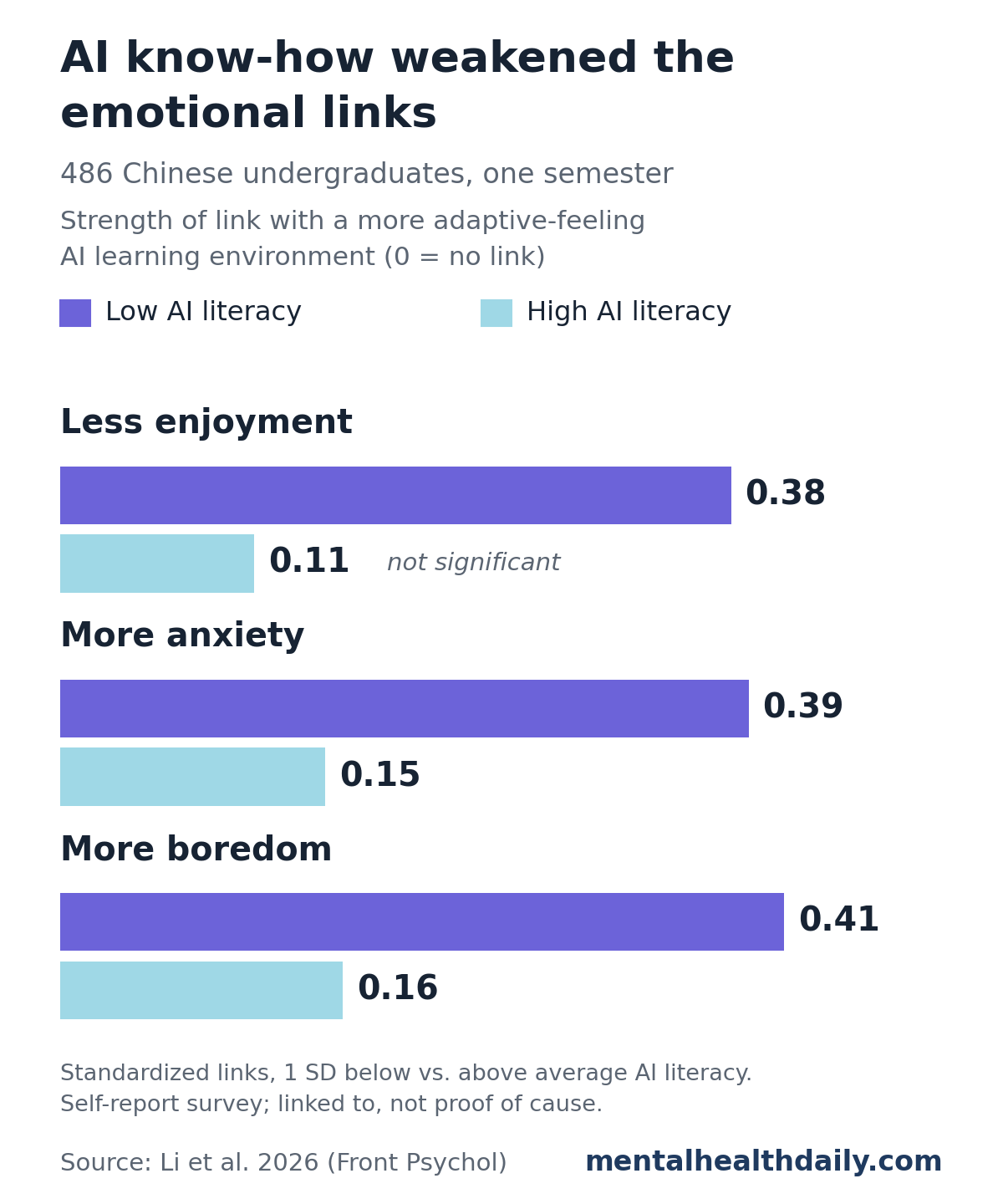
Carried through to study habits, the emotional route to weaker self-regulated learning shrank as well. For boredom, it went from −0.14 at low AI literacy to −0.04 at high AI literacy, and at high literacy none of the 3 emotional routes was clearly different from zero.1
AI literacy was measured, not taught, so the study cannot say whether training students would produce the same buffer. Students who understand AI well may also differ in other ways, such as confidence or prior grades.
Other Research on AI Tutors, Study Emotions and Learning
Adaptive tutoring can raise test scores. A meta-analysis of 50 controlled evaluations of intelligent tutoring systems found a median gain of 0.66 standard deviations, roughly moving an average student from the 50th to the 75th percentile.4 The 2026 survey did not measure grades, so it says nothing against those gains.
Unguarded AI help can weaken independent learning. In a field experiment with nearly 1,000 Turkish high school math students, a plain GPT-4 chat assistant raised practice grades by 48%. Once access was taken away, those students scored 17% lower than students who never had it. A tutor version built to give hints instead of answers largely avoided that drop.5
Study emotions track performance. A meta-analysis of 68 studies found that enjoyment of learning was linked to better academic performance (ρ = 0.27) and boredom to worse (ρ = −0.25).6 That fits with the emotional pathway the Chinese survey describes.
Limitations of This AI Learning Survey
- Not cause and effect: the 3 waves put the measures in time order, but each one was taken only once. Without starting levels of emotions or study habits, students who were already anxious or disorganized may simply have rated their AI tools differently.
- All self-report: no usage logs, grades or observed study behavior. The researchers found little sign that a shared reporting style drove the results, but it cannot be ruled out.
- Mixed tools: chatbots, tutoring platforms and language apps were combined into one rating, so the results cannot be pinned on genuinely adaptive systems.
- New measure: the adaptive-environment scale was built for this study.
- Study emotions, not disorders: anxiety here means worry while studying, not an anxiety disorder.
- One country: 4 universities in China; attitudes toward AI and study norms vary across cultures.
What This Means for Students Using AI Learning Tools
Keep some decisions for yourself. If a platform picks every next step, it may help to set your own weekly goals, plan your own review and check your progress outside the app. In the survey, students with stronger habits like these also reported more enjoyment and less boredom.
Learn how the tool works. Students with more AI literacy showed much weaker links to anxiety and boredom. Knowing why a system recommends something, and when to override it, is a reasonable skill to build.
For schools and designers: the researchers recommend AI literacy courses and platforms that explain their recommendations and let students adjust them. Those ideas still need testing in trials.1
Ongoing anxiety about school that interferes with sleep, eating or daily life is worth raising with a campus counseling center or a doctor.
References
- Li J, Lin Z, Qiu C. The personalization paradox: how AI-driven adaptive learning environments are associated with college students’ academic emotions and self-regulation learning—a moderated mediation model. Frontiers in Psychology. 2026;17:1915839. doi:10.3389/fpsyg.2026.1915839
- Broadbent J, Poon WL. Self-regulated learning strategies & academic achievement in online higher education learning environments: a systematic review. The Internet and Higher Education. 2015;27:1–13. doi:10.1016/j.iheduc.2015.04.007
- Pekrun R. The control-value theory of achievement emotions: assumptions, corollaries, and implications for educational research and practice. Educational Psychology Review. 2006;18(4):315–341. doi:10.1007/s10648-006-9029-9
- Kulik JA, Fletcher JD. Effectiveness of intelligent tutoring systems: a meta-analytic review. Review of Educational Research. 2016;86(1):42–78. doi:10.3102/0034654315581420
- Bastani H, Bastani O, Sungu A, Ge H, Kabakcı Ö, Mariman R. Generative AI without guardrails can harm learning: evidence from high school mathematics. Proceedings of the National Academy of Sciences. 2025;122(26):e2422633122. doi:10.1073/pnas.2422633122
- Camacho-Morles J, Slemp GR, Pekrun R, Loderer K, Hou H, Oades LG. Activity achievement emotions and academic performance: a meta-analysis. Educational Psychology Review. 2021;33:1051–1095. doi:10.1007/s10648-020-09585-3