Hope, fear and anger were each linked to more political activity among Black women in 2 large US surveys, and which emotion mattered depended on what the women were feeling about.1 No single “angry” pattern described how they got involved.
Research Highlights
- 3 emotions, 3 different patterns: in surveys of 2,141 (2016) and 2,228 (2020) non-Hispanic Black women, hope, fear and anger were each linked to more non-voting political activity in at least 1 of 3 contexts — race relations, personal finances and the election.1
- Hope about race relations went with costly action: women more hopeful about race relations reported more high-cost activity, such as donating, protesting, volunteering or contacting officials. Hope about finances or the election showed no such link.1
- Fear was linked to more activity, not less: fear about race relations went with more petition-signing, boycotts and similar easy acts, and fear about the election went with more costly acts.1
- Anger was 1 piece of the picture: anger was linked to easy acts for race relations and the election, and to costly acts for personal finances, contrary to the researchers’ prediction that hope would carry costly action.1
- Links, not cause and effect: both surveys captured feelings and activity at one point in time.1
Why Researchers Studied Black Women’s Emotions and Political Activity
The “angry Black woman” is a long-running stereotype that casts Black women’s emotions as mostly anger. Political scientists Jamil Scott-Cummings and Kenicia Wright argue that it has also shaped research: emotion studies have focused heavily on anger, much of it in White samples, with the results assumed to apply to everyone.1
In studies of the general electorate, anger is the emotion researchers have most often linked to political action. A well-known 2011 study combining an experiment, a 2008 national survey and decades of election data found that anger, more than anxiety or enthusiasm, mobilized political participation.2
Research centered on Black Americans points in other directions:
- Hope: a 2020 study using an experiment and a national survey found that hope had a strong, consistent link to political participation among Black Americans and no effect among White Americans.3
- Anger about race: lab and survey experiments found that anger about race made Black Americans more willing to protest and donate to Black organizations, but not more active in general, non-race-specific ways.4
Scott-Cummings and Wright asked whether Black women specifically follow any of these patterns, or a different one.
How the CMPS Surveys Measured Hope, Fear and Anger
The researchers used the Collaborative Multiracial Post-Election Survey (CMPS), a national survey run after US elections that deliberately oversamples racial and ethnic minority groups. That design gave them enough Black women to study the group on its own.1
- 2020 survey: 2,228 non-Hispanic Black women rated how hopeful, angry and fearful they felt about race relations in the US and about their personal economic situation.
- 2016 survey: 2,141 non-Hispanic Black women rated the same 3 emotions about the election.
- Analyzed: 1,589 women in each 2020 model and 1,364 in each 2016 model.
Voting was not part of the analysis. Instead, the researchers split non-voting political activity into 2 groups based on how much time, money or personal risk each act takes:
- Low-cost acts: signing a petition, discussing politics online, wearing a campaign button or posting a sign, and boycotting a company or product.
- High-cost acts: volunteering for a campaign, attending a campaign event or a protest, donating money, and contacting a public official.
The most common activity was an easy one: 39% of women in 2020 reported signing a petition. The least common was working or volunteering for a campaign, at about 7%.1
Each model tested all 3 emotions together and adjusted for a long list of other factors — age, education, income, employment, marriage, parenthood, birthplace, political ideology, interest in politics, community involvement, religiosity, region and trust in government, among others.1
Which Emotions Were Linked to More Political Activity
The answer changed with the topic. Every significant emotion link pointed toward more activity, not less.1
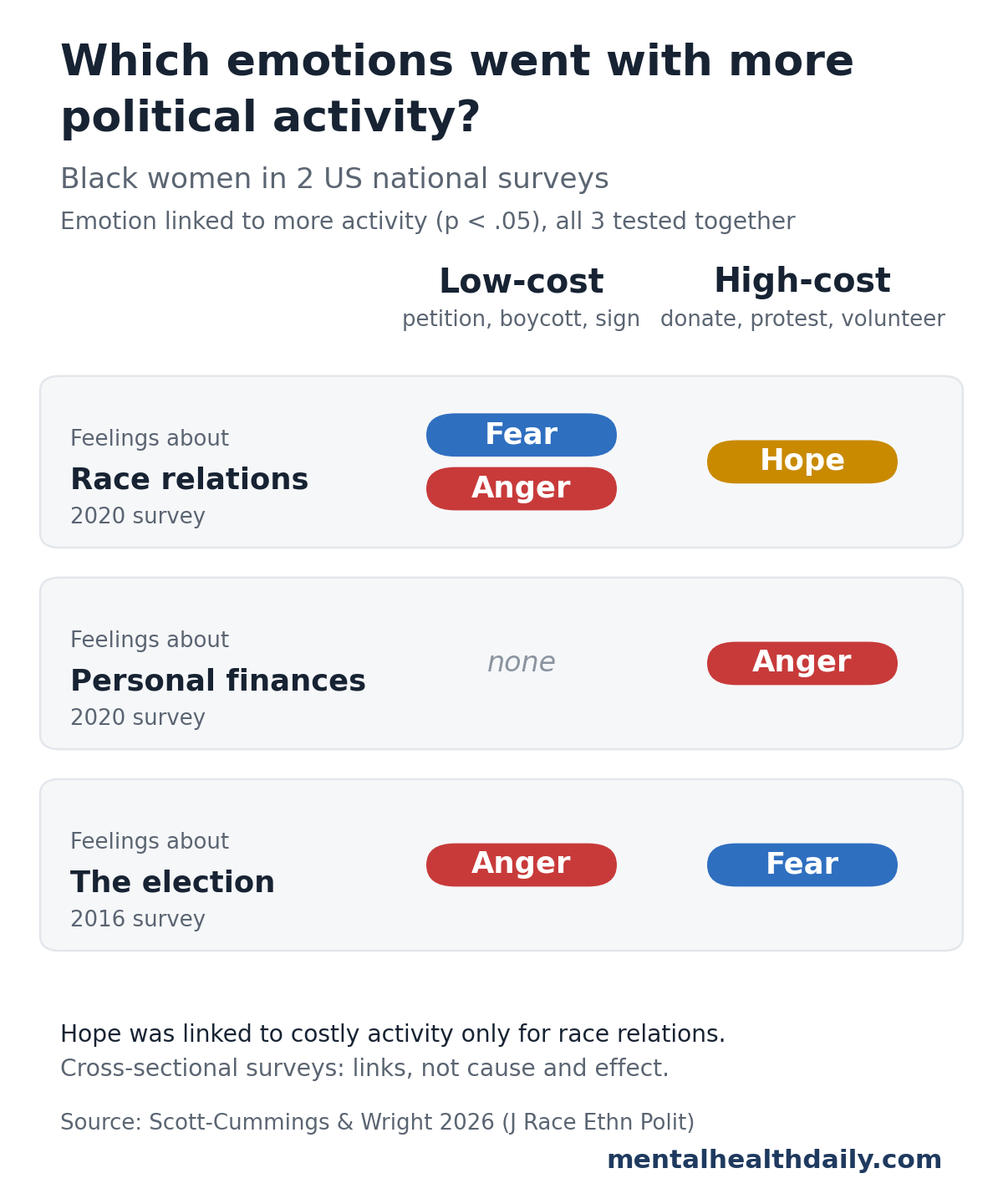
Race relations (2020): fear and anger about race relations were linked to more low-cost activity. Hope about race relations was the only emotion linked to more high-cost activity, in line with the researchers’ first prediction.1
Combining all activities into one score, only fear and anger stood out. Without the low-cost and high-cost split, the hope link would have been missed.1
Personal finances (2020): feelings about money were the weakest signal. None of the 3 emotions was linked to low-cost activity or to the combined score.1
The one exception ran contrary to the prediction: anger, not hope, about personal finances was linked to more high-cost activity. The researchers called it “a departure from our expectations.”1
The election (2016): anger about the election was strongly linked to more low-cost activity, matching the classic finding that anger mobilizes voters.12 Fear about the election, though, was linked to more high-cost activity, while election anger was not.
That fear result stands out. Earlier work had linked fear and anxiety mostly with seeking out information rather than taking action. Here, fear went with demanding political acts.1
How the Findings Push Back on the “Angry Black Woman” Stereotype
Anger was linked to Black women’s political activity in all 3 contexts, but it was not the emotion behind every kind of involvement:
- Hope was the only emotion linked to costly action on race relations.
- Fear was linked to more activity in 2 of 3 contexts, including costly action around the election.
- Anger was linked to easy acts for race relations and the election, and to costly acts only for finances.
The researchers conclude that how Black women are asked about their emotions shapes which emotions show up in their political behavior, and that theories built specifically around Black women are needed to capture this picture.1
The hope result is consistent with the 2020 finding that hope is an unusually strong motivator for Black Americans.3 The race-relations anger result fits the experimental evidence that anger about race pushes Black Americans toward specific kinds of action rather than toward everything.4
Other Factors Linked to Black Women’s Political Activity
Emotions were not the strongest predictors. Across all 3 sets of models, social capital — involvement in one’s community and its groups — had by far the largest link to political activity. Interest in politics and a more liberal ideology were also consistently linked to more activity.1
In the 2020 models, older women reported fewer non-voting political acts. Women who were more religious, born in the US or more trusting of government reported more high-cost activity.1
Limitations of This Black Women’s Emotions and Politics Study
- Snapshot surveys: emotions and activity were reported at the same time, so the study shows links, not whether emotions cause political action.
- 2 different surveys: election emotions come only from 2016 and race and finance emotions only from 2020, with different sampling designs. The researchers could not compare, say, hope about race relations with fear about the election in the same women, or tell whether the patterns hold beyond those years.
- Missing activities: the activity lists left out service and civic groups such as the National Council of Negro Women, The Links and historically Black sororities, where many Black women are politically active.
- Self-report: emotions and activities were self-reported, and voting was not analyzed.
- A small inconsistency: the discussion section says election fear and anger were both linked to high-cost activity, but the results table shows only fear.
The study measured feelings about public life, not mental health. It says nothing about any group’s inherent emotional makeup.
What This Means for Understanding Emotions and Civic Engagement
Emotions depend on their topic. A woman can feel hopeful about one issue and afraid or angry about another, and in this study each feeling was linked to a different kind of involvement.
Fear and hope deserve as much attention as anger. In this study, both were linked to the most demanding forms of political action, which a focus on anger alone would miss.
Stereotypes miss the range. Reducing Black women’s political lives to anger leaves out the hope and fear that were linked to their involvement just as clearly.1
References
- Scott-Cummings JS, Wright K. The (Not So) Angry Black Woman: How Emotions Influence Political Participation of Black Women. The Journal of Race, Ethnicity, and Politics. 2026:1–22. doi:10.1017/rep.2026.10060
- Valentino NA, Brader T, Groenendyk EW, Gregorowicz K, Hutchings VL. Election night’s alright for fighting: the role of emotions in political participation. The Journal of Politics. 2011;73(1):156–170. doi:10.1017/S0022381610000939
- Phoenix DL. Black hope floats: racial emotion regulation and the uniquely motivating effects of hope on Black political participation. Journal of Social and Political Psychology. 2020;8(2):662–685. doi:10.5964/jspp.v8i2.847
- Banks AJ, White IK, McKenzie BD. Black politics: how anger influences the political actions Blacks pursue to reduce racial inequality. Political Behavior. 2019;41:917–943. doi:10.1007/s11109-018-9477-1