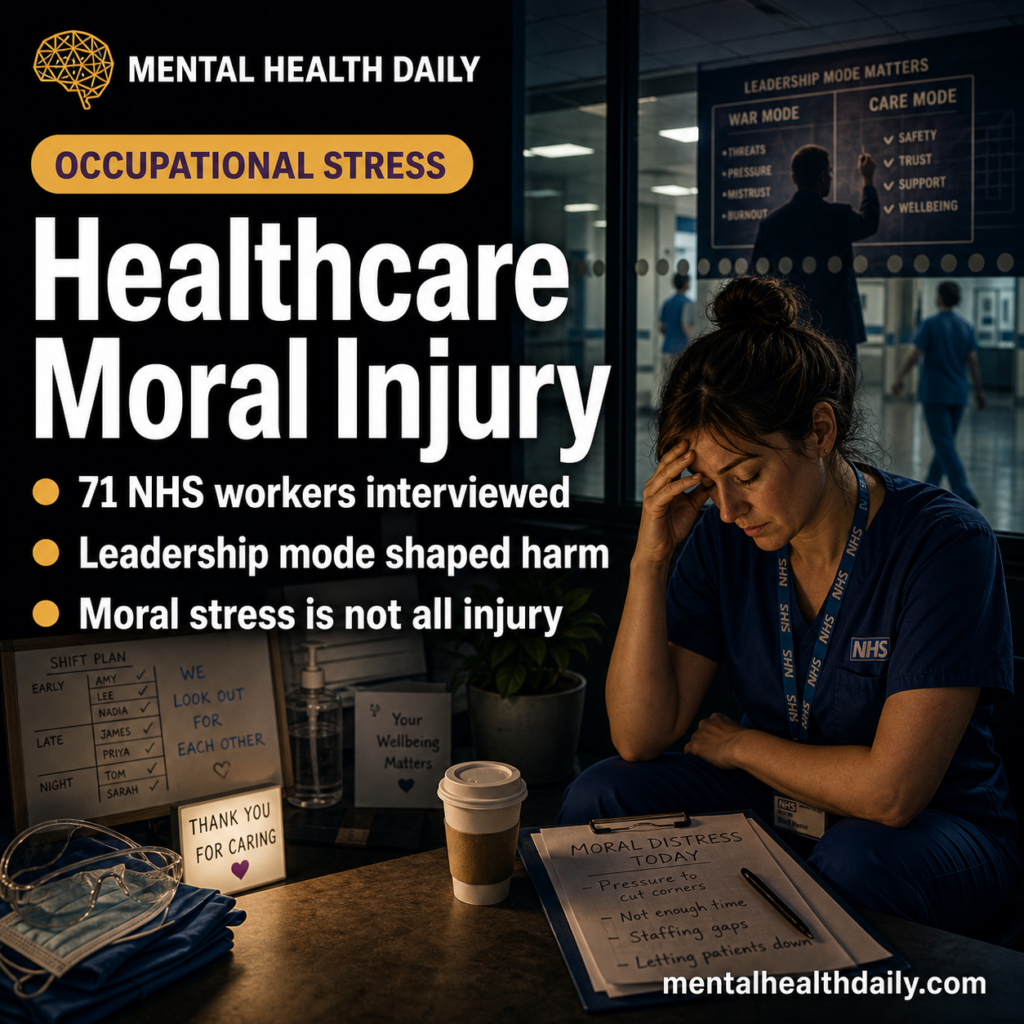
A 2026 qualitative study of 71 UK National Health Service workers argued that a shift into “war-mode” leadership during an atypical crisis could push moral stress, distress, conflict, and suffering toward moral injury.1 Moral-injury endpoint: moral injury was the severe endpoint, while unresolved lower-consequence moral phenomena may become the pathway to it.
Research Highlights
- 71 NHS workers informed the analysis: the qualitative study drew on 82 semi-structured interviews conducted over 4.5 years with clinical, managerial, and non-clinical staff.1
- 2 claims drive the paper: reports labeled moral injury may include lower-consequence moral phenomena, and leadership mode may help push those experiences toward severe harm.1
- Command logic was the stressor: emergency war-mode leadership conflicted with healthcare workers’ ordinary logic of care in the NHS accounts.1
- Conceptual clarity changes prevention: moral stress, distress, conflict, demoralization, suffering, and injury require different intervention points before harm escalates.1
- Prevalence is not estimated: qualitative interviews can identify mechanisms and meanings, but they cannot say how many healthcare workers had moral injury.1
Moral injury is psychological and moral harm that follows actions, omissions, betrayals, or systems that violate a person’s deeply held moral beliefs. In healthcare, the term often appears beside burnout, posttraumatic stress, and moral distress, but it is not the same construct.
Rosell’s study is useful because it slows the vocabulary down. The interviews examined a continuum of moral phenomena including moral traps, demoralization, moral conflict, moral dilemma, moral stress, moral distress, and moral suffering.1
War-Mode Leadership Clashed With the Logic of Care
The study focused on the NHS emergency response during COVID-19 and the use of command structures. Command leadership means a centralized, urgent decision structure designed for crisis response. In the paper’s language, war-mode leadership uses military-like logic to neutralize an enemy, while the logic of care is built around relational judgment, patient needs, and professional responsibility.
Those 2 logics can collide. A clinician may be told to follow a crisis protocol that feels operationally necessary but morally wrong for a specific patient, team, or standard of care. Repeated exposure to that conflict can create moral stress before it becomes moral injury.
Participants described senior leadership as disconnected from the moral basis of care. One account framed the harm as repeated small injuries rather than 1 catastrophic event: a “subtle, gentle, constant 400 times a day” pattern.1 That phrasing captures the slow-burn model.
Moral Stress Is Not the Same as Moral Injury
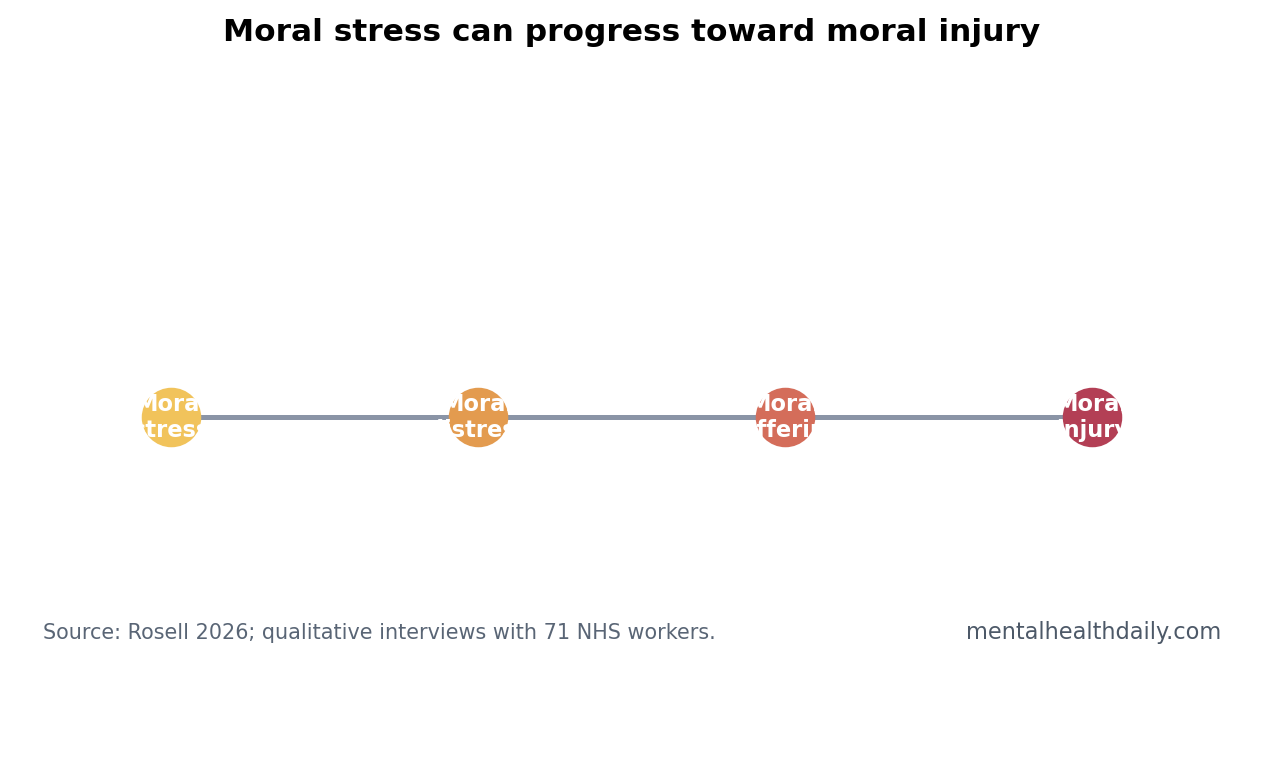
The paper’s most useful correction is taxonomic. Healthcare workers may say “moral injury” when their experience is actually moral stress, moral distress, demoralization, or moral suffering. That is not a pedantic distinction. It changes what an organization should do.
Moral stress can occur when someone knows what seems right but has to operate inside constraints that make the right action difficult. Moral distress is a stronger negative emotional state when institutional barriers block morally appropriate action. Moral injury sits at the severe end, with deeper and more durable damage to trust, identity, and moral coherence.
If everything becomes “moral injury,” organizations may wait until workers need clinical repair. If leaders can identify moral stress and moral distress earlier, they can change processes, staffing, communication, escalation pathways, and decision authority before the injury becomes deeper.
The COVID Context Makes the Mechanism Visible
COVID-19 intensified the moral stakes: scarce resources, fear of infection, redeployment, family-risk concerns, uncertainty, and rapidly changing rules. Earlier qualitative research in frontline healthcare workers described painful morally injurious experiences during the pandemic.2 Rosell’s contribution is to place leadership mode inside that mechanism.
The emergency context matters because it can justify unusual command structures. But emergency tools can outlast their legitimate window. A war-mode frame that may be tolerable for a short acute crisis becomes corrosive when workers experience it as overriding care values after the immediate emergency has shifted.
Evidence-strength note: this was a qualitative study, not a prevalence survey or causal trial. It can identify how workers interpreted leadership, care values, and moral harm. It cannot prove that command leadership alone caused moral injury or estimate how common the problem was.
Leadership Intervention Points Come Before Clinical Repair
Rosell’s framework points to earlier organizational intervention. Once moral injury is severe, clinical support may be needed. But before that point, the levers are managerial, ethical, and operational.
- Before moral stress accumulates: clarify decision authority, staffing thresholds, escalation routes, and exceptions to command rules.
- During moral distress: create real routes for workers to challenge unsafe or morally incoherent processes without retaliation.
- After possible injury: offer trauma-informed support, peer processing, leadership accountability, and repair of trust rather than wellness slogans.
Trauma-informed care has been proposed as one missing link in addressing burnout and moral harm in healthcare systems.4 The Rosell study adds that trauma-informed support should not replace structural repair. If the system keeps creating the moral trap, counseling alone is a weak answer.
Moral Injury Should Not Become a Catch-All Burnout Label
Burnout usually refers to exhaustion, cynicism, and reduced professional efficacy. Moral distress refers to blocked moral action. Moral injury implies deeper harm after betrayal, violation, or complicity. These can overlap, but collapsing them makes interventions less precise.
Healthcare-worker mental-health research also includes measurable risks such as depression, anxiety, and suicidal thoughts.3 Moral injury is not a substitute for those outcomes. It names a particular kind of wound: harm to moral identity and trust.
That is why the leadership focus is important. If a worker’s distress comes from impossible workload, staffing repair is central. If it comes from being forced into morally unacceptable decisions, ethical governance and decision transparency matter. If it comes from cumulative betrayal, trust repair and accountability become part of treatment.
Earlier Language Can Prevent Later Overmedicalization
Precise language also protects workers from overmedicalization. A worker who is morally stressed by an unsafe process may not need a diagnosis. They may need a changed process, a staffing correction, an ethical review, or authority to refuse a harmful instruction. Calling every moral conflict an injury can move attention away from the workplace condition that produced it.
At the same time, undernaming severe harm is dangerous. A worker who feels complicit in patient harm, betrayed by leadership, or unable to trust the institution may need more than ordinary stress management. The continuum helps because it permits both truths: some experiences are remediable moral stressors, and some become deep moral wounds.
For leaders, the operational standard is earlier detection. Repeated reports of moral conflict, unsafe workarounds, shame, avoidance, anger, withdrawal, or loss of trust should trigger organizational repair before workers are sent to resilience training. The earlier the phenomenon is named accurately, the more likely the response can be structural rather than purely clinical.
That standard also changes how staff surveys should be read. A single item about burnout will not identify moral traps. A useful assessment would ask whether workers were pressured to violate care standards, whether they could escalate concerns, whether leaders explained morally painful tradeoffs, and whether workers believed repair was possible. Those questions point to preventable systems failure rather than individual weakness.
Rosell’s paper is strongest as an organizational warning. Crisis leadership may be necessary during an emergency, but the same mode can become morally damaging when it suppresses care judgment, hides accountability, or leaves workers feeling complicit in harm they could not prevent.
Leadership repair has to come before resilience messaging. The paper’s useful intervention point is not a new diagnosis code; it is a better organizational response when workers report moral conflict early. A hospital can ask whether the worker had a real route to challenge the decision, whether the tradeoff was explained honestly, and whether leaders returned later to repair trust after the crisis decision passed.
That sequence is different from treating moral harm as an individual coping deficit. If staff were told to accept unsafe staffing, ignore patient-specific judgment, or carry out rules they believed were morally incoherent, the first repair target is the rule-making process itself. Peer support and counseling may still matter, especially after severe injury, but they should not become a way to avoid governance changes.
Workers need the source of moral conflict addressed, with support afterward when harm has already occurred. Rosell’s distinction between lower-consequence moral phenomena and moral injury gives leaders a timing map: act when stress and distress are still visible, before betrayal, shame, withdrawal, and loss of professional trust become the dominant outcome.1
Questions About Healthcare Worker Moral Injury
Did this study prove NHS leadership caused moral injury?
No. It provided qualitative evidence that a shift into war-mode leadership was experienced as complicit in moral phenomena that could progress toward moral injury.
How is moral injury different from burnout?
Burnout centers on exhaustion and work strain. Moral injury centers on violation of deeply held moral beliefs, betrayal, complicity, or forced participation in actions felt to be wrong.
What should healthcare organizations do first?
Identify moral stress and moral distress before they harden into injury: improve staffing, escalation, ethical review, leadership transparency, and real worker voice in crisis decisions.
References
- Rosell S. Complicity in moral injury: a study of moral phenomena in healthcare work settings. Journal of Healthcare Leadership. 2026;18:1-22. doi:10.2147/jhl.s568758
- Hegarty S, Lamb D, Stevelink SAM, et al. “It hurts your heart”: frontline healthcare worker experiences of moral injury during the COVID-19 pandemic. BJPsych Open. 2021;7:e84. doi:10.1192/bjo.2021.29
- Padmanathan P, Lamb D, Scott H, et al. Suicidal thoughts and behaviour among healthcare workers in England during the COVID-19 pandemic: a longitudinal study. PLOS One. 2023;18:e0286207. https://doi.org/10.1371/journal.pone.0286207
- Elisseou S. Trauma-informed care: a missing link in addressing burnout. Journal of Healthcare Leadership. 2023;15:169-173. doi:10.2147/jhl.s389271