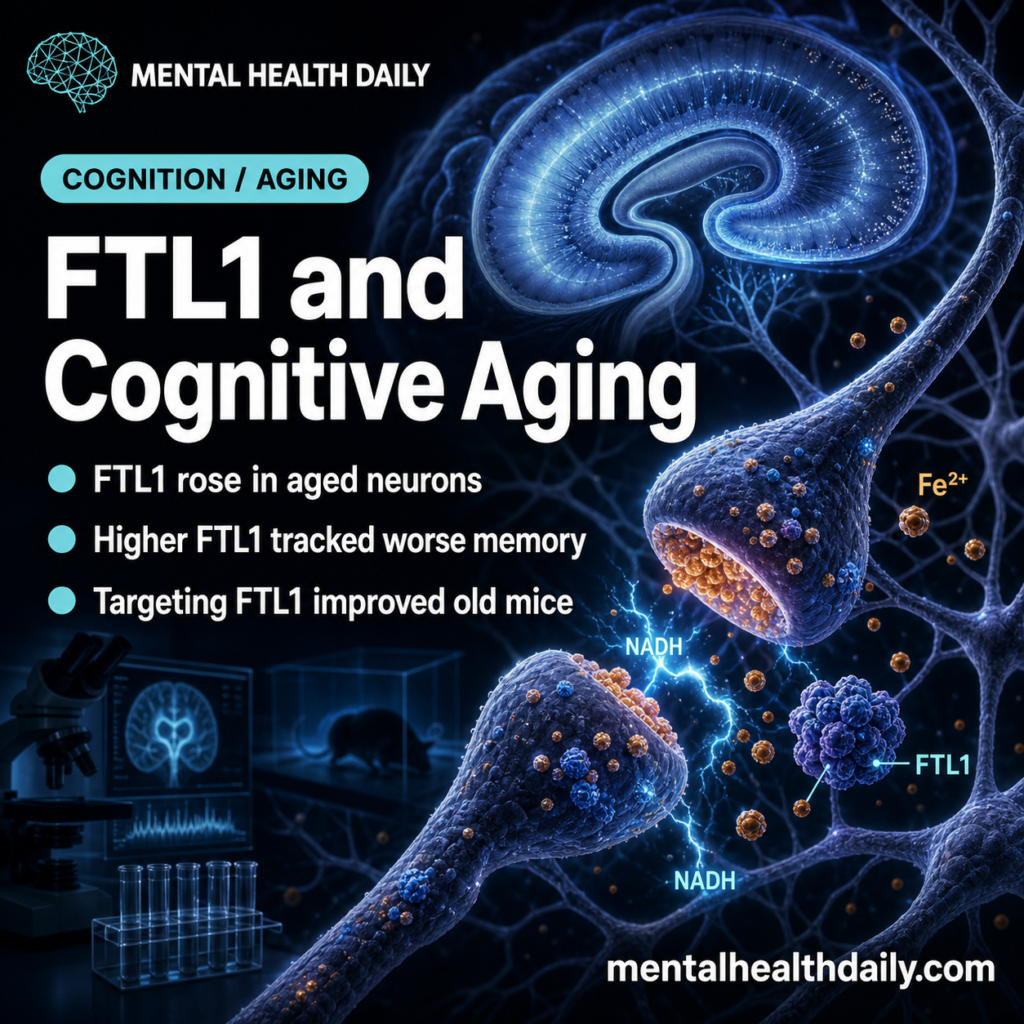
A 2025 Nature Aging study found that hippocampal ferritin light chain 1 (FTL1) rose with age in mouse neurons, tracked poorer cognition, and became experimentally reversible in old mice. This is an animal-mechanism result, not a human anti-aging treatment.1
Research Highlights
- FTL1 rose in aged hippocampus: Western blot data showed higher hippocampal FTL1 in aged mice than young mice (N = 12 vs. N = 9, p < 0.0001).1
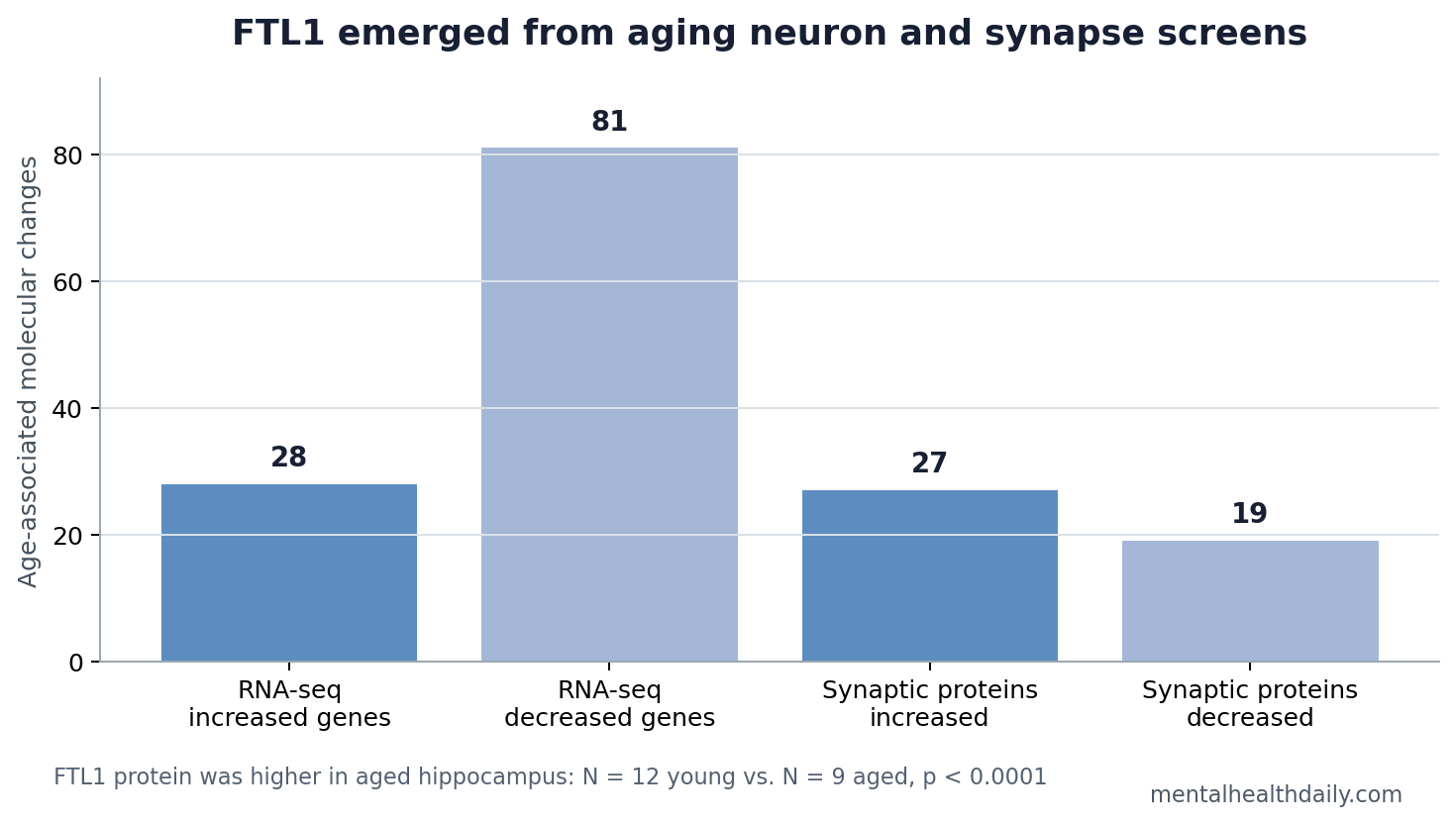
- Molecular screens converged: Neuronal RNA-seq found 28 genes increased and 81 decreased with age; synaptic proteomics found 27 proteins increased and 19 decreased.1
- Higher FTL1 tracked poorer cognition: Hippocampal FTL1 expression showed a significant negative association with overall cognitive performance.1
- Overexpression aged young neurons: Raising neuronal FTL1 in young mice altered labile iron oxidation states and promoted synaptic and cognitive aging features.1
- Targeting FTL1 helped old mice: Reducing neuronal FTL1 in aged hippocampus improved synaptic-related molecular changes and cognitive impairments.1
FTL1 stands for ferritin light chain 1, one part of ferritin, a protein complex that stores iron. In the brain, iron handling is essential because neurons need iron for metabolism, but poorly controlled iron chemistry can promote oxidative stress and synaptic dysfunction.
Hippocampus means a memory-critical brain region involved in learning, spatial navigation, and episodic memory. Age-related hippocampal dysfunction can impair memory without requiring massive neuron death, which makes synaptic and metabolic mechanisms especially important.
FTL1 Was the Shared Signal Across Neuron and Synapse Screens
Remesal et al. first profiled neuronal nuclei from young 3-month and aged 18-month mouse hippocampus. Neuronal RNA sequencing identified 28 genes with increased expression and 81 genes with decreased expression in aging.1
The researchers then analyzed synaptic fractions from young and aged mouse brains using mass spectrometry. Synaptic proteomics identified 27 proteins with increased abundance and 19 with decreased abundance. FTL1 was the one factor that appeared as a conserved age-increased signal across the neuronal transcriptomic and synaptic proteomic datasets.1
Higher Hippocampal FTL1 Tracked Worse Cognitive Performance
Correlation alone would not be enough. Many proteins change with age because the tissue is aging, not because they drive cognitive decline. Remesal et al. strengthened the case by linking hippocampal FTL1 protein levels to performance across hippocampal-dependent learning and memory tasks in an independent young and aged mouse cohort.1
Extended data showed higher hippocampal FTL1 protein in aged mice than young mice, with N = 12 young and N = 9 aged mice and p < 0.0001. The paper also reported a significant negative association between FTL1 expression and overall cognitive performance.1
Plain-English interpretation: FTL1 behaved like a candidate driver rather than an age label. Higher FTL1 sat near the behavioral problem the paper cared about: poorer hippocampal cognitive performance.
Overexpressing FTL1 Made Young Mice Look Older
A causal aging target should pass 2 tests: increasing it in young animals should create aging-like problems, and reducing it in old animals should improve them. Remesal et al. tested both directions.
When researchers mimicked an age-related increase in neuronal FTL1 in young mice, labile iron oxidation states changed and synaptic and cognitive features of hippocampal aging appeared.1 Labile iron means the more chemically reactive iron pool, not safely stored iron locked away inside ferritin.
The important nuance is that FTL1 produced synaptic and metabolic aging features without requiring a simple neuron-death explanation. Age-related cognitive decline in otherwise aging brain tissue often looks more like impaired synaptic function and metabolism than massive cell loss. That fits the paper’s emphasis on synaptic and metabolic disruption.
Targeting FTL1 Improved Old-Mouse Cognition-Related Measures
In aged mice, targeting neuronal FTL1 in the hippocampus improved synaptic-related molecular changes and cognitive impairments.1 That reversal direction makes the study more than an aging biomarker paper.
NADH is a reduced form of nicotinamide adenine dinucleotide that helps shuttle electrons during cellular energy production. Remesal et al. used neuronal nuclei RNA sequencing to identify changes in metabolic processes including ATP synthesis, then found that NADH supplementation mitigated the pro-aging cognitive effects of neuronal FTL1.1
The pathway is more specific than an “iron is bad” slogan: age increases neuronal FTL1, FTL1 shifts iron handling and metabolic function, ATP-linked processes suffer, synaptic function declines, and hippocampal cognition worsens.
Prior Rejuvenation Studies Make the Reversal Claim Plausible
Villeda et al. showed that systemic aging factors can impair neurogenesis and cognitive function in mice.2 Katsimpardi et al. reported that young systemic factors could improve vascular and neural function in aged mice.3 Those studies helped shift brain aging away from a purely one-way decline model.
Remesal et al. fit that broader rejuvenation literature but add a more targetable neuronal mechanism. Instead of saying old brain environments are broadly harmful, the paper points to hippocampal neuronal FTL1 as one molecular lever.
Iron biology also matters because brain aging and neurodegenerative disease repeatedly involve iron dysregulation, oxidative stress, mitochondrial strain, and synaptic vulnerability. The FTL1 result gives that broad theme a specific experimental handle.
What This Mouse Study Can and Cannot Support
Supported: hippocampal neuronal FTL1 increased with age in mice, tracked worse cognition, impaired young mice when experimentally raised, and improved old mice when targeted. NADH data connected the effect to cellular metabolism.
Not supported: human anti-aging treatment, dementia therapy, iron supplement advice, iron-lowering advice, or a claim that FTL1 explains all cognitive aging. The intervention was experimental, brain-region-specific, and preclinical.
Clinical translation problem: human work would need safe measurement of FTL1-related biology, evidence that the same hippocampal mechanism appears in people, and an intervention that changes the pathway without disrupting essential iron storage.
Iron Biology Makes the Target Attractive and Risky
Iron is not a toxin by default. Neurons and glia need iron for mitochondrial energy production, myelin biology, neurotransmitter synthesis, and many enzyme systems. The brain problem is balance: too little iron impairs function, while poorly controlled labile iron can increase oxidative chemistry and stress vulnerable synapses.
Ferritin complexity: ferritin stores iron in a safer form, so a higher ferritin-related signal can mean protection, compensation, dysfunction, or overload depending on cell type and context. Remesal et al. make FTL1 look pro-aging in hippocampal neurons, while broad ferritin suppression would be biologically risky.
This is why translation should focus on pathway precision rather than supplement logic. The paper points to neuronal FTL1, labile iron oxidation states, ATP synthesis, and NADH-sensitive metabolic function. Each piece needs human validation before anyone can infer a treatment direction.
Memory Decline Without Cell Death Is a Different Target
Age-related memory decline can occur when synapses, metabolism, and network plasticity become less efficient even if most neurons remain alive. That distinction changes the therapeutic imagination. A dying-neuron model pushes toward rescue after damage; a synaptic-metabolic model suggests that some dysfunction may be reversible if the right pathway is found early enough.
Why this matters for FTL1: the study’s strongest claim is not that old brains become young. It is that a specific hippocampal molecular burden can be experimentally increased, reduced, and partly rescued in a way that moves cognition-related outcomes. That is a sharper claim than generic brain-aging rhetoric.
A human version would also need to separate normal cognitive aging from neurodegenerative disease. Alzheimer’s disease, vascular brain injury, Lewy body disease, sleep apnea, depression, medication burden, and hearing loss can all reduce cognitive performance in older adults. FTL1 would be clinically useful only if it explains variance beyond those common drivers.
Best near-term use: FTL1 is a candidate mechanism for laboratory aging studies, not a consumer biomarker. Its value is that it gives researchers a concrete neuronal target to test against memory, metabolism, iron handling, and synaptic function.
Why the rescue experiment carries weight: the study did not stop at an age-associated protein screen. It pushed FTL1 upward in young mice and saw cognition-related impairment, then targeted FTL1 in old mice and saw improvement in memory-linked measures. That bidirectional pattern is stronger than a correlation between an aging marker and poor performance, because it tests whether changing the candidate pathway can move the phenotype.
The metabolic layer also keeps the claim specific. Remesal et al. connected FTL1 to iron handling, mitochondrial energy output, and NADH-sensitive rescue rather than presenting ferritin light chain as a vague aging label. NADH is a cellular electron carrier used in energy metabolism. If FTL1 disrupts hippocampal energy handling, a memory deficit could emerge before widespread neuron loss appears.
Human validation would need several steps: researchers would need to show that FTL1 changes in human hippocampal or related brain tissue track cognitive aging, that the signal is separable from Alzheimer’s pathology and vascular disease, and that a measurable peripheral marker reflects the brain pathway. None of those steps is guaranteed from a mouse intervention study.
The careful conclusion is still strong for preclinical aging biology. FTL1 is not an anti-aging supplement target. It is a plausible neuronal mechanism linking iron storage, metabolic stress, and age-related memory decline in mice, with enough experimental leverage to justify deeper testing.
Questions About FTL1 and Cognitive Aging
Is FTL1 bad?
No. Ferritin proteins help manage iron safely. The concern is age-related excess or mislocalized FTL1 in hippocampal neurons, not the basic existence of ferritin.
Does this apply to Alzheimer’s disease?
Not directly. The study is about age-related cognitive impairment in mice. It may inform neurodegeneration research, but it is not an Alzheimer’s treatment study.
Should people take NADH because of this?
No clinical recommendation follows from this mouse experiment. NADH was used as a mechanistic rescue in a controlled preclinical design.
What would make FTL1 clinically relevant?
Human studies would need to show that FTL1-related markers predict cognitive decline and that safe pathway modulation improves cognition beyond placebo or practice effects.
References
- Remesal L, Sucharov-Costa J, Wu Y, et al. Targeting iron-associated protein Ftl1 in the brain of old mice improves age-related cognitive impairment. Nature Aging. 2025. doi:10.1038/s43587-025-00940-z
- Villeda SA, Luo J, Mosher KI, et al. The ageing systemic milieu negatively regulates neurogenesis and cognitive function. Nature. 2011. doi:10.1038/nature10357
- Katsimpardi L, Litterman NK, Schein PA, et al. Vascular and neurogenic rejuvenation of the aging mouse brain by young systemic factors. Science. 2014. doi:10.1126/science.1251141
- Ganz AB, Beker N, Hulsman M, et al. Neuropathology and cognitive performance in self-reported cognitively healthy centenarians. Nature Medicine. 2018. doi:10.1038/s41591-018-0297-y