hit counter

CoQ10 Preserved Working Memory in Drp1-Deficient Mice Through Coa6

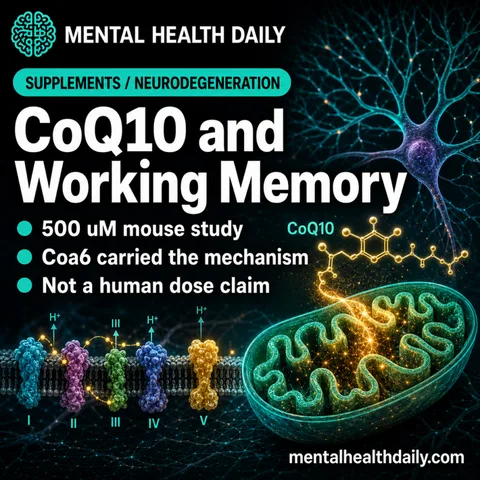
MHD featured image for CoQ10, working memory, Drp1 deficiency, Coa6, and mitochondrial respiratory-chain function.

A 2026 mouse study found that long-term CoQ10 exposure reduced working-memory errors in Purkinje-cell-specific Drp1-deficient mice, tying the behavioral rescue to Coa6 binding and support for mitochondrial respiratory-chain function.1 The result supports a narrow mechanistic CoQ10-Coa6 pathway under neuronal mitochondrial dysfunction while leaving human memory-supplement claims untested. Research Highlights Working memory improved in a mouse …

Read more

IL-6 Deficiency Worsened Parkinson’s Mouse Models, Especially in Females

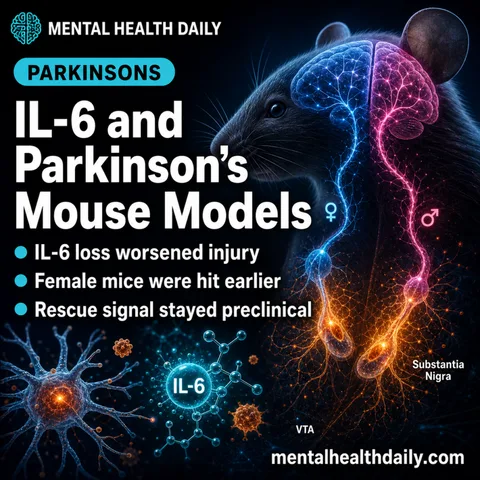
MHD featured image for IL-6 deficiency and sex-dependent Parkinson's disease mouse models.

A 2026 mouse study found that complete IL-6 deficiency worsened motor dysfunction and dopaminergic injury in MPTP and alpha-synuclein A53T Parkinson’s disease models, with earlier and broader vulnerability in female knockout mice.1 The result cuts against a simple “less inflammation is always better” frame: recombinant IL-6 partly improved MPTP-induced motor dysfunction and striatal dopaminergic terminal …

Read more

FTL1 Iron Protein Reversal Improved Cognitive Aging in Old Mice

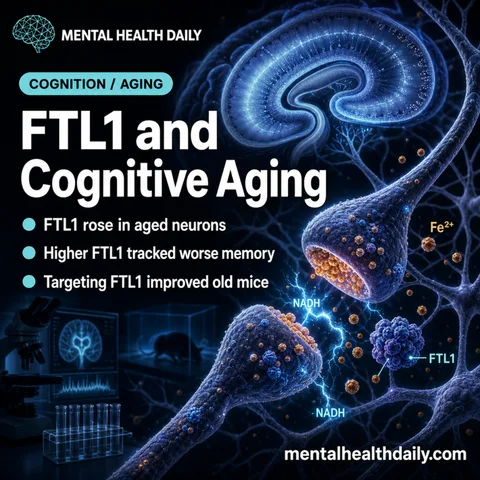
MHD featured image for FTL1, iron biology, and cognitive aging in mice.

A 2025 Nature Aging study found that hippocampal ferritin light chain 1 (FTL1) rose with age in mouse neurons, tracked poorer cognition, and became experimentally reversible in old mice. This is an animal-mechanism result, not a human anti-aging treatment.1 Research Highlights FTL1 rose in aged hippocampus: Western blot data showed higher hippocampal FTL1 in aged …

Read more

TMEV Viral Parkinson’s Mouse Model Caused 20-Week Dopamine-Lesion Behaviors

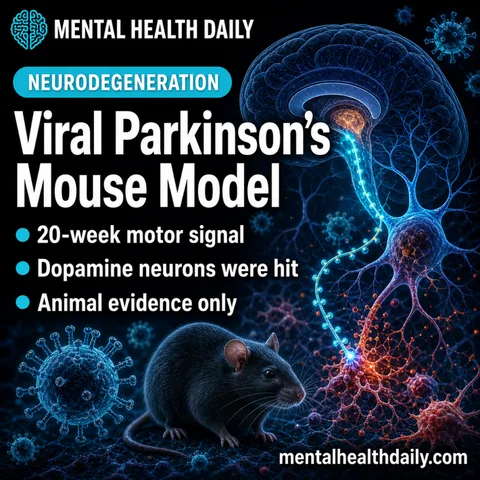
MHD featured image for a viral Parkinson's mouse model using Theiler's murine encephalomyelitis virus.

A 2026 mouse study found that Theiler’s murine encephalomyelitis virus (TMEV) injected into the substantia nigra produced persistent Parkinson’s-like motor signals through 20 weeks, including apomorphine-induced rotations at every measured post-injection timepoint.1 The finding makes TMEV a useful viral-neuroinflammation model of dopamine-neuron injury, but it does not show that Theiler’s virus causes human Parkinson’s disease. …

Read more

Syntaxin-6 Knockout Rescued Motor and Frailty Signs in Tauopathy Mice

MHD featured image for syntaxin-6 knockout and tauopathy motor rescue in mice.

A 2026 humanized P301S tauopathy mouse study found that syntaxin-6 knockout partly rescued early motor impairment from months 1 to 4, protected gait at 5.5 months, reduced frailty (p = 0.0052), and reduced superficial-cortex neurodegeneration at 3 months (p = 0.0055).1 The finding strengthens syntaxin-6 as a tauopathy modifier, but it is still mouse genetics, …

Read more

Restless Legs: Striatal Dopamine-Opioid Hypersensitivity

Restless legs syndrome (RLS) and opioid-withdrawal restlessness both produce night-worsening urges to move. A 2026 npj Parkinson’s Disease mouse study tied that overlap to hypersensitive striatal D1-mu-opioid receptor signaling in basal-ganglia motor circuits.1 Research Highlights 2 clinically similar states converged: restless legs syndrome and opioid-withdrawal restlessness both point toward a striatal D1-mu-opioid circuit that regulates …

Read more