A 254-person FaceYourFears moderator analysis found that people with schizophrenia-spectrum paranoia and higher avolition or moderate-to-high delusion severity may improve more with virtual-reality CBT than with standard CBT for psychosis.1 The result is useful as a treatment-matching hypothesis, not as a rule that assigns patients to a headset.
Research Highlights
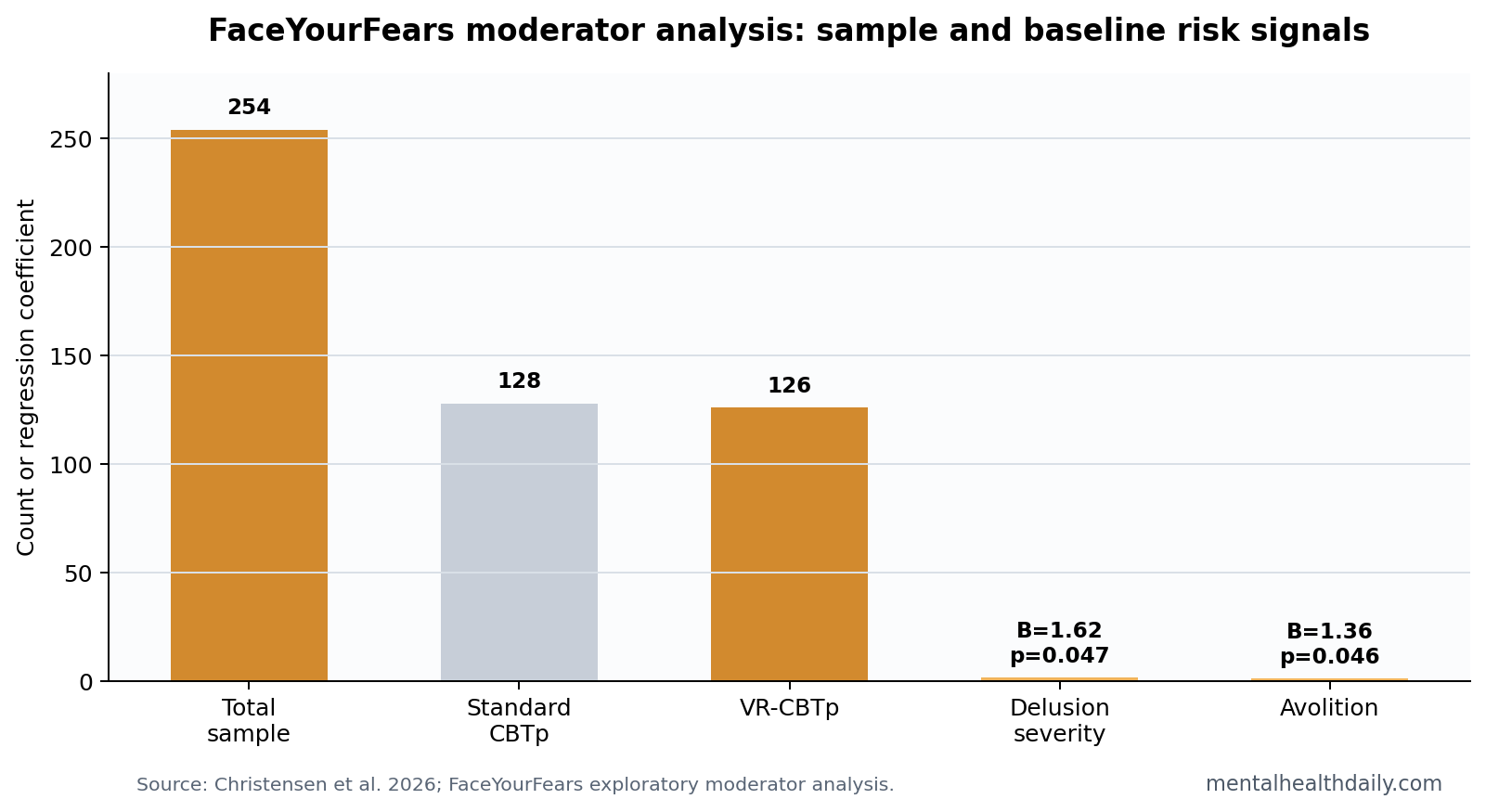
- 254 participants were analyzed: 128 received standard CBTp and 126 received VR-CBTp in the FaceYourFears trial.1
- Higher baseline symptoms predicted poorer outcomes: avolition had B = 1.36, p = 0.046, and delusion severity had B = 1.62, p = 0.047, across treatment groups.1
- VR-CBTp signal was subgroup-shaped: high avolition and moderate-to-high delusion severity appeared to favor VR-CBTp, while lower delusion severity favored standard CBTp.1
- CBTp moderator work is still developing: prior CBTp moderator analyses support personalization questions, but effects are usually modest.3
- Clinical use should stay provisional: a 2026 exploratory analysis can guide trial design, not determine patient eligibility by itself.1
Virtual-reality CBT for psychosis (VR-CBTp) uses simulated social environments to help patients test threat beliefs and safety behaviors in controlled situations. For paranoia, the practical appeal is that a patient can practice entering a bus, street, cafe, or store-like scene without starting in the full unpredictability of ordinary public life.
Avolition means reduced motivation to initiate or persist in goal-directed activity. In schizophrenia-spectrum disorders, avolition can make ordinary homework-heavy therapy harder because the treatment asks patients to plan, initiate, and repeat effortful social exposures.
FaceYourFears Compared 10 Sessions of VR-CBTp vs. Standard CBTp
Christensen et al. analyzed baseline moderators in the FaceYourFears trial, which compared 10 sessions of standard CBTp with 10 sessions of VR-CBTp for paranoid ideation in schizophrenia-spectrum disorders.1 The parent trial supplied the treatment contrast; this analysis asked whether baseline clinical features changed who benefited more from each format.2
Candidate moderators included symptom severity, safety behavior, cognitive biases, negative symptoms, avolition, functioning, trauma, and demographic variables. Moderator analysis asks whether a baseline feature changes the effect of treatment A vs. treatment B.
High Avolition May Be Where VR Adds the Most
Across treatments, higher baseline avolition, safety behavior, delusion severity, and cognitive biases were associated with poorer paranoia outcomes.1 That is not surprising: more severe baseline maintenance factors usually make improvement harder.
The differential signal is more interesting. High baseline avolition appeared to favor VR-CBTp over standard CBTp. One plausible explanation is that VR makes exposure work more immediate. A patient who struggles to initiate real-world practice may still engage when the social situation is brought into the therapy room.
VR may partially bypass one barrier to exposure practice without directly treating avolition itself. Motivation still needs to be assessed directly, because headset novelty, therapist structure, and session attendance can all contribute to the observed pattern.
Delusion Severity Split the Direction of Treatment Fit
Moderate-to-high baseline delusion severity appeared to favor VR-CBTp, whereas lower delusion severity favored standard CBTp.1 That pattern is clinically plausible. Stronger paranoid beliefs may benefit from controlled, repeatable social-threat experiments that can be adjusted in intensity.
Lower delusion severity may not require immersive exposure. Standard CBTp may be enough when the person can already reflect on beliefs, test interpretations, and tolerate ordinary homework tasks.
Evidence-strength note: the analysis was exploratory. The fixed trial sample was not designed to produce definitive subgroup thresholds, and the paper itself emphasized modest effects. A treatment-matching threshold would need prospective confirmation.
VR-CBTp Should Be Treated as a Delivery Tool, Not a Magic Mechanism
Systematic reviews of virtual-reality interventions in psychosis have generally supported feasibility while warning that trials are still heterogeneous and often small.4 VR can make social exposure more controlled, repeatable, and emotionally vivid. It does not remove the need for formulation, therapist skill, safety planning, or post-session learning.
For MHD readers, the most useful interpretation is operational:
- High avolition: VR may help when initiating real-world exposure is the barrier.
- Higher delusion severity: VR may help when controlled exposure is safer than jumping into uncontrolled public settings.
- Lower delusion severity: standard CBTp may be enough when reflective work and homework are feasible.
Moderator Signals Should Change Trial Design First
The practical use of this paper is not immediate triage. The practical use is better trial design. If high avolition and delusion severity are plausible treatment modifiers, the next VR-CBTp trial should stratify or enrich for those groups rather than burying them in a broad psychosis sample.
Stratification means balancing important baseline features across treatment arms before randomization or analyzing them according to a prespecified plan. Without that step, subgroup findings can be unstable because a few participants with high symptom burden may carry much of the apparent interaction.
Avolition is a particularly important modifier to test prospectively because it affects treatment delivery and symptom severity at the same time. A patient with severe suspiciousness but preserved motivation may complete standard CBTp homework. A patient with moderate paranoia and severe avolition may need more in-session structure before any between-session practice becomes realistic.
That distinction changes how VR should be evaluated. If VR mainly helps by making exposure vivid, delusion severity should be the main moderator. If VR mainly helps by reducing initiation burden, avolition should be the main moderator. The FaceYourFears analysis leaves both possibilities open.
Safety Behavior and Cognitive Biases Still Belong in the Formulation
The analysis also found that baseline safety behavior and cognitive biases were associated with poorer outcomes across treatment groups.1 Safety behaviors are actions that reduce immediate fear but keep the threat belief alive, such as avoiding eye contact, checking exits, carrying protective objects, or scanning strangers for danger.
Cognitive biases are repeated interpretation patterns that pull ambiguous information toward threat. In paranoia, they can include jumping to conclusions, attention to threat, and negative beliefs about other people.
These variables remain central to therapy even when the treatment-format split is less sharp. VR-CBTp can stage social situations where safety behaviors are tested directly. Standard CBTp can also target the same behaviors through real-world experiments, belief work, and graded exposure. Format choice should follow the barrier: if real-world practice is reachable, standard CBTp may be enough; if avoidance blocks practice, VR may create the first workable step.
What a Stronger Clinical Rule Would Need
A clinically useful selection rule would need more than a significant interaction. It would need clear thresholds, replication, and evidence that using the rule improves outcomes compared with ordinary therapist judgment.
That future rule would likely combine several inputs: avolition, persecutory-delusion severity, safety behavior, cognitive biases, technology tolerance, cybersickness risk, and patient preference. Preference changes the exposure context itself. A patient who fears surveillance may experience a headset differently than a patient who sees VR as a safe rehearsal room.
The trial also reminds clinicians that “paranoia” is not one treatment target. One patient may mainly avoid buses because strangers feel threatening. Another may attend crowded places but carry multiple safety behaviors that prevent disconfirmation. Another may intellectually question the belief but lack motivation to practice. VR-CBTp may help most when the therapy problem is access to repeated, tolerable social experiments.
Standard CBTp should not be framed as the low-tech fallback. For patients who can complete real-world practice, ordinary CBTp may generalize faster because the exposure setting is already real. The best treatment format is the one that gets the patient to test the feared prediction often enough, safely enough, and specifically enough for learning to occur. Format should follow the bottleneck, not the novelty of the device.
A stronger rule would also need to separate treatment access from treatment response. A patient with high avolition may benefit from VR because it lowers the activation cost of beginning exposure work, but that same avolition may also reduce attendance, homework, and follow-through.
A trial that only measures end-of-treatment paranoia could miss whether VR helped by improving exposure dose, by changing belief updating, or by keeping people engaged long enough to receive therapy.
Process measures would clarify the mechanism. Future studies should report several therapy-delivery variables alongside symptom outcomes:
- Completed sessions and exposure tasks.
- Safety behaviors used inside VR scenes.
- Homework completion after VR sessions.
- Cybersickness dropouts and technology refusal.
- Whether feared predictions were explicitly tested.
Those details would show whether the headset changes the mechanism of therapy or simply makes an existing CBTp mechanism easier to deliver.
Replication should report absolute outcomes alongside interaction terms. A subgroup can appear to favor VR-CBTp statistically while still leaving many patients with clinically meaningful paranoia. Treatment matching only helps if the matched group improves enough to matter in daily social functioning.
Questions About VR-CBTp for Paranoia
Did VR-CBTp outperform standard CBTp for everyone?
No. This analysis points to possible treatment modifiers, not universal superiority.
Can clinicians use avolition to assign treatment now?
Not as a hard rule. Avolition should inform clinical judgment and future trial stratification, but it is not a validated treatment-selection cutoff.
Why might VR help high-avolition patients?
VR can bring exposure practice into the session, reducing the initiation burden of real-world homework. That mechanism is plausible, but the analysis does not prove it.
References
- Christensen MJ, et al. Treatment effect modifiers of virtual reality-based versus standard cognitive behavioral therapy for paranoia in schizophrenia spectrum disorders. Psychological Medicine. 2026. https://doi.org/10.1017/s0033291726103870
- van der Stouwe ECD, et al. Virtual-reality cognitive behavior therapy versus cognitive behavior therapy for paranoid ideation. Psychological Medicine. 2025. doi:10.1017/s0033291725100949
- Turner DT, et al. Efficacy and moderators of cognitive behavioural therapy for psychosis versus other psychological interventions. Frontiers in Psychiatry. 2020;11. https://doi.org/10.3389/fpsyt.2020.00402
- Schroeder AH, et al. Feasibility and efficacy of virtual reality interventions to improve psychosocial functioning in psychosis: systematic review. JMIR Mental Health. 2022;9:e28502. https://doi.org/10.2196/28502