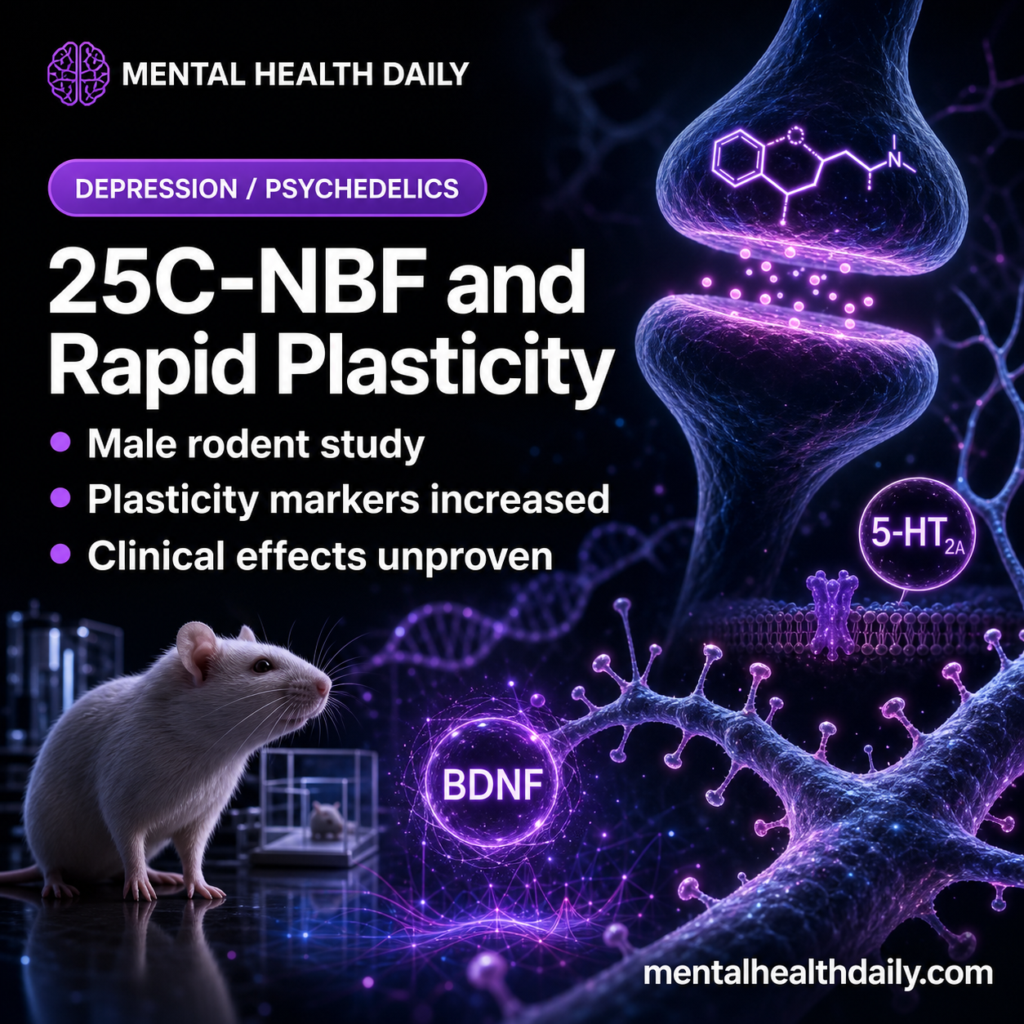
A 2026 preclinical study found that 25C-NBF, a selective 5-HT2A psychedelic phenethylamine, increased plasticity-related markers and produced rapid antidepressant-like effects in male rodents, while showing no detected reward or reinforcement signal in the models tested.
Research Highlights
- 25C-NBF was preclinical: Nadal-Gratacos et al. tested cells, male mice, and male rats, not patients with depression.1
- 5-HT2A selectivity was central: NBF compounds showed high affinity and selectivity for the serotonin 5-HT2A receptor, the main psychedelic receptor target.
- Reward signals were not detected: conditioned place preference used n = 10-12 mice per group, self-administration used n = 7-8 rats per group, and microdialysis used 3 mg/kg without accumbal dopamine increases.
- Plasticity markers increased: 25C-NBF promoted dendritogenesis, spinogenesis, and Bdnf mRNA expression in vitro and in vivo.
- Antidepressant-like behavior was rapid: 10 mg/kg 25C-NBF restored sucrose preference in a corticosterone anhedonia model and reduced immobility 24 hours after dosing.
Psychoplastogens are compounds that rapidly promote structural or functional neural plasticity, including dendrite growth, dendritic-spine remodeling, or synapse-related signaling. 25C-NBF is an N-(2-fluorobenzyl) phenethylamine analog designed around serotonin 5-HT2A receptor pharmacology.
The calibrated read is straightforward: the paper is interesting because it links receptor selectivity, plasticity, and antidepressant-like behavior in the same compound family. It is still an animal and cell-study package, not evidence that 25C-NBF treats human depression.
25C-NBF Targets the Psychedelic 5-HT2A Pathway
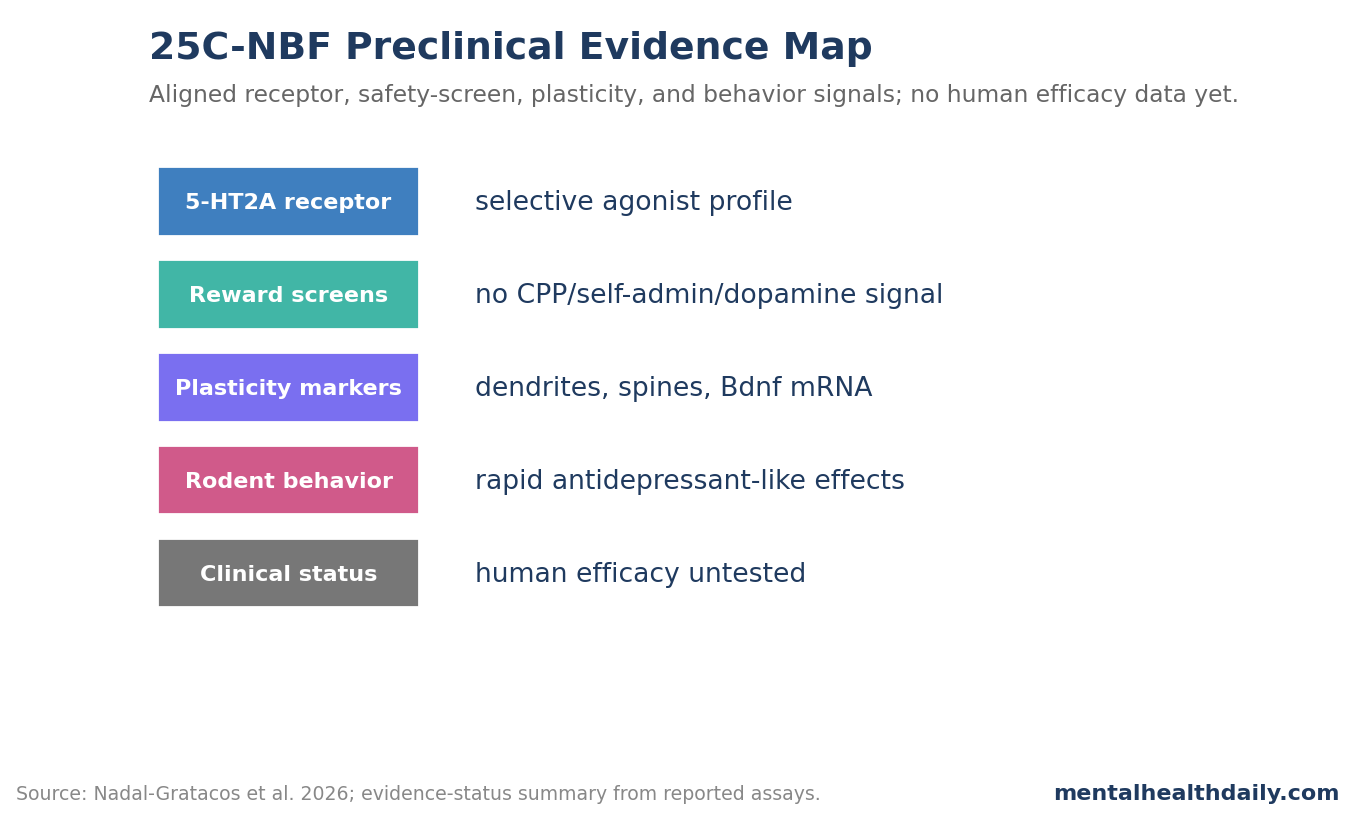
The study examined 25C-NBF, 25B-NBF, and 25I-NBF, then characterized 25C-NBF most deeply. The compounds showed high affinity and selectivity for 5-HT2A receptors and signaling bias similar to serotonin, with preference for Gq over β-arrestin pathways.
5-HT2A receptors are serotonin receptors heavily implicated in classic psychedelic effects. Agonism means the compound activates the receptor. Signaling bias means the receptor may favor one downstream pathway over another after activation.
Acute administration produced moderate head-twitch responses, a mouse behavioral marker often used as a proxy for 5-HT2A-mediated psychedelic-like activity. Locomotion and prepulse inhibition were not detectably disrupted in the reported tests.
Reward and Reinforcement Tests Did Not Flag Abuse Liability
The researchers ran 3 abuse-liability screens. These tests do not prove real-world safety, but they help separate a compound worth studying from one that immediately looks reinforcing.
- Conditioned place preference: mice did not show a preference for the drug-paired chamber after NBF exposure.
- Self-administration: rats trained on methamphetamine did not maintain responding when NBF compounds replaced methamphetamine for 5 sessions.
- Accumbal dopamine: NBF dosing at 3 mg/kg did not increase extracellular dopamine in the nucleus accumbens, a reward-circuit region.
That pattern matters for prioritization. Phenethylamine psychedelics include compounds with substantial recreational-risk baggage, so a candidate with no detected reinforcement signal in these assays deserves a different development status from a compound that robustly drives self-administration.
Plasticity Findings Fit the Psychoplastogen Model
Ly et al. previously showed that several psychedelics can promote structural and functional neural plasticity in cortical systems.2 Nadal-Gratacos et al. extended that model to 25C-NBF by reporting dendritogenesis, spinogenesis, and increased Bdnf mRNA.
BDNF, brain-derived neurotrophic factor, is a growth-supporting protein involved in synaptic remodeling and neuronal survival. Increased Bdnf mRNA means cells were producing more messenger RNA for that growth-factor pathway, not that a clinical antidepressant response had occurred.
Prefrontal cortex relevance is biologically plausible. Pizzagalli and Roberts reviewed how prefrontal circuits contribute to depression pathophysiology,3 and animal stress studies have linked depression-like behavior to prefrontal dendritic-spine loss.4 25C-NBF sits inside that mechanism lane.
Antidepressant-Like Behavior Is Not Human Antidepressant Efficacy
The behavioral results were strongest in stress-linked rodent assays. In acute-stress conditions, 25C-NBF reduced despair-like behavior. In a chronic corticosterone model, 10 mg/kg 25C-NBF restored sucrose preference, a common readout for anhedonia-like behavior.
Corticosterone models expose rodents to sustained stress-hormone signaling to produce depression-relevant behavioral changes. Sucrose preference estimates reward sensitivity because rodents usually prefer sweet solution; reduced preference is treated as an anhedonia-like signal.
Evidence-strength note: these assays support preclinical antidepressant-like activity. They do not establish dose, safety, subjective effects, durability, or therapeutic value in humans. Male-only animal emphasis also limits sex generalization.
Safety Claims Need More Than Reward Screens
The reward and dopamine results are useful because they make 25C-NBF less concerning than a compound that animals readily self-administer. They are still an early safety slice. Psychedelic phenethylamines can have cardiovascular, thermoregulatory, perceptual, anxiety-provoking, and dose-escalation risks that reward models do not capture.
A stronger preclinical safety package would need several layers:
- Dose-response range: antidepressant-like effects should be separated from sedation, locomotor suppression, seizure risk, or toxic behavior.
- Cardiovascular monitoring: blood pressure, heart rate, vasoconstriction, and arrhythmia risk matter for serotonergic phenethylamines.
- Sex comparison: the current male-rodent emphasis leaves female-response and hormone-cycle questions open.
- Repeated dosing: rapid effects after acute dosing do not establish tolerance, sensitization, or durable benefit.
- Drug-interaction screening: future psychiatric use would require compatibility data with SSRIs, SNRIs, antipsychotics, mood stabilizers, and stimulants.
Development implication: 25C-NBF has enough signal to justify deeper study, but the attractive phrase "rapid antidepressant effects" should stay anchored to male rodent models until human safety and efficacy data exist.
Plasticity Is a Mechanism Hypothesis, Not a Treatment Outcome
Dendritic growth and BDNF signaling are plausible antidepressant-relevant mechanisms because chronic stress and depression models often involve synaptic remodeling in prefrontal networks. Nadal-Gratacos et al. connected those cellular changes to behavior in the same compound.
Mechanism limit: a compound can increase plasticity and fail as a medication if the effect is too brief, too nonspecific, too toxic, or too dependent on uncontrolled subjective experience.
Psychedelic development also has to account for setting, expectancy, psychotherapy context, and adverse psychological reactions.
Reader translation: the 25C-NBF result is a candidate-prioritization result. It says the molecule deserves more controlled testing, not that patients should seek it out or that the compound belongs in unsupervised use.
Route of administration and exposure timing are also unresolved. A rodent injection dose does not translate directly into a human therapeutic dose, and psychedelic-like compounds can have steep dose-response curves. The useful next question is whether the plasticity and behavioral signals appear at exposures that are tolerable and controllable.
The reward-screen findings should be read in the same calibrated way. No conditioned place preference, self-administration, or accumbal dopamine increase is reassuring within those assays. It does not rule out misuse risk, psychological adverse events, or toxicity under different doses, combinations, or social contexts.
Clinical-development filter: a future program would need to show that antidepressant-relevant plasticity can be separated from unsafe cardiovascular activation, uncontrolled perceptual effects, and reinforcing use patterns. Until then, the compound is a mechanistic lead, not a treatment recommendation.
Durability is another open issue. The study reported rapid behavioral effects, including 24-hour signals, but depression treatment requires more than a short-lived movement in a rodent assay. A convincing program would need to show whether benefits persist, whether repeat dosing changes the response, and whether plasticity markers normalize or overshoot.
Comparator choice will also matter. Ketamine, psilocybin, DMT-like compounds, and conventional antidepressants all create different mixes of onset speed, subjective effect, plasticity, monitoring burden, and risk. 25C-NBF should eventually be judged against those alternatives rather than against an empty promise of rapid onset.
The 25C-NBF study is valuable because it did several early filters in one place: receptor pharmacology, reward screening, plasticity readouts, and depression-relevant behavior. The next stage needs the same breadth with stronger safety and durability endpoints.
Preclinical enthusiasm should also stay separated from access decisions. Novel psychedelic chemistry can move quickly through online communities, but a compound with rodent-only antidepressant-like evidence has no established purity standard, therapeutic index, interaction profile, or emergency-management protocol for unsupervised use.
Those missing safeguards are the difference between a research lead and a usable medicine for depression care in real patients with complex medication histories and relapse risk over time after treatment starts in practice outside laboratories and clinics.
Early human planning would also need a psychiatric-risk screen. A serotonergic psychedelic-like compound could be especially risky in people with bipolar-spectrum illness, psychosis vulnerability, severe anxiety, cardiovascular disease, or complex medication combinations. That does not erase the rodent signal. It defines the safety work required before a plasticity hypothesis can be tested in depressed patients.
Preclinical dosing should also map the distance between desired behavioral effects and unwanted physiological activation. A narrow margin would make the compound less attractive even if the depression-like behavior signal replicates.
Replication across laboratories would make the signal more credible.
Questions About 25C-NBF and Depression
Is 25C-NBF an approved antidepressant?
No. The evidence here is preclinical. It supports further pharmacology and safety research, not clinical use.
Why is no reward signal important?
A compound proposed for psychiatric use needs abuse-liability screening. Lack of conditioned place preference, self-administration, and accumbal dopamine response is encouraging, but broader toxicology and human safety work would still be required.
Which evidence would make the 25C-NBF signal more convincing?
Replication across sexes, dose ranges, safety measures, and depression-relevant models should come before any human efficacy claim. A first-in-human pathway would need pharmacokinetics, toxicity, cardiovascular monitoring, and controlled subjective-effect assessment.
References
- The Psychedelic Phenethylamine 25C-NBF, a Selective 5-HT2A Agonist, Shows Psychoplastogenic Properties and Rapid Antidepressant Effects in Male Rodents. Nadal-Gratacos N et al. Molecular Psychiatry. 2026;31:1909-1922. doi:10.1038/s41380-025-03341-1
- Psychedelics Promote Structural and Functional Neural Plasticity. Ly C et al. Cell Reports. 2018;23(11):3170-3182. doi:10.1016/j.celrep.2018.05.022
- Prefrontal Cortex and Depression. Pizzagalli DA, Roberts AC. Neuropsychopharmacology. 2022;47:225-246. doi:10.1038/s41386-021-01101-7
- Dendritic Spines in Depression: What We Learned from Animal Models. Qiao H et al. Translational Psychiatry. 2016;6:e759. doi:10.1038/tp.2015.212