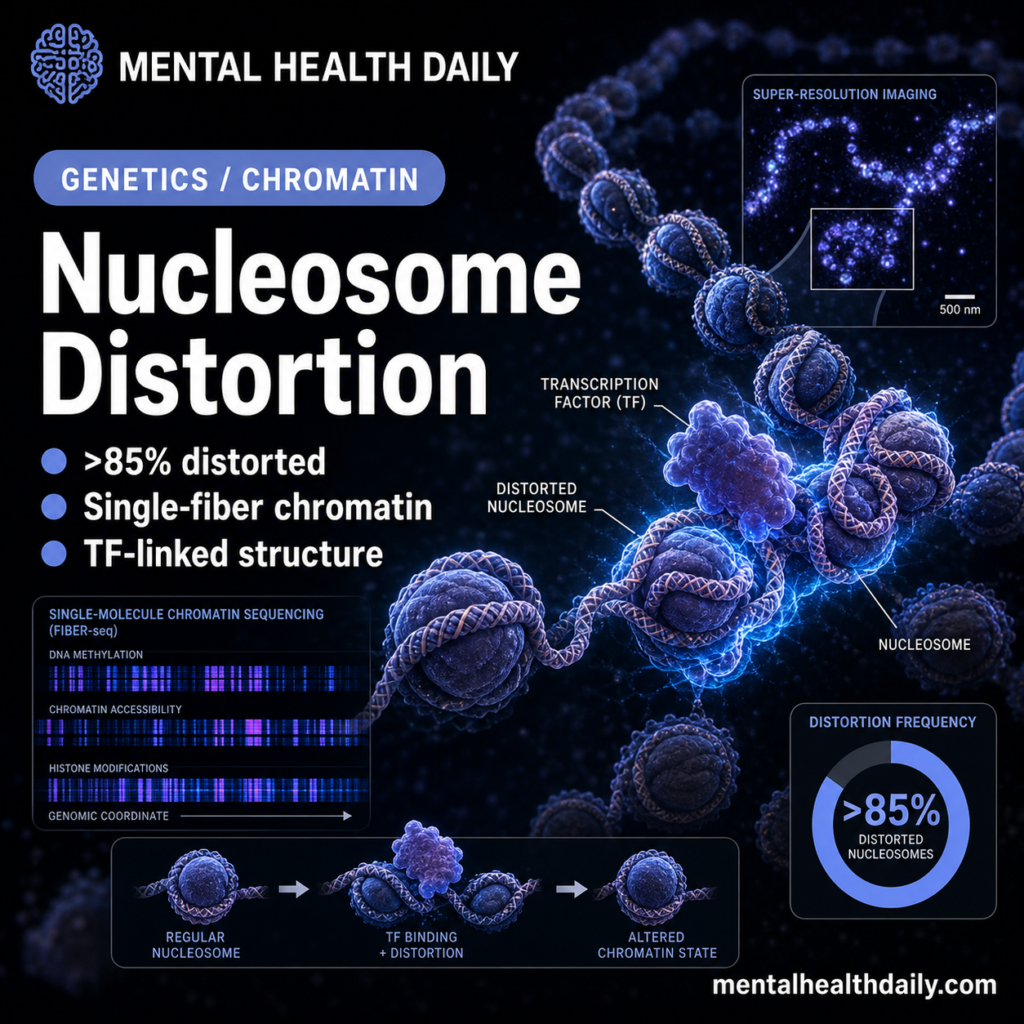
Nucleosomes may be far less uniform inside living chromatin than the textbook picture suggests. In a 2026 Nature study, a single-molecule method called IDLI found that more than 85% of sampled nucleosomes in mouse embryonic stem cells showed intranucleosomal DNA accessibility, meaning the DNA wrap was partly open or distorted rather than perfectly sealed around the histone core.1
Research Highlights
- IDLI mapped nucleosome structure on individual chromatin fibers. The method classifies inaccessible DNA footprints into full nucleosomes, partially accessible nucleosomes, unwrapped nucleosomes, and subnucleosomal species.1
- The headline number was striking. In mouse embryonic stem cells, more than 85% of nucleosomes showed intranucleosomal accessibility, which the authors call nucleosome distortion.1
- Distortion was regulated, not random damage. Patterns differed by epigenomic domain, promoter activity, satellite repeats, and transcription-factor motifs.1
- CTCF, SOX2, and FOXA2 were mechanistically informative. Degron and genetic experiments suggested transcription factors can directly shape nucleosome distortion patterns.1
- The mental-health relevance is upstream biology. The 2026 data are not psychiatric outcomes, but chromatin regulation is one layer by which development, cell identity, and disease-linked gene expression are controlled.
The result makes “open versus closed chromatin” too blunt. Some DNA may remain nucleosome-associated while still becoming locally accessible within the nucleosome wrap itself.
IDLI Reads Nucleosome Shape on Single Chromatin Fibers
Yang et al. built Iteratively Defined Lengths of Inaccessibility, or IDLI, on top of long-read single-molecule footprinting. The underlying idea is Feynman-simple: accessible adenines are methylated, protected DNA stays unmethylated, and long-read sequencing preserves the pattern along the same chromatin fiber.1
Older chromatin methods often average across many cells or chop chromatin into fragments. That can tell researchers where chromatin is broadly open or closed, but it can lose the structure of individual nucleosomes sitting on individual DNA molecules. Long-read methyltransferase footprinting methods such as SAMOSA helped solve part of that problem by preserving multi-nucleosome patterns on single molecules.4
The IDLI study pushed further. By changing the transition probability used to call inaccessible footprints, the authors could inspect subfootprint patterns inside nucleosome-sized regions. In mouse embryonic stem cells, this produced a classification system for nucleosome states, including linker-histone-associated nucleosomes, nucleosomes with focal DNA accessibility, symmetrically unwrapped nucleosomes, hexasomes, tetrasomes, and smaller protected species.1
A compact method snapshot:
- Assay foundation: SAMOSA-style adenine methyltransferase footprinting plus long-read sequencing.
- Primary cell system: E14 mouse embryonic stem cells.
- Scale: 88.87 Gb of SAMOSA data and 795,765 footprints used for the main nucleosome-type visualization.1
- Validation layers: MNase-ChIP fractions, H1 triple-knockout cells, in vitro reconstituted chromatin, degron depletion, differentiation systems, primary mouse hepatocytes, and in vivo FOXA2 perturbation.1
IDLI is more than another sequencing pipeline because it tries to recover structure from a molecule-by-molecule record: which pieces of DNA were accessible, which were protected, and how those protected segments line up along the same physical chromatin fiber. That is closer to reading chromatin architecture than just counting open regions.
More Than 85% of Nucleosomes Showed Internal Accessibility
The headline result is simple but destabilizing: most nucleosomes in the sampled mouse embryonic stem-cell chromatin were not perfectly inaccessible wraps. The paper states that more than 85% exhibited intranucleosomal DNA accessibility.1
The DNA wrapped around the histone core can have focal accessible zones, partial unwrapping, missing histone-dimer configurations, or subnucleosomal structures while the nucleosome remains present. The canonical nucleosome remains the reference model, but the living chromatin landscape appears to contain many more intermediate structural states than a simple occupied/unoccupied map suggests.
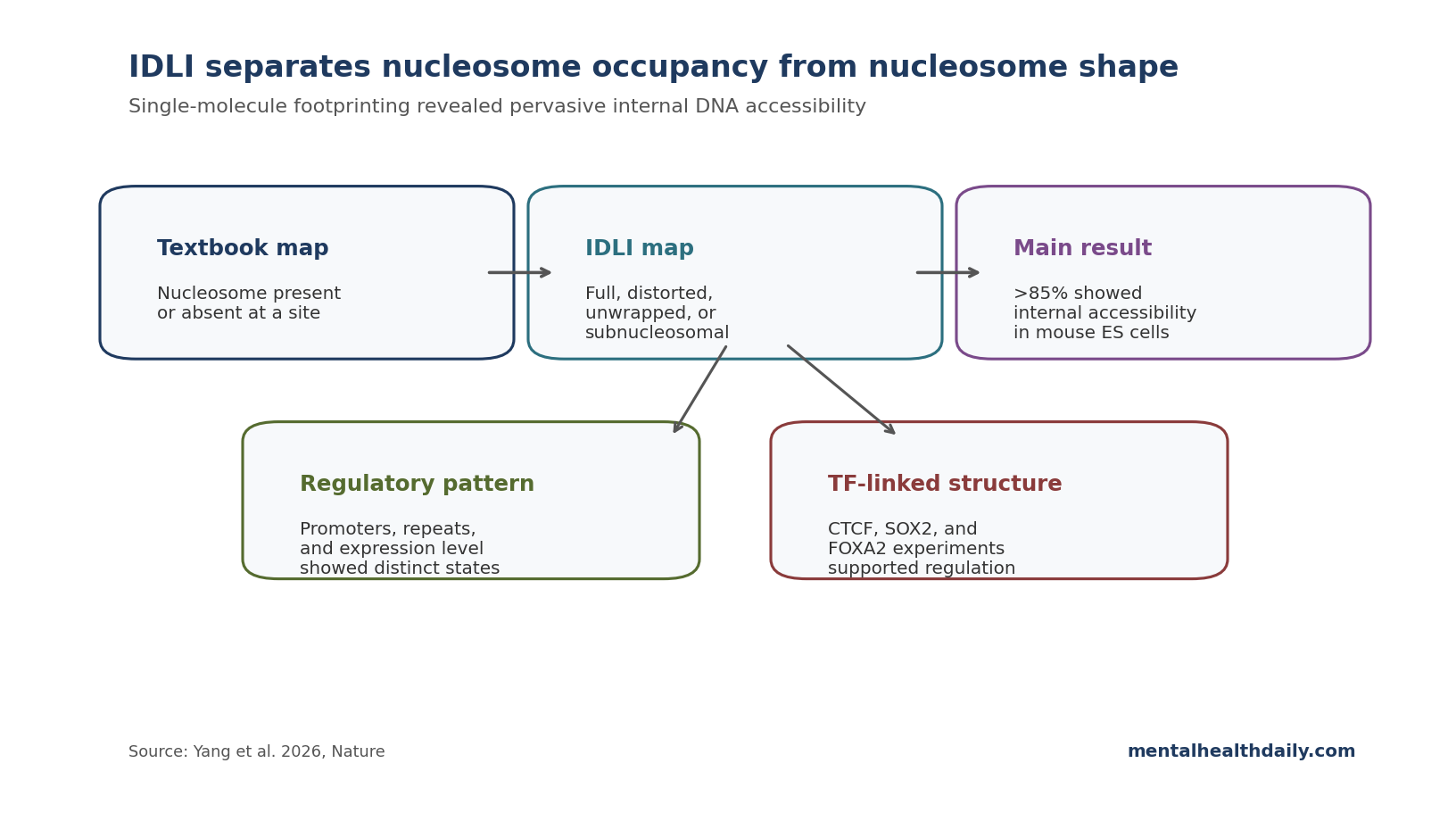
This helps explain why chromatin accessibility has always been hard to compress into one measurement. ATAC-seq, DNase-seq, MNase-seq, and related methods can identify accessible regions, but accessibility can come from different structures: a missing nucleosome, a shifted nucleosome, a partially unwrapped nucleosome, a hexasome, a transcription factor sitting on nucleosomal DNA, or a remodeling intermediate.3
Distortion Was Tied to Promoters, Repeats, and Transcription Factors
The most important qualifier is that distortion was not treated as random wear. The authors observed epigenomic-domain- and expression-level-specific patterns, including promoter-associated patterns and features at mouse satellite repeats. Transcription-factor motif occurrence correlated with distinct distortion types.1
Transcription factors are the proteins that read DNA sequences and help control gene expression. Some transcription factors need open DNA. Pioneer transcription factors are different: they can engage DNA even when it is wrapped in nucleosomes, helping open regulatory regions during development or cell-state transitions.5
In the IDLI paper, acute depletion of factors such as CTCF and SOX2 shifted nucleosome distortion patterns in mouse embryonic stem cells. The authors also extended the approach to in vitro endoderm differentiation in human induced pluripotent stem cells and primary mouse hepatocytes, where distortion appeared at FOXA2-binding sites. Genetic perturbation of a FOXA2 nucleosome-binding domain in mice directly affected nucleosome structure in vivo.1
Plain English: transcription factors may help create, position, or stabilize partially accessible nucleosome structures instead of only finding DNA that is already open.
Nucleosome Distortion Could Shape Brain and Psychiatric Gene Regulation
The immediate data concern chromatin structure rather than depression, schizophrenia, autism, or dementia. The connection to mental health is one level upstream: neurons, glia, immune cells, and developmental progenitors all depend on cell-type-specific gene regulation. Chromatin structure is one of the systems that decides which genes can be used in which cell state.
Brain disorders frequently involve regulatory DNA, developmental timing, cell-type specificity, and environmental sensitivity. A method that can resolve nucleosome structure on single fibers may eventually clarify why a risk variant changes gene expression in one cell type but not another, or why a regulatory site is permissive during development but inaccessible later.
The key is not that nucleosome distortion itself is a psychiatric biomarker. It is that the regulatory genome is more structurally nuanced than bulk assays imply. If a disease-associated enhancer sits in a locally distorted nucleosome state, binary “open chromatin” language may miss the mechanism.
Many common psychiatric-risk variants sit outside protein-coding regions. Their effects are thought to operate through enhancers, promoters, transcription-factor binding, chromatin looping, or cell-state-specific regulatory programs. If those regulatory elements are partly nucleosome-bound but internally accessible, then “closed” and “open” may be too crude for explaining risk biology.
Limitations of the IDLI Interpretation
Method dependence matters. IDLI infers structure from methylation accessibility patterns. The method is powerful, but it is still an inference pipeline that depends on enzyme behavior, sequencing kinetics, model parameters, and validation against known structures.
Mouse embryonic stem cells are not every cell. The more-than-85% figure comes from a specific cellular context. The paper extends findings into differentiation systems and hepatocytes, but mature human brain cells will need direct study.
Distortion is a broad category. A focal accessible patch, a partially unwrapped nucleosome, a hexasome, and a transcription-factor-bound nucleosome are not the same biological object. The strength of IDLI is that it separates some of these states; the limitation is that each category still needs functional interpretation.
Function is still downstream. A distorted nucleosome near a promoter or enhancer is suggestive, but the next layer is perturbation: change the factor, change the structure, then show that gene expression, differentiation, or cell behavior changes in the predicted direction.
Brain-cell translation is untested. The strongest psychiatric relevance would come from applying IDLI-like maps to neurons, astrocytes, oligodendrocytes, microglia, and developmental progenitors rather than assuming that embryonic stem-cell chromatin behaves the same way. A cortical enhancer, a striatal enhancer, and an immune-cell enhancer may carry different nucleosome structures even when the same risk locus is nearby.
Timing also matters. A regulatory element could be partly accessible during fetal brain development, tightly protected in adult tissue, and reopened during inflammation or stress. That would make nucleosome distortion a context-dependent mechanism, not a fixed property of a DNA sequence.
Nucleosome Occupancy Is Not Enough for Regulatory Interpretation
For chromatin biology: nucleosome occupancy is not enough. The structure of the occupied nucleosome can carry regulatory information.
For epigenomics: single-molecule long-read methods may reveal regulatory states that short-read or digestion-based assays blur together.
For neuroscience: this is method-enabling biology. The payoff would be applying these approaches to specific brain cell types, developmental windows, and disease-relevant regulatory elements.
For readers: many nucleosomes may be locally flexible, partially accessible, or structurally remodeled while still occupying DNA. The result is not a claim that DNA is freely exposed everywhere.
Questions About Nucleosome Distortion
Why does a partly accessible nucleosome matter for gene regulation?
A nucleosome is DNA wrapped around histone proteins, so local accessibility inside that wrapped structure can change which regulatory proteins reach DNA without requiring the whole nucleosome to disappear.
What did IDLI find?
IDLI found that more than 85% of sampled nucleosomes in mouse embryonic stem cells showed intranucleosomal accessibility, implying widespread nucleosome distortion.1
Does distortion mean the nucleosome disappeared?
No. It means DNA within the nucleosome footprint had accessible regions or noncanonical structural features while the region still carried nucleosome-like protection.
Why mention this on a mental-health site?
Because psychiatric and neurologic risk often acts through gene regulation. Better maps of chromatin structure can eventually clarify disease-linked regulatory mechanisms.
References
- Pervasive and Programmed Nucleosome Distortion on Single Chromatin Fibers. Yang MG, Richter HJ, Wang S, et al. Nature. 2026. doi:10.1038/s41586-026-10418-6
- Crystal Structure of the Nucleosome Core Particle at 2.8 A Resolution. Luger K, Mader AW, Richmond RK, Sargent DF, Richmond TJ. Nature. 1997;389:251–260. doi:10.1038/38444
- Chromatin Accessibility and the Regulatory Epigenome. Klemm SL, Shipony Z, Greenleaf WJ. Nature Reviews Genetics. 2019;20:207–220. doi:10.1038/s41576-018-0089-8
- Massively Multiplex Single-Molecule Oligonucleosome Footprinting. Lee I, et al. eLife. 2020;9:e59404. doi:10.7554/eLife.59404
- Pre-Marked Chromatin and Transcription Factor Co-Binding Shape the Pioneering Activity of Foxa2. Donaghey J, et al. Nucleic Acids Research. 2019;47(17):9069–9086. doi:10.1093/nar/gkz627