A 2026 longitudinal study involving 951 adolescents found 5 emotion-regulation profiles, not the 3-profile structure the researchers expected, and the clearest mental-health separation came from the adaptive and maladaptive profiles.1 Teen coping looked less like a single good-versus-bad scale and more like a pattern of motives, strategies, and beliefs about whether those strategies work.
Research Highlights
- 5 profiles, not 3: Latent profile analysis identified hypo-regulating, hyper-regulating, adaptive, maladaptive, and normative profiles in 951 adolescents.1
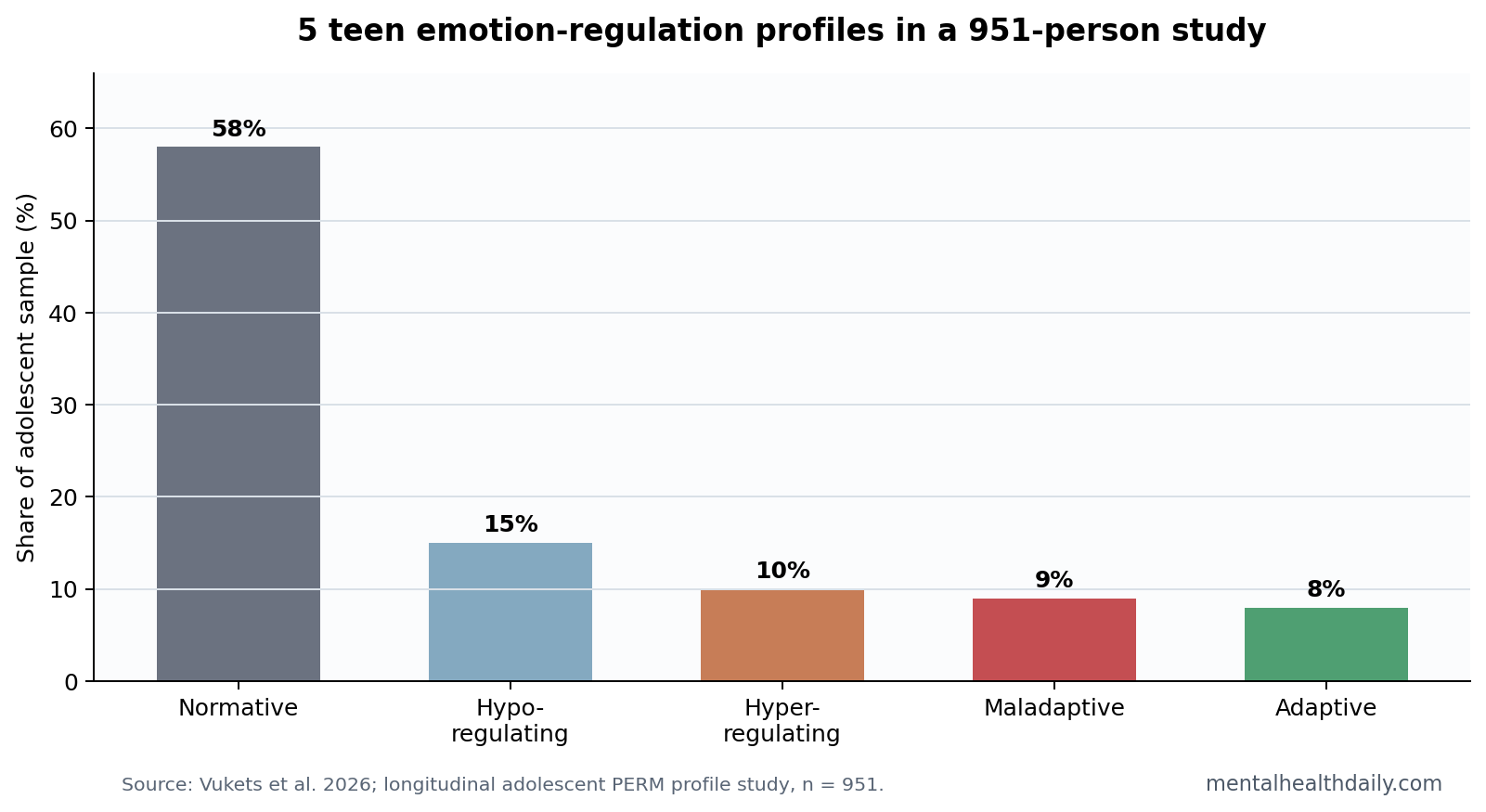
- Most teens were normative: The largest group was the normative profile at 58%, followed by hypo-regulating at 15%, hyper-regulating at 10%, maladaptive at 9%, and adaptive at 8%.1
- Valenced profiles carried the strongest signal: Adaptive teens had the best positive and negative wellbeing pattern, while maladaptive teens had the worst.1
- Over-regulation was not the same as good regulation: Hyper-regulating teens looked elevated on negative outcomes such as anxiety and depression despite using many strategies.1
- Unhelpful styles moved more: Random-intercept latent transition analysis suggested unhelpful regulation profiles were more transient over 5 months than helpful profiles.1
Emotion regulation means the ways people try to shape what they feel, when they feel it, and how strongly they express or sustain it. In teenagers, that can include reappraisal, acceptance, avoidance, suppression, rumination, distraction, and deliberate attempts to feel better or worse.
Vukets et al. used the Process of Emotion Regulation Measure, or PERM, which separates motives, strategies, and perceived efficacy. That matters because 2 teens can use the same strategy for different reasons, or can use many strategies while believing the harmful ones are more effective.
5 Emotion-Regulation Profiles Emerged in 951 Teens
The researchers analyzed a longitudinal community sample of 951 adolescents. They obtained 828 responses at time 1 and 792 at time 2; after exclusions and imputation, the merged longitudinal dataset included 951 participants.1
Latent profile analysis is a statistical method that groups people by response patterns rather than by one score at a time. Instead of asking whether suppression correlates with depression across the whole sample, it asks whether clusters of motives, strategy use, and perceived strategy success form distinct teen profiles.
The 5-profile solution was chosen because model-fit indices stopped improving cleanly at 6 profiles and the 5-profile solution was interpretable. That was directionally different from the researchers’ first hypothesis, which expected 3 groups: normative adaptive, maladaptive, and non-regulating.1
The Normative Group Mixed Helpful and Unhelpful Strategies
The normative profile included 58% of the sample. Teens in this group looked close to the sample average across pro-hedonic motives, contra-hedonic motives, adaptive strategies, maladaptive strategies, and perceived efficacy ratings.1
Pro-hedonic motives are attempts to move toward feeling better. Contra-hedonic motives are attempts to sustain or move toward negative emotion, such as staying angry, sad, or distressed because that state feels justified, protective, or identity-consistent. The normative group used adaptive and maladaptive strategies at similar frequencies, which makes it a mixed middle rather than a clean healthy pattern.
This is why “teach teens coping skills” can be too blunt. A teen might already use some helpful skills and some unhelpful ones. The intervention question becomes which motive-strategy loop is dominant, which strategies the teen trusts, and whether the strategy actually changes distress in daily life.
Adaptive and Maladaptive Profiles Were Mirror Images
The adaptive group, only 8% of the sample, had high pro-hedonic motives, low contra-hedonic motives, frequent adaptive strategy use, less maladaptive strategy use, and high perceived efficacy for adaptive strategies.1
The maladaptive group, 9% of the sample, showed the opposite pattern: more maladaptive indicators relative to adaptive indicators, lower pro-hedonic motives, higher contra-hedonic motives, and stronger belief that maladaptive strategies were useful.1
The mental-health split tracked that mirror-image structure. Adaptive teens had the highest positive wellbeing constructs and lowest negative constructs. Maladaptive teens had the lowest positive constructs and highest negative constructs. The differences were statistically robust across all 8 mental-health outcome variables in the researchers’ profile comparisons.1
That finding fits older evidence. Aldao et al. meta-analyzed emotion-regulation strategies across psychopathology and found broad links between maladaptive strategies and symptoms.2 The 2026 study adds a person-centered layer: symptom risk depends on the profile of motive, use, and perceived usefulness around each strategy.
Hyper-Regulating Teens Still Had More Anxiety and Depression
The hyper-regulating group made up 10% of the sample. These teens reported high scores across the regulation indicators, including high contra-hedonic motives and a tendency to rate maladaptive strategies as effective.1
That pattern matters because high effort is not the same as healthy regulation. A teen who is constantly managing emotion can still be stuck in threat monitoring, rumination, suppression, reassurance seeking, or self-protective negativity.
In the 2026 profile comparisons, hyper-regulating and hypo-regulating styles mainly shifted negative outcomes such as anxiety and depression, while having less effect on positive outcomes such as optimism and resilience.1
- Hypo-regulating: low engagement with regulation indicators; closer to adaptive teens on negative symptoms, but not as strong on positive wellbeing.
- Hyper-regulating: high engagement with many regulation indicators; closer to maladaptive teens on negative symptoms.
- Valenced profiles: adaptive and maladaptive groups produced the clearest overall mental-health contrast.
The 5-Month Transition Pattern Supports Early Intervention
Random-intercept latent transition analysis estimates how likely people are to remain in or move between latent profiles over time while accounting for stable person-level differences. In simpler terms, it asks whether profile membership is sticky or fluid.
The study found a general trend toward adaptiveness, with unhelpful emotion-regulation styles described as considerably more transient than helpful styles across the 5-month interval.1 That is a hopeful finding, but it should not be overread. The analysis observed natural change; it did not randomly assign teens to therapy or prove that moving profiles caused symptom improvement.
Prior developmental work also suggests that adolescence is an active window for emotion-regulation change. Cracco et al. reported evidence for a maladaptive shift across childhood and adolescence, while Compas et al. synthesized broad links among coping, regulation, and youth psychopathology.34
Profile Labels Should Not Become Diagnostic Labels
Evidence-strength note: this was a longitudinal self-report profile study. It can describe clusters and symptom associations. It cannot diagnose a teen, prove causality, or decide which intervention an individual should receive.
Profile labels are best treated as clinical-thinking aids. A teen who looks “maladaptive” in a survey is not a type of person. The label points to modifiable loops: wanting to sustain negative emotion, using avoidance or suppression, trusting unhelpful strategies, or not believing helpful strategies work.
That distinction affects intervention design. A teen in the hypo-regulating group may need activation, noticing skills, and basic strategy access. A hyper-regulating teen may need fewer strategies but better selection, less rumination, and less confidence in strategies that keep distress alive.
Teen Coping Programs Should Target Motive and Efficacy
Many programs teach strategies: reappraise thoughts, breathe slowly, name feelings, accept sensations, solve problems. The PERM framework says strategy lists are incomplete unless they also measure why teens are using those strategies and whether they believe the strategies help.
Motives: some teens may regulate toward relief, connection, or long-term goals. Others may regulate toward punishment, anger maintenance, avoidance, or emotional certainty.
Perceived efficacy: a strategy can be harmful and still feel useful in the short term. Avoidance reduces distress immediately, which can teach the brain to repeat it even when it worsens functioning.
Profile change: a useful program should reduce symptom scores and test whether teens move away from maladaptive or hyper-regulating profiles in ways that predict durable wellbeing.
Program design implication: a one-size coping curriculum can miss why the same skill works for 1 teen and backfires for another. Reappraisal can reduce anxiety when it helps a teen reinterpret a threat realistically, but it can become avoidance if it is used to talk away every uncomfortable feeling. Acceptance can increase flexibility, but it can also be misunderstood as passivity unless the program teaches when to act.
The Vukets profile structure points to sequence as well as content. A hypo-regulating teen may first need emotional labeling, sleep stabilization, behavioral activation, and practice using any strategy consistently. A hyper-regulating teen may already use many strategies and need help dropping repetitive checking, rumination, or over-control. A maladaptive-valenced profile may need direct work on motives that sustain anger, shame, or self-punishment.
Measurement consequence: intervention studies should ask whether motives, strategy selection, and perceived efficacy changed in the expected direction, alongside anxiety and depression scores. If symptoms improve but the same maladaptive profile remains, relapse risk may stay high. If profile membership changes before symptom scores move, the profile could become an early process marker.
That is the useful read of a profile study. It does not turn 951 adolescents into fixed personality types. It gives school and clinical programs a more precise set of modifiable targets than “teach better coping” or “reduce negative emotion.”
Questions About Teen Emotion-Regulation Profiles
Was the 2026 study about diagnosed anxiety or depression?
No. It measured mental-health outcomes such as anxiety/stress and depression symptoms in a community adolescent sample. The results are relevant to symptom risk, not diagnostic classification.
Is using many coping strategies always good?
No. The hyper-regulating group used many regulation indicators but still showed elevated negative outcomes. Strategy quantity is weaker than strategy fit, motive, and whether the teen trusts helpful or harmful strategies.
What should parents or schools take from this?
Ask which emotions the teen is trying to sustain or reduce, which strategies they use under stress, and whether those strategies help after the first few minutes.
References
- Vukets G, Jose PE. A Person-Centred Approach to Adolescent Emotion Regulation Motives, Strategies, and Perceived Efficacies. Research on Child and Adolescent Psychopathology. 2026. https://doi.org/10.1007/s10802-026-01461-y
- Aldao A, Nolen-Hoeksema S, Schweizer S. Emotion-regulation strategies across psychopathology: A meta-analytic review. Clinical Psychology Review. 2010. https://doi.org/10.1016/j.cpr.2009.11.004
- Cracco E, Goossens L, Braet C. Emotion regulation across childhood and adolescence: evidence for a maladaptive shift in adolescence. European Child & Adolescent Psychiatry. 2017. https://doi.org/10.1007/s00787-017-0952-8
- Compas BE, et al. Coping, emotion regulation, and psychopathology in childhood and adolescence: a meta-analysis and narrative review. Psychological Bulletin. 2017. https://doi.org/10.1037/bul0000110