A 2026 analysis linked emotional disorders in heart failure to poorer cardiovascular health, oral-health burden, and oral microbiome dysbiosis, but the strongest mediation signal came from oral health rather than systemic immune-inflammation index.1 In fully adjusted NHANES models, emotional disorders were associated with lower Life’s Essential 8 cardiovascular health, OR 0.39, while self-rated oral health mediated 9.55% of the relationship.
Research Highlights
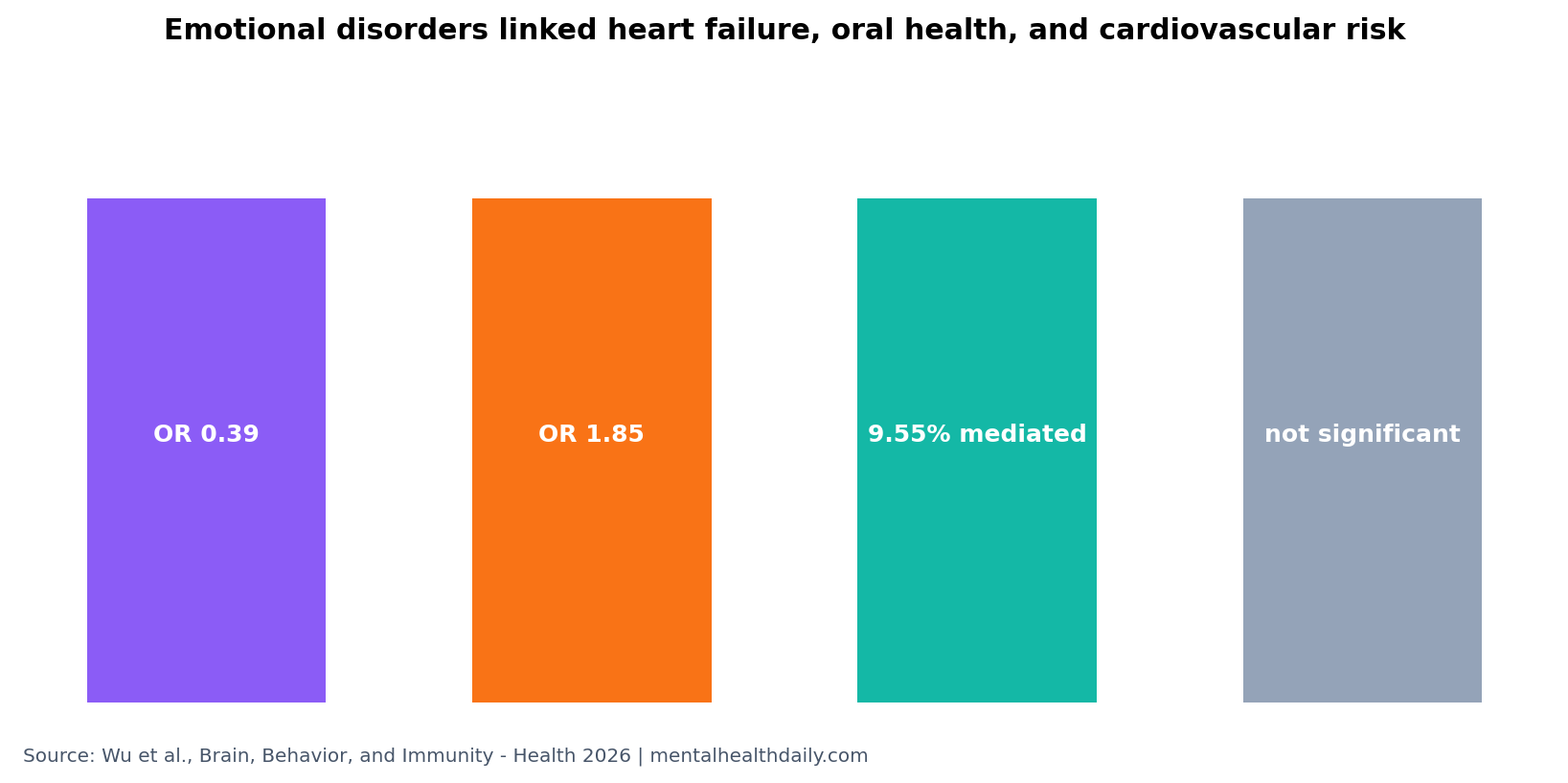
- Cardiovascular-health odds were lower: emotional disorders were associated with lower Life’s Essential 8 status in fully adjusted models, OR 0.39 (95% CI 0.28-0.54, P < 0.0001).1
- Tooth loss was part of the pathway: emotional disorders were associated with missing teeth, OR 1.85 (95% CI 1.31-2.63, P 0.001).1
- Self-rated oral health mediated more: self-rated oral health mediated 9.55% of the emotional-disorder to cardiovascular-health relationship, compared with 1.93% for tooth loss.1
- Inflammation alone did not explain it: systemic immune-inflammation index mediation was not significant, P 0.16.1
- Microbiome evidence is early: the heart-failure microbiome sample suggested oral dysbiosis, but the cohort was too small to prove that changing oral bacteria improves outcomes.1
Emotional disorders in this study meant depression and anxiety markers, not vague distress. Life’s Essential 8 is an American Heart Association cardiovascular-health score covering diet, activity, nicotine exposure, sleep, body mass index, blood lipids, blood glucose, and blood pressure.
Oral microbiome dysbiosis means a shifted mouth-bacteria pattern, often with depletion of potentially protective organisms and enrichment of inflammatory or disease-associated taxa. It is not the same as proving that bacteria caused heart failure, depression, or anxiety.
Emotional Disorders Were Associated With Lower Life’s Essential 8 Scores
Wu et al. combined NHANES cross-sectional data with a prospective oral microbiome cohort in heart failure.
Analysis structure: the main NHANES pathway linked emotional disorders to cardiovascular health, oral-health indicators, and systemic immune-inflammation index. The microbiome cohort asked whether heart-failure patients with emotional disorders showed oral dysbiosis.1
Main adjusted result: emotional disorders were associated with lower Life’s Essential 8 cardiovascular health, OR 0.39, 95% CI 0.28-0.54, P < 0.0001. An odds ratio below 1.0 means the emotional-disorder group had lower odds of better cardiovascular-health status after adjustment.
This fits older heart-failure literature showing that depression and anxiety are not side symptoms. Depression in heart failure has been associated with worse quality of life, poorer self-care, hospitalization risk, and mortality signals across prior studies.2,3
The Life’s Essential 8 framing matters because it is broader than a single laboratory value. A lower score can reflect less physical activity, worse sleep, nicotine exposure, higher body mass index, poorer blood pressure control, abnormal glucose, abnormal lipids, or diet quality. Depression and anxiety can touch several of those behaviors at once through fatigue, low motivation, sleep disruption, appointment burden, medication adherence, and reduced capacity to manage daily self-care.
That does not make mood symptoms the only driver of heart-failure risk. The adjusted model still leaves room for heart-failure severity, socioeconomic factors, dental access, diet texture, dry mouth, medication side effects, and comorbid illness. The useful point is more operational: when emotional disorders show up in heart failure, cardiovascular-health behavior and oral-health function deserve direct assessment rather than being treated as unrelated problems.
Cardiovascular-health context: the score also avoids a common false split between “mental” and “medical” outcomes. Sleep, nicotine exposure, blood pressure, glucose, diet, and activity are daily-life variables. Depression and anxiety can worsen them through behavior, physiology, or both, which is why a heart-failure visit that ignores mood and oral function can miss part of the risk pathway.
Oral Health Carried More Mediation Than SII Inflammation
The cleaner finding was not “inflammation explains everything.” Emotional disorders were associated with missing teeth, OR 1.85, 95% CI 1.31-2.63, P 0.001, and poorer self-rated oral health, OR 0.54, 95% CI 0.42-0.69, P < 0.0001.1
Mediation asks whether part of the relationship between an exposure and an outcome runs through a third variable. Tooth loss mediated 1.93% of the emotional-disorder to cardiovascular-health effect, P 0.02. Self-rated oral health mediated 9.55%, P < 0.0001. Systemic immune-inflammation index, or SII, did not significantly mediate the relationship, P 0.16.
That ordering is clinically useful. Depression and anxiety in heart failure may cluster with oral-health barriers, diet quality, self-care burden, access to dental care, medication burden, and inflammation. The oral-health signal is actionable because it can be screened directly; the SII result is less decisive as a single explanatory biomarker.
Self-rated oral health is a blunt measure, but that is partly why it can be useful. A patient rating their mouth health as poor may be summarizing pain, chewing difficulty, denture problems, gum bleeding, missing teeth, embarrassment, cost barriers, dry mouth, and avoided dental care in 1 answer.
A mediation percentage near 10% leaves most of the heart-failure mood pathway unexplained while still showing that the oral-health layer carried more measurable signal than the tested inflammatory index.
SII combines neutrophil, platelet, and lymphocyte counts into a systemic inflammation marker. It can be informative in population studies, but it is not a clean readout of oral inflammation, heart-failure biology, or depression biology by itself. A nonsignificant mediation result here argues against a simple “mood → inflammation → heart health” shortcut, not against inflammation having any role.
Oral Dysbiosis Was Hypothesis-Generating, Not Treatment Proof
The prospective heart-failure microbiome cohort found oral dysbiosis in patients with emotional disorders.1
Microbiome pattern: the signal included depletion of taxa described as potentially beneficial and enrichment of potentially dysbiotic taxa. That is biologically plausible because oral inflammation, periodontal disease, and cardiovascular disease share immune and vascular pathways.4
The microbiome result should be read carefully. 16S rRNA sequencing profiles bacterial communities by reading conserved genetic regions. ITS sequencing profiles fungal communities. Those methods can show community shifts, but they do not prove that a specific mouth microbe caused depression, anxiety, or heart failure outcomes.
Evidence-strength note: NHANES mediation was cross-sectional, so temporality is uncertain. Oral health may worsen because depression reduces self-care. Poor oral health may worsen inflammation and cardiovascular strain. Heart failure severity may worsen both mood and oral-health access. The design cannot fully separate those directions.
The microbiome layer also needs a denominator-aware read. A changed bacterial or fungal profile can be a consequence of oral hygiene, medication exposure, diet, saliva flow, immune status, dental disease, and health-care access. In heart failure, diuretics, polypharmacy, frailty, diet changes, and dry mouth can all plausibly change oral ecology before any causal microbiome effect on mood or cardiac function is invoked.
A stronger causal study would follow heart-failure patients over time, measure depression and anxiety repeatedly, collect dental exams rather than only self-report, sequence oral samples at multiple points, and test whether oral-health treatment changes inflammation, symptoms, and cardiovascular-health behavior. The 2026 study is a map of linked signals; it is not yet an intervention trial.
That evidence tier should shape language. “Oral microbiome dysbiosis” is a finding, not a prescription. The safer interpretation is that oral-health burden may be a visible marker of a larger self-care and inflammatory context in heart failure patients with depression or anxiety.
Screening Logic Is Stronger Than Microbiome-Treatment Logic
The most defensible clinical interpretation is integrated screening. A heart-failure patient with depression or anxiety may need oral-health assessment, dental referral, nutrition support, self-care support, and cardiovascular-risk review, not a premature microbiome product.
Care pathway:
- Screen for depression and anxiety when heart-failure symptoms or self-care decline.
- Ask about tooth loss, chewing problems, gum disease, dry mouth, dental access, and oral pain.
- Use inflammation markers as context, not as proof that inflammation is the only bridge.
- Treat oral-health and mental-health burden as practical barriers to cardiovascular-health behavior.
For patients, the practical read is not “fix the microbiome.” It is more basic and more useful: mood symptoms, mouth pain, missing teeth, gum disease, sleep, diet, and heart-failure self-care can reinforce each other.
A person who cannot chew comfortably may drift toward softer, saltier, or more processed foods. A person with depression may postpone dental visits and daily oral care. A person with worsening heart-failure symptoms may have less energy for both.
That loop is exactly where screening has value. Oral-health questions are cheap, low-risk, and concrete. They can uncover barriers that a cardiac medication list or depression scale will miss, while keeping the microbiome finding in the right evidence tier: biologically plausible, worth studying, but not yet a treatment target.
The same logic applies to research design. Future trials do not need to start with microbiome manipulation. A pragmatic first test would ask whether adding structured oral-health referral and dental-barrier support to heart-failure depression care improves self-care, diet quality, inflammation markers, and quality of life over 6 to 12 months.
Questions About Heart Failure, Mood, and Oral Health
Does oral microbiome dysbiosis cause depression in heart failure?
This study cannot prove that. It found associations and mediation patterns, plus an exploratory microbiome signal. Causality would need longitudinal and intervention studies.
Why is self-rated oral health important?
Self-rated oral health may capture pain, function, access, embarrassment, diet limitations, and dental disease burden in a way that a single clinical measure misses.
What should clinicians or patients do with this evidence?
The practical move is screening. In heart failure, depression or anxiety should prompt attention to oral health, self-care burden, and cardiovascular-health behaviors.
References
- Wu Y, et al. Oral microbiome dysbiosis mediates the link between emotional disorders and systemic inflammation in heart failure. Brain, Behavior, and Immunity – Health. 2026. doi:10.1016/j.bbih.2026.101240
- Rutledge T, Reis VA, Linke SE, Greenberg BH, Mills PJ. Depression in heart failure: a meta-analytic review. Journal of the American College of Cardiology. 2006. doi:10.1016/j.jacc.2006.06.055
- Celano CM, Villegas AC, Albanese AM, Gaggin HK, Huffman JC. Depression and anxiety in heart failure: a review. Harvard Review of Psychiatry. 2018;26(4):175-184. doi:10.1097/hrp.0000000000000162
- Sanz M, Del Castillo AM, Jepsen S, et al. Periodontitis and cardiovascular diseases. Periodontology 2000. 2020. doi:10.1111/prd.12317