A 2026 mouse study found that long-term CoQ10 exposure reduced working-memory errors in Purkinje-cell-specific Drp1-deficient mice, tying the behavioral rescue to Coa6 binding and support for mitochondrial respiratory-chain function.1 The result supports a narrow mechanistic CoQ10-Coa6 pathway under neuronal mitochondrial dysfunction while leaving human memory-supplement claims untested.
Research Highlights
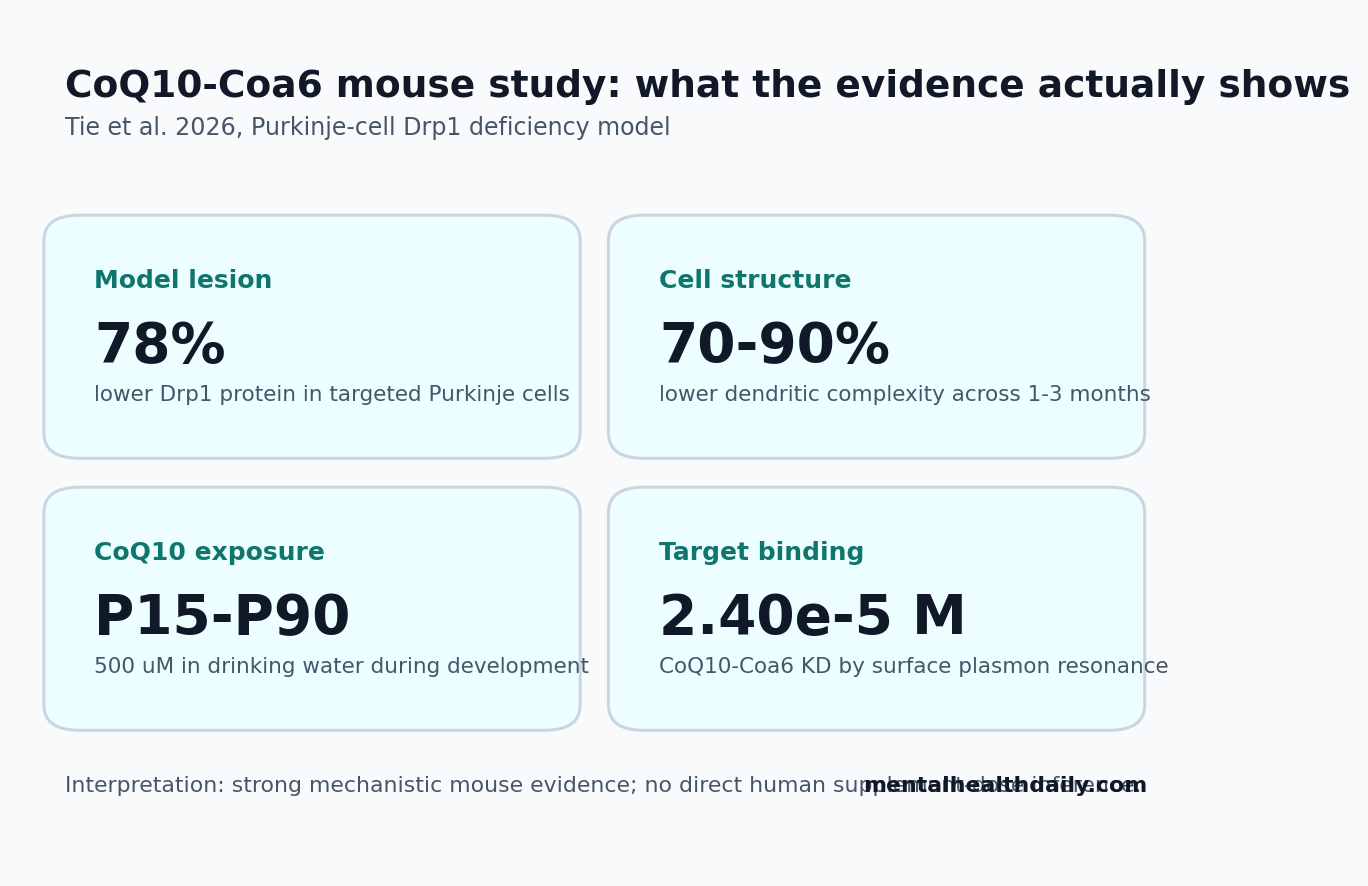
- Working memory improved in a mouse model: 500 μM CoQ10 in drinking water from postnatal day 15 to day 90 reduced eight-arm-maze errors in Purkinje-cell Drp1-deficient mice.
- The model had a real mitochondrial lesion: targeted mice showed a 78% reduction in Drp1 protein and progressive Purkinje-cell structural damage.
- Purkinje-cell structure was badly affected: dendritic complexity was about 70% lower at 1 and 2 months and about 90% lower at 3 months vs. controls.
- Coa6 was the proposed target node: CoQ10 bound Coa6 with a reported KD = 2.40 × 10⁻⁵ M, and Coa6 manipulation shifted mitochondrial and memory outcomes.
- Clinical translation is still limited: the study used preclinical assays and did not calculate a daily mg/kg CoQ10 dose, so it should not be read as a human dosing recommendation.
Coenzyme Q10 (CoQ10) is a fat-soluble molecule that helps shuttle electrons inside mitochondria, the energy-producing structures inside cells. It is also sold as a supplement, which makes mechanistic papers easy to overread: a mouse rescue experiment can sound like a consumer memory claim unless the model, dose route, and target biology stay visible.
Drp1 is a mitochondrial fission protein that helps mitochondria divide, move, and maintain normal shape. Purkinje cells are large cerebellar neurons that help coordinate motor control and cognitive timing. Tie et al. deleted Drp1 selectively in Purkinje cells, then asked whether CoQ10 could preserve working memory by stabilizing mitochondrial respiratory-chain biology.1
Drp1-Deficient Purkinje Cells Produced a Working-Memory Model
The study used a Cre-Lox mouse system to remove Drp1 from Purkinje cells. Western blotting showed a 78% reduction in Drp1 protein, and staining suggested that the deletion was selective for Purkinje cells rather than neurons, astrocytes, or microglia more broadly.1
Behaviorally, the model separated movement from memory. Open-field testing suggested that mice could still walk normally, while the Morris water maze and eight-arm radial maze detected worsening cognitive performance with age.
Working-memory task: in the eight-arm maze, a re-entry into an already visited arm counted as a working-memory error. Drp1-deficient mice showed significantly more errors at 3 months, not at 1 or 2 months, and their search strategy shifted away from efficient sequential exploration.
Cell-structure signal: Purkinje-cell dendritic complexity was already about 70% lower at 1 and 2 months and about 90% lower at 3 months. Dendritic length and spine density also dropped, pointing to a structural substrate for disrupted cerebellar information handling.
Prior cerebellar working-memory evidence makes the behavioral endpoint plausible. Deverett et al. previously showed that disrupting cerebellar activity impaired working memory during evidence accumulation, supporting the broader claim that cerebellar circuits can contribute to cognitive decisions as well as movement.2
CoQ10 Treatment Ran From Postnatal Day 15 to Day 90
Tie et al. gave Drp1-deficient mice CoQ10 in drinking water at 500 μM, starting on postnatal day 15 and continuing through day 90. Vehicle mice received drinking water containing 3% dimethyl sulfoxide. The paper reported increased CoQ10 concentrations in serum and cerebellar tissue after 1 month of exposure.1
CoQ10-treated Drp1-deficient mice made fewer working-memory errors and used a more efficient sequential search strategy in the eight-arm maze. The same intervention also reduced activated microglia by about 60%, suggesting that the behavioral effect sat inside a broader mitochondrial and inflammatory shift.
Safety within the model: wild-type mice given 250 μM, 500 μM, or 1000 μM CoQ10 for 1 month did not show obvious changes in Purkinje-cell morphology, mitochondrial quantity, working memory, reactive oxygen species, adenosine triphosphate, or mitochondrial membrane potential. That is a useful internal control, but it still does not establish human safety or efficacy.
Adjacent CoQ10 work makes the result plausible without making it clinically settled. Manolaras et al. reported that CoQ10 rescued mitochondrial dysfunction and calcium dysregulation in COQ8A-ataxia Purkinje neurons, another vulnerable-neuron model in which mitochondrial biology and cerebellar pathology meet.3 Asadbegi et al. also found CoQ10-linked improvements in learning, memory, and synaptic-plasticity measures in an aged amyloid-induced rat model, although that design was still preclinical and disease-model-specific.6
Coa6 Turned CoQ10 From a Broad Antioxidant Claim Into a Specific Mechanism
Coa6 is a mitochondrial protein involved in building cytochrome c oxidase, also called respiratory-chain complex IV. Complex IV helps mitochondria pass electrons to oxygen; when assembly fails, energy production can weaken and oxidative stress can rise. Prior COA6 work already tied the protein to complex IV biogenesis, which made it a plausible node for a mitochondrial rescue pathway.5
Tie et al. used several target-engagement assays to test whether CoQ10 interacts with Coa6. Cellular thermal shift assays and drug-affinity responsive target stability assays suggested that CoQ10 stabilized Coa6 protein. Surface plasmon resonance reported a CoQ10-Coa6 dissociation constant of 2.40 × 10⁻⁵ M, and molecular docking pointed to a proposed interaction with lysine 18 on Coa6.1
Why that changes the interpretation: a generic antioxidant explanation would say CoQ10 helped because mitochondria were stressed. The Coa6 result makes a sharper claim: CoQ10 may support respiratory-chain assembly or stability through a definable mitochondrial protein, at least in this Purkinje-cell Drp1 model.
Respiratory-Chain and Purkinje-Cell Findings Moved With Coa6
CoQ10 treatment improved several mitochondrial readouts in Drp1-deficient mice. The paper reported better mitochondrial network measures, less abnormal mitochondrial enlargement, higher cristae occupancy, higher mitochondrial membrane potential, and improved oxidative-phosphorylation markers.
The respiratory-chain pattern was not a simple all-complex rescue. CoQ10 increased protein levels for complex III and complex V, did not significantly change the tested complex I, II, or MTCO1 complex IV marker, and increased COX4 expression. The researchers interpreted the complex IV signal through Coa6 assembly biology rather than through a single structural complex IV subunit.
Coa6 manipulation then tested whether the target was merely associated with the effect or actually moved the phenotype:
- Coa6 knockdown: in CoQ10-treated Drp1-deficient mice, lowering Coa6 weakened the protective effect, increased working-memory errors, reduced dendritic-spine markers, lowered oxidative-phosphorylation complexes I–V, raised reactive oxygen species, and reduced mitochondrial membrane potential and adenosine triphosphate.
- Coa6 overexpression: in Drp1-deficient mice drinking regular water, raising Coa6 partly improved working-memory errors, dendritic-spine density, oxidative-phosphorylation complex levels, mitochondrial membrane potential, adenosine triphosphate, and oxidative-stress markers.
The intervention, target-engagement assays, knockdown, and overexpression all point in the same direction: Coa6 appears to sit inside the mechanism connecting CoQ10 exposure to mitochondrial function and working-memory behavior in this model.
The Human Supplement Claim Is Much Weaker Than the Mouse Mechanism
Kageyama et al. previously showed that mitochondrial division helps postmitotic neurons survive by suppressing oxidative damage, which fits the upstream Drp1 biology behind this study.4 The new Tie et al. paper adds a CoQ10-Coa6 rescue pathway downstream of Drp1 deficiency, but it does not answer the questions a supplement user would naturally ask.
Evidence-strength note: this was a preclinical mouse and biochemical study. It can support a mechanistic claim: CoQ10 may rescue working-memory impairment caused by a specific Purkinje-cell mitochondrial lesion through Coa6-linked respiratory-chain biology. It cannot support a clinical claim that CoQ10 improves memory in healthy adults, prevents dementia, treats Parkinson’s disease, or provides a known human-equivalent dose.
The paper’s own limitations keep the boundary clear. The researchers did not systematically measure body weight or water intake, so they could not calculate actual daily CoQ10 intake in mg/kg.
That dosing uncertainty matters because supplement translation depends on exposure, formulation, absorption, brain delivery, and the concentration placed in a mouse drinking-water bottle.
The strongest next animal step would measure intake, serum levels, cerebellar levels, and respiratory-chain rescue in the same animals used for behavior.
CoQ10 is hydrophobic and difficult to label without changing its properties, so the study lacked direct in vivo tracking or pull-down proof. Human blood-brain-barrier penetration also remains uncertain enough that cerebrospinal-fluid measurement and better formulations would be needed before assuming central target engagement.
Questions About CoQ10, Coa6, and Working Memory
Did this study show that CoQ10 improves human memory?
No. It showed that CoQ10 reduced working-memory errors in a specific mouse model where Drp1 was deleted from Purkinje cells. The design supports a mitochondrial mechanism, not a human supplement recommendation.
Why did the paper focus on Purkinje cells?
Purkinje cells are cerebellar neurons with heavy energy demands and broad effects on cerebellar output. Damage to their dendrites, spines, and mitochondrial function gives the study a plausible path from cellular dysfunction to maze performance.
What does Coa6 add to the CoQ10 story?
Coa6 makes the mechanism more specific. Instead of saying only that CoQ10 is an antioxidant or electron carrier, the paper proposes that CoQ10 binds a mitochondrial complex IV assembly factor and helps stabilize respiratory-chain function.
Should this change how people use CoQ10 supplements?
Not by itself. The study did not calculate a human-equivalent dose, test people, or prove adult human brain target engagement. Its value is mechanistic: it identifies a pathway worth testing more carefully in mitochondrial and neurodegenerative disease contexts.
References
- Tie J, Li S, Huang X, et al. The Drp1-CoQ10-Coa6-ETC axis represents a therapeutic potential for working memory impairment caused by neuronal mitochondrial dysfunction. Translational Neurodegeneration. 2026;15:18. doi:10.1186/s40035-026-00552-6
- Deverett B, Kislin M, Tank DW, Wang SS. Cerebellar disruption impairs working memory during evidence accumulation. Nature Communications. 2019;10:3128. PubMed
- Manolaras I, Del Bondio A, Griso O, et al. Mitochondrial dysfunction and calcium dysregulation in COQ8A-ataxia Purkinje neurons are rescued by CoQ10 treatment. Brain. 2023;146:3836-3850. PubMed
- Kageyama Y, Zhang Z, Roda R, et al. Mitochondrial division ensures the survival of postmitotic neurons by suppressing oxidative damage. Journal of Cell Biology. 2012;197:535-551. PubMed
- Pacheu-Grau D, Wasilewski M, Oeljeklaus S, et al. COA6 facilitates cytochrome c oxidase biogenesis as thiol-reductase for copper metallochaperones in mitochondria. Journal of Molecular Biology. 2020;432:2067-2079. PubMed
- Asadbegi M, Komaki H, Faraji N, et al. Effectiveness of coenzyme Q10 on learning and memory and synaptic plasticity impairment in an aged amyloid-beta-induced rat model of Alzheimer’s disease. Psychopharmacology. 2023;240:951-967. PubMed