Three men with ADHD and lifelong tics, treated at a Tokyo clinic, saw their tics ease soon after starting a low dose of guanfacine, a non-stimulant ADHD medication, according to a 2026 case report.1
Their ADHD symptoms improved more slowly and only partly, and with 3 patients and no comparison group, the report raises a question for trials rather than settling one.
Research Highlights
- Tic scores fell in all 3 men: combined motor and vocal tic scores went from 20 to 5, 10 to 3, and 19 to 15 on extended-release guanfacine started at 1 mg a day.1
- Tics changed first: 2 of the men reported fewer tics within days to a week, before their ADHD symptoms shifted.1
- ADHD gains were partial: after doses were raised to 2 or 3 mg, some ADHD ratings dropped, but most stayed in the clinical range.1
- No side effects reported: none of the 3 men described sedation or other problems during the few weeks covered.1
- Trial evidence is mixed: guanfacine reduced tics in a 2001 trial of children with ADHD and tics, but a 2017 trial of children with tic disorders found no clear benefit over placebo.23
Why Tics Complicate ADHD Treatment
Tics are sudden, repeated movements or sounds that a person feels driven to make, such as blinking, shoulder jerks, grunting or throat clearing. Tourette syndrome is the form with several motor tics and at least 1 vocal tic lasting more than a year. Most tics fade by adulthood, but some people keep them for life.
ADHD is one of the most common conditions that occur alongside tics. That creates a treatment puzzle: stimulants such as methylphenidate work well for ADHD, but they have been reported to make tics worse in some people, although this appears to be uncommon.1
Guanfacine is a non-stimulant ADHD medication. It activates alpha-2A adrenergic receptors, docking sites for the brain chemical noradrenaline on nerve cells in the prefrontal cortex, the brain region behind planning, focus and impulse control. Activating these receptors is thought to strengthen that region’s top-down control, and unlike stimulants, guanfacine does not raise dopamine release, which is linked to worse tics.1
American Academy of Neurology guidelines give a Level B recommendation (the second-highest grade) for alpha-2 agonists such as guanfacine and clonidine when tics occur with ADHD.5 Most of the supporting research was done in children, which is the gap this case report addresses.
Tics Eased Soon After 1 mg of Guanfacine in All 3 Men
Koji Tada et al., of Jimbocho Mental Health Clinic and Kyorin University School of Medicine, described 3 men who had ADHD and tics since childhood but had never been treated before adulthood.1 Each started extended-release guanfacine (a once-daily form) at 1 mg a day, with no other ADHD or tic medication.
Tics were rated on the Yale Global Tic Severity Scale (YGTSS), a clinician interview that scores motor and vocal tics separately from 0 to 25 each, with higher scores meaning more frequent, intense and disruptive tics.
- Case 1, age 40, Tourette syndrome: blinking, shoulder jerks, and an “Ah” sound that had grown into shouted swear words. Within 2 to 3 days, the vocal tics stopped. His vocal tic score went from 11 to 0 and his motor score from 9 to 5 when rated 2 weeks after his dose was raised to 3 mg.
- Case 2, age 22, chronic motor tics: forceful blinking, abdominal tensing, and a repeated finger bend that sometimes hurt. Within the first week, these became much less frequent, and his motor tic score fell from 10 to 3. He had no vocal tics.
- Case 3, age 27, motor and vocal tics: head shaking, mouth noises and grunting. After 2 weeks, he said his tics had roughly halved. His scores fell more modestly, from 9 to 7 for motor tics and 10 to 8 for vocal tics. A habit of shouting when painful memories surfaced did not change.
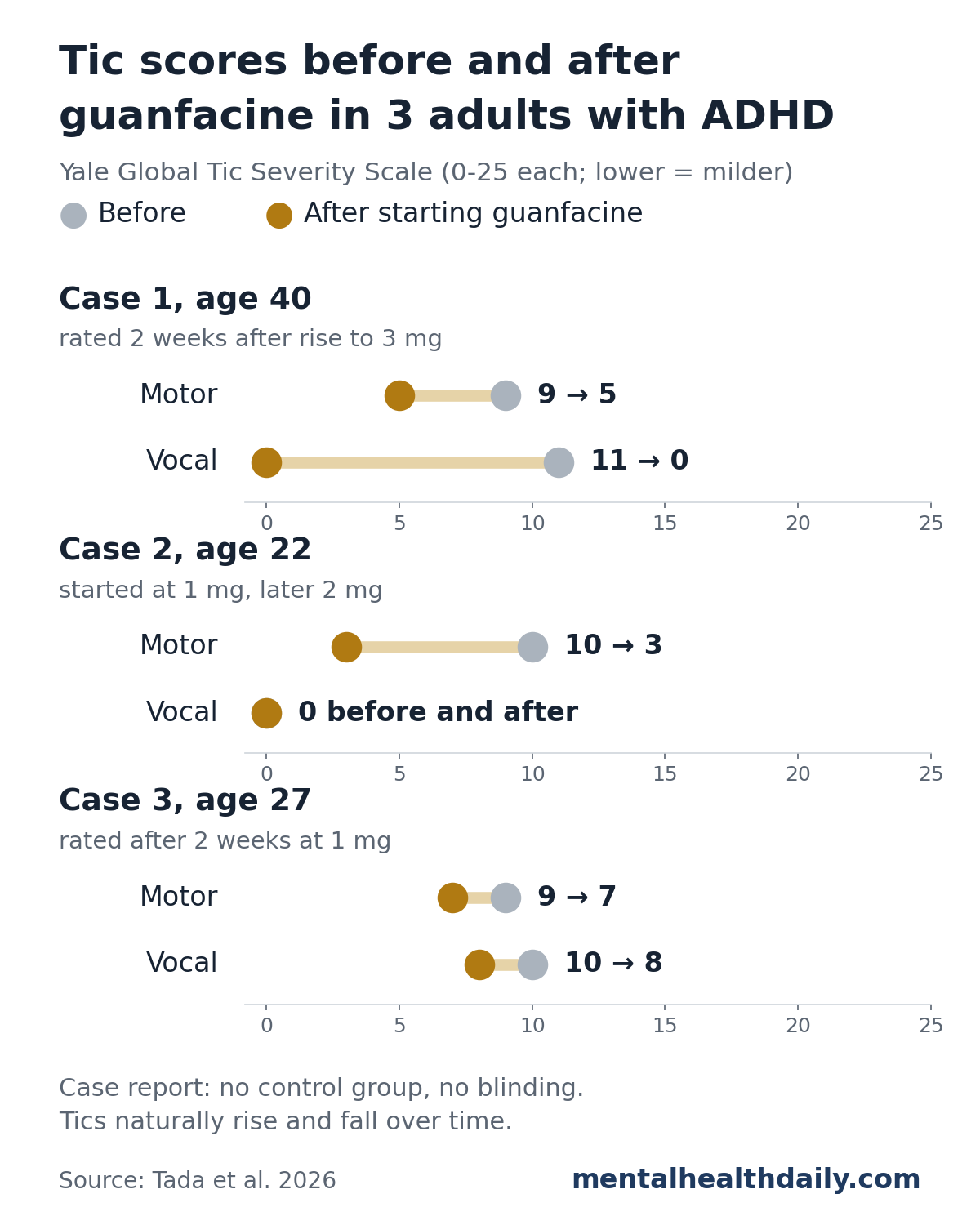
All 3 men had mild to moderate tics at the start. The gains in tic control held after the dose was raised, and none of the men reported side effects.1
ADHD Symptoms Improved Slowly and Only Partly
ADHD symptoms were measured with the Conners’ Adult ADHD Rating Scales (CAARS), a questionnaire that converts answers into T-scores, where 50 is average for the general population and above 65 counts as clinically elevated. All 3 men scored above 65 on every CAARS subscale at the start.
At 1 mg, ADHD symptoms changed little, although Case 1 felt calmer and fidgeted less. Doctors raised the dose after about a month, to 3 mg for Case 1 and 2 mg for Cases 2 and 3, and rated ADHD again 2 weeks later:1
- Case 1: hyperactivity and restlessness fell from 90 to 81, but inattention stayed at 82. He no longer looked restless at visits.
- Case 2: impulsivity and emotional ups and downs fell from 79 to 62, the only score to drop below 65 in any of the men. Distractibility persisted, and he managed it with behavioral strategies.
- Case 3: inattention and memory problems fell from 88 to 78, and impulsivity from 88 to 81. He said he felt “calmer in my mind” and less forgetful.
The researchers read the timing (tics easing at 1 mg, ADHD only at 2 to 3 mg) as a sign that guanfacine acts on tics directly rather than by calming ADHD first.1 That idea is plausible, but 3 cases cannot test it.
What a 3-Person Case Report Can and Cannot Show
A case report describes what happened to specific patients in routine care. It can flag a pattern worth testing and show that adults responded much like the children in earlier studies. It cannot show that guanfacine caused the improvement or predict how often it would help other adults.
The researchers acknowledge some of these limits themselves. The main ones are:
- No comparison group. Without placebo-treated patients, there is no way to tell how much improvement would have happened anyway.
- Tics wax and wane. People often seek help when tics are at a peak, so some later improvement is expected on its own (a pattern called regression to the mean).
- No blinding. The treating doctors rated the patients, and everyone knew a new medication had started.
- Narrow and short. All 3 were men at 1 clinic, with mild to moderate tics, followed for only about 6 weeks. Timing of the follow-up rating also differed between the 3 men.
- Self-report and scale disagreed. Case 3 described his tics as halved, while his YGTSS scores fell by about one-fifth.
The researchers argue that 3 consistent responses, with no relapse during follow-up, make chance improvement less likely. Three of the 4 authors also disclose speaker fees or other payments from drug companies, including Takeda.1
How Guanfacine Has Done in Controlled Trials
Randomized trials give a fuller picture, and they point in different directions depending on who was studied:
- Children with ADHD and tics: a 2001 trial randomized 34 children to guanfacine or placebo for 8 weeks. ADHD rating scores improved 37% with guanfacine vs. 8% with placebo, and tic severity fell 31% vs. 0%.2
- Children with tic disorders: a 2017 pilot trial randomized 34 children with chronic tics to extended-release guanfacine or placebo for 8 weeks. Tic scores fell by similar amounts in both groups, and 19% vs. 22% were rated much improved.3
- Adults with ADHD: a 2020 Japanese trial randomized 201 adults to extended-release guanfacine at 4 to 6 mg a day or placebo for 10 weeks. ADHD scores fell 11.6 points vs. 7.3. Side effects were more common with guanfacine (81.2% vs. 62.0%), mainly sleepiness, thirst and lower blood pressure, and 19.8% vs. 3.0% stopped because of them. Tics were not studied.4
Two points stand out. The men in the case report took 1 to 3 mg, well below the 4 to 6 mg used in the adult ADHD trial, which may explain their limited ADHD response. And the 2017 trial, which enrolled children selected for chronic tics, shows that guanfacine does not reliably reduce tics in every group, so the adult tic effect described here needs its own controlled test.
What This Means for Adults With ADHD and Tics
- Guanfacine is already a guideline option when tics and ADHD occur together, based mostly on research in children.5
- This report adds adult examples, not proof. Tics eased quickly in all 3 men, while ADHD symptoms needed higher doses and stayed partly unresolved.
- Behavioral therapy is another option. The same guidelines recommend Comprehensive Behavioral Intervention for Tics (CBIT), a therapy that teaches people to notice the urge before a tic and replace it with a competing movement, as an initial treatment where it is available.5
- Medication choices belong with a clinician, who can weigh tic severity, ADHD symptoms, blood pressure and other medicines.
References
- Tada K, Tada T, Tsuboi T, Watanabe K. Three adult cases of ADHD with comorbid tic symptoms successfully treated with guanfacine monotherapy. Neuropsychopharmacology Reports. 2026;46:e70167. doi:10.1002/npr2.70167
- Scahill L, Chappell PB, Kim YS, et al. A placebo-controlled study of guanfacine in the treatment of children with tic disorders and attention deficit hyperactivity disorder. American Journal of Psychiatry. 2001;158(7):1067–1074. doi:10.1176/appi.ajp.158.7.1067
- Murphy TK, Fernandez TV, Coffey BJ, et al. Extended-release guanfacine does not show a large effect on tic severity in children with chronic tic disorders. Journal of Child and Adolescent Psychopharmacology. 2017;27(9):762–770. doi:10.1089/cap.2017.0024
- Iwanami A, Saito K, Fujiwara M, Okutsu D, Ichikawa H. Efficacy and safety of guanfacine extended-release in the treatment of attention-deficit/hyperactivity disorder in adults: results of a randomized, double-blind, placebo-controlled study. Journal of Clinical Psychiatry. 2020;81(3):19m12979. doi:10.4088/JCP.19m12979
- Pringsheim T, Okun MS, Müller-Vahl K, et al. Practice guideline recommendations summary: treatment of tics in people with Tourette syndrome and chronic tic disorders. Neurology. 2019;92(19):896–906. doi:10.1212/WNL.0000000000007466