Children with ADHD often find math harder than their classmates do, but a weak gut sense of “how many” does not seem to be the reason.
In a 2026 Italian study of 20 children with ADHD and 43 children without it, the ADHD group scored lower in math yet estimated quantities of dots, flashes and their own finger taps about as well as their peers.1
Research Highlights
- Math was clearly lower: the ADHD group averaged a math z-score of −0.50 (0 is average for age), compared with +0.39 in children without ADHD.1
- Quantity estimates were similar: after adjusting for age, reasoning and math skill, children with ADHD were as precise as controls on all 3 tasks.1
- An early gap faded: before adjustment, the ADHD group was slightly less precise overall, but the statistical evidence for that gap was weak.1
- Accuracy never differed: neither group tended to over- or underestimate more than the other.1
- Math skill tracked estimation in everyone: children with higher math scores made more precise and more accurate estimates, whatever their diagnosis.1
What the “Number Sense” Is and Why It Was Suspected in ADHD
The number sense is the ability to judge roughly how many things are in front of you without counting them. Glance at a bowl of cherries and you know there are about 10, not 30.
People differ in how sharp this sense is. A well-known 2008 study found that 14-year-olds with a more precise number sense had earned higher scores on standardized math tests, all the way back to kindergarten.4
Children with dyscalculia, a learning disorder that specifically affects math, often show a blunted number sense. That raised an obvious question for ADHD (attention-deficit/hyperactivity disorder), a condition marked by ongoing inattention, hyperactivity or impulsivity that is also linked to weaker math. A 2015 systematic review found a consistent link between ADHD symptoms and lower math ability, strongest for inattention.3
If a weak number sense also sat underneath math struggles in ADHD, the two conditions would share a root cause. If not, the math gap in ADHD needs a different explanation.
How Researchers Tested Quantity Estimation in Children With ADHD
Giovanni Anobile et al., at the University of Florence and the Stella Maris research hospital in Pisa, compared 2 groups of children:1
- ADHD group: 20 children aged 7 to 17 (average about 12) with a clinical ADHD diagnosis; 14 had combined-type ADHD and 6 mainly inattentive ADHD, and none had ever taken ADHD medication.
- Control group: 43 children of similar age with typical development, whose data came from an earlier study by the same team using identical tasks.
Each child gave a spoken estimate for 10 to 15 items in 3 formats. To stop counting, children had to repeat the syllable “ba” as fast as they could while doing each task.
- Dots: a cloud of black dots flashed on screen for half a second.
- Flashes: a series of white flashes appeared one after another.
- Taps: children pressed a key rapidly until a beep told them to stop, then estimated how many presses they had made.
The researchers scored two things:
- Precision (Weber fraction): how much a child’s answers for the same number varied from trial to trial, divided by that number. A value of 0.16 means answers to 12 dots typically spread by about 2.
- Accuracy (absolute bias): how far a child’s average answer sat from the true number, whether too high or too low.
Children also took age-standardized math tests and two reasoning tests, one verbal and one visual.
Children With ADHD Scored Lower in Math but Estimated Quantities Like Their Peers
On standardized tests, the ADHD group did worse. Their combined math score averaged −0.50 (half a standard deviation below the age norm) vs. +0.39 in controls, and they also scored lower on both reasoning tests.1
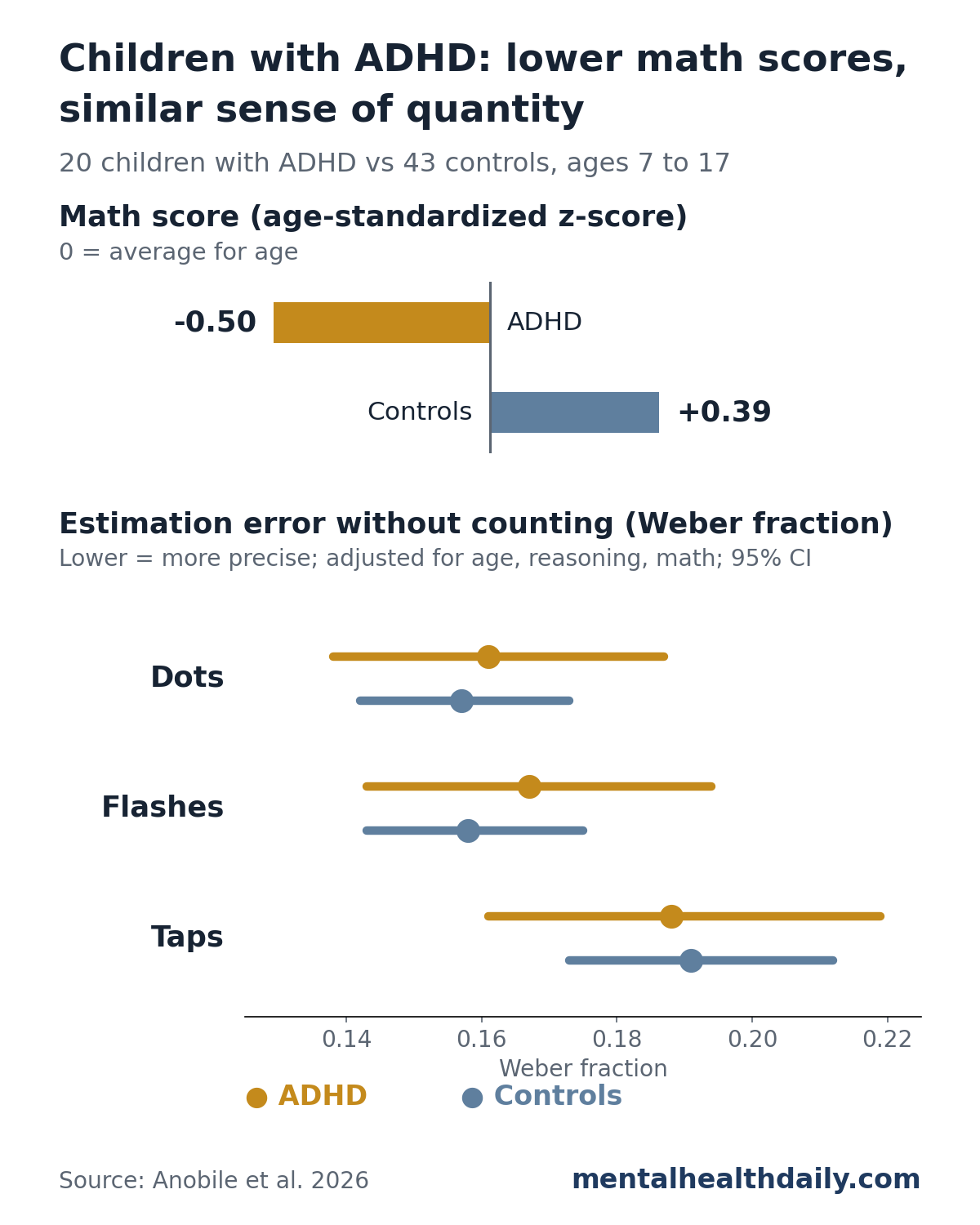
Estimation precision was another matter. Once age, reasoning and math skill were taken into account, the two groups’ Weber fractions were almost the same on every task:1
- Dots: 0.161 with ADHD vs. 0.157 in controls
- Flashes: 0.167 vs. 0.158
- Taps: 0.188 vs. 0.191
Before adjustment: the ADHD group was a little less precise overall (average Weber fraction 0.188 vs. 0.16, p = 0.027). A Bayes factor, which weighs evidence for a difference against evidence for none, rated this gap as only anecdotal, and no single task held up after correcting for multiple comparisons.1
Accuracy: average estimation error was about 1.2 items in both groups, with no difference in any analysis.1
Without dyscalculia: 3 children in the ADHD group also had dyscalculia. Leaving them out did not change any result.1
Math Skill, Not ADHD Diagnosis, Predicted Better Estimates
Across all 63 children, those with higher math scores made more precise estimates (p = 0.002) and more accurate ones (p = 0.03). Older children were also more precise. Diagnosis added nothing once these factors were in the model.1
The results match an earlier study by the same group. In 2022, 20 children with ADHD were as good as 20 controls at picking which of 2 dot clouds held more dots, despite weaker symbolic math.2 The 2026 study extends that finding from comparing quantities to naming them, and from dots to flashes and actions.
Researchers suggest the math gap in ADHD more likely comes from general thinking skills such as attention, working memory and self-monitoring, which help with following multi-step problems and catching errors. The study did not measure those skills, so this remains an open question.1
Limitations of This Small ADHD Number-Sense Study
This was a small case-control study, so it makes a large number-sense deficit in ADHD unlikely but cannot rule out a small one:
- Small ADHD group: with 20 children, modest differences could be missed. Bayes factors leaned toward no difference, but their strength ranged from weak to moderate.
- Adjusting for math: math scores were lower in ADHD and also predicted precision, so including them in the model may have absorbed part of any real group gap.
- Borrowed control data: controls came from an earlier study and took shorter math and reasoning tests than the ADHD group.
- Faster flash sequences: each child’s flashes copied the rhythm of their own tapping, and children with ADHD tapped faster (4.6 vs. 3.7 taps per second), so their flash sequences were quicker and shorter.
- Specific sample: all children were unmedicated, the session lasted about 1.5 hours, and the group was too small to compare ADHD types or boys and girls.
What It Means for Children With ADHD Who Struggle With Math
For a child with ADHD who finds math hard, this study points away from a basic inability to sense quantities. In this group, the intuitive feel for “how many” worked about as well as in other children.
That makes ADHD math difficulties look different from dyscalculia, where a weaker number sense is common. Larger studies that also measure attention and working memory are needed before anyone can say exactly where the math gap comes from.
References
- Anobile G, Ditano S, Martelli S, Ricci F, Bieber E, Pfanner C, Tinelli F. Numerosity estimation in children with ADHD across space, time, vision and action. Frontiers in Human Neuroscience. 2026;20:1940478. doi:10.3389/fnhum.2026.1940478
- Anobile G, Bartoli M, Masi G, Tacchi A, Tinelli F. Math difficulties in attention deficit hyperactivity disorder do not originate from the visual number sense. Frontiers in Human Neuroscience. 2022;16:949391. doi:10.3389/fnhum.2022.949391
- Tosto MG, Momi SK, Asherson P, Malki K. A systematic review of attention deficit hyperactivity disorder (ADHD) and mathematical ability: current findings and future implications. BMC Medicine. 2015;13:204. doi:10.1186/s12916-015-0414-4
- Halberda J, Mazzocco MMM, Feigenson L. Individual differences in non-verbal number acuity correlate with maths achievement. Nature. 2008;455:665–668. doi:10.1038/nature07246